Endure

Genesis 25-26


Genesis 26 29 NIV

Yesterday we looked at Abraham and how committed he was to God and didn’t hold anything back. Today our passage is Genesis ch.apters 25-26 but we are really going to hone in on Genesis 25.29-34. Hopefully all of us including myself can gain a different perspective on it. But first, story time….

I grew up running. When I was in high school, I ran track and field. I ran the half mile, the mile and the two mile. I did that for a couple seasons but was pretty inconsistent. When I didn’t compete one season I didn’t run at all because who really likes running with no goal.  In college I had to run because I went to a military school. I had physical fitness tests that I had to pass. That sort of renewed my interest in running and I began to run more frequently. I had always dreamed of and put on my bucket list to run a marathon. When I was 26 I made my first attempt to train for a marathon. Training for a marathon requires a lot of commitment. You need to run 5-6 times a week for 16 weeks. Many of these runs during training are quite literally hours long and exhausting. You essentially make yourself a slave to your running program and do whatever it tells you to do. On my first attempt I fractured my ankle on the longest run of the program, three weeks before my race. It was terrible. I had invested 13 weeks of training into something that would never produce any fruit. I was literally right at the end of my program. All the runs in the program after this would have been easier than previous runs and I was easily on my way to completing a marathon before I stepped on that cracked sidewalk.

In Genesis 25.29-34 we have Isaac’s two sons, Jacob and Esau. Jacob was a quiet man who dwelled in tents. While Esau was a skillful hunter and a man of the field. Esau comes back in from the field and is starving. I feel like all of us have been there. Sometimes the last thing that you want to do when you come in the door after a long day is to cook yourself a meal and I think this is what Esau was feeling. It is hard for me not to empathize with Esau here. Rough day of hunting and he is exhausted and his younger brother has stew on. His brother takes advantage of his situation and asks him for his birthright in exchange for some wonderful stew. This feels super under handed and not a great way to treat your siblings or frankly anyone. We could cry “Where is the justice in this situation, God?” but I think a better attitude for this situation is to ask “What can I learn from this situation?” and I don’t mean how to exhort people’s birth rights.

I think that the lesson to be learned here is not from God’s perspective or Jacob’s but from Esau’s perspective. When Esau came in from a hard day out in the field and didn’t have any food, I’m sure he could probably get food from somewhere. Esau was right there at the end and at the very last second, he let his desires to satiate his hunger get in the way of what was good for him. If Esau had persevered for a little while longer, I imagine that he would have been able to find food somewhere and may have not even gone to bed hungry. Instead, he let something as inconsequential as some stew get in the way of him receiving his birthright.

In my case with the marathon it was an injury that stopped me. It’s too often that I end up quitting right before I get to the part where my efforts bear fruit. Too often just a little bit more effort and a little bit more endurance would give me the results of all my work. 2 Timothy 2.12 says, “If we endure with him, we will also reign with him.” We need to not lose sight of our hope and endure with him so we will reap the rewards of all that God wants to do in our lives. If we focus on this hope I believe that we will also be able to persevere with him until the end.


Daniel Wall


Today’s Bible passage can be read or listened to at https://www.biblegateway.com/passage/?search=Genesis+25-26&version=NIV


Tomorrow’s Bible reading will be Genesis 27-29 in the 2020 Chronological Bible Reading Plan

Holding Nothing Back

Genesis 22-24

Genesis 22 12b NIV

One of the sayings that I sort of cling to in my life is, “You get out of life what you put into it.” I find this can be helpful in those moments where Netflix or a nap can be much more appealing than doing homework, reading a book, folding laundry or any of the other responsibilities we have in this life. Even though some of those things listed like folding laundry or reading a book I can really enjoy and get a sense of accomplishment from doing those things. In a way doing things like taking naps or watching Netflix are just easier and don’t require any brain activity from me. For instance there can be a temptation to just read devotions and not actually read the Bible on your own. This is because reading a devotion, which is an already processed thought is easier than having to read and process the Bible on your own.

Now, is reading devotions great?  Absolutely.  Devotions are great because you can see what God worked on in another person’s heart and that is pretty cool to be a part of. I love writing these devotions and hope they add to your spiritual growth and help you understand God better.

You may be wondering why I wrote two paragraphs about putting an effort into life and what I really think is the principle at work here is sacrifice, and that is what Genesis 22 is really about.

In Genesis 22.1-14 is a story about sacrifice and commitment to God and I don’t think it is necessarily in the way that we think. Right now, you should go read Genesis 22.1-14. My next paragraph will wait for as long as they maintain the rights to the domain name. Haha

I’m glad you are back. What Abraham was about to do here is crazy. He was willing to offer his son, that he had waited 25 years for and had at 99 years, because God told him to. Abraham could have so easily rationalized disobedience away by saying “There is no way that I am going to harm a child.” But Abraham decided to obey God despite all reservations that he had. One of my favorite verses as a teenager and even now is Matthew 6.21 “For where your treasure is, there your heart will be also.” Abraham didn’t treasure his child more than he treasured God and IT SHOWED in a big way. He held nothing back from God.

You may be getting a mixed message at this point. I’m not telling you to give all your stuff away or to sacrifice your brother or sister as a burnt offering. That would not bless God. What I am telling you is that if you live your life holding nothing back from God, you will reap the reward from that. The same principle applies to how much work and effort you put into your spiritual growth.

If you want God to really change your life cut Netflix out of your life for a month and instead spend that time with your head in a Bible and see what God does in your heart and how he changes you.

If you really want to serve others and see God do something through you then commit yourself to that and go do it. Make it your center point! Go help others in whatever way you can. Look for ways to serve others and give your life away to them.

The reason that Abraham is the father of our faith is because he held nothing back. After this story Abraham received a promise from God that his offspring would be as the stars in heaven and sands on the seashore and that all the nations of the earth would be blessed through him. Abraham got out of life what he put in. Abraham was used by God through this promise because Abraham was completely devoted to God.

I know there is a better life. When our lives are completely focused on God, something changes. I want to say this to you and hope you take it to heart. I know what being sold out to God is like and it is uncomfortable and can be really hard but the reward is life altering, it’s God glorifying and it’s kingdom strengthening. Our sacrifices don’t go unnoticed by God and they will come to fruition and it isn’t always how we expect it.

Do not take this as me telling you that you can make God do things but rather God honors the sacrifices that we make in our lives for him. He in turn wants to bless us and help us. Do not do any of things that I mentioned unless you really want to do them. God doesn’t want just sacrifices. He wants our hearts behind the sacrifices that we make and, honestly, that is the key to love. When your heart and actions combine into one that is true love.

Daniel Wall


Today’s Bible passage can be read or listened to at https://www.biblegateway.com/passage/?search=Genesis+22-24&version=NIV

Tomorrow’s passage will be Genesis 25 & 26 on the 2020 Chronological Bible Reading Plan


Stuck

Genesis 19-21

Genesis 19 16

Have you ever gotten your car stuck before? Growing up, my brothers and I often went over to our grandparents’ farm. In high school, I started helping out with keeping up around the place. I would load up in the old beat up farm truck and head to the places that need to be looked after, which sometimes took me down into the swampy parts of the property. Some days, I could maneuver just fine through the trees and brush, but on others, I would begin to sink. If the truck got into a place where the tires couldn’t get traction, then they would start to spin, sinking the truck even deeper into the muck.


Lot has got himself stuck in a similar situation. In Genesis 13, Lot chose the edenic land close to the evil cities of Sodom and Gomorrah, while Abram moved further away from him. Abraham, through his prayers and his concern for his nephew Lot, convinced God to relent in destroying the city in chapter 18. But, even so, we see the depth of the evil of the city in chapter 19, where the angels could not even find 10 righteous people. Because of this, the destruction God had planned was set to occur. God was going to destroy the city with burning sulfur (Gen. 19:23-26), an epic and troubling display of God’s wrath.


In the midst of these verses, filled with despicable actions and God’s judgment of them, we also see the tender portrayal of God’s forgiveness and compassion. While getting ready to destroy the city, the angels, who God had sent, grabbed Lot’s hand and pulled him out of the city. This was done “because of the Lord’s compassion for him” (Gen. 19:16). Lot was stuck in his ways, stuck in the lifestyle of sin created by the place he was living in. He was stuck in the filth and mud. God however loved Lot too much to leave him in this place. He grabbed Lot and brought him out of his former life.


So often, we are like Lot. We thought we chose the best path for ourselves when we survey the options in front of us. Sometimes though, what looks best to us may lead us too close to the lifestyle of sin. We get into that swampy place and spin our tires – stuck even if we wanted to get out. It’s in these moments that God reaches in and pulls us out. It may be painful, but it is so so worth it to leave behind those sinful places and follow God out of what is destined to be destroyed.


Do you feel like you are stuck in sin? Pray for God’s salvation today.


-Cayce Fletcher
Read or listen to today’s Bible reading here – https://www.biblegateway.com/passage/?search=Genesis+19-21&version=NIV
Tomorrow’s reading will be Genesis 22-24 as we continue the 2020 Chronological Bible Reading Plan

To Trust God

Genesis 16-18

Genesis 17 1 NIV

In chapter 12, we met Abram and the covenant story of the Bible began. God expands on that covenant in chapter 15 when he promises that Abram, who was childless, would have a son who would be the father of nations. Genesis 15:6 says, “Abram believed the LORD, and He credited it to him as righteousness.”


Many of us wonder how we can be righteous, and some of us may feel like, to be righteous, we need to live a perfect, sinless life. However, we can learn from the life and attitude of Abram that righteous living is not only about right actions. Righteous living also centers around our belief. What does it mean to believe in God? Many assume that this belief is just to acknowledge that God exists. However, James says that even the demons know that God exists and shudder (James 2:19). Belief that produces righteousness is not simply that. Instead, belief is trusting in God and letting that trust influence our actions. Through belief, we do end up living a righteous life, but that is because we know that God’s plan for our life is trustworthy- it is the best way to live.


To trust God is not a one time choice that we make. It takes a lifetime to learn how to truly trust God, and many times it seems like we are taking one step forward and two steps back on our trust journey. Abram certainly experienced this. In chapter 15, he believed in God’s promises and trusted him. But, in chapter 16, he tries to build a family in a way that was not God’s plan through his servant, Hagar. Then, in chapter 17, he shows his commitment to the covenant through circumcision. Our lives will often mirror this. When we feel like God is delaying in his promises, we may stop trusting him and try to fulfill those promises ourselves, falling prey to the lie the serpent spoke in Genesis 3 when he said, “Did God really say…?” We have to remember that God’s timing is the perfect timing and be assured of his faithfulness.


Where do you need to trust God today? What steps do you need to take in faith to show that trust?

~ Cayce Fletcher
To read or listen to today’s Bible passage check out https://www.biblegateway.com/passage/?search=genesis+16-18&version=NIV
Tomorrow’s reading will be Genesis 19-21 as we continue on the 2020 Chronological Bible Reading Plan

The Covenant Story Begins

Genesis 12-15

Genesis 12 1 CSB

Genesis 1-11 details the heartbreaking story of a perfect world and people, created lovingly by God, turning away from him to pursue the desires of their heart. The consequences for this sin is great, but like the rainbow after the flood symbolizes, the redemption God provides is also great. In Genesis 3, God promises a future savior who will fight for and redeem mankind. In today’s reading, we see the plan set in place since the beginning start to take shape.


In Genesis 12, God tells Abram, a man from Ur (in Mesopotamia), “Go out from your land, your relatives, and your father’s house to the land that I will show you. I will make you a great nation, I will bless you. I will make your name great and you will be a blessing. I will bless those who bless you, and I will curse those who treat you with contempt, and all the peoples on earth will be blessed through you” (vv. 1-3).


These verses are so important, because in them, we see the storyline of the redemption begin. God chose Abram, the man from whom the Jewish people would be descended, and made a covenant or promise with him. If Abram followed God’s plan, then he knew that he would be blessed by God. This covenant was built on and changed over the course of scripture, but ultimately, it is still being fulfilled even now through Christ’s death on the cross. Abram began the chain reaction that led to Christ’s birth, death, and resurrection. Because Abram listened to God, we are blessed through him.


Abram is a prime example of a faith filled life. He didn’t know anymore of God’s plan than just to go and leave everything that he knew. Despite this, he eagerly followed God. This pattern of obedience continues throughout the rest of his life. When presented with God’s new covenant, the promise of salvation in Christ, do we faithfully trust that he will keep his promises? Do we faithfully obey when we hear his call?


As we read through the Bible this year, keep an eye out for the word covenant. God continues to refer to both this first promise and the promises he made after this as he faithfully pursues his covenant people.
Cayce Fletcher
You can read or listen to today’s passage at https://www.biblegateway.com/passage/?search=Genesis+12-15&version=CSB
Tomorrow’s passage will be Genesis 16-18 as we follow the 2020 Chronological Bible Reading Plan

The Struggle with Sin Continues

January 3 – Genesis 8-11 

Genesis 9 20 NIV.png

Genesis 8-11 is a story of great hope and promise, and also a tragedy that reminds us all of our brokenness before God. After the great flood that God brought on the earth to remove all the sinful people, He is now ready to start over with Noah and his family. God gives them the same commands that He gave to Adam and Eve: “be fruitful and multiply, and fill the earth.” (9:1) The story appears to have taken care of humanity’s disobedience; unfortunately, that’s not the case. Noah apparently is just as sinful as everybody else, falling into a drunken stupor, and then something suspicious happens with his son, Ham. While we don’t know exactly what happened in this scene, we do know that it was sinful, as Ham’s son is cursed because of what took place.


This story should remind us all of just how broken we truly are. Although we have been redeemed by God through Jesus’ sacrifice and have escaped from the Final Destruction through his death, we still fall short and sin against our God. (Romans 3:23) The apostle Paul tells us his own struggle with sin, by stating that “I am not practicing what I would like to do, but I am doing the very thing I hate.” (Romans 7:15) He continues and says that, although his status is “in Christ”, his body still struggles to do the right things and falls into sin (Romans 7:18-25).


If you have accepted Christ, you are now experiencing a tension within yourself: the battle between the Spirit and the flesh (see Romans 8). Although you know that you have been saved by Jesus Christ, and desire to do the right thing, your “flesh” still struggles with sin. This is a constant struggle that we will face until Jesus comes back to finally deal with sin completely, in our hearts and in the world. This is a struggle that is painful and reminds us daily that “no one is righteous” before God (see Romans 3:9-12). However, it is a blessing, since God’s Spirit is working within us to clean up the areas where we are still dirty with sin.


Today, I challenge you to be aware of the decisions that you make. Is this something that is in line with God’s Spirit, or is it something that would be considered a “deed of the flesh”? (Galatians 5:16-25) Does the action I am about to take bring life or death? Does it build others up, or does it tear them down? Is it beneficial to my faith, or is it a barrier?


As you struggle along this journey of the Christian path, I want to encourage you that the hardship is absolutely worth it in the end! God loves you and is with you through this!


Talon Paul


Print your yearly reading plan here –  2020 Chronological Bible Reading Plan
Read, or listen, to today’s passage here – https://www.biblegateway.com/passage/?search=Genesis+8-11&version=NIV

The Cure for Death

January 2 – Genesis 4-7

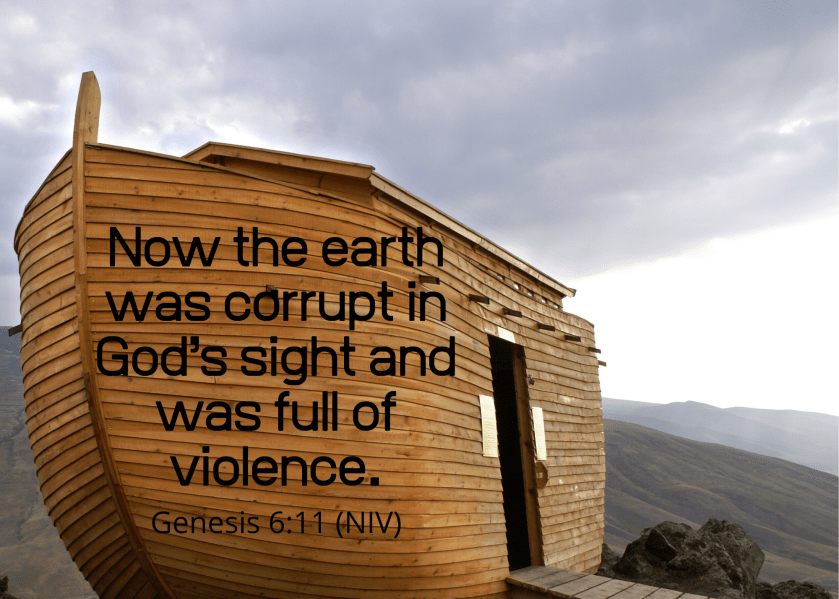
Genesis 6 11 niv

The tragedy of the Garden of Eden continues, as we see the effects of the humans’ disobedience played out in a very real way. Brothers begin to kill each other, women are taken as “prizes to be won”, destruction throughout God’s creation grows exponentially, and even angels begin to break their commitment to God, coming down to mate with human women! (Depending on your interpretation of Genesis 6) God’s solution is to “clean the slate” and destroy humanity with a flood, starting from scratch with Noah and his family. It is surprising that things got this bad, right? Well, maybe it’s not as surprising as we may think…


We are told in 2 Peter 2:4-10 that this event happened “as an example” of what will happen when God returns to earth again; sinful humanity will be destroyed again, leaving only “the righteous” left on earth to inherit God’s Kingdom. In 1 Peter 3:18-22, we are told that we have the opportunity to be saved from this destruction through the sacrifice of Jesus and responding in faith by being baptized. Thankfully, we are also told in 2 Peter 3:3-9 that God is being patient with us all about bringing this destruction, desiring that everybody in the world come to repentance and faith in Jesus, so that they can be saved.


While this may seem like a very dark devotion, it should motivate us and make us appreciate the sacrifice that Jesus made even more. It is only because of Jesus’ willingness to die on our behalf that we have the opportunity at salvation in God’s Kingdom (see Ephesians 2:8-10), not because of anything we have done. God has been gracious and provided us a way out of destruction through His son, all because He loves us and wants to spend eternity with us.


This story should also motivate us to share this message with our loved ones, giving them the opportunity to be saved as well. If you had the cure for cancer, would you keep that information to yourself, or would you share with everybody that you came into contact with? This message is even greater than that; it is the cure for death itself, and a promise for immortality. Why are we not sharing with people every chance we get?


As you go about your day today, I want you to remember three things from this story:

  1. Your actions have real consequences, so think before you act
  2. God loves you and has provided a way for you to spend eternity with Him
  3. You need to love someone enough today to share the gospel with them, giving them a chance at salvation


As you consider and act on these three things, I will be praying for you!

Talon Paul


Day 2 of 2020 Chronological Bible Reading Plan

Today’s passage can be read or listened to at BibleGateway (https://www.biblegateway.com/passage/?search=Genesis+4-7&version=NIV)


Believing the Lies

January 1 – Genesis 1-3

Genesis 3 4 (NIV)

The opening chapters of Genesis play out like a graphic novel, presenting us with the dream scenario where the world is perfect, God is dwelling among His creation, and human beings are in perfect relationship with each other and their Creator. Unfortunately, the scene does not last very long, as the human beings forget their Creator and disobey, bringing an end to God’s perfect world. They start to blame each other, are ashamed of the way that they look, and are separated from God’s presence. It is a terrible tragedy, but one that we still experience today.


At the very core of this story, and the reason that the humans disobeyed God, is because they believed a lie rather than the truth of their Creator. The serpent in the garden promised the humans that if they ate of the forbidden fruit, that they would “be like God, knowing good and evil.” What is tragic about this story is that the humans are already like God, being made in His image (1:26-28)! They did not believe the words spoken by their Creator, and instead, let the lies spoken by the serpent define and destroy them.


Unfortunately, this isn’t just a story of the past, but a daily struggle that every human being faces today. The teenage boy is told that he isn’t worth anything because he failed to perform well at a sporting event. The young girl is told that she is ugly because she doesn’t match what the pictures show in the magazines. The elderly man is told that he is no longer useful since he can’t operate the same way as he could in his youth. The barren woman is told that she has no purpose because she struggles to bear children in this world. And the list continues to go on and on…


These are all lies that the serpent still tells God’s creation, in order to drive them into despair and death (see John 10:10). We see and feel this on a daily basis; we all buy into the lies of the serpent, forgetting the truths that God pronounces over each of us. Scripture tells us that God loves us (John 3:16), that He has plans for us (Jeremiah 29:11), that we are chosen in Christ (Ephesians 1:4), that we are forgiven of our sins in Jesus (Romans 8:1), and that God made each and every one of us in a very special, personal way (Psalm 139:13-14).


Today, I want to encourage you to listen to the truths of your Father and forget the lies you’ve been told. You are valuable. You are precious. You are loved. You belong to Him. God cares deeply for you, and wants you to come into a real relationship with Him like our ancestors had in the Garden of Eden. Come before Him through the blood of Jesus and rest, knowing that your Creator tells you the truth.


Talon Paul


Day 1 of the 2020 Chronological Bible Reading Plan


Here’s a link to BibleGateway.com where you can read, or listen to, today’s passage:

https://www.biblegateway.com/passage/?search=Genesis+1-3&version=NIV


The End of the Patriarchs (Genesis 48-50)

At the end of their lives the patriarchs bless their children.  The ancients believed words matter.  If you asked them, “What’s wrong with the world?”  or “Why is the world broken?” they would answer, “The curse.”  What’s wrong with the world is that God cursed it–using words.  So, how should we expect the world to find healing and redemption?  How does God plan to undo the consequences of our first parent’s rebellion?  He blesses.  First he calls Abraham and blesses him.  Abraham calls Isaac and blesses him.  Isaac calls Esau, but Jacob impersonates him to receive the blessing.  Even so, now Jacob has come to die and he wants to pass on the  blessing to his twelve sons who will become the twelve tribes of Israel.  Somehow or other, God is going to use this dysfunctional Abrahamic family to initiate his master plan of redemption that will one day culminate with making everything wrong with the world right.  Jacob is here playing his part in God’s agenda.

What’s interesting about how he blesses his children is that for several of them, the blessing sounds more like a curse.  For example, to Levi and Simeon he says, “Cursed be their anger…I will divide them in Jacob and scatter them in Israel.”  Through Jacob’s words, God is prophesying about the future.  Indeed Levi was scattered throughout the tribes and Simeon was absorbed into Judah.  What’s so fascinating about the blessing is that Israel passes over his first born, Reuben, as well as his second and third born, Simeon and Levi, and he jumps to boy number four–Judah.  He compares Judah to a lion and then says, “The scepter shall not depart from Judah, nor the ruler’s staff from between his feet” (Genesis 49.10).  This prophesy is rather staggering as we look forward to the rest of the bible.  The great king David and his successors were from Judah.  Ultimately, Jesus, himself, descended from Judah.  So, how did Jacob know which of his children would hold the scepter?  The odds of guessing it right are only one in twelve–about 8%.  God was working with this man of faith to know what to say and whom to say it to.  Jacob might be old, be he is still walking with God, right up until his last breath.

After Jacob dies, we learn about how Joseph forgives his brothers rather than taking vengeance into his own hands.  Ultimately, Joseph himself arrives at death’s door.  We read in the New Testament hall of faith the following about Joseph:

Hebrews 11.22
By faith Joseph, at the end of his life, made mention of the exodus of the Israelites and gave directions concerning his bones.

Out of everything that Joseph went through, his heroic perseverance and faith in God, this is what he is remembered for.  When he came near to death, that same Abrahamic promise that had burned in Israel’s heart, blazed in Joseph’s as well, even while he came to the end of his life.  He expressed his faith by this last request:

Genesis 50.24-25
24 And Joseph said to his brothers, “I am about to die, but God will visit you and bring you up out of this land to the land that he swore to Abraham, to Isaac, and to Jacob.”  25 Then Joseph made the sons of Israel swear, saying, “God will surely visit you, and you shall carry up my bones from here.”

Look at the faith of this man!  He’s suffered so much in the course of his life and yet he never gave up on God.  He had been elevated to the highest office in the land, next to Pharaoh, and he still retained his faith.  In the end, God’s promises to Abraham, Isaac, and Jacob would not die.  One day he would return to the land of his childhood.  It would be centuries, but eventually, when the Israelites came out of Egypt, they carried Joseph’s sarcophagus with them through the desert and laid him to rest in the promised land.  Whether you experience hardship or prosperity, be like Jacob and Joseph and keep faith your in God’s promises to bring the kingdom.

Faith to the End (Genesis 46-47)

In these chapters Israel and his children and grandchildren migrate to Egypt, totaling seventy people.  They left the parched promised land behind and came to live under the care of Joseph.  I can understand why Israel was reticent to move down.  He remembered the stories of his grandfather, Abraham, about how God had promised to give him the land of their sojourning.  He was now 130 years old and had lived in Canaan most of his life.  Imagine living through over a century of nomadic shepherding, seeing bounty and famine, ups and downs, good times and bad ones.  Should he just ride this one out or should he uproot his entire extended family and move them to Egypt.  What would this mean about the covenant God made with Abraham, Isaac, and him?  If he leaves, does that mean he is giving up on God?  This is probably why God came to Israel in the night.  He spoke to him and told him not to be afraid to go down to Egypt and that he would go down with him.  After God assured him, Israel packed up the family and went to Egypt.  There, this group of nomads would incubate, growing from seventy to well over a million souls.

When Israel finally came face to face with Pharaoh he said, “The days of the years of my sojourning are 130 years.  Few and evil have been the days of the years of my life, and they have not attained to the days of the years of the life of my fathers in the days of their sojourning” (Genesis 47.9).  Israel had suffered greatly throughout the course of his life.  He duped his blind father under his mother’s advice to steal his brother’s blessing and then ran away to hide out in a foreign land.  While living with his uncle, he got duped himself repeatedly.  Laban constantly changed his wages and performed a switcheroo on his wedding night, substituting Leah for Rachel.  After twenty years of toiling under Laban’s greedy gaze, he finally broke free.  Terrified of meeting his angry brother Esau, Israel journeyed back home.  Fortunately his brother was no longer out for blood and the two established peace.  However, his overt favoritism of his one wife over the other three led to severe relational pain.  So jealous were his sons of the way Israel treated Joseph that they resolved to murder the lad and tell their father a beast tore him to pieces.  Although they sold Joseph into slavery, they still told their father his favorite son was dead.  Israel grieved for Joseph for days, months, years, and decades.  Indeed, his life was full of suffering: some self-inflicting and some just happenstance.

Yet, this is not the end of the story.  Israel may not have unlocked the secret to “Your Best Life Now,” but he did retain the faith of Abraham.  He may have poisoned his family relationships with favoritism, but he remembered the promise of God.  At the end of 147 years, he found himself on his deathbed in a foreign land, far from the land of God’s covenant.  As a result, his last request was simple.  He had Joseph swear to him, “Do not bury me in Egypt, but let me lie with my fathers.  Carry me out of Egypt and bury me in their burying place” (Genesis 47.29-30).  This seemingly insignificant and inconvenient request, is actually the indication of Israel’s tenacious faith.  He has seen a lot in his century and a half, but in the end he stayed true to the covenant.  He believed in his bones that God would give him and his descendants that land, and his last request was to receive a proper burial in the promised land.  Although he had suffered more than most in his life, he never gave up on God.  As a result, he will participate in the resurrection of the just and one day he will inherit that land as God promised.  I wonder, how deep is your faith?