Clearing Out the Garbage (Numbers 31-33)

September 10

talon-sat

By Talon Paul

As the Israelites are preparing to finally enter the Promised Land after 40 years of wandering in the wilderness, God commands them in 33:52 to “drive out all the inhabitants of the land” (not kill them all) and “destroy all their molten images and demolish their high places.” The very first thing that God commands them to do after driving out everybody is to completely destroy their false gods. God wants nothing but Himself as the divine authority of the Israelites’ lives, and He wants only Himself as the divine authority of our lives as well.

YHWH God says in v. 55 and 56 that if they do not do these things, then those people and their false gods will trouble them in the land. As we know from the rest of the story, the Israelites did not listen and they suffered the consequences for not obeying. They later on begin to follow these false gods and God punishes them for their actions.

But just like the Israelites who needed to clear out the ‘garbage’ of the Promised Land before inheriting it, we as Christians need to do the same. We need to take out the ‘false gods’ in our lives, whether that be a bad relationship, an obsession, an addiction, or anything that keeps us from giving complete devotion to our Heavenly Father. If we don’t, those things can come back and trouble us for the rest of our lives, just like they did to the Israelites. We need to be diligent and active in removing the ‘garbage’ from our life so we can give everything that we are to our Heavenly Father and His son Jesus.

Passing the Torch (Numbers 27-30)

September 9talon-fri

By Talon Paul

Once again, we have come across another section of Numbers with a number of sacrifices, laws, and other things that the ancient Israelites were expected to fulfill.  Unfortunately for us, those laws are not as relevant to us today and can seem boring. To them though, these were essentially important to living in communion with their God. But what lesson can we Christians who are no longer bound by the Old Covenant take from this section?

I believe that 27:15-23 has very great insight for all people of all ages. This passage explains that Moses will not be leading the people into the Promised Land because of his disobedience back in 20:8-12. However, Moses is commanded to install Joshua as his successor as leader of the Israelites. Up to this point, Joshua was likely studying underneath Moses and worked with him.

The point of this lesson is two-fold: Those that are older need to prepare someone younger to take their place eventually, and those that are younger need to learn from those that are older. Unfortunately today, people have a mindset that their generation is the only one that is correct, while the truth is that there is much that can be learned from all generations, both older and younger.

To those that are older: Look for the potential in those that are younger in your church and start training them up to eventually enter ministries that you will be leaving eventually

To those that are younger: Learn from those older than you, be willing to do ministry work in your church, and develop a passion for the Lord.

Blessings or Curses (Numbers 24-26)

September 8

talon-thur

Photo of Mountains in Israel By Beivushtang at the English language Wikipedia, CC BY-SA 3.0, https://commons.wikimedia.org/w/index.php?curid=3485696

By Talon Paul

If you are like me and have read through this entire section, you are probably tired of reading all of the names listed and the counting of individuals for war. This information was very important to the Israelites, but has become “back-burner” information for us today in 21st century America.

Although it is very strenuous to read this section, there is a very important story in chapter 24, which is extended on from chapter 23. Here we see a man named Balaam being commanded by Balak to curse the Israelites who are passing through his land. However, when they get up to a high place to see over all of Israel, Balaam can only cast blessings down on the people, thanks to God. Why is this so important?

While the Israelites were complaining about their lives, going through the motions of everyday life, God was protecting them without them even knowing it. They had no idea that just over the mountain was a man being unable to curse them because God intervened.

The same is true in our lives. When we are in the midst of all the struggles of life and are busy doing everything we need to, God is still protecting us, whether we realize it or not. Although we may not be able to see what He is doing immediately, we know that He has promised to protect His people. God is doing wonders for you right now; do you believe it, even though you can’t see it?

Set Free from Satan’s Venom (Numbers 21-23)

Sept. 7

talon-wed

By Talon Paul

In chapter 21 of Numbers, the Israelites set out on a journey from Mount Hor where they have been for some time since Aaron had died. As they were traveling, verse 4 says that they became impatient with YHWH and with Moses, and they began complaining about their hunger and thirst (have we seen this scenario before?). God punishes them by sending serpents to attack them and show them the error of their ways. Luckily for them, Moses intercedes for them. God commands Moses to make a bronze snake and put it on a pole, and whenever the Israelites looked to the snake, they were healed from the venom of the snake.

The New Testament uses this illustration to describe Jesus’ sacrifice on the cross in John 3:14-16. It says that “the Son of Man must be lifted up”, talking about his crucifixion. The passage later says that “whoever believes in Him shall not perish, but have eternal life.”

Just as the Israelites looked to the bronze snake to be healed from the venom of the serpents, so we too can look to Jesus and be healed from the venom (sin) of the Great Snake (Satan). Jesus has provided a way for us to be healed from the pain and hurt that sin brings into our lives. All we are commanded to do is look to him, believe in him, and obey his commands. Praise God for such a wonderful sacrifice that sets us free from Satan’s venom in our lives!

When God says speak . . . don’t strike instead (Numbers 18-20)

September 6

talon tues

By Talon Paul

In Numbers 18-20, most of us have gotten bored of all the sacrifice talk and all the specifics that the priests had to perform to make these sacrifices. There is also detail given to what happens when someone touches a dead body, purification, and everything else that just does not apply to us today. However, beyond all of these historical specifics, there is a tragic story in chapter 20 for Moses and Aaron.

Moses and Aaron are commanded to speak to a rock in order to produce water for the Israelites (v.8), but instead, they hit the rock with a staff (v.11). This was an act of disobedience and disbelief (v.12). Because of these actions, both Moses and Aaron are forbidden to enter the Promised Land.

Let this serve as a fair reminder for us as well. If we do not have full and complete trust in God and His plan for salvation, and if we do not obey His Son (see John 3:36), we will not enter the Promised Land (Kingdom of God) either. God demands our full obedience and trust, even when we are frustrated and things don’t quite make sense. We must have absolute faith in Him because He has something greater in store for us, rather than disobeying Him.

REMEMBER (Numbers 15-17)

September 5

talon mon

By Talon Paul

In this section of reading, it can get very overwhelming to read with all of the laws that God gives to the Israelites that may not matter to us in 21st century America very much. However, one of the laws that God gives the Israelites should draw our attention and is very important to understand.

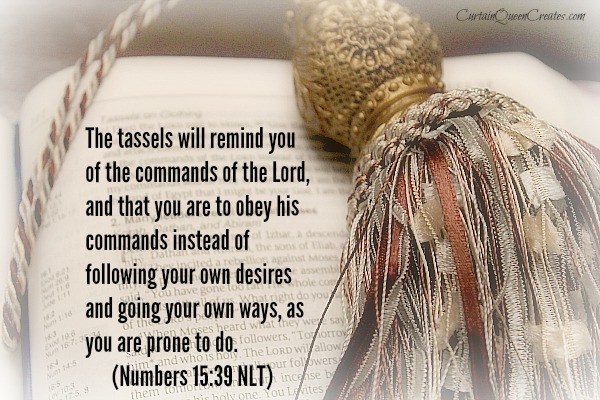
In Numbers 15:38-41, God commands the Israelites to wear ‘tassels’ on their outfits, but it isn’t just so that they look fashionable and “cool”. God has commanded this so that, as verse 39-40 state, the Israelites will remember all that God has done for them and to remember to do all that God commanded.

We as Christians have a very firm and more powerful reminder to do what God has commanded: the cross. A man, Jesus, was literally tortured and executed because of our sins. We can look back to this as a reminder of the fact that God has given us a way to be forgiven of our sins, but also as a reminder that, because of that sacrifice, we need to obey the commands of Jesus and God. When we do this, it keeps us from sinning against them and gives us a hope for the future.

Will you be like the 10? Or the 2? (Numbers 12-14)

Sunday, September 4 – Start of Week 7

talon sun

By Talon Paul

After the Israelites have been freed from their slavery in Egypt by God Almighty (see Ex. 3-14), the Israelites are on their way through the desert towards the land that God promised to Abraham and his descendants (see Gen. 12). However, along this brutal journey, the Israelites become hungry, angry, and resentful of their God. In chapter 13, the Israelites are within distance of the Promised Land and send spies to see how the land looks, and if they are able to overcome it. Two out of the twelve spies believe that God will give them this land, while the other ten are fearful and not trusting of God. It gets so bad that the Israelites start to miss their past life in Egyptian slavery! (see 14:3-4)

Our Christian walk can be much the same as the Israelites’ journey. There are times when we question whether or not the promise of the Kingdom of God is worth all the hardships that we face. We sometimes become bitter and resentful of our God as well, although we know He has a better future planned for us. We sometimes look back and wonder if our lives before becoming Christian was easier and better for us too!

Let the Israelites’ story be a warning to us. They were unable to enter the Promised Land because they desired their past life more than God’s plan. I pray that we don’t fall into that same trap. Put your hope in God and His plans, especially when times seem rough. He has a better future in store for us; immortal life without pain or sorrow.

QUIT Complaining and START Praying! (Numbers 9-11)

Saturday, September 3

rebecca sat

By Rebecca Dauksas

Ok, we know that things are not going to go well when we read, Now the people complained about their hardships in the hearing of the Lord, …

Why would they do that? The Israelites grumbled, argued and complained, but this never works out for them. Honestly, if we look at our own lives, are we guilty of this too?  Do we show God that we are thankful for our life and the provisions that He gives us?  If I may quote Madame Blueberry: “A thankful heart is a happy heart.”  But, the Israelites are not thankful, and they are not happy.  In Numbers 11, they complained about their hardships in the hearing of the Lord, and when he heard them his anger was aroused. Then fire from the Lord burned among them and consumed some of the outskirts of the camp.

So, surely they adopted a new way of doing things, a new way to react to the situations that arose. Nope.

“The rabble with them began to crave other food, and again the Israelites started wailing and said, “If only we had meat to eat!  We remember the fish we ate in Egypt at no cost—also the cucumbers, melons, leeks, onions and garlic. But now we have lost our appetite; we never see anything but this manna!” (verses 4-6)

Wow. Yep that slavery, that was the good life. Sure, they lived lives of servitude, but they had cucumbers.

Unfortunately, this complaining spread until Moses heard the people of every family wailing at the entrance to their tents. The LORD became angry and Moses was troubled. This is where I think we can learn from the way Moses responds.  He asked the LORD.  He is troubled because he is in a situation that is impossible for him to handle alone.  He just has an honest conversation with the LORD. We see him react in the same way that he did in chapter 9 when he is asked a question about the Passover feast.  He told the people to wait until he found out what the LORD commanded concerning them. I think that is how all of us should handle hardships.  We should talk with God about what ever is troubling us. If we are in a continual conversation with the LORD, we bring him our praises and requests continually too.

Moses told Him that he could not carry all those people by himself; the burden was too heavy. The LORD had a solution for him. The LORD would take some of the power of the Spirit that was on Moses and put it on seventy of Israel’s elders.  They shared the burden of the people so Moses did not have to carry it alone. As far as the request for meat, the quail arrived when the LORD said it would.  Even Moses did not know how God could do it, but again he talks with God about it. I wonder how things would have gone for the Israelites if they had humbly thanked God for their manna and asked for meat.  The LORD could even have thrown in cucumbers if He wanted to.  From today’s reading lets be encouraged to pray continually sharing our hardships and praises with God.


Oxen in the Offering Plate (Numbers 7-8)

Friday, September 2

Rebecca Fri

By Rebecca Dauksas

We have a time in our Worship Service when we receive tithes and offerings.  Of course, for most of us that means writing a check or placing cash in the offering plate.  It is not the objects themselves that are of value, but the time and energy we exerted to create the money for our gifts to the LORD. In Numbers 7 the leaders of Israel brought their offerings of Dedication for the Tabernacle. They presented twelve oxen and six carts to the LORD in front of the Tabernacle.  The LORD told Moses to let each leader bring his gifts on a different day for the dedication of the altar. They placed them before the altar. The offering of each leader included a silver plate, a silver sprinkling bowl filled with the finest flour mixed with olive oil, a gold dish filled with incense, a young bull, a ram, a male lamb, a male goat, two oxen, five rams, five male goats and five male lambs. Can you imagine bringing in these gifts?  But these offerings had value. The people crafted the carts, formed the precious metal dishes, raised the animals, …these offerings cost the people something.  They wanted to donate these items to the LORD.  They wanted to show their thankfulness, they wanted to be a part of their Tabernacle.  What are we offering the LORD this week?  Maybe it is from our checkbook or wallet and maybe it is our time.  Time invested in Bible Study. Time devoted to serving the needs of others.  Time spent with God in prayer.  Time showing others what the Love of God truly looks like.  Of course, we want to support the work of God financially – the LORD loves a cheerful giver.  But we want to offer the LORD more than just our financial gifts.  We want to offer ourselves.  Think about a God given ability or talent that you have. Could you use that in some way to serve God today?


The Priestly Blessing (Numbers 5-6)

Thursday, September 1  – By Rebecca Dauksas


The Lord said to Moses, “Tell Aaron and his sons,

‘This is how you are to bless the Israelites. Say to them:

“‘“The Lord bless you and keep you;

the Lord make his face shine on you and be gracious to you;

the Lord turn his face toward you and give you peace.”’

“So they will put my name on the Israelites, and I will bless them.” Numbers 6:22-27


This is a beautiful and comforting blessing from our reading today. A blessing was one way of asking God’s divine favor to rest upon others. This ancient blessing was supposed to convey hope that God would (1) bless and protect  (2) smile on them (be pleased), (3) be gracious (merciful and compassionate), (4) show his favor toward them (give His approval), and (5) give peace. (Life Application Study Bible, Tyndale).

I noticed that the priests put the LORD’s Name on the Israelites.  This has also been suggested as a way to designate the Israelites as the LORD’s people. The LORD’s Name is so important, so holy, so precious, but it seems that I see it misused more than ever.  I hear children scream out the name of God when they are upset, youth yell the name of God because they are happy, or couples saying it over and over after having their newly remodeled house revealed on the latest HGTV show.  I asked a teen girl why they misuse the name of God; after all, she has known the Ten Commandments since she was a child. She said I just didn’t understand because that is not a big deal to anyone anymore. Just this week, I had a cold and was watching a late show that I usually do not watch. I was shocked when a comic skit had a Muppet curse with God’s Name. Blasphemy is committed for the sake of a laugh. I was not amused and I won’t be tuning in to that show again.

Each line of the Priestly Blessing begins with the name Yahweh.  The ancient Hebrew authors revered Him so much that they would not write His full name. In Hebrew it was written as YHWH, the symbol meaning Yahweh. It is built on the word for “I AM” (Exodus 3:14).

It is my prayer that we will experience this blessing today.  That we will receive the LORD in every way.  That it will be evident to everyone that we are the LORD’s people who are called by His Name.


— We are so pleased to have Rebecca writing devotions for us this week.  Rebecca Dauksas has been a Youth Worker her entire adult life.  She serves on the Youth Advisory Committee, has been a regional Youth Director, and is serving as the Youth Director at her local congregation of Guthrie Grove Church in South Carolina. She enjoys working with all ages of youth, interns and service-learning students and encouraging Youth Workers in their ministry and is looking forward to teaching a Youth Ministry class at ABC this fall.  She has a passion for the scriptures and loves exploring them with Youth. She volunteers in her community including a Christian crisis center. Rebecca and Dave, her husband of 26 years, enjoy living on a farm near the church.