
OLD TESTAMENT READING: ISAIAH 63 & 64
POETRY READING: PSALM 90
NEW TESTAMENT READING: James 4
As we focus on James 4. We are going to look particularly at 4:13-16. Let’s walk through this text together, see the picture of God that is here, and how James says it should affect us. Who Is James addressing?
James 4:13, “Come now, you who say, ‘Today or tomorrow we will go to such and such a city, and spend a year there and engage in business and make a profit.'”
James is reprimanding some folks here – perhaps businessmen or merchants – but it is stated very broadly to include virtually anyone. Anyone who does what? Five things:
1. They plan to set out on a trip today or tomorrow: “Today or tomorrow we will go . . .”
2. They plan to arrive at a destination: “Today or tomorrow we will go to such and such a city.”
3. They plan to spend a certain amount of time there: “Today or tomorrow we will go to such and such a city and spend a year there.”
4. They plan to engage in business and carry through a plan of action while they are in that city: “Today or tomorrow we will go to such and such a city, spend a year there, and engage in business.”
5. They plan for the business to have certain results: “Today or tomorrow we will go to such and such a city, spend a year there, and engage in business, and make a profit.”
What’s the problem here? Is this wrong? To plan and intend to go places and do things? No, not really. In verse 15 he is going to say it is legitimate to plan to do this or that. What’s wrong then if it’s not planning?
What’s wrong is that the plan that is made in verse 13 is made in the mind and spoken with the mouth (“Come now you who say . . .”) without taking a true view of life and God into account. Verse 14 talks about the true view of life that is not being considered, and verse 15 talks about the true view of God that is not being considered when they plan their business venture.
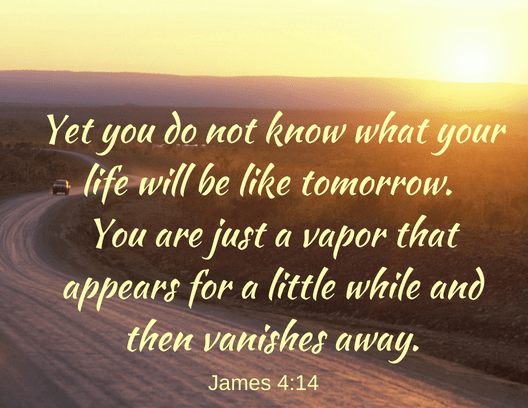
In verse 14, James says to those who are planning this business venture: “Yet you do not know what your life will be like tomorrow. You are just a vapor that appears for a little while and then vanishes away.” In other words, in all your planning and in all your talk about your planning (“Come now you who say . . .” verse 13) you are not taking this view of life into account.
My Life Is a Vapor. So What? So what is the point? The point is that for James, and for God, it matters whether a true view of life informs and shapes the way you think and how you speak about your plans. Your mindset matters. How you talk about your plans matters. Think about this. Believing that your life is a vapor may make no practical, bottom-line difference in whether you plan to do business in a place for one month or one year, or ten years. But, in James’ mind – and he speaks for God – it makes a difference how you think about it and talk about it. “Come now you who say . . .”
Why? Why does that matter? Because God created us not just to do things and go places with our bodies, but to have certain attitudes, convictions, and verbal descriptions that reflect the truth – a true view of life and God. God means for the truth about himself and about life to be known and felt and spoken as part of our reason for being. In other words, it not only matters that you have a right view of life when you make your plans – you are like a vapor – but it also matters that you have a right view of God as you make your plans. And that you give an expression of this true view of God: “You ought to say, ‘If the Lord wills, we will live and also do this or that.'” Look at some of the plans you have made and ask yourself today “Have I considered God”? We will finish James 4 tomorrow and answer the question “What is the right view of God?
-Andy Cisneros
Reflection Questions
- As Andy suggests, look at some of the plans you have made and ask yourself today “Have I considered God”?
- How does remembering that your life is a vapor affect your planning and how you speak about your planning?
- What does the phrase, “If the Lord wills” mean to you? Do you use the phrase? Do you have that mindset? How would it affect your hearers if you were to use it?
 Seek Grow Love