
Old Testament: 1 Chronicles 1 & 2
Poetry: Ecclesiastes 1
New Testament: Philippians 3
1. Ecclesiastes is wisdom literature
Ecclesiastes is unlike any other book in the OT canon. It is part of the wisdom literature genre, but it is presented in a unique fashion with a different approach than the other wisdom books. Each of the wisdom books in the OT are unique in their style and approach (Job, Psalms, Proverbs, Ecclesiastes, Song of Songs). Nevertheless, there are definitely some aspects of Ecclesiastes that are akin to what is found in the Book of Proverbs.
2. The approach of Ecclesiastes
Ecclesiastes can be likened to a journal that contains the reflections of one man’s journey through life.
- It conveys the author’s observations on life.
- It records his attitudes and feelings as he searches for meaning in life.
- It sets forth his conclusions after a lifetime of searching.
We could also think of Ecclesiastes as like a travel log or guidebook that was left after a traveler had completed his trip, and he wanted the next traveler to see what lies ahead of them if they follow his path. Thus, it contains all the uncensored observations and learnings of a man along the journey of life that was fully lived with no avenue or pursuit left unexplored. He’s done it all, and he simply tells it like he sees it because he has lived it and knows it.
3. Why is the book called “Ecclesiastes”?
The title “Ecclesiastes” is actually the Greek title given to the book in the LXX (Greek translation of the Hebrew OT done around the 3rd cent. BC). Actually, most of the book names in the OT that we have in our English Bibles today come from the LXX rendering of the Hebrew.
Before we talk about the word “Ecclesiastes,” let’s take one more step back in time to the Hebrew Bible. The title “Ecclesiastes” is translated from the Hebrew word Qohelet, which roughly means “one who calls the assembly” or “one who addresses the assembly.”
And thus, an “ecclesiastes” was a person who sat in or spoke to an ekklēsia (“assembly”). Ekklēsia is the NT word for “church” and the OT word used in the LXX for the “assembly” (i.e., “the congregation”) of Israel.
4. Who is the author?
There is no specific identified author of Ecclesiastes, but it has traditionally been ascribed to King Solomon, the 3rd king of Israel. All we know is that the author identifies himself as the Qohelet (“the Ecclesiastes”) in v. 1. But there are other clues in the book that lead us to conclude that the author is likely King Solomon.
- He was a king in Jerusalem (1:1)
- He was a/the son of David (1:1)
- He considered himself to be the wisest man (1:16)
- He was a great builder (2:4-6)
- He was extremely wealthy (2:8)
- He had a large harem (2:8)
But some scholars have noted that there are a couple of factors that militate against concluding that Solomon was the author, or at least that Solomon wasn’t the one to compose the book.
There are shifts from 1st person to 3rd person, suggesting the possibility of a narrator as the composer of the book, much like the way Gospel writers composed their re-telling of the life and ministry of Jesus by recording his teachings and activity, but Jesus was not technically the author.
But whether Solomon was the direct author, or a later editor compiled his writings into their final form, it seems best to still identify the “Sage” as being Solomon.
5. The Main Theme
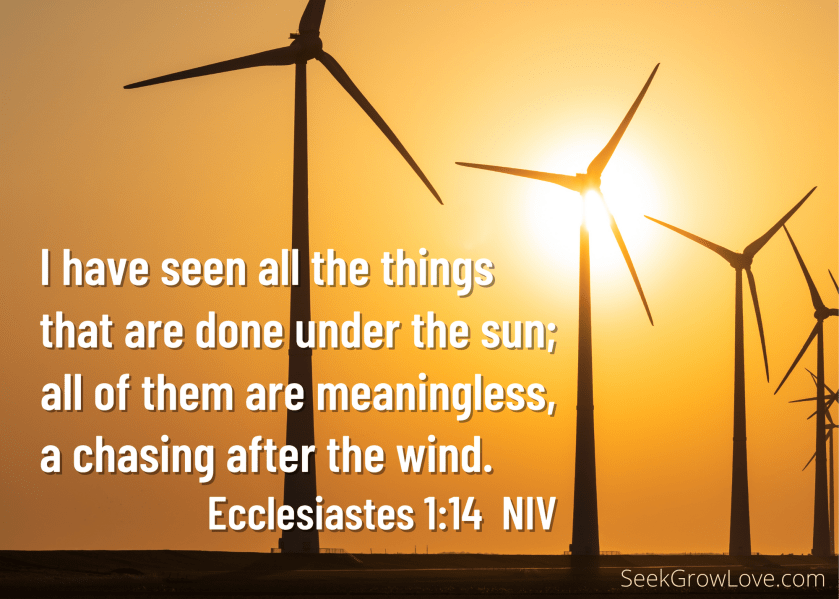
Ecclesiastes 1:2-3
“Utterly pointless!” says the Sage;
“Utterly pointless! Everything is pointless.”
3What does a person gain from all his toil
at which he toils under the sun?
Solomon’s basic premise → “When all is said and done in life, there is nothing that can give a true sense of accomplishment and gratification.” True, it is a very pessimistic outlook on life. Solomon is basically saying that nothing can actually satisfy and provide what we want. Life on a purely human level, no matter how great it is lived, will be pointless. Why is that? Because activity, in and of itself, doesn’t produce anything of lasting and ultimate value.
Have you ever worked really hard and then thought to yourself, “Am I even getting anywhere?” We can work really hard, and yet not feel like what we do is really going to matter. In one sense, this is correct. We can work ourselves to the bone, but all that effort is really not going to produce something that truly lasts or has an enduring value.
One of Solomon’s other points in this opening section is: Nothing is every truly “new.”
Solomon has observed that there really is nothing ever truly new in life. Either people have forgotten what has gone by in the past, and then later rediscovered it, or people were never aware of it in the first place and then think their eventual perception of it is somehow a profound and novel occurrence.
All that life consists of, all the complexities and frustrations it brings, and all the incredible advancements in human knowledge don’t change the fact that life as we know it is basically the same. We may use different tools, be involved in different activities, or use various other means by which we accomplish the tasks of life, but everyone is still occupied with the same basic needs and desires as they always have been. Nothing in the centuries and millennia of human existence has ever really deviated from the original pattern.
-Jerry Wierwille
Reflection Questions
- Who do you know who has passed along wisdom after they have “travelled the road”? What did you learn from them?
- Are you generally a pessimistic or optimistic person? What do you think of Ecclesiastes 1? What wisdom do you find in this chapter?
- Why do you think God wanted Ecclesiastes 1 included in the Scriptures?
 Seek Grow Love