
Old Testament: 1 Chronicles 9-10
Poetry: Ecclesiastes 5
New Testament: Philippians 4:7
In chapter 5, again the theme of oppression from 4:1-3 resurfaces in Solomon’s observations of the world, and along with that the issue of wealth, which is often procured by oppressive means in society. But this time Solomon addresses it as it pertains to a systematic form of oppression. While individuals can oppress others, Solomon now proclaims that one should not be amazed at all the oppression and denial of justice and righteousness that goes on in the land because such widespread oppression and injustice is caused by the corruption that exists within the structural hierarchy of government that protects those who perpetuate it.
Often corruption is allowed to remain because it exists at multiple levels, each person watching out for the others so that their oppressive regime can remain in effect. In the following verses, Solomon will proceed to give seven reasons for the pointless pursuit of money in one’s life.
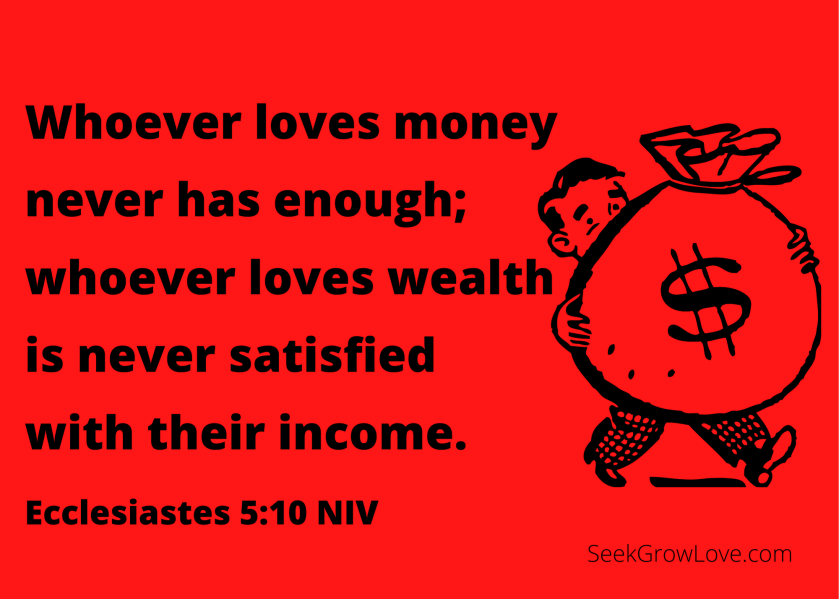
FIRST reason: wealth is both addictive and unfulfilling (v. 10).
Greed is never satisfied; there is always room for more. The question is, “How much money is enough?” Do you have “enough” money? Most people would say, “no.” But no matter how much money one has, they will never be satisfied because they will have the desire for more. Therefore, whatever goal you set for yourself in life, whether it’s a million dollars or whatever, once you reach that, you will not be happy stopping there.
There are a few things that we can truly say people are never satisfied with, no matter how much they have: money, power, and pleasure.
SECOND reason: more wealth just means more people to consume it (v. 11a), and THIRD reason: wealth doesn’t benefit the owner (v. 11b).
The person whose wealth has increased, has also increased the labor force with which to sustain the wealth. As the possession of the owner multiplies, he must hire more help to manage it. And so, he grows wealthy, but as wealth is produced, it is then given to the workers. And so, because of this natural consequence that accompanies wealth, the owner doesn’t get to enjoy his wealth except to watch it pass through his hands as others consume it. The fortune that is amassed is met by a large household and expenses that need provisions to keep running, and therefore, the owner finds no advantage for himself.
FOURTH reason: wealth robs the owner of peace and rest (v. 12).
The main premise that Solomon argues from is that the rich do not sleep well. He doesn’t explain the mechanism behind why this is the case, but perhaps it is because rich people are always concerned about their money: what to do with it, how to multiply it, will they lose it, etc. The endless possibilities for projects, purchases, & property surround him every day and follow him into the night where they do not permit his mind to be at rest, and thereby, enjoy deep and rejuvenating sleep.
FIFTH reason: hording wealth is an unhealthy behavior and causes harm to the owner (v. 13).
Why is that? Isn’t it a good idea to save up money? Well, the answer is “yes.” But it appears that Solomon has in mind someone who is accumulating money for the mere sake of its accumulation, that is, for a big number in the bank account. He doesn’t specify why this behavior is detrimental to the owner, but since the money is never used, it does not benefit the owner and brings him no tangible joy or pleasure. Perhaps the problem lies in the owner’s incessant worrying or anxiety that it might be stolen by robbers or is so concerned about it that he or she counts it all the time to make sure they haven’t misplaced or lost any of it. Whatever the specific reason might be, the principle that Solomon is warning about is to not make money a treasure to be kept hidden and stashed away. Money is meant to be used and to be a blessing for the needs of life that it provides.
SIXTH reason: foolish choices in business can lead to bankruptcy (v. 14).
The problem that Solomon identifies is that a person can’t rely upon wealth for security. It may or may not be there in the future, as it can be lost through some unknown misfortune. The evil that is being attributed here to wealth is the fact that after it was accumulated, it was then suddenly lost. And now there is nothing to pass on to the next generation.
SEVENTH reason: wealth will disappear at death (v. 15).
Death will deprive a person of all their wealth. You might be the wealthiest person alive, but when you die, you go back to being flat broke!
On top of the fact that every person begins and ends their life in the same way, the person who seeks to find meaning in life by earning money is filled with “darkness” and with “much frustration, sickness, and anger” (vv. 16-17). Darkness is likely a metaphor for the gloom of isolation, anxiety, and joylessness that is experienced when money is your goal in life. It is a life wasted in pursuit of nothing, and the years spent running after the dollar will reward you with heartache, disappointment, and regret.
It is probably impossible to paint a more depressing outlook on life, but such is the way that Solomon sees it if you try and squeeze meaning out of money. It will only leave you empty and disillusioned.
The bottom line is that we can’t serve both God and money (Matt 6:24-26), and as Solomon showed, money is a cruel master that will do nothing but disappoint in the end.
-Jerry Wierwille
Reflection Questions
- Can you give an example of a time your own pursuit of money (and perhaps what it could buy) left you empty?
- What do you see as the problems created by money or a chasing after money or loving money?
- Do your financial decisions reveal that you are loving and serving God or money?
 Seek Grow Love