
God’s Presence and the Tabernacle

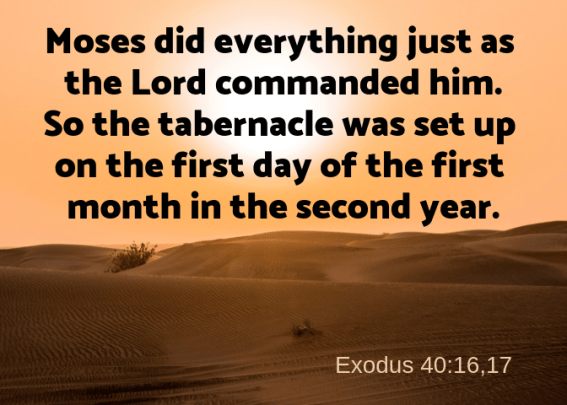
Exodus 40 16 17

Text: Exodus 40


As we leave the Garden, the state of God’s relationship with his creation is strained. Adam and Eve have been kicked out of the garden because of their defiance, and no longer have access to God’s presence like they had before. They are effectively exiled.


Let’s jump ahead to Moses. Now, there is much that happened between the garden and the introduction of Moses, and it is important stuff to know, but I want to race ahead to our topic of God’s presence.


As you probably know, Moses was a man chosen by God to lead God’s people (the Israelites) out of captivity in Egypt. It’s quite the epic story, and it is crucial to the Israelites. It reminds them how God chose them as his people and was faithful to them, bringing them out of captivity.


So now the Israelites, under the leadership of Moses and the miraculous deliverance of God himself, have escaped the clutches of Pharaoh. While they are in the middle of nowhere, at the foot of Mt. Sinai, God begins to form a deeper relationship with them. He begins by giving them some basic guidelines of being his people, part of which is what we know as the Ten Commandments.


In Exodus 25, God begins giving Moses some very specific (exhaustive!) guidelines for building a tent structure called the tabernacle. It is important to ask why, just like how we asked why God would create us in the first place. And I think the answer to why he created and the answer to why he wanted a tabernacle built are the same answer: In 25:8, God says, “Let them construct a sanctuary for Me, that I may dwell among them.”


Simple enough. But God has been interacting with his people all along. We can see how he worked in Noah, Abraham, and Joseph, just as a few examples. And now he has entered into a very special relationship with Moses, and by extension, to the rest of the Israelites. So if God is working among them and has a relationship with them, why do they need a tent thing?


I don’t know why God chose a tent specifically, but there is something special about it. God wanted to use it to dwell among his people, in a way that was closer to how he dwelt in the Garden. It was a much more intense dwelling and presence than he had been able to have among his people for a long time, since the Garden. Mankind lost special access to God’s presence after the Garden was off limits, but with the tabernacle, God was providing them with a new way to access his presence again. God is in the business of restoring.


God’s intentions and vision for this tabernacle are made more clear by the frequent callbacks to creation. In chapters 25-31, there are seven sections that begin, “the LORD spoke to Moses…” followed by detailed tabernacle plans. This is a reference back to the seven days of creation, when God commanded the cosmos into order. The sixth speech mentions craftsmen and priesthood, where day six of creation features mankind created in his image. The seventh speech is a reminder to the Israelites about the importance of the Sabbath, while day seven of creation is when God rests.


The tabernacle and creation accounts are further connected in structure with key phrases: Gen 1:31 vs Ex 39:43 (seeing what was done), Gen 2:1 vs Ex 39:32 (completing), Gen 2:2 vs Ex 40:33 (finishing work), Gen 2:3 vs Ex 39:43 (blessing), and Gen 2:3 vs Ex 40:9 (sanctifying).


Additionally, there are several symbols in the tabernacle that are connections back to Eden. The lampstand in 31:8 is a symbol of the tree of life, and the ark may symbolize the tree of knowledge (it contains the law, and you die if you touch it). There are images of cherubim in the tabernacle, reminding us that cherubim guarded the entrance to the garden. Gold and precious stones may also be symbols that tie the tabernacle back to Eden.


Similar connections to creation and the garden exist when looking at Solomon’s Temple, but I’ll leave that unexplored to return to our regularly scheduled program.


What is the purpose of all these references to creation and the garden? I believe God wanted his people to recognize the symbolism as his attempt to bring the garden back to them, in a way. God wanted to commit to his people and assure them that they could again have access to his presence. God wanted them to know that dwelling with them was his plan from the very beginning, and he will restore it. And we know that God’s intent is to dwell with us too, in ways that far surpass the tabernacle among the Israelites, and in ways that far surpass even the garden.


What? Yes! We’ve only seen the tip of the iceberg. Now to Exodus 40 before I get too excited. When everything for the tabernacle was done according to God’s instructions to Moses, God’s presence rested in it:


Ex 40:34-38 (NASB): “Then the cloud covered the tent of meeting, and the glory of the LORD filled the tabernacle. Moses was not able to enter the tent of meeting because the cloud had settled on it, and the glory of the LORD filled the tabernacle. Throughout all their journeys whenever the cloud was taken up from over the tabernacle, the sons of Israel would set out; but if the cloud was not taken up, then they did not set out until the day when it was taken up. For throughout all their journeys, the cloud of the LORD was on the tabernacle by day, and there was fire in it by night, in the sight of all the house of Israel.”


If you are Moses, then this is a fairly anti-climactic way of ending Exodus. He didn’t even get to go in! There is still apparently a problem with sin. If you go into the holy of holies and are not clean enough, you die. Only the high priest can go in, once a year, offering blood to cover for the sins of him and the people (Hebrews 9:7). Looking back at the garden, and how sin and the presence of God are incompatible, maybe kicking Adam and Eve out of the Garden could have been more of an act of mercy than a harsh punishment.


But here is God, dwelling among his people again, restoring and guiding them. My prayer for you today and every day is that you will seek to be where God is, by following that cloud. That you will linger when the cloud lingers and that you will set out when the cloud is taken up. That God will show you where and how he is moving and invite you in on the action.


Jay Laurent

God’s Presence at Creation

Hello Readers!  If you have been reading along with us everyday in 2019 – you have now read all of the gospel of Matthew.  Well done!   We will cover the other three gospels later in the year (John in April, Mark in August and Luke in December). This week we are going to take a little theme break and investigate the topic of the Presence of God.  Every day there will be a Bible passage to read, but they won’t be consecutive New Testament chapters.  Then, next week (starting Sunday, February 10) we will begin a chapter by chapter daily walk through the book of Acts.  Remember, stick with us all year and we will cover the whole New Testament – as well as lots of other golden nuggets as well.  And so we begin – – – The Presence of God at Creation!

Text: Gen 1:1 – 2:3

Isaiah 66 1 a

This week, I want to lead you in some thoughts, taking a tour through scripture to highlight some big moments in the story of God’s presence among us. Today we are going to start this journey in Genesis 1, with creation.


But why creation? I think that is an important question, if not the biggest question Genesis 1 aims to answer. Probably hundreds of times I came there preoccupied with questions about who, what, when, where, and how, but forgot to ask why. And the answer to the “why” question is intimately tied to God’s presence.


When we think about “why” questions, we’re starting to think about purpose. Teleological questions. We’re going places scientific inquiry doesn’t (and can’t) go. We’re starting to ask the questions God wants us to think about most.


The opening verses of Genesis paint a picture of a wasteland. God is hovering over the deep, or the waters (a recognized symbol of chaos). The earth is said to be without form and void. It has no purpose. God begins his work to shape it all into order.


But why? If you are God, do you need the heavens or an earth? Do you need plants, animals, and people? I’d guess that no, God doesn’t require any of those things. He’s God, right? It seems that if God doesn’t need anything, he was motivated by something to create.


The earth was set up as a space for us to live, and rule with God, or be stewards, over the rest of creation (this is at the core of what it means to be made in God’s image). The earth is a gift to us. The first six days of creation are the account of God separating, naming, and giving function and purpose to all the moving parts of his cosmos, really for our benefit.


God calls what he did “good” after each day, and then after he is finished, he calls the whole thing “very good.” In other words, all the parts come together and work like a well-oiled machine. Thank God the earth functions beautifully for us, but there is something more going on here, particularly when we talk about day seven.


Day seven is something we usually mention as an aside to creation. We say things like, “now God kicked back to relax, and he did it to admire his creation and be an example for us so that we remember to take a day off.” And we might be correct in saying something like that. But let’s be real, God doesn’t need rest. There is something more going on here.


First, “rest” in this context probably doesn’t mean God is tired and needs to recharge. It means he now has stability and order in his creation. You can see this idea of stability and security come up many times in scripture when it talks about God giving rest (see Exodus 33:14, 1Ch 22:9, 2Sa 7:11).


Second, it is understood among the Israelites and other ancient Near Eastern cultures that when deities rest, they rest in temples. And a temple isn’t finished until a deity rests in it. This is a strange idea to us, but it was understood in those cultures (we can see a similar thing happening in the ancient Babylonian creation epic, Enuma Elish, for example). They would know right away from the text of Genesis 1:1-2:3 that it has a temple theme, and that God rests in it on day seven.


Third, the number seven carries with it a symbolic meaning of completion. We think of numbers strictly as representing quantities. Ancient Israelites aren’t as strict with their use of numbers, and use them in ways that qualitatively symbolize things. This is why you see numbers like 7, 12, and 40 all over the place in the Bible.


But where was the temple in the story, though? Did you miss it? So did I. Ever seen Indiana Jones and the Last Crusade? It’s the best Indiana Jones movie, by the way. There is a part in that movie where they are in an old church that was converted to a library, and they’re trying to match Roman numerals from a stained glass window with locations in the building. They are stuck on finding the location of 10, until Indiana walks up a staircase to a balcony overlooking where they were standing. Lo and behold, there is a giant X across the whole floor. They didn’t see it, because they were standing on it the whole time.


If you are looking for the temple in Genesis 1, it’s been under your nose the whole time. In Isaiah 66:1, God declares, “Heaven is My throne and the earth is My footstool.” The whole cosmos is God’s temple. God spends the first six days of creation naming and giving purpose to the different parts of the heavens and the earth, to provide a place where we can thrive, but the dual purpose is that these parts are being inaugurated and paraded in as pieces of his temple.


But to just build a temple out of materials doesn’t make it a temple. A temple isn’t a temple until God rests in it, otherwise it’s just a structure. Day seven is when God rests in and inhabits his temple. It’s when he moves in with us. This is part of why it was important to the Jews to observe the sabbath, to celebrate his stability and presence in their lives.


Day seven isn’t the aftermath of creation, it is the completion, the crown, like the shiny star or angel on your Christmas tree. God could have made this beautiful place, put us in it, and moved on, never to have contact with us again, and it would still be amazing! But no, God didn’t just wind up the clock and step away, as some people mistakenly believe he did. He decided to be involved with his creation, especially us, in real and intimate ways. He decided that he would be present in his temple, living among us.


The why of creation, the purpose, is that God wanted to make his home with us.


Next, we’ll travel to the garden.


Just a quick note to give credit where it is due. The idea of creation being a temple isn’t mine. First of all, it is God’s idea. But if you are interested in reading more about it from scholars who can articulate and support it much better than I can, check out The Lost World Of Genesis One by John Walton, or The Temple and the Church’s Mission by G.K. Beale.

— Jay Laurent