
Hey, Siri. What’s an ephod?

Wednesday – Judges 8-9

Judges Devotions-3

While Gideon is presented as a mighty warrior earlier in Judges, his legacy becomes more muddled in today’s reading. When you first learned about Gideon in Sunday School, your teacher probably didn’t tell you about his seventy sons (one of whom killed nearly all of his brothers) or the ephod he made out of gold.

If you’re like me, you’re asking Siri right now what an ephod is, but let me save you the trouble. An ephod is a sacred, decked-out, garment worn by the high priest that hung from his neck, similar-ish to a vest. After the Israelites invade the Midianite camp, Gideon requests that everyone bring him a gold earring from their share of the plunder. From the forty pounds of gold gathered, Gideon makes an ephod. He’s not Israel’s first leader to build something grandiose out of gold (we’re looking at you, Aaron).

Unfortunately, like Aaron’s golden calf, the Israelites begin worshipping Gideon’s ephod, which resided in his hometown. I’m not exactly sure why Gideon made the ephod, perhaps to mark Israel’s victory or assert his dominance as a leader. At any rate, I don’t think Gideon’s intent was to make something for the Israelites to bow down and worship. After all, he had just told the Israelites that there is only one king: God.

I think there are two valuable lessons we can learn from Gideon’s mistake:

1. You can hurt people even when you don’t “mean to.” Whenever I got in trouble as a child, my go-to phrase was, “I didn’t mean to.” However, even if I didn’t mean to hit my brother, he still had a bloody nose. My intent wasn’t to make my brother’s nose gush uncontrollably, but that was the impact of my actions. In the same way, Gideon didn’t intend to build something that would create a rift between the Israelites and God, but it did. It is important to take responsibility for our actions, even when they’re not premeditated. With urgency, deal with the hurt you may have caused.

2. Watch out for snares! The author of Judges describes the ephod as a snare to Gideon and his family. Be on guard, avoiding traps that try to rip you from God—maybe it’s a lie that keeps running through your head, a movie you know you shouldn’t be watching, or a friend who pressures you into something you’re uncomfortable doing. Also, be proactive in looking for snares that could trip up a brother or sister in the faith; the church works best when we look out for each other. If your roommate struggles with pornography, don’t let them sit alone on their computer. If your friend is a recovering alcoholic, don’t take them to the restaurants covered in beer advertisements. If your classmate is tempted to cheat during a test, cover your answers.

In a world where sin is often celebrated, let’s make sinning as difficult as possible.

Mackenzie McClain


Today’s Bible reading passage can be read or listened to at https://www.biblegateway.com/passage/?search=judges+8-9&version=NIV

Tomorrow’s reading will be Judges 10-12 as we carry on with the 2020 Chronological Bible Reading Plan
God is with me

Tuesday – Judges 6-7

Judges Devotions-2

I could tell you the story of Gideon in my sleep, but probably only in Spanish. For the past couple years, I’ve told many groups of children in different cities throughout Peru the story of Gideon. Each time, we make torches like the ones Gideon’s men brought into battle. Whether we’re gathered at a local park, a giant school assembly, an alleyway on a busy street, or a kitchen table, we all shout enthusiastically, “Dios está conmigo!” which means, God is with me. The pure joy and conviction in the children’s echoing voices give me shivers each time. The God who was with Gideon, is with me, with you, and with hundreds of children in Peru.

66101650_2270193566383697_6905642581095350272_o.jpg

Reading the story of Gideon again today, I am amazed by how God defies human logic; His ways often seem mysterious to us, but they lead to victory. Of all the people to raise up an army to fight against the Midianites, God picks Gideon, a self-proclaimed runt of the litter from the weakest clan in the whole city. He looks at Gideon and says:

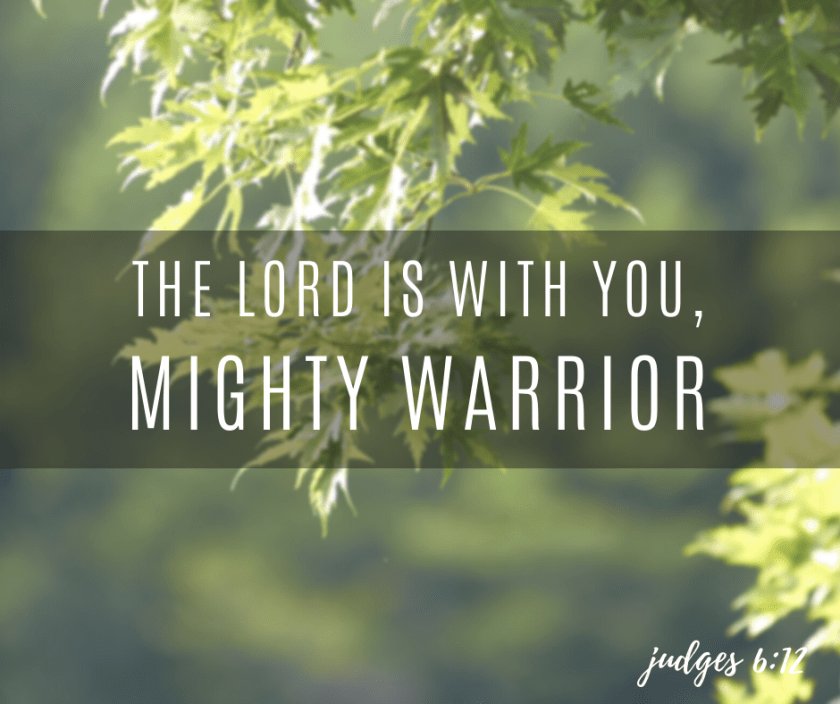
The LORD is with you, mighty warrior. (Judges 6:12)

Gideon’s response to God’s calling is laughable:

Pardon me, my lord. (Judges 6:13)

He talks to God’s angel like he just accidentally bumped into someone at the grocery store. Gideon’s hesitation continues, as he asks God for a handful of signs, involving a goat, bread, and fleece. When Gideon is finally sure that God is indeed with him, he assembles an army of 32,000 men. God, however has a very different plan. With just 300 men armed with trumpets, jars, and torches, God leads His people to victory, conquering the Midianite army of 135,000 well-equipped soldiers. The same God who triumphs over seemingly impossible circumstances is still at work today.

I, like many of you, entered the year 2020 with the word “vision” on the mind. To me, vision meant clarity and a plan. I was hopeful that this would be the year I would “figure everything out.” In these past few weeks, everything I thought I knew, everything I planned, has been thrown out of the window—all because of a virus I didn’t see coming.

Much like Gideon, I’m scared, uncertain, and don’t understand what God is doing (yet). So maybe 2020, the year of vision, wasn’t a promise for answers, but rather a challenge of your faith. Will you seek God’s provision and plan for your life? Will you cling to Him when everything else is shaky, foggy, and unknown? Will you trust that He is present even if His ways don’t make sense to you yet?

For the next few hours, I challenge you to not look at the latest news headlines or CDC guidelines; instead, rest assuredly in this simple truth:

God is with me.


Mackenzie McClain


Today’s Bible passage can be read or listened to at https://www.biblegateway.com/passage/?search=judges+6-7&version=NIV


Tomorrow’s reading will be Judges 8-9 as we continue seeking God in His Word on the 2020 Chronological Bible Reading Plan

Battle Cry

sunday dec. 31

We are in the midst of war. This war was waged about 6,000 years ago when Adam and Eve committed the very first sin. The fruit they ate was the gateway for sin to enter the world. God and sin do not peacefully coexist, because “God is Light, and in Him there is no darkness at all” (1 John 1:5).  This war, like any war, is made up of battles and tomorrow, the beginning of 2018, marks a new battle. Are you ready?

Every battle needs a battle cry— a word or phrase cried out by the soldiers going into combat for the purpose of uniting your regiment and intimidating the enemy. One of my favorite battles in the Bible happens in the book of Judges. The Israelites have lost their leader, Joshua, leaving them in a vulnerable place. Over and over in the book of judges the Israelites repeat the cycle of falling into sin, becoming oppressed by another group of people, calling out to God for help, being delivered by a judge (not the kind that carries a gavel, think more of like a temporary Superman), and finally enjoying a time of peace. Our story begins as the Israelites have been given into the hands of the Midianites, who are notorious for invading the Israelite’s land, destroying their crops, sheep, cattle, and donkeys. The Israelites are now so impoverished and helpless that their only option is to cry out for the God of their ancestors. Hearing their cries, God appoints a man named Gideon to deliver Israel from the Midianites, telling Gideon, “The Lord is with you, mighty warrior” (Judges 6:12).

After a bit of hesitation, Gideon gathers an army of 32,000 men. As he prepares to bring them into battle, God nudges Gideon, telling him that he has too many men. If Israel were to win, they would think it was because of their own power and not because of God’s almighty power. Gideon tells his army that if anyone is scared they can turn back now. 22,000 soldiers left, while only 10,000 remained. With only a third of Gideon’s army remaining, God still says there are too many men, so Gideon takes his men down to the water. Every man who drank from cupped hands, lapping like a dog was allowed to fight, but every man who got down on their knees to drink were sent back home. Gideon’s army now consists of 300 men (who are probably at this time pooping their pants in fear). These men were not given traditional weapons; instead, they had trumpets and jars with torches inside.

In case you’re lost, here are the numbers: 135,000 well-equipped Midianite soldiers stacked up against 300 Israelite soldiers holding trumpets, jars, and torches. If I was a betting man, I would put my money on the Midianites. Regardless, Gideon and his teeny-tiny army surround the Midianite camp just as the Midianites were changing guard. Suddenly, all 300 Israelites blow their trumpets, smash their jars, and yell their battle cry, “For the LORD and for Gideon!” Mass chaos ensues. The Midianites are now the ones pooping their pants, crying for their mommies, and turning on each other with their swords. That’s right, the Midianites defeat themselves while the Israelites stand back and watch.

The first step to being battle-ready is having a battle cry—a shout for solidarity and to frighten the enemy (bonus points if you make them poop their pants). Throughout the week, we will be covering words to adopt as our own battle cries in 2018. These words will strengthen us, unite us, give us courage, and intimidate the enemy. The enemy has waged war; our only option is to fight back, mighty warrior.

The whole story of Gideon defeating the Midianites is found in Judges chapters 6 and 7. Seriously, read it all. It’s full of so much juicy goodness.


~ Mackenzie McClain