

Different Temptations

Old Testament Reading: Leviticus 17 & 18
Psalms Reading: Psalm 55
New Testament Reading: 1 Corinthians 8

In the letter of 1 Corinthians, Paul is writing to the church in Corinth.  Corinth is in modern day Greece, so it was at the heart of Greek influence.  This would have meant that the church in Corinth would have been surrounded by people who put their faith and hope in the Greek gods.  The worship of idols was not just an aspect of the Greek culture, it was the heart of Greek culture.  I’m sure many in the church at Corinth would have come from this background of worshipping the Greek gods.  For some, that would not have been a big deal; they could separate themselves from the worship of idols.  For others, it would have been difficult to separate themselves from the worship of idols.  For those who had troubles separating themselves from the worship of idols, they would have had a conflicting conscience eating food that was originally offered as a sacrifice to these idols.  Was it sinful to do so? 

Paul explains that we are not better or worse off if we eat the food originally offered to idols.  At the same time, Paul urges those who aren’t conflicted by eating food originally offered to idols to withhold from eating this food in front of those whose conscience was conflicted.

There are two key takeaways that I would like to mention here:

1) Everybody is susceptible to different temptations.  One path may be safe for someone to travel down; however, that same path may lead to danger for someone else.  For the church at Corinth, some could eat the food offered to idols and stay away from the temptation to commit idolatry while others could not.  One person may be fine having social media and be safe from the temptation to covet, while another person may not be safe from this temptation.  One person may be fine having a drink of alcohol and be safe from the temptation to get drunk, while another person may not be safe from this temptation.  One person may be safe to have digital media on their phone and be safe from the temptation to lust, while another person may not be safe from this temptation.  You catch the drift.

As we alluded to in yesterday’s devotion, you must be acutely aware of what triggers you to commit sin.  It is different for everybody.  Being self-aware of your triggers is key to your recovery from a sinful habit and key to keep you away from a sinful habit.

2) If something is safe for you to indulge in but not for those around you, then don’t take part in it.  Paul urged the Christians at Corinth to not serve as a stumbling block for those around them by eating the food originally offered to idols in front of others who may struggle with this.  Therefore, do we not only need to be aware of what triggers may lead us to sin, it’s imperative that we understand what triggers those around us to sin.  When we act as a stumbling block to those around us, we are sinning ourselves.  In one of my favorite teachings, Jesus explains the severity of causing others to stumble in Matthew 18:6 – check it out.

All in all, be cognizant that God made us all different, and we are all tempted by different things.  Be aware of what tempts you while also being aware of what tempts those around you.

-Kyle McClain

Reflection Questions

  1. What are your temptation triggers? What boundaries can you create to help keep yourself from sin?
  2. How can your actions lead your family members and Christian brothers and sisters who might have different temptations and consciences to sin? What can you do instead to support them and strengthen them in their stand (or flight) against temptation?
  3. What does your Bible reading today tell you about the One who inspired these words? Who is He and what is His desire?

With Great Power Comes Great Responsibility

1 Corinthians 8

June 9

While we now live in an era where information is at the tips of our fingers, just a few swipes and searches away, knowledge still holds as much power as ever. At the beginning of this chapter, Paul reminds us of this crucial fact when he says, “… But knowledge puffs up while love builds up. Those who think they know something do not yet know as they ought to know. But whoever loves God is known by God.” (1 Corinthians 8:1b-3) Here, Paul highlights how gaining knowledge can lead to becoming arrogant and result in divisions between people. He then explains the flip side of this coin: love. By using what we do know for the benefit of others, we can become better leaders in the church and set an example for how to live a life like Christ. To better elaborate on this concept, Paul addresses a question the people of Corinth had for him concerning eating food sacrificed to idols.

Later in the chapter, Paul states, “… yet for us there is but one God, the Father, from whom all things came and for whom we live; and there is but one Lord, Jesus Christ, through whom all things came and through whom we live But not everyone possesses this knowledge…” (1 Corinthians 8:6-7a) Since Christians are aware that all things come from God, it was clear at the time that the meat in the markets was just meat, despite its old use in rituals to idols past. As more experienced Christians were aware of this fact, they would eat the meat casually as they should; however, as Paul states, not everyone knows this information. To the average individual, seeing the meat could still serve as a reminder of the idols of the past, and witnessing Christians eating this same meat could cause confusion and make one deviate in their faith. It’s here where Paul warns us, “Be careful, however, that the exercise of your rights does not become a stumbling block to the weak.” (1 Corinthians 8:9)

The rest of the chapter really speaks for itself as Paul describes how wounding someone with knowledge by being that stumbling block also hurts yourself. In verses 11-13, Paul writes, “So this weak brother or sister, for whom Christ died, is destroyed by your knowledge. When you sin against them in this way and wound their weak conscience, you sin against Christ. Therefore, if what I eat causes my brother or sister to fall into sin, I will never eat meat again, so that I will not cause them to fall.” The result of not being responsible with our knowledge is devastating because not only do we sin against the individuals concerned, but we also sin against Christ. However, as mentioned previously, there is a flip side to all of this. If we are responsible with this powerful knowledge and use it lovingly, then we can build upon one another. It’s no easy feat of course—like giving up meat for good, as Paul describes—but by preventing the fall of those around us, we can continue to raise our commitment to Christ together.

— Austin Kizer

Questions for Reflection and Discussion

  1. How do you use your knowledge to grow closer to Christ? Do your actions and applications of this knowledge show other people your firmness in faith, or are you sending mixed signals? 
  2. A unique phrase in this chapter was “stumbling block for the weak”. What are different stumbling blocks that the world throws at us, and how can we combat them to stay firm in our faith?
  3. With knowledge about Christianity becoming more accessible to people worldwide, it’s important to hone in on the areas that we can directly impact. Discuss how Christians in this modern day can share their knowledge and build relationships with people in their community.

Knowledge Puffs Up, But Love Builds Up

1 Corinthians 8

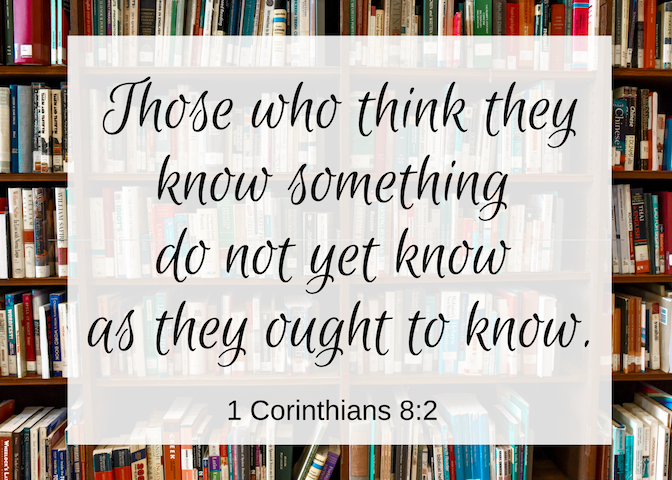
Those who think they know something do not yet know as they ought to know.

Would it surprise you to know that in a discussion about issues that people disagree on, Paul would bring up the subject of pride?  The Corinthians disagreed on a lot, what to eat, how to worship, what was moral behavior, and more.  Paul kind of leads with this in chapter one (1:10) saying that he ‘appealed to them’ to get rid of the divisions and live in unity with one another.

Now here, in chapter 8, Paul is in the middle of working through one of their many dividing issues.  But instead of focusing on the issue, I’d like to hone in on some wisdom that Paul shares about unity in the body.

“Knowledge puffs up, but love builds up”

We shouldn’t be mistaken.  Paul is not saying that knowledge itself is bad, or that the desire to pursue knowledge is in itself prideful.  He’s not suggesting that we should pursue love instead of pursuing knowledge.  Not at all.  It seems that what Paul is concerned with is what that knowledge does in us and how we share that knowledge.

Do you like to be the smartest person in the room.  That’s pride.

Do you use your tone of voice to make people feel dumb because they don’t know what you do.  That’s pride.

And here’s an important thing to note… we’ll only really know that we are building up (or edifying) with our knowledge by how others respond.  Edifying is not something we can claim.

“I hereby edify you!”

Nope.  Not how it works.

If you think that you are sharing your knowledge with love, it will be evident by the unity that you are helping to create.  When Scripture calls us to be peacemakers (Matt. 5:9, James 3:18) it implies actively building peace and unity.  Being a peacemaker is more than just not shooting anyone.  A peacemaker makes peace as opposed to division, they edify and build up those around them.

Picture a person filled with knowledge who you just love to be around because of the way they make you want to know more, to be better, simply because of the kindness and grace with which they speak.  Their whole demeanor draws you to them.  Sounds a lot like Jesus, if you ask me.  It also sounds like the kind of person Paul is calling us to be.


-Susan Landry