
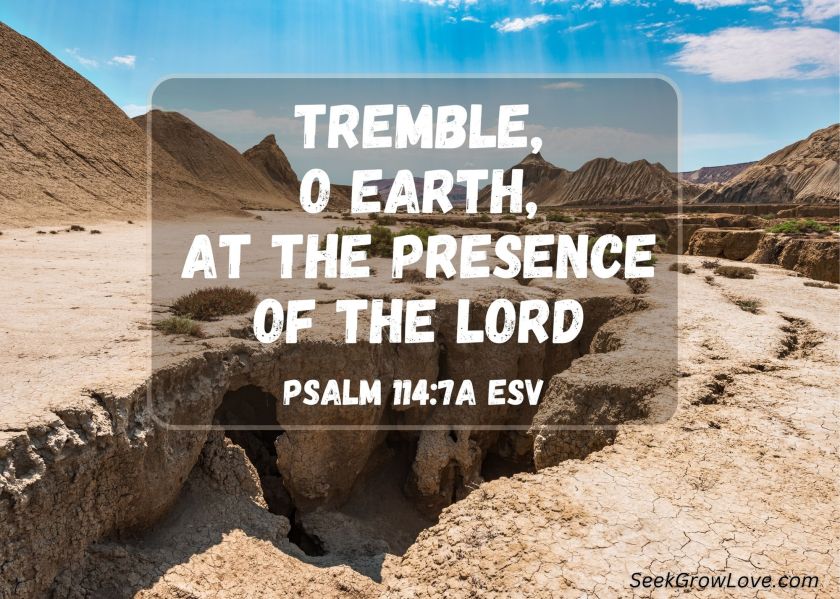
Tremble!

OLD TESTAMENT: Isaiah 65 & 66

POETRY: Psalm 114

NEW TESTAMENT: 1 Peter 3

Isaiah 65:17-18 (LEB):

“For look! I am about to create new heavens and a new earth,

and the former things shall not be remembered,

and they shall not come to mind.

But rejoice and shout in exultation forever and ever

over what I am about to create!

For look! I am about to create Jerusalem as a source of joy,

and her people as a source of gladness.”

Isaiah 66:2 (LEB):

“For my hand made all these things,

and all these came to be,” declares Yahweh.

“But I look to this one: to the humble and the contrite in spirit,

and the one who trembles at my word.”

Psalm 114:7-8 (LEB):

“Tremble, O earth, at the presence of the Lord,

at the presence of the God of Jacob,

who turns the rock into a pool of water,

the flint into a fountain of water.”

1 Peter 3:8-9 (LEB):

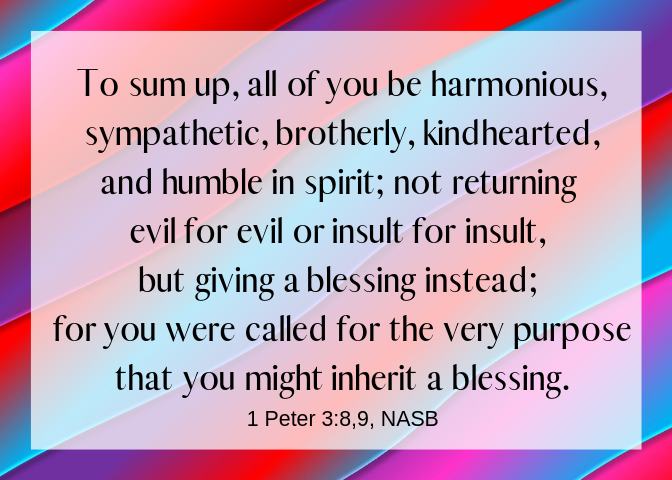
“Finally, all of you be like-minded, sympathetic,

showing mutual love, compassionate, humble,

not repaying evil for evil or insult for insult,

but on the contrary blessing others,

because for this reason you were called,

so that you could inherit a blessing.”

In Isaiah 65, God speaks of a future where He will create new heavens and a new earth, where the pain and sorrow of the former world will be forgotten. This promise is not only a vision of a restored creation but a source of deep joy for God’s people. Jerusalem, once marked by suffering and loss, will become a place of gladness, and its people will experience the fullness of God’s grace and redemption.

As we move into Isaiah 66, the prophet emphasizes the kind of people God looks to in this time of renewal: those who are humble, contrite in spirit, and who tremble at His word. This passage reminds us that God’s renewal is not just about external transformation but also about the transformation of the heart. God values a spirit that is humble and reverent before Him, acknowledging His greatness and responding in obedience to His word.

Psalm 114 recounts the mighty works of God during the Exodus, as He led Israel out of Egypt and through the Red Sea. The psalm paints a vivid picture of the earth trembling at God’s presence. The seas part, the mountains skip, and rocks turn into pools of water. This psalm highlights the awe-inspiring power of God over all creation, reminding us of His authority to transform not only nature but also our lives.

As the earth trembles at God’s presence, we are called to approach Him with reverence. Just as He turned the hard rock into flowing water, God can bring life and renewal to the hardest and most barren areas of our lives. In times of dryness or difficulty, we can trust in God’s power to transform our circumstances and bring about new life.

1 Peter 3 encourages believers to live in harmony with one another, showing compassion, humility, and love. Peter calls us to be sympathetic and humble, responding to evil and insult not with retaliation but with blessing. This instruction reflects the heart of Jesus’ teachings on loving our enemies and blessing those who persecute us (Matthew 5:44). As followers of Christ, we are called to embody a radical love that seeks peace and extends grace, even in the face of opposition.

Peter’s reminder that we are called to inherit a blessing is significant. As we bless others, we align ourselves with the heart of God, who has blessed us richly through Christ. Our identity as recipients of God’s mercy and grace empowers us to live in ways that reflect His love to the world.

This week, meditate on the renewal God promises in Isaiah, the power He displays in Psalm 114, and the call to humble, compassionate living in 1 Peter. Let these truths remind you of God’s ability to transform both your life and the world around you, as you seek to live in harmony with others and bless them in Christ’s name.

-Jeff Ransom

Reflection Questions:

How does the promise of a new heaven and new earth in Isaiah 65 inspire hope in your daily life, especially in the midst of challenges or sorrow?

What does it mean to you to have a “humble and contrite spirit” before God, as described in Isaiah 66? How can you cultivate this posture in your relationship with Him?

Reflect on the power of God over creation as seen in Psalm 114. How can you trust in His transforming power in areas of your life that feel difficult or barren?

In what ways can you embody the compassionate and humble living described in 1 Peter 3? How can you actively bless others, even when faced with opposition or insult?
A Hot Topic

1 Peter 3

Sunday, October 9, 2022

Gender is a hot topic these days. We live in a society where there is much flexibility in how someone chooses to live their life, irrespective of cultural norms or the directives of our creator (let’s stick to what Peter writes about in his letter). Misogyny and radical feminism are two ways in which humans have messed up what was designed to be a tremendous blessing from God.

There is a lot to unpack here as Peter begins by addressing wives. In reading the text and then looking at commentaries it appears that foremost in Peter’s mind is a woman who has come to a saving faith in Jesus but is married to a man who does not share that faith (though we can gain something from this even if we’re not in that demographic).

The way that societies functioned, specifically the society that Peter would be writing to, did not offer much in the way of opportunity for a woman to exert influence over her husband. Her options may be quite limited in what her husband allowed her to do or permitted her to go. Where a husband and father who came to faith would be expected (even simply allowed) to bring his family along with him to religious functions, the same could not be said for the wife.

So how is a woman to minister to her unbelieving husband? How does she influence him intentionally in a way to bring him into the body of Christ? Nagging is probably not the most effective way to do this, in fact it might have the opposite effect; rather, the solution that Peter proposes is to allow the gospel of Jesus (i.e., the gospel of the Kingdom) to radically influence your way of living. Being salt and light (Matthew 5:13-14) is not just something that you are to be for people whom you may be unfamiliar with, even more importantly it is something you are to be with those who you are most intimate with. Living a life that bears the fruit of the spirit (Galatians 5:22) and exemplifies Jesus’ beatitudes (Matthew 5:3-11; Luke 6:20-26) will make you a more desirable (and influential) person.

Obviously, there is no way to guarantee that an unbelieving spouse will come to faith, but by being holistically attractive (not just externally, but internally as well) you will have a far better chance to influence them than if you were to try to get by on physical attraction (I don’t even know how that would really work) but be ugly on the inside.  

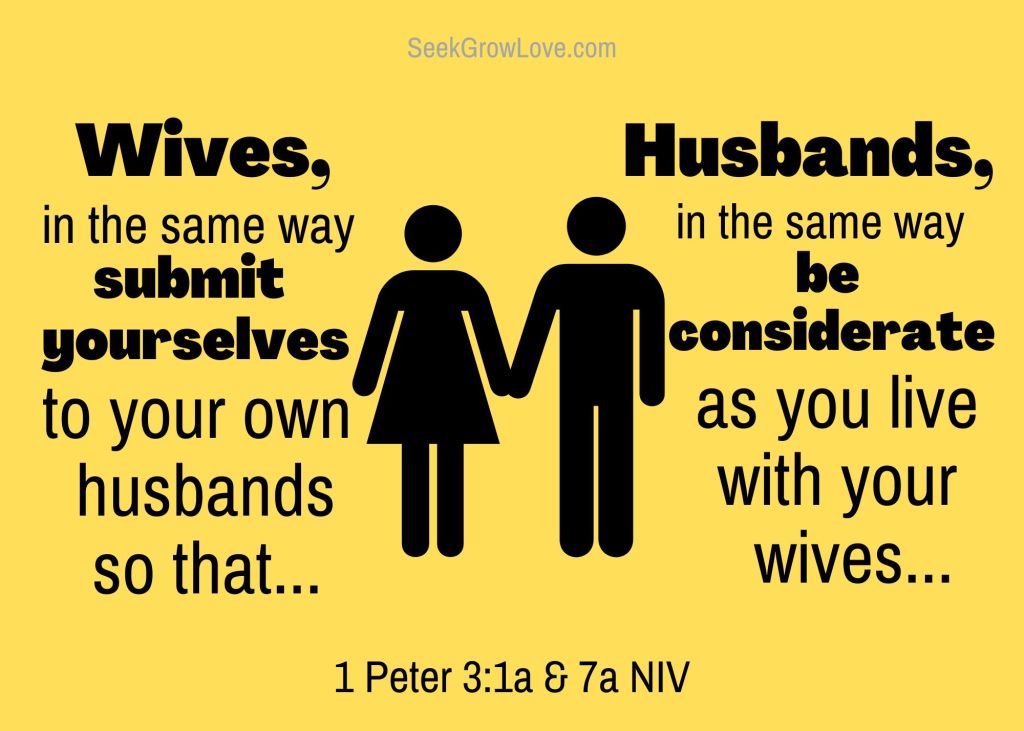
Peter addresses the ladies in verses 1-6, but he shifts gears in verse 7 and speaks to husbands. He says to “live with your wives in an understanding way” (ESV), literally living with her “according to knowledge” as opposed to living with her in “sheer thoughtlessness” as the Expositor’s Bible Commentary puts it. I can speak from experience, it is very easy to do what I want and expect my wife to pick up the slack, but that is not the way that Peter instructs husbands to operate. Instead of living in a way that could breed resentment and other problems (infidelity?), husbands are commanded to live in a thoughtful way.

Husbands are instructed to honor their wives as “the weaker vessel.” Huh? What does that mean? There are different ways to look at this… Societally women were weaker (we’ve already considered the lack of influence), typically women are weaker in physical strength (I can think of a few ladies that could probably wipe the floor with their husbands in a fight), and sometimes women are more emotionally fragile (have a wider range of feelings?) than men. The word for weaker (ἀσθενεστέρῳ) can be translated with lots of nuance, but one big take away from this is that women are not inferior to men. Whatever Peter is getting at with the idea of the wife being a weaker vessel, something is very clear: we are co-heirs of all the benefits that come with accepting Jesus and believing in the kingdom message. As objects of God’s salvation there is no distinction between male and female, just as there is no distinction between Jew or Greek. While husbands and wives may be called to different roles in their relationship and even in their roles in the church, this is not because of a lack of capability, this is the function that God has laid out. Husbands and wives are to minister to one another and to minister to others. We can use our marriages as an example and an opportunity in ministry. Authentic Christianity has done more to liberate women from misogyny and oppression than any other organization ever has; that being said, it has not changed the fact that men and women are different. We have equality in standing before God, we have equality in salvation, we ought to have equality in rights, but we are still different and that is a blessing. As the church is a body with many parts, the one flesh that we become in marriage takes into account our uniqueness as individuals and the differences in our physiology. We are to be reliant on one another (do not read as co-dependency), and we are responsible to one another to meet the needs that we have as image bearers of God and the uniqueness that we have as men and women.

-J.J. Fletcher

Action/Reflection:

To those of us who are married: We should evaluate where we are at in living as Peter instructs. Hopefully you are married to a fellow believer who you can discuss this passage with and commit to one another to implement these tactics in your union. If married to a non-believer, behave in a way that is intentional in living the gospel out to them.

To those of you who are engaged or hope to be married one day: Look for a spouse who takes scripture seriously and is willing to change their behavior to conform to what scripture dictates, both in their life as an individual and the way that they approach relationships.

For those of you who are called to a life of singleness (or just end up that way) or those of you who know someone who fits that description: I believe that the behaviors that the relational and internal things that Peter speaks of here will be beneficial in building authentic relationships that help navigate the potential challenges that a life of singleness may bring.

It’s All In The Attitude

I Peter 3

1 Peter 3 8 9

Aretha Franklin said it best in her hit song:   RESPECT – all she needed and wanted  was to be given a little bit of respect.   Are we not the same?  In I Peter 3 the apostle starts off by reminding the readers that they are to give respect and behave respectfully so that others will be won to Christ through their exemplary conduct.    What it all boils down to; summarizing his words is that;  in relationships mutual respect is key for both individuals, having the attitude of  honoring  the other person above themselves.  Imagine if everyone in our world today adopted this same kind of respectful attitude.  What a different world we would live in.

Have you ever seen someone who was dressed beautifully but then opened their mouth to display an ugly attitude?  Isn’t  it always disappointing to see?  In this chapter the apostle Peter reminds us that true beauty is found on the inside.  Our attitudes and  actions towards others speak louder than the clothing or jewelry we wear or the hairstyle we choose.  God desires for us to be beautiful on the inside and shine that outwardly.  In our world today we seem to be bombarded with the notion that beauty can be bought or acquired through purchasing – however true beauty is a quality that cannot be bought or sold.

Further on in verse 7 and 8 He points out that answers to prayer can be hindered by actions and attitudes of not being respectful toward one another.  We are not to be quarrelsome, we are to seek peace and pursue it.  This is the righteous expectation that believers are called to.  In verse 12 we are reminded that the eyes of the Lord are toward the righteous and his ears attend to their prayers.

We are to live righteous lives being sure of the hope we have in Christ.  In the final section of I Peter 3 the apostle Peter reminds the believers that they are to be sure of the hope they have.  This hope is believing  that Jesus is the only begotten son of God, that his death provides forgiveness and salvation from sin, and that his resurrection gives us the hope of eternal life.  Belief in these things and the outward symbol of baptism is the indicator of the believer’s new life with Christ.   With this new life in Christ, the believer is then called to live a life of righteousness that pleases God our Father.

-Merry Peterson