
OLD TESTAMENT: Daniel 4
POETRY: Psalm 136
NEW TESTAMENT: John 8:31-47
Daniel is a strange book. It contains narratives like we have been reading over the last couple days. It contains visions that we will read in a few days. Today, however, we are treated to a very different kind of tale. It seems that the author of Daniel decided to insert someone else’s writing into his book.
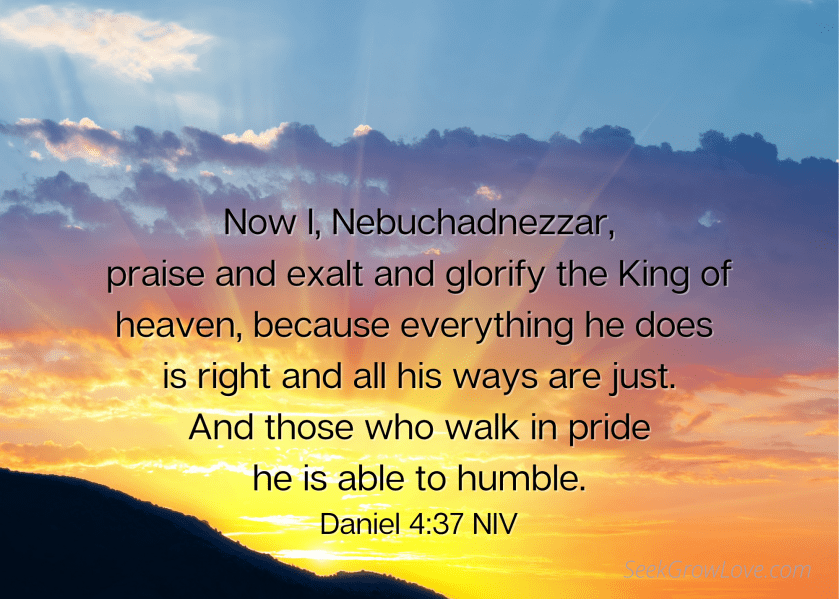
In chapter four, King Nebuchadnezzar himself writes about his encounter with the Almighty God. He extols God’s power, God’s virtue, his work through the interpretation of Daniel/Belteshazzar, his giving Nebuchadnezzar madness, and him undoing the madness after Nebuchadnezzar had learned his lesson.
Now, if you are a regular reader of the Bible, you might think this makes perfect sense. God shows up and changes the lives of people, and it happens to King Nebuchadnezzar. If you are a new reader, you may think, “this is crazy nonsense who can believe it?” I am about to make both camps a little uncomfortable with some history and archaeology: In ancient Babylon, there is a prayer written by a king that reads this way : I “was afflicted [with an evil ulcer] for seven years, and far from [men] I [was driven, until I prayed to the most high God.] And an exorcist pardoned my sins. He was a Jew from [among the children of the exile of Judah, and said:] “Recount this in writing to glorify and exalt the name of [the most high God.”Then I wrote this:] “When I was afflicted for seven years [by the most high God] with an evil ulcer during my stay at Tayma, I prayed [to] the gods of silver and gold, [bronze and iron,] wood, stone and lime, because [I thought and considered] them gods […]”
That last ellipses (the “…”) shows that the rest of the prayer is lost. So nice and easy, case closed right? That sounds very similar to Nebuchadnezzar’s experience, so we have confirmation of the biblical story. It might be, if we hadn’t left off the first few lines. “Words of the prayer, said by Nabonidus, king of Babylonia, [the great] king, [when afflicted] with an ulcer on command of the most high God in Tayma: [“I, Nabonidus,] was afflicted…”
The similarities are striking, of course: afflicted for seven years/times, driven far from people, a Jew from the children of Judah, an exorcist, pardoned his sins and told him to praise the Most High God. But the differences are also clearly apparent: Nabonidus vs. Nebuchadnezzar, an ulcer vs. mental illness, warned of judgement as opposed healed to give glory, and the words of Nabonidus about the types of God are connected to Daniel 5, so bringing in Belshazzar and more questions.
The Bible, the history of the Bible, and the relationship between the Bible and history are not *simple* questions. There are those who would deny the Bible’s truth based on the prayer of Nabonidus, but there is also reason to believe that the prayer of Nabonidus was written to explain the connection between Daniel 4 and Daniel 5, or maybe both are true accounts with God judging multiple kings of Babylon with seven years/times of judgement. The same kind of questions come up when we think about the anointing of Jesus with oil. Everyone agrees it was an extravagant act of love with costly oil. But was it in Bethany or not? Was it Mary, or a sinful woman? Was the woman being shown love by being forgiven, or was she anointing the body for burial? Did it only happen once, or were there two anointings of Jesus? (It would be weird for it to happen twice.)
This is the part of the devotion where you may expect me to clear up the confusion and say “here is the answer to all your questions.” I am not going to do that. I am going to instead give you four helpful ways to think about the Bible. The Bible is inspired, authoritative, true, and livable.
- The Bible is inspired: Daniel 4 and the anointing(s) of Jesus and everything from Genesis to Revelation is inspired by God for the education, edification, encouragement, and empowerment of his people. The Bible is not just the nice thoughts of noble men and women, but God’s thoughts for God’s people.
- The Bible is authoritative: Because the Bible is God’s word to humans, when the Bible tells God’s people how to live, then that is how we must live. If we are called to pick up our cross daily, if we are called to feed the hungry and clothe the naked, if we are called to live like Jesus (and we are!), then that is what we must do!
- The Bible is true: Because the Bible is God’s word to humans, then the Bible is not intending to deceive. Everything in the Bible is intending to lead us to the God of truth. Not everything will be literal (trees don’t have hands, a multiheaded monster won’t come out of the Atlantic) but everything will be true (nature will praise God, there are evil forces that work against God’s goodness). When we understand genre of books and individual stories, we will be able to know whether a story is literally true or figuratively true.
- The Bible is understandable in order to be livable: The Bible TAKES time to understand, and it is deep. Yet, in the essential elements, the Bible is simple. The Bible is like a holiday at sea; children can begin by playing in the shallows, but experienced swimmers can go to depth where their feet do not touch the ground. You can be a new Christian and gain insight, knowledge, and joy from scripture. And when you are ready to go deeper into the Bible, into faith, there is always greater depth to be discovered.
The author of Daniel 4 was inspired to write about the dream of Nebuchadnezzar and the judgment he faced as the King. It could be true even if the name “Nebuchadnezzar” is used in place of Nabonidus; but I think it makes more sense to see the Prayer of Nabonidus as responding to the book of Daniel rather than vice versa. BUT, the bigger point than these minor historical notes is that we are called to be humble and praise God for his just and righteous ways. There is no need for us to get archeological degrees and engage in fancy philosophy to recognize that God is bigger than we are, and that we are called to praise and worship him.
May we all do that together today.
Questions:
- Would you describe the Bible as inspired, authoritative, true, and livable? Do you disagree with any or would you add in any? For example, you might say “the Bible is literally true”, but what do you do with the psalms? You might say “the Bible is simple”, but then what do we do about Revelation and Daniel?
- Do you find yourself drawn to disregard the Bible as superstition when archeology or science sounds like they disagree with the Bible? Or do you disregard archeology and science when it sounds like they disagree with the Bible? How can we see that God is the God of all truth, and that truth has nothing to fear?
- If you find yourself having a hard time trusting the Bible, or explaining why you trust it, I would encourage you to check out *The Disciple Collective* at https://www.disciplecollective.com/home. This online Christian learning platform offers high-quality self-paced courses for motivated students, and the first course, which is available now, is “Can I trust the Bible?” If you feel like you are leaving today’s devotion with some serious questions, that course may give you some serious, robust answers.
-Jake Ballard
 Seek Grow Love