
Old Testament: 1 Chronicles 15 & 16
Poetry: Ecclesiastes 8
New Testament: Philippians 4:10-23
Solomon begins by asking “Who is like the wise man?” in a rhetorical fashion to get the reader to consider if they are like the wise man in the verses that follow where Solomon will set forth several scenarios involving a king (who represents any authority figure) and how certain responses are appropriate or not. The phrase “makes his face shine…hardness of his face is changed” refers to how using wisdom can change the way someone is presenting themselves to their superiors. One’s demeanor and conduct, if done with wisdom, can sway the other person’s opinion of them and earn them their favor.
Verse 3 is probably better as expressing the wisdom in leaving the king’s presence and carrying out his command rather than the instruction to remain since the following phrase instructs the reader to not “persist in an evil thing” by objecting to the king’s command and remaining in his presence to argue and oppose him.
An “evil thing” is likely a reference to a “bad idea” or a proposal that is not favorably received by the king. On the basis of the king’s authority as absolute, anything that interferes with or opposes his will automatically becomes “evil.” However, this is not moral evil, it is just Solomon’s way of describing something that causes trouble (the Hebrew word for “evil” also can mean “trouble”).
Wisdom would say for a person to respect those in authority and not push their agenda or object rudely to their directions. Why is that? Well, Solomon says that “the king’s word is authoritative.” Now, Solomon has in mind a monarchical government where the ruler (i.e., the king) is a totalitarian. This was the common form of government in the ancient world. But in our world, we could think of someone who has a superior rank (e.g., our teachers, boss, or civil leader).
“Whoever keeps the commandment” refers to the person who listens and obeys the king. This person will be safe, and no harm will come to them. Punishment does not fall on the one who does what they are told. Rather, the consequences are reserved for the one who rebels and disobeys.
But if there is a disagreement with the king, Solomon notes that there is “a proper time and procedure,” meaning that there is an appropriate way to provide feedback and one’s opinion for the king’s consideration. The wording here is extremely close to the wording we saw in 3:1—“For everything there is a season, and a time for every matter under heaven.”
Verse 10 begins a new section in Solomon’s discourse in the chapter. The issue that Solomon raises is about justice and retribution. He sets forth a scenario where he sees wicked people live and then die, and he watches them get buried. He even describes them as previously participating in the temple worship of Yahweh, and they received the praise of people in the city where they carried out their wicked schemes.
Here in this section, the pointlessness that Solomon is interested in expressing is about the delay judgment of these wicked people. He asserts that they were never judged while they were alive, and so it seems as though they never were punished, and the victims never received justice for their crimes.
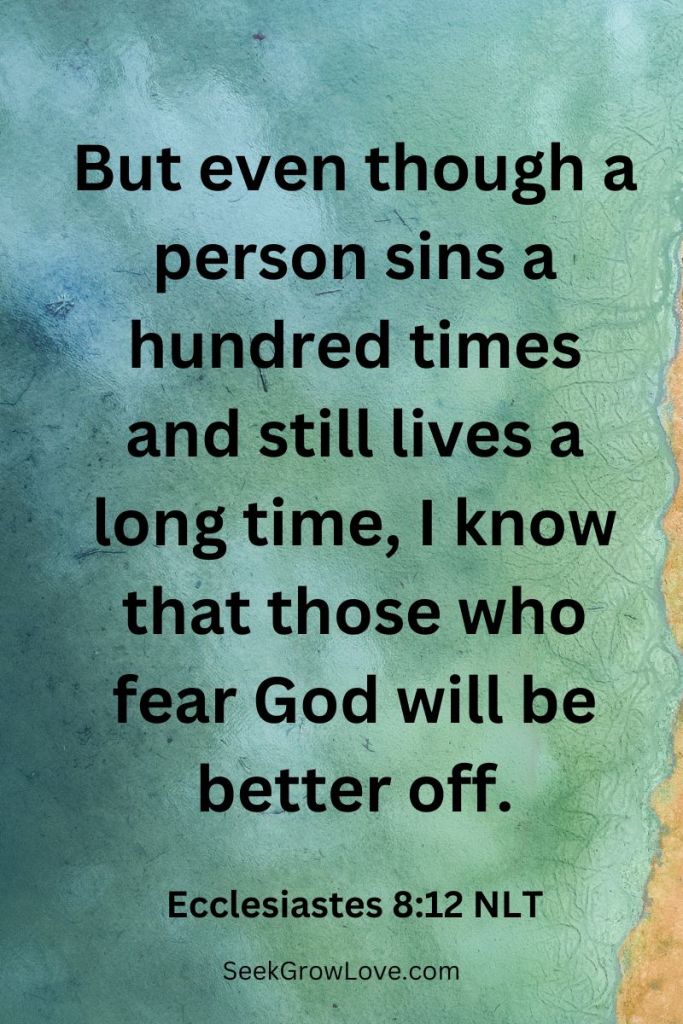
vv. 12-13—this is the first assertion that Solomon makes that departs from his methodology of observation. It is outside the scope of inquiry to know that it will be “better” for the person who fears Yahweh and is reverent before him, since all of his observations point toward an experiential indifference between the righteous and the wicked. In fact, he even notes an inversion that he sees in the world where the wicked live long and the righteous die young.
Solomon is expressing a distinction between what he “knows” and what he “observes.” What he “sees” happening is vastly different from what he internally “knows.” And so, we begin to see the dilemma that Solomon is facing in his quest. But he doesn’t resolve the tension here. He merely presents it.
Solomon expressed a similar idea in 3:16-17, where he said, “16And moreover I saw this under the sun: in the place of justice, that wickedness was there, and in the place of righteousness, that wickedness was there. 17I said in my heart, “God will judge the righteous person and the wicked person, for there is a time of judgment for every purpose and for every deed.”
The judgment of God was not something that Solomon observed. In fact, what he saw was a complete absence of justice “under the sun.” And thus, the issue of delayed justice is brought back up again in verse 14: the righteous are punished and the wicked go free.
Since the judgment of the wicked is not happening in the present world, but Solomon “knows” that it will occur, his advice is to not focus on it, but to enjoy life despite the brokenness and the injustice happening all around. The “joy” that Solomon says is to accompany one’s work and the eating and drinking the fruit of that work has been a theme already mentioned twice before in 2:24 and 5:18.
In certain circumstances in life, we often make a deductive choice on what would be at least a good way to respond. For Solomon, his deduction is at least, “enjoy life,” by eating, drinking, and being merry. This is at least a good response for humankind with the work that God has given them to do.
The exhaustive effort that Solomon has applied to his search has caused him to lose sleep. The lack of any satisfying answer has left him disturbed and unable to find rest. All day and all night, his mind is busy, preoccupied with the question that he feels he must answer. But because he cannot solve it and discover the ultimate meaning of life, he resorted to a simplified suggestion as a baseline of what he knows—it is good to enjoy life as one labors all the days that God has given to them.
Solomon offers verse 17 as a summary of his effort and makes a grand claim that he has observed it all—all the work of God—and his conclusion is that no one can find it out. No matter how thorough Solomon has been or could be in his investigation, his methods fail; he cannot discover the answer to the ultimate meaning of life. And if a wise person thinks that he can figure it out, he’s wrong, Solomon says—He can’t, because no one can.
-Jerry Wierwille
Reflection Questions
- Can you give some examples of when what you “see” is different than what you “know”?
- What is your approach to people in authority? Is there anything you can learn from Solomon in this chapter regarding your interactions with people in authority?
- What are the benefits to being a wise person? What are the limitations to human wisdom?
 Seek Grow Love