
Old Testament: 1 Chronicles 17 & 18
Poetry: Ecclesiastes 9
New Testament: Colossians 1:1-14
One of life’s great paradoxes is that it is predictably unpredictable. Life never seems to go the way we think. Solomon reflects on the inevitability of mortality where death is the great equalizer, the advantage of being alive, and encourages the reader to relish and enjoy life on the way to death, because that is what awaits everyone in the end.
There is a common “fate” that awaits every person: death. And regardless of a person’s righteousness or wickedness, the same end is waiting for them. Solomon says, “people do not know whether it is love or hatred; everything is ahead of them.” “Love or hatred” refers to divine favor or judgment. No one knows what their work will produce because it lies in the future. According to Solomon’s method of investigation, no one can say whether they will receive “love” or “hatred” in the future.
Solomon describes the common denominator of life—death—as an “evil” that is done under the sun. No one can predict when it will happen, and no one can escape it. There is “one event” that happens to all. After death, a person has no further reward or enjoyment of things done under the sun.
But for those who have not joined the ranks of the dead, Solomon says “there is still hope!” There is “hope” that while being alive a person can acknowledge the reality of death and thereby embrace the joys in life that they can, because no possibility exists for the dead as their life has ended and there is no going back.
In Solomon’s perspective, life is better than death. Period! Even a measly, no good dog (the ancient world did not have a high view of dogs) is better than a dead lion (viewed as one of the strongest and greatest of all animals in the ancient world). He brings the “hope” of the living into plain view by bluntly stating the obvious, “the living know they will die, but the dead do not know anything.”
Solomon’s point is for the reader to embrace life and all its blessings and joys. We only have a certain amount of time to do this, and then it is over, and we can’t have more. When a person dies “their hatred, and their envy” all perish with them. And so, while we are living, Solomon advises that we pursue life to the fullest and to engage in every activity with all that we are. Soon enough, we won’t be able to. So live it up, Solomon says, “Let your garments be always white, and do not let oil be lacking from your head. Enjoy life with the wife whom you have loved.” He is using very festive language here about wearing white garments and applying oil on one’s head.
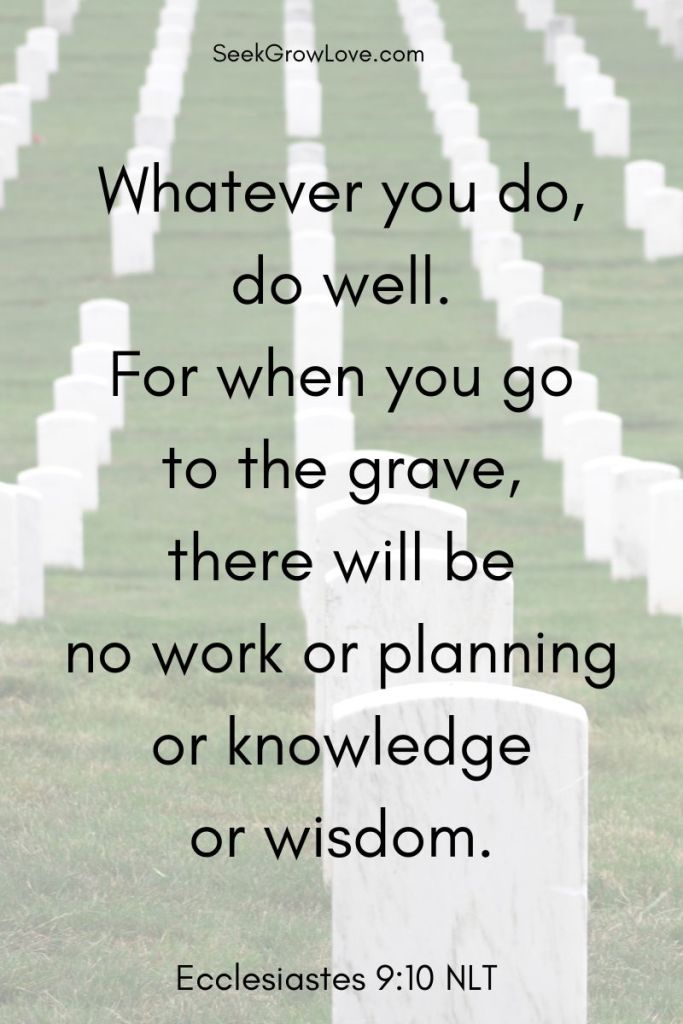
But it is important to note that as part of the life that Solomon suggests one should live, he includes dedicating the time to work hard. That is part of the fullness of life, and the food and drink from one’s labor is part of the essential joys one can partake of in life.
Solomon turns to address the uncertainty of life as something perplexing and which he finds unsatisfying. Everything he lists seems to be disordered. The race should be won by the fastest racer, the battle should be won by the strongest soldier, wise people should have food to eat, foolish people shouldn’t have money, people who are skilled should be preferred (i.e., have favor), etc. But Solomon identifies that “time and chance happen to them all.” The point is misfortune and disaster are not selective about who they happen to fall on any given day. Everyone is susceptible to the chance of bad things happening to them. To prove his point, Solomon draws upon two negative images—fish in a net and birds in a snare—to illustrate the horror of the human condition where people find themselves encountering adversity when they least expect it.
In the final section of the chapter, Solomon tells a parable of a small city that is saved by the wisdom of a poor man, but in time, the poor man was forgotten about. So, Solomon affirms traditional wisdom that says, “Wisdom is better than strength.” But people did not recognize the poor man’s wisdom as such and soon forgot about it and him.
While traditional wisdom says that “wisdom is better than strength,” Solomon’s observations seem to complicate that conclusion because things are not always that way in reality. According to the narrative in his parable, it only takes one sinner to destroy (i.e., neglect) what wisdom says. And so, Solomon is asserting that as powerful and valuable as wisdom is, it has its limits. It is certainly preferrable to foolishness, but it is not immune to the destructive effects of a little foolishness. A small bit of foolishness can spoil the greatness of wisdom. This then begs the question, “What real value is wisdom if it can be overthrown so easily by a single fool?”
-Jerry Wierwille
Reflection Questions
- How has the unpredictability of life ever caught you by surprise?
- What do you enjoy about life? How do you embrace it? Does this include your labor?
- Can you give an example of when or how, “A small bit of foolishness can spoil the greatness of wisdom”?

 Seek Grow Love