
His Name Forever

Exodus 1-3

After Moses fled Egypt and saved the Midianite women from the jerks at the well he settled down and had children and lived a simple life as a farmer/shepherd.  Meanwhile the rest of the Israelites were groaning in their captivity in Egypt and their cry rose up to God and he took pity on them (Exodus 2:23-25).  God was then ready to call up Moses out of the wilderness so that he can carry out God’s plan.

Exodus 3:10-15

10 So now, go. I am sending you to Pharaoh to bring my people the Israelites out of Egypt.”

11 But Moses said to God, “Who am I that I should go to Pharaoh and bring the Israelites out of Egypt?”

12 And God said, “I will be with you. And this will be the sign to you that it is I who have sent you: When you have brought the people out of Egypt, you will worship God on this mountain.”

13 Moses said to God, “Suppose I go to the Israelites and say to them, ‘The God of your fathers has sent me to you,’ and they ask me, ‘What is his name?’ Then what shall I tell them?”

14 God said to Moses, “I am who I am. This is what you are to say to the Israelites: ‘I am has sent me to you.’”

15 God also said to Moses, “Say to the Israelites, ‘The Lord, the God of your fathers—the God of Abraham, the God of Isaac and the God of Jacob—has sent me to you.’

“This is my name forever,

   the name you shall call me

   from generation to generation.”

It is very interesting that Moses had to ask God about his name.  In the eyes of the Israelites God had abandoned them when they were enslaved in Egypt, and they had mostly wandered away from God since then and had taken on the gods of the Egyptians.  It was the mindset of the Israelites that God had forsaken his promises to Abraham, Isaac and Jacob and Moses was basically asking if God was wanting to start over in his relationship with the Israelites and form new covenants.  God emphatically states that he is to be known to his people as the God of Abraham, the God of Isaac, and the God of Jacob, to remind them that those promises still stand, and will stand for eternity. It is helpful to remember God in terms of what he has done for you or your loved ones, which is why God instructs the people to remember him as the God of Abraham so they will remember the stories that have been passed down of God’s faithfulness to their ancestors.

We need to be reminded of the fact that God does not change his mind like we do.  God does not forget a promise. Just because things have changed in our lives and we are having doubts doesn’t mean that God is no longer the one who created the foundations of the earth.  If we have sinned, or walked away from God for a time, or had a traumatic event in our lives it doesn’t change the fact that God IS, and that the blood of His Son Jesus can still cover our sins.

-Chris Mattison

(Originally posted for SeekGrowLove on Oct 3, 2018)

Reflection Questions

  1. What do we learn about Moses in the first 3 chapters of Exodus?
  2. How did the first 40 years of his life, spent in Egypt in the Pharaoh’s house, help prepare him for the job God selected him to do when he was 80? How did his years in Midian help prepare him? What talents, characteristics, knowledge, wisdom, connections, experiences, failures and accomplishments are in your past and present that could be useful for a future task God is preparing you for?
  3. What examples of God’s faithfulness would you do well to remember and pass on to the next generation so they can remember, too?
  4. What does it mean to you that God wants to be known by this same name forever? What does it tell us about God? What does it tell us about the past, present and future?
God’s Deliverance Begins – Again

Exodus 1-3

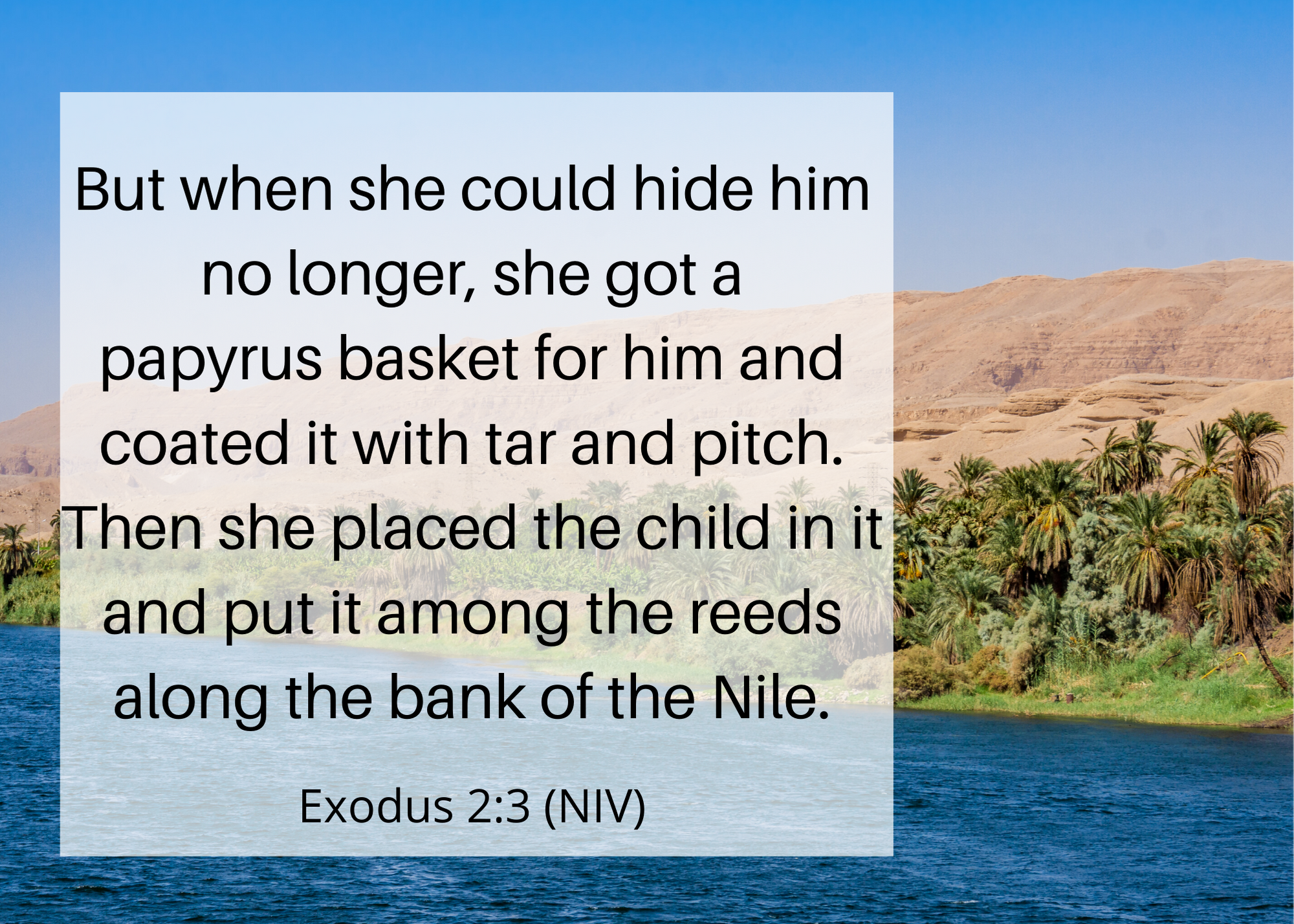
Exodus 2 3 NIV

I had fun with today’s reading; I laughed out loud numerous times. I’m going to try to recreate some of the internal dialogue that was playing out in my head as I read it. Enjoy.


“We need to be shrewd with these Israelites. What should we do? I have a brilliant idea! Let’s enslave them.” – The new Pharaoh, probably.

Shrewd: having or showing sharp powers of judgment; astute.

I’m not sure the new king really knows what shrewd means. I suppose he was astute in his observation that the Israelites are more powerful than he, yet he is not displaying great judgement in putting shackles on the people who got to their current position thanks to a very shrewd man named Joseph. As Egypt will soon find out, God is great at providing the Israelites with shrewd men who are capable of delivering them at just the right time.


“Murder all the baby boys. Do it for king and country, why else? What’s that? It’s immoral to kill babies? Why would you possibly think that?” – Also the new Pharaoh, probably.

The midwives are smart enough to lie to the king and tell him that they aren’t responsible for the lives of these children (as if a person could be considered “responsible” for someone else continuing to live). They claim that the women giving birth are just so skilled at it that they do not need the assistance of a midwife. That is quite a longshot. When is the last time you heard of someone giving birth to a child without the assistance of a professional? Yet the king is dull enough to buy it. He sincerely believes that these women have no concept of morality other than to obey the edicts of their government. The midwives feared God over their government and followed the commands of morality and God instead of the king.


The mother of Moses saves him because she thinks he is beautiful. When is the last time a mother did not think their baby was beautiful? Every mother in this time must have been like her, attempting to hide their baby boys after seeing how beautiful they were. After all, the king made it the family’s duty to kill their own children. Moses’ mother was shrewd. She put him in a basket and set him out in the Nile, intending for him to survive. This sounds insane knowing what lurks in the Nile. She created the basket so that he would be protected, it was waterproofed with pitch. She placed it among the reeds so that it wouldn’t wash away. Finally, she had Miriam, Moses’ sister watch over the basket from a distance. His mother was certainly crafty. I believe she knew exactly what would happen next, otherwise she would not have done it. When Moses is found, his own mother is hired to raise him. That is the work of divine providence and the craftiness of Moses’ mother.


As a side note, the midrash states that Miriam had a significant role in leading Israel alongside Moses and Aaron after the Exodus. https://jwa.org/encyclopedia/article/miriam-midrash-and-aggadah


The bloodlust of Levi comes out in Moses when he kills the Egyptian.


The burning bush seems unique at this point in the story. In the past, God had interacted with people by sending messengers. Abraham speaks with God before the destruction of Sodom and Gomorrah. Jacob wrestles with God. Now we have Moses talking to God in a bush. It is a little different but this begins to be the pattern from here on out. We soon get the pillar of fire and cloud (which appears over the tent whenever Moses speaks with God), and the mountain covered in cloud when Moses receives the law. Later God identifies himself in a new way. He gives himself a name “I AM WHO I AM” or “I AM THAT I AM” which is the translation of the Hebrew YHWH. Up until this point, He has always identified Himself as “The God of your fathers, Abraham, Isaac and Jacob.” This encounter seems to be a turning point in the human story. From now on, a large group of people is going to interact with God in a personal way, they will address Him by name and they will be in close contact with Him.


Nathaniel Johnson


Today’s Bible reading can be read or listened to at https://www.biblegateway.com/passage/?search=Exodus+1-3&version=NIV


Tomorrow’s reading will be Exodus 4-6 as we continue the 2020 Chronological Bible Reading Plan