
Old Testament: Ezekiel 27 & 28
Poetry: Psalm 102
New Testament: Revelation 17
Revelation 17 begins a section about “the great harlot,” or Babylon the great (17:1) which finishes in chapter 18. One of the seven angels from the seven bowls introduces the topic, and later John is shown the bride of Christ, meaning the new Jerusalem (21:9‑10, perhaps by the same angel). So, in these chapters John sees two cities portrayed as women, one a pure bride partnered with Christ, and the other an immoral prostitute partnered with the antichrist. God is making the sides in the conflict clear and wants us to be clear about our choice.
Babylon’s fall had been announced in 14:8 and 16:19 – from those verses alone we know that it made nations drunk on the wine of its immorality and was given the wine of God’s wrath to drink. Revelation is picking up from Old Testament texts about Babylon with a somewhat different feel, there Babylon brought punishment on countries for God in war. Babylon was described as itself being the cup of God’s wrath which those nations drank from, maddening them. But after its work was done God turned against Babylon, and the city was also defeated (Jeremiah 25:15ff; 51:7, 11). With Revelation Babylon the great’s immorality is key, and it brings destruction to others by association; it is then destroyed for what it did to God’s servants, and the destruction comes at the hands of its allies.
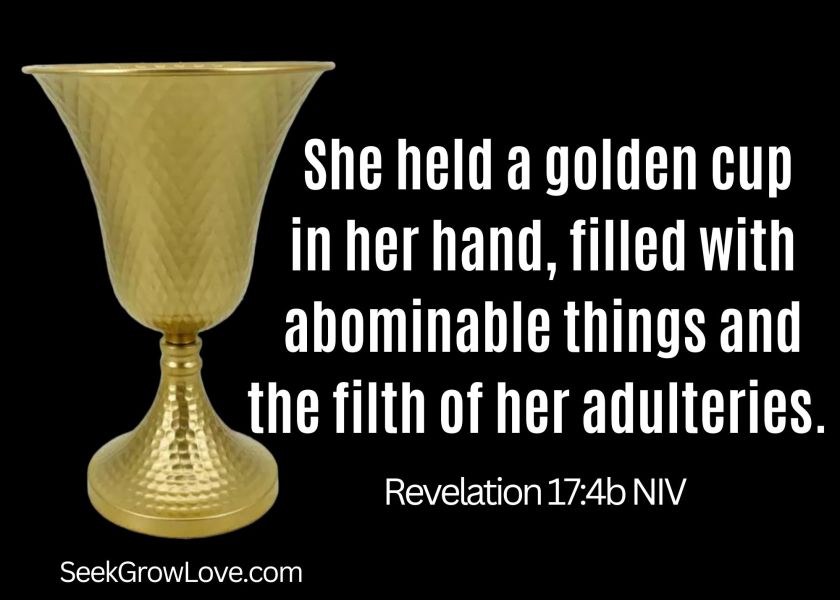
The vision shows Babylon as a wealthy, richly dressed prostitute, drunk on the blood of God’s servants and offering her immorality from a valuable cup. She is sitting on “a scarlet beast, full of blasphemous names, having seven heads and ten horns,” which is a simple depiction of the Beast from Revelation 13:1. We may be meant to see Babylon as trying to use the Beast, in riding on it, but the Beast uses Babylon, gaining influence from it. In 17:18 we are told that Babylon is the “great city” that reigns (or “has a kingdom”) over the kings of the earth. The identity of the city remains in dispute, but like so much about Revelation it should become much clearer later. The city is presented like an imperial capital, though some authors want to treat it as a culturally unifying site important for its influence in other ways.
People often question how ‘literally’ to take things in scripture, particularly if they don’t see how events favor a near-term fulfillment. The reestablishment of Israel in 1948, for example, was highly significant for earlier generations in the Church of God but many other groups doubted it would ever take place. As another example, when the two witnesses die their bodies are seen by “the peoples and tribes and tongues and nations” and “those who dwell on the earth rejoice over them” (11:9, 10). In 1962 the communications satellite Telestar I launched, and it was hailed as allowing live broadcasts to be relayed around the world. A few years earlier people would have thought in terms of the witnesses’ photos being published in newspapers. And technology keeps advancing, along with the speed at which changes increase. The iPhone was introduced in 2007, and it is thought that already over two‑thirds of the world’s population has a smartphone – a much simpler way for ‘everyone’ to be shown events happening anywhere in the world. I’ve begun to wonder if the fact that those devices permit use of translation services, which at least partially undo God’s choice to confuse the languages at Babel/Babylon (the name through Hebrew and Greek) could end up relevant to the fact of Babylon the great being the name given for the city, and an aspect of its influence. What is a global false religion without the ability to communicate globally, after all? It’s just a thought.
I find it disturbing to think that the corruption pictured in Revelation 17 with Babylon the great could come to pass through human failings. But I think that may be part of what God wanted us to recognize, that even before any supernatural power got involved the situation was awful. And that could be why the end of the age comes when it does, because things reach the point that it is time for change.
Lord, I do not feel endangered today, where I am, but I know you have servants who face risks in many countries around the world today. Please strengthen the hearts of your people, and protect them. They are faithful, help them to remain faithful. Let them trust you and stand firm. Keep them from the evil one, and sanctify them in the truth. And Lord, as I do not feel endangered, let me be bold for you. Let me not forget what your son has done for me. In his name I pray this, Amen.
-Daniel Smead
Reflection Questions
- Do you ever struggle over whether a scripture ought to be seen as literal or figurative? What helps you to make up your mind about that?
- Is there a Christian or a ministry that you regularly pray on behalf of? If so, consider writing them a note today to share your appreciation for them. If not, consider saying a prayer today for someone whose ministry matters to you who you haven’t seen in a while.
 Seek Grow Love