Sowing and Reaping

OLD TESTAMENT: Ezekiel 27-28

*POETRY: Psalm 126

NEW TESTAMENT: John 2:12-25

          As a child one song I enjoyed singing in church was called Bringing In The Sheaves.

1 Sowing in the morning, sowing seeds of kindness,

Sowing in the noontide and the dewy eve;

Waiting for the harvest, and the time of reaping,

We shall come rejoicing, bringing in the sheaves.

Refrain:

Bringing in the sheaves,

Bringing in the sheaves,

We shall come rejoicing, bringing in the sheaves;

Bringing in the sheaves,

Bringing in the sheaves,

We shall come rejoicing, bringing in the sheaves.

2 Sowing in the sunshine, sowing in the shadows,

Fearing neither clouds nor winter’s chilling breeze;

By and by the harvest, and the labor ended,

We shall come rejoicing, bringing in the sheaves. [Refrain]

3 Going forth with weeping, sowing for the Master,

Though the loss sustained our spirit often grieves;

When our weeping’s over, He will bid us welcome,

We shall come rejoicing, bringing in the sheaves. [Refrain]

As a little child I really had no Idea what the song meant.  What were sheaves?  Why did people go out sowing with weeping.  What made them so sad? Why were people rejoicing while bringing them in?

Fortunately, Psalm 126 answers a lot of those questions.

Psalm 126

A song of ascents.

When the Lord restored the fortunes of Zion,
    we were like those who dreamed.
Our mouths were filled with laughter,
    our tongues with songs of joy.
Then it was said among the nations,
    “The Lord has done great things for them.”
The Lord has done great things for us,
    and we are filled with joy.

Restore our fortunes Lord,
    like streams in the Negev.
Those who sow with tears
    will reap with songs of joy.
Those who go out weeping,
    carrying seed to sow,
will return with songs of joy,
    carrying sheaves with them.


The first half of the Psalm is a Song of Rejoicing.  It likely refers to the time when Israel returned from their time in Exile.  King Cyrus of Persia released the exiles in Israel and allowed them to return to Israel where they could live in freedom and rebuild the city of Jerusalem and the Temple.  It was a time of rejoicing.  It was a time of rejoicing, laughter, songs of joy.  The surrounding nations could see how God did great things for them.  Sadly over time Israel faced a whole new set of trials.  So God’s people pray that once again God would step in and bless his people and restore their fortunes.

There was a time of drought that led to famine.  The people were sad from their misfortune so they went out in faith with bags of seed to plant.  It was an act of faith that God would supply abundant rain so that their seed would grow and be harvested so that they would carry back bundles… sheaves or grain.  There would be laughter and shouts of joy in happy gratitude for God’s blessings.

Today, we go through times of great rejoicing at the blessings.  November is a special time of celebrating God’s abundant blessings and rejoicing in God’s gifts.  It can also be a time when we go through pain and loss.  There’s a passage in Job that says “The Lord gives and the Lord takes away, blessed be the name of the Lord.” (Job 1:21)  Some times we go out weeping and, in hope plant seeds believing that God will give blessings.

Is today a day that you are going out weeping with seeds to sow, or is today a day that you come back rejoicing  at what God has provided, carrying those seeds of blessing? 

Trust that God will give blessings if we faithfully sow, even with tears.

Pastor Jeff Fletcher

Reflection Questions

  1. Is today a day that you are going out weeping with seeds to sow, or is today a day that you come back rejoicing  at what God has provided, carrying those seeds of blessing? 
  2. What seasons of sowing in tears have you had? What seasons of rejoicing in reaping have you had? Where have you seen God’s faithfulness?

The Answer

Old Testament: Numbers 25 & 26

Poetry: Job 19

New Testament: Mark 4:26-41

A teacher poses a challenging question in his class.  Most students begin to ponder, some begin to turn and whisper, some cross their fingers and hope they are not asked to contribute.  Not a single hand goes in the air.  The teacher repeats the question; this time, he says it in a different way.  It doesn’t help.  Thoughts become more frantic.  Anxiety increases.  Some students begin to avoid eye contact.  At the moment that it seems that the teacher will start combing the class for a response, a lone hand ascends into the air.  It is that kid who knows everything. Thank you, that kid who knows everything! The teacher calls on her, and you are saved from having to answer the question.  All’s right with the world; you now can rest easy.

I have seen this scenario played out many times as both a student and a teacher.   No matter how difficult the question, it seems there is always one person in our lives who is prepared to answer it.  Whether it is at school, in your family, your circles of friends, or your work, there is always that one person (who very well may be you) that you turn to that has the experience, knowledge, or wisdom it takes to figure out life’s most difficult questions.

A passage in today’s text is like “that kid who knows everything.”  It  is the all-encompassing answer that holds God’s key and fundamental truth in which we can fix our hope. It stops us from over-thinking, stifles our anxiety, and helps us to take on, not avoid challenging situations, like:

  • When you are having trouble making sense of the world around you
  • When you feel like your prayers are not being answered
  • When you seek  “the reason” THIS is happening to YOU
  • When you lose someone or something you dearly love
  • When justice cannot be found
  • When we lose our health or happiness
  • When we face many other examples from Job 19:7-20

This is Job’s answer and ours:

Job 19:25-27 – “I know that my redeemer lives, and that in the end he will stand on the earth. And after my skin has been destroyed, yet in my flesh I will see God; I myself will see him  with my own eyes—I, and not another. How my heart yearns within me!”


It is not resignation.  It is not a cop-out.  It does not mean you stop seeking, studying, or pursuing.  It is the assurance and peace which you can rest in and be guided in while you are waiting.

-Aaron Winner

(Originally posted December 18, 2016)

Reflection Questions

  1. What are some of the hard questions Job was wrestling with? What hard questions do you have?
  2. What was Job’s “that kid who knows everything” answer in Job 19? What is the definition of redeemer? Do you have one – who lives? How do you know?
  3. What is your hope for the future? How does this give you peace today?

God Cares

Exodus 3

February 9

Two powerful themes stand out to me in this third chapter of Exodus. One is the holiness of God and the second is God’s continued compassion for His people.

5 “Do not come any closer,” God said. “Take off your sandals, for the place where you are standing is holy ground.” 6 Then he said, “I am the God of your father, the God of Abraham, the God of Isaac and the God of Jacob.” At this, Moses hid his face, because he was afraid to look at God.

This scripture always strikes me as an extremely important reminder of the holiness of God and the importance of recognizing it and considering if our actions adequately reflect that recognition. Are our hearts and minds in the right place when we go before God in prayer or worship?

The second theme of God’s continued compassion for His people jumps out at me in verse 7:

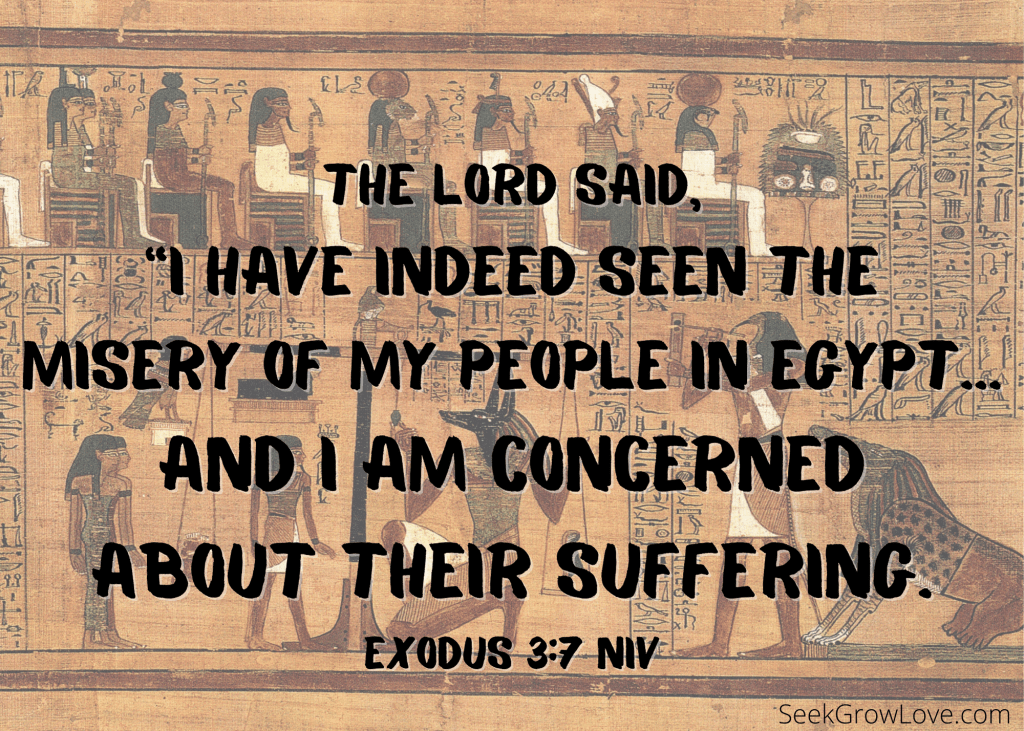
7 The Lord said, “I have indeed seen the misery of my people in Egypt. I have heard them crying out because of their slave drivers, and I am concerned about their suffering.” 

God chooses to hear our cries and to care about our suffering. I have been through a very difficult season the past few years that has been punctuated by many great losses. For this reason, reading those words in verse 7 takes on a whole new meaning. There is power in being reminded that He is listening and that He cares so very deeply.

Not only does He care about our suffering, but He also understands our insecurities and the challenges they can present for us.

11 But Moses said to God, “Who am I that I should go to Pharaoh and bring the Israelites out of Egypt?”

12 And God said, “I will be with you. And this will be the sign to you that it is I who have sent you: When you have brought the people out of Egypt, you will worship God on this mountain.”

-Kristy Cisneros

Questions for Reflection and Discussion

  1. In what ways might you need to “take your sandals off” before God so that you can properly acknowledge His holiness?
  2. When you encounter hard seasons in life, what are some ways that you can be reminded that God hears you and cares about your suffering?
  3. How might God be calling you to help others who are stuck in suffering? How can you bring God’s words, power and compassion to them?

Tomorrow we will read Exodus 4.