
Old Testament: Isaiah 15 & 16
Poetry: Psalm 66
*New Testament: Hebrews 11
Hebrews chapter 11 is very well known and a powerful and beautiful piece of writing, maybe on a level with 1 Corinthians 13. What Paul wrote in 1 Corinthians 13 about love is more often quoted in wedding services, out of context, than used to discuss the situation at Corinth. Something similar may be true with what Hebrews 11 says regarding faith. Good use is made of the passage to discuss faith, but perhaps comparatively not much of the time in the context of what Hebrews is about. It is extremely easy to break this passage away from the rest of what was written by Herb (my name for the author of Hebrews, for simplicity).
New Testament Greek had no chapter breaks, or even paragraph breaks. When authors of that time wanted to establish a change in topic they needed to do so with their words. Herb does a lot with inclusio, also called bracketing, which used repeated words to emphasize a section of text. The presence of these repetitions helped people who were following along with a work while hearing it out loud – and those attempting to memorize it. For hundreds of years very few people had access to written copies of these works and often they depended on listening to them spoken aloud, perhaps even from memory. (In seminary I had a teacher who assigned students to memorize a Psalm and recite it. Part of the point was to gain some sense of what it was like to hold scripture in your mind and speak it aloud. He was pleased and surprised when a student took up the challenge of learning Psalm 119 and succeeded.) There is an inclusio in Hebrews 11:2 and 39 created with the Greek for “to witness” which sets apart that chapter and shows our chapter break to be reasonable.
But Herb did not discuss “faith” only in chapter 11. The Greek word for “faith” appears in Hebrews a total of 32 times: in 4:2; 6:1, 12; 10:32, 38, 39; then in chapter 11 (24 times); 12:2; and 13:7. Outside chapter 11 the references to faith almost all involve Herb expressing concern about believers having proper faith in Christ. You can also see a cluster of four references around chapter 11 which show how Herb set up that chapter and then picked up from it to move into the next part of the letter.
For these devotions we generally read a single chapter but if you wish after reading this devotion you could reread the text, backing up a few verses to include part of chapter 10 as a lead-in to chapter 11. First, I want to highlight a few more words to pay attention to that appear in both Hebrews 10 and 11.
In Hebrews 10:34 a Greek word for “better” appears which Herb uses 13 times in Hebrews. That is far more than elsewhere in the New Testament, but It obviously fits with the tone of the book, which keeps saying that Jesus is better than one thing or another. The word then gets used in 11:16, 35, and 40.
In Hebrews 10:36 a Greek word for “receive” appears for the first time in Hebrews. It will be used twice more, in 11:19 and 39.
Also in Hebrews 10:36, a Greek word for “promise” appears, the eighth of 14 uses. The remaining six times are in 11:9 (twice), 13, 17, 33, 39.
Breaking down the list, “faith” is mentioned in the end of chapter 10, all through chapter 11, and at the start of chapter 12. Three other words connect the end of chapter 10 to chapter 11, suggesting that Herb set up points he was going to make in the faith chapter: “receive,” “better,” “promise.” You could back up to Hebrews 10:32 and read on through 12:2 to see how these words are emphasized together.
If you choose to, you could also do a second exercise, for a different way of looking at things, considering these facts:
In Hebrews 10:32 a Greek word for “endured” / “endure” appears. It is used four times in Hebrews, here and in 12:2, 3, and 7.
In Hebrews 10:36 a Greek word for “patient endurance” or “perseverance” appears. It is used only here and 12:1.
So two words about ‘endurance’ bridge the end of chapter 10 to the start of chapter 12, for a total of six appearances. This suggests that while Herb didn’t choose to emphasize endurance on the part of the Old Testament figures chapter 11 discusses he wanted to emphasize endurance on the part of the Christians he wrote to. This will become very clear if you try another read through starting at Hebrews 10:32 perhaps, but this time skip over chapter 11 entirely and read to 12:7.
Hebrews 11 has a remarkable message about many great examples of faithfulness from the past who trusted God to be reliable and now serve as examples to us. Many people speak of the great acts of faith that these people engaged in, but that is not how the chapter describes them. It says that they “gained approval” from God for their faithfulness (v. 2, 39). In terms of Herb’s actual message these figures from the past are case studies in endurance, people who did not shrink back. Herb finally emphasizes not what they received through faith but what they did not receive, because none of them got what they were waiting for, which is interesting as it shows their common understanding of what to expect and that they did not allow thousands of years of waiting to throw off their patience (v. 39). We also see that the list of named figures stops with David and Samuel, in the time of the tabernacle. Some of the other figures are identifiable as from later times, such as the reference in verse 33 to “shut the mouths of lions,” which is plainly Daniel, but they remain unnamed.
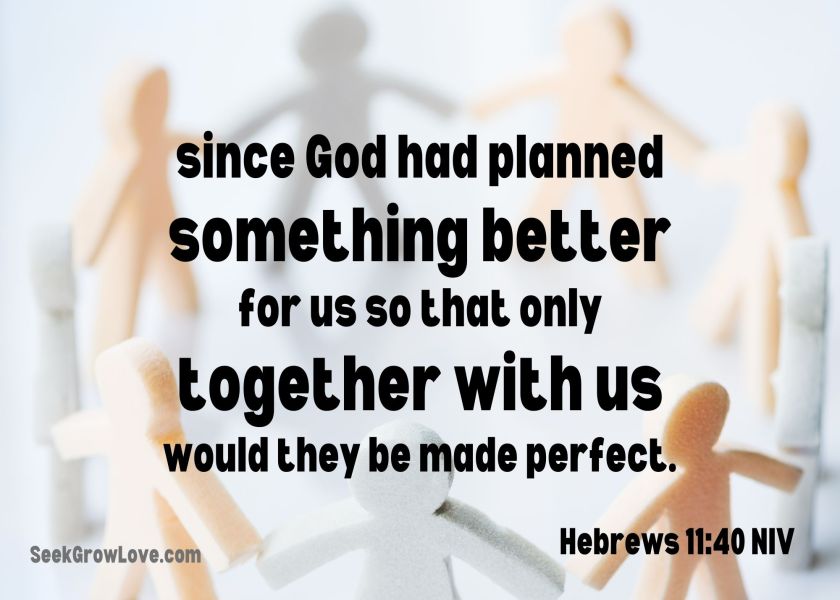
Verse 40 is the kicker for this chapter, of course. “God provided something better for us, so that apart from us they would not be made perfect.” This is now the twelfth of fourteen uses of this language about perfection in Hebrews (the next will be in 12:2, the last in 12:23). It is remarkable the lengths that have been gone to in some interpretations to have this language make sense, without having the return of Christ and the resurrection hope be significant for the Old Testament saints and the church, together. But the repeated (and, in my Bible, underlined) words of the chapter prompt us and we can’t ignore them – receive better promises – there is no reasonable explanation where some part of the Church has already inherited what God planned to give us. We are a body, undivided, faithful, and patient. “Christ the first fruits, after that those who are Christ’s at his coming.” (1 Corinthians 15:23).
Lord, you have made lovely poetry, and remarkable prose. Yours are the greatest inventions, incredible art, the purest flavors, colors and lightning. I praise your creativity, and I await the wonders of the more perfect world that awaits when your son returns to earth. All I know now is the damaged version of what you intended. Some of what you first made still shines through, and it is amazing to me. Let me grow in faith in you always, for you are almighty and perfectly trustworthy. Amen.
-Daniel Smead
Reflection Questions
1. Imagine if chapter 11 really were not in Hebrews. What would we be missing?
3. Have you ever tried to memorize part of Hebrews 11? With its repeated pattern about “faith” it seems set up for that purpose, but modern Americans don’t tend to try memorizing much. What advantages do you see to memorizing scripture? How do you decide what scripture to memorize?
3. Do you expect that faith is easier to hold to if you have people encouraging you to be faithful? How have you tried to be encouraging today? What things do you find encouraging?
 Seek Grow Love