
2 Samuel 8-9 and 1 Chronicles 18
I somewhat recently took a job as a Residential Counselor at Residential Treatment Facility for youth in the teenage age range. These kids have had severe traumas in their lives and have had terrible things done to them and happen in their lives. Most of them have terribly dysfunctional families that have hurt them in extreme ways. In order to cope and also survive through learned behavior they verbally and sometimes physically abuse staff for reasons as simple as being told “No.” There are times they will use all the ammo on you to try to hurt you or get a rise out of you. This isn’t normal teenage behavior like saying I hate you or You are dumb. Think the worst things that people have ever said to you. Now I want to be super clear that these behaviors are not entirely these kids’ faults. They’ve simply been dealt an unfair hand and do not entirely have the capacity to behave in ways other than this.
One night, I was handling a situation with a kid where other kids had lied to a girl, I will call Ivery, and told her the lie and how I reacted to the situation. In an attempt to advocate for the youth on the unit she proceeded to call me every name under the sun. She called me a pervert. She made fun of me in every way she could think of and then because she knew I had a girlfriend started to say anything to get a rise out of me in that area of my life. Finally, when she was running out of ammunition to get me off kilter, she threatened to kill me, my family and my girlfriend. Now, I knew she couldn’t actually pull that off but it was quite an experience to be threatened like that. I responded as best I could and didn’t try to discuss anything when she was just looking for an argument. After the fact I was definitely hurt that anyone would say those things about me.
I would love to say my next shift I just showed up and loved her and it all went away but those feelings stuck with me longer than I would have liked them to.
2 Samuel 9 is a great example of a man who despite what was done to him didn’t let the actions of other people affect how he treated overs. In this chapter David is looking for someone from the house of Saul to bless on account of Jonathan, Saul’s son. If you remember, this is the same Saul who had chased David through the desert and caves all over Israel seeking to kill him. This wasn’t just a brief period of time. Some scholars imagine this time period to be 7 years!! I can’t imagine what I would feel toward my oppressor after being chased under threat of death for even 3 years. All the same, I feel David’s desire to try to find someone from Saul’s house to bless is an amazing story of forgiveness. I could probably write a whole devotion about that but I want to focus on one particular verse of this awesome story.
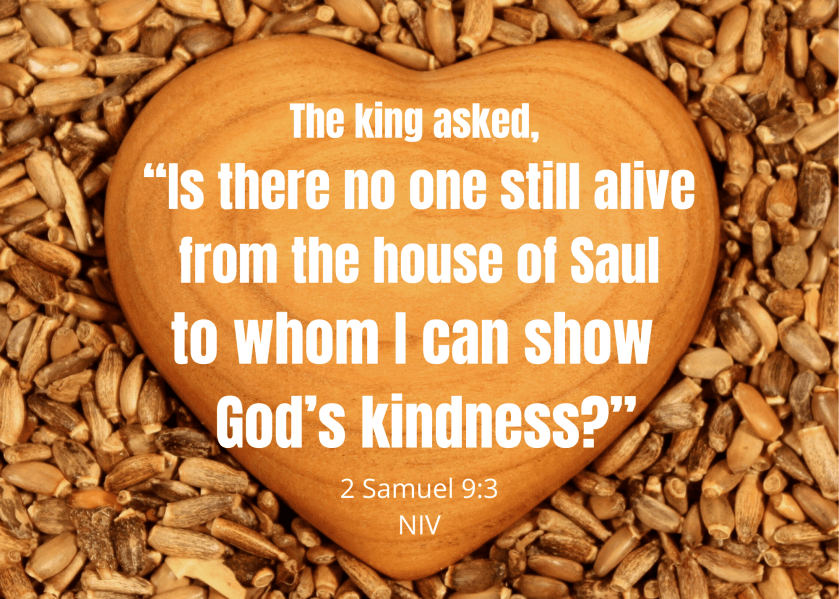
In verse 3 David is talking to Saul’s former servant and asks him, “Is there not still someone of the house of Saul, that I may show the kindness of God to him?”. This whole line is crazy to me. David is asking and even seeking out someone to bless from the house of Saul. I’ll be honest, most my kindness doesn’t go past the people I interact with. It stays in my world. I am not seeking out people that I can bless.
Let alone am I seeking out people from the family of the man who had just tried to kill me for 7 years and literally only by his death could I return to my home country. But that is David, the man after God’s own heart. This is extreme grace, thoughtfulness and care that he would go out of his way to search out a man from Saul’s house to bless.
The phrase “that I may show the kindness of God to him?” says once again so much about David and how he viewed everything. David releases in this simple phrase any form of ownership to how he was going to bless Saul’s relative. He points it directly back to God. He didn’t try to take the credit and say look at my kindness to my enemy. He identifies back to God.
This line continues to show just how much David acknowledged the fact that what he had wasn’t his. He lived in continual recognition that what he had been given to him was by God. He acknowledges his forgiveness isn’t from himself. His kindness isn’t his. His life isn’t his. His kingdom isn’t his. It is God’s.
He viewed the world not “how can I be kind to people” but rather “how can I show God’s kindness to others.” While the difference is oh so subtle, one is making our good deeds about us and the other is pointing the kindness back to God. David recognized as a servant to God it was no longer him doing it. It wasn’t his resources that he was using to bless this descendent of his enemy it was God’s that he was temporarily in possession of.
Now, in the same way I had the opportunity to show God’s kindness to Ivery the next day by overwhelming her with love or by showing her kindness. Don’t let opportunities slip by in your own life to give away something that isn’t ours. Rather, give away what God has given you to give away.
Daniel Wall
Today’s Bible reading can be read or listened to at https://www.biblegateway.com/passage/?search=2+Samuel+8-9%2C+1+Chronicles+18&version=NIV
Tomorrow we return to the Psalms (50,53,60,75) as we continue the 2020 Chronological Bible Reading Plan


 Seek Grow Love