Thought Provoking Proverbs

Old Testament: 1 Samuel 17 & 18

*Poetry: Proverbs 10

New Testament: Acts 4

Proverbs 10 begins a new section in the Book of Proverbs where the longer wisdom speeches of chapters 1-9 disappear, and the more traditionally recognized two-line couplets of Proverbs become the predominant form.

The couplet form of most proverbs in chapter 10 and onward is based primarily on the Hebrew poetry structure of parallelism, where two (or sometimes more) lines are related to each other in a particular way. The three dominant types of parallelism are: synonymous, antithetic, and synthetic. The simple way to view these parallelisms is that in synonymous parallelism, the lines are usually saying the same/similar idea in just two different ways; in antithetic parallelism, the lines are usually saying opposing ideas of each other (not necessarily just the opposite); and in synthetic parallelism, the lines function together to present the whole idea of the proverb, where any one line by itself is insufficient to understand the point that the proverb is trying to make.

While the proverbs that are collected in chapter 10 and following rarely have any direct connection from one to the next, something important to note is that certain themes or subjects resurface in various places. So to get an understanding of what Proverbs has to say about a specific topic often requires searching and collecting scattered verses throughout the book and then viewing them together to get an overall picture of what sort of wisdom Proverbs contains on it. But that then becomes the trick with Proverbs, figuring out what they are trying to say.

For example, in Proverbs 10:10, “The one winking his eye causes pain, and the one who is foolish with his lips will come to ruin.” It is not readily apparent what “winking” the eye has to do with causing “pain.” Unless the reader understands that there is an implicit context that must be discerned, they might just walk away scratching their head. We have to ask ourselves, “In what situation would this proverb prove true?” Our basic assumption is that the wisdom of Proverbs is true wisdom, therefore, there must be a context in which the wisdom of the proverb proves to be true. The task of us as readers is to decipher what that context might be. And this is the beauty of wisdom literature like Proverbs, it is very thought provoking, requiring a person to carefully deliberate on it for a while.

To answer the question of what does “winking his eye causes pain” mean in Proverbs 10:10, we must first understand that within the biblical culture, “winking” (or “squinting”) of the eyes represents hostile or mischievous behavior. This sort of gesture is associated with wickedness and is indicative of a person’s evil and malicious intent. Thus, to “wink” indicates that the person is conniving and plotting something deceitful which would bring harm to the unsuspecting victim, and they would not see it coming until it was too late.

-Jerry Wierwille

Reflection Questions

  1. Pick two of the verses in Proverbs 10. Which type of parallelism is each an example of?
  2. What can be learned from today’s proverbs? Did any stand out as something you specifically need to work on or need to remember more often?
  3. Are there any that don’t seem to make sense to you at first? If so, take a little time to do some research on the meaning of this proverb.
  4. Why do you think God included these Proverbs in His Holy Scriptures? What do we learn about God in our Bible reading today?

Which Will You Be?

Proverbs 10

Monday, July 18, 2022

In Proverbs 10, we see several contrasts between a person with Godly wisdom who lives a Godly life versus someone who doesn’t.  I thought it might be nice to summarize those contrasts here.

A person with Godly wisdom and who lives a Godly life:

  • Brings joy to their father (v1)
  • God doesn’t let this person go hungry (v3)
  • Hard-working (v4, 5)
  • The memory of this person will be a blessing (v7)
  • Accepts commands (v8)
  • Their mouth is a fountain of life (v11)
  • Love covers wrongs (v12)
  • Wise and discerning (v13)
  • Receives life (v16)
  • Holds their tongue (v19)
  • Delights in wisdom (v23)
  • Desires will be granted (v24)
  • Stand firm forever (v25)
  • Adds length of life (v27)
  • Has joy (v28)
  • Will not be uprooted (v30)
  • Mouth brings forth wisdom (v31)
  • Knows what is fitting (v32)

A person who doesn’t:

  • Brings grief to their mother (v1)
  • God thwarts this person’s cravings (v3)
  • Lazy (v4, 5)
  • Violent (v6, 11)
  • Name will be cursed (v7)
  • Fool comes to ruin (v8)
  • Hatred stirs up dissension (v12)
  • Punished (v13, 16)
  • Conceals hatred (v18)
  • Spreads slander (v18)
  • Their heart is of little value (v20)
  • Finds pleasure in evil conduct (v23)
  • What they dread will overtake them (v24)
  • Swept away (v25)
  • Their life is cut short (v27)
  • Hopes come to nothing (v28)
  • Will not remain in the land (v30)
  • Only knows what is perverse (v32)

Which list would you like to describe you? If you see some attributes in the second list that may be used to describe you, you can change.

Hebrews 3:8 says, “Today if you hear his voice, do not harden your hearts”.  If something here got your attention, take action.  Don’t let this moment pass.

2 Corinthians 6:2 says, “I tell you, now is the time of God’s favor, now is the day of salvation.”  Now is the time to act.

James 4:4-10 says, “You adulterous people, don’t you know that friendship with the world means enmity against God? Therefore, anyone who chooses to be a friend of the world becomes an enemy of God.  … That is why Scripture says: ‘God opposes the proud but shows favor to the humble.’

Submit yourselves, then, to God. Resist the devil, and he will flee from you.  Come near to God and he will come near to you. … purify your hearts, you double-minded.  Grieve, mourn and wail. Change your laughter to mourning and your joy to gloom.  Humble yourselves before the Lord, and he will lift you up.”

You can be a friend of the world, and fall into the second list, or be a friend of God and fall into the first list.  But in order to be a friend of God, you first must submit to God, resist the devil, and draw near to God.  You must humble yourself before God, only then He will lift you up.  Only then will the first list fully describe you.

–Steve Mattison

Application Questions

  1. What 2-3 points do you find most appealing from the first list for the Godly life?
  2. What 2-3 points do you find most distasteful or disturbing from the second list?
  3. Both lists include some actions/attitudes as well as consequences. How do your choices now determine your future? How often do you remember this?
  4. If you choose to humble yourself before God and submit to Him, what will that look like for you today? How will you work to remove something from the second list to replace it with something from the first?

Watch Your Words

Proverbs 10

Proverbs 10 8

This chapter contrasts the righteous person versus the wicked person.  There are so many things that could be written about, and I started to pick and choose a few to write about.  As I read the chapter a few times, I was struck by how many times the mouth, or what we say was mentioned.

Blessings are on the head of the righteous,
But the mouth of the wicked conceals violence

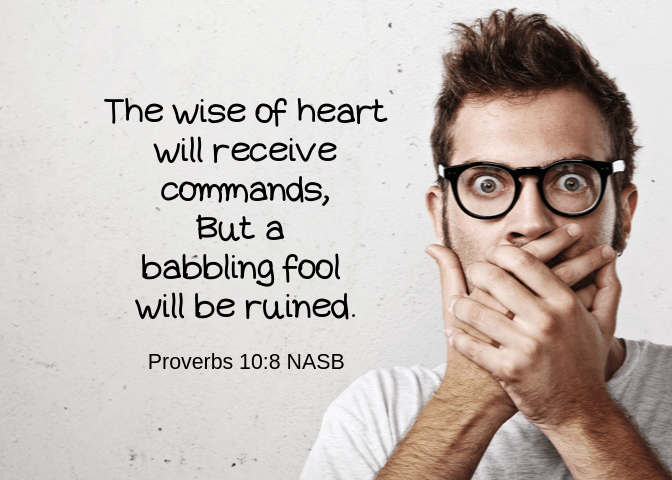
The wise of heart will receive commands,
But a babbling fool will be ruined.

11 The mouth of the righteous is a fountain of life,
But the mouth of the wicked conceals violence.

13 On the lips of the discerning, wisdom is found,
But a rod is for the back of him who lacks understanding.
14 Wise men store up knowledge,
But with the mouth of the foolish, ruin is at hand.

18 He who conceals hatred has lying lips,
And he who spreads slander is a fool.
19 When there are many words, transgression is unavoidable,
But he who restrains his lips is wise.
20 The tongue of the righteous is as choice silver,
The heart of the wicked is worth little.
21 The lips of the righteous feed many,
But fools die for lack of understanding.

31 The mouth of the righteous flows with wisdom,
But the perverted tongue will be cut out.
32 The lips of the righteous bring forth what is acceptable,
But the mouth of the wicked what is perverted.

These are some of the verses, but maybe not all.  We can often see a lot about ourselves (and others) by what is said or not said.  Listen to what comes out of your mouth.  Are you listening, or receiving commands, or are you babbling and therefore unable to hear the instruction?  Are you choosing when to talk and when to refrain?  Are you speaking righteousness?  It is often hard to control what we say but doing this is a sign of wisdom and righteousness.

This topic is something that shows up several other places in proverbs, as well as other places in the Bible.  I think of James 1:19.

This you know, my beloved brethren. But everyone must be quick to hear, slow to speak and slow to anger;

We often speak without thinking or think about what we should say instead of listening to the other person.  Then, what comes out of our mouth is either not appropriate or not helpful.  We often don’t like silence, so we say something just to have noise, even if it is not useful.

I encourage you to pay attention to what you are saying, and when you are talking.  Take time to listen.  Take time to gain from what others are saying.  Take time to allow silence to occur.  Our words are a good indicator of whether we are seeing wisdom or being fools.

Andrew Hamilton