
A Proverb a Day Keeps the Folly at Bay #1

Old Testament: Jeremiah 25-26

Poetry: Proverbs 16

New Testament: 2 Peter 3

Over the next few days, I’d like the reader to notice how much wisdom is condensed in each of Solomon’s pithy proverbs and how they can help us live better. Sound good? When looking at the Proverbs (or any Old Testament passage), we must always remember that, though these passages were written before Jesus was born, it is both appropriate and beneficial to interpret and apply the passages to our lives in light of the revelation of God’s son. Each time you read a passage in Proverbs, consider taking a deeper dive into just one verse to see how the reflections of someone a few thousand years removed from our modern context can still have relevance to our plight in this broken world.  

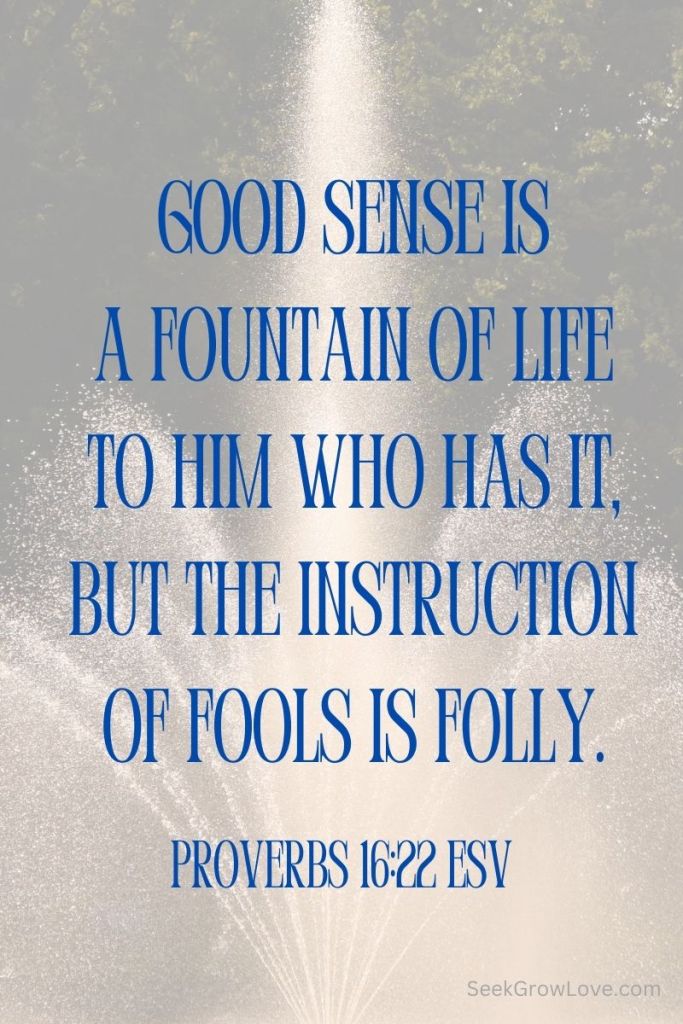
The proverb I want to consider and meditate on today is Proverbs 16:22, which in the English Standard Version goes like this:  

“Good sense is a fountain of life to him who has it, but the instruction of fools is folly.” 

I’m not sure if good sense has ever really been common or if “common sense” is what Solomon would consider good. From my perspective (maybe I’m just getting old and crotchety at 29), there isn’t much good sense flowing freely in our society–just turn on the TV or scroll down your social media feed. There is some, however, and where it is found, it is like a fountain flowing within an oasis in a barren, desert land.  

I’ve heard (though I can’t remember where) that most people who get behind the wheel of a car (the number I heard was above 90%) in both this country (USA) and in the land of our cousins across the pond (GB) believe themselves to be above-average drivers. If you consider this for a moment, you will realize how absurd this is. I think most people (I would guess north of 90%) have at least a small blind spot in their relationship to reality. I know I have at times overestimated my ability to maneuver a motor vehicle at high speeds (no accidents, yet…not a high speed, anyway).  

This inability to see ourselves in relation to the world clearly could be called folly, while the ability to do so can be deemed wisdom. The wise person, who has good sense, will receive instruction, discipline, and correction as a means of growth. The foolish person, who has a lack of sense, will see things such as teaching, reproof, and direction as an unnecessary waste of time, something only for those who “need” it. Because of this, the wise will continue to flourish like a tree soaking in the life it receives from water and nutrients, while the folly of the fool will ensure the continued degradation of their weakly rooted weed–that is, their inner life. 

This proverb takes on a new meaning in light of the Good news. Jesus gives living water and refreshes and restores those who have the good sense to recognize their need for him. Despite our lack of self-awareness, if we turn our attention to Jesus–that is, if we are aware of our need for his help, mercy, and kindness, we can drink from the fountain of life in a new sense (in the best sense). To see Jesus and not recognize our need for him as Savior is the highest form of folly. Exercise good sense and drink the water that satisfies like nothing else.  

-Joel Fletcher

Reflection Questions

  1. On a scale of 1-10 how would you rate your own “good sense”? How do you think those who know you well would rate you? Are there any specific areas where you might benefit from a more accurate view of yourself and reality?
  2. Do you recognize your need for Jesus to be your Savior? If so, how would you explain it to someone who didn’t?

Trusting in the Guidance of the Lord

Old Testament: 1 Samuel 29-31

Poetry: Proverbs 16

New Testament: Acts 10

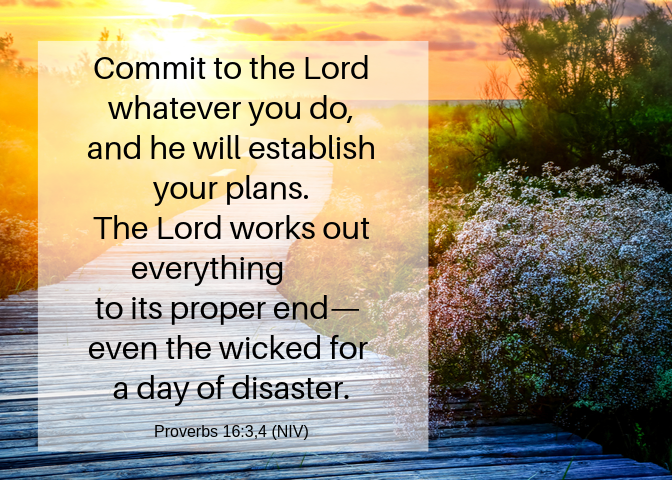
In the book of Proverbs, we find a treasure trove of wisdom that has the power to transform our lives. Chapter 16 is no exception, offering profound insights that speak directly to our hearts and the way we navigate this world. Today, let us take a closer look at verse 3, which encourages us to commit our work to the Lord, knowing that He is the one who establishes our plans.

In a society driven by achievement and self-reliance, it is easy to fall into the trap of thinking that success is solely dependent on our own abilities and strategies. We may spend countless hours meticulously crafting our plans and pursuing our goals, forgetting that we are called to acknowledge God’s sovereignty and seek His guidance in all that we do. However, Proverbs reminds us that true success comes from surrendering our efforts to the Lord.

Committing our work to the Lord involves recognizing that He is the ultimate authority and the source of all wisdom and understanding. It requires us to approach our tasks, aspirations, and dreams with an attitude of humility, acknowledging that apart from Him, we can do nothing of lasting significance. We are called to submit our plans to His will, seeking His guidance and trusting that He will align our desires with His purposes.

By entrusting our work to God, we are liberated from the burden of self-reliance and the anxiety that often accompanies it. We can rest in the assurance that the Lord, in His infinite wisdom and love, will establish our plans. This does not mean that we will be exempt from challenges or difficulties along the way, but it does mean that God will faithfully guide us, direct our steps, and use our efforts for His glory.

When we commit our work to the Lord, we invite Him to be an active participant in every aspect of our lives. We open ourselves up to His guidance and leading, allowing Him to shape our plans according to His perfect will. Our work becomes an opportunity to partner with God, to be instruments through which His purposes are fulfilled in this world.

As we reflect on Proverbs chapter 16, may we be encouraged to surrender our ambitions, our dreams, and our work to the Lord. Let us seek His wisdom, trust in His guidance, and find peace in knowing that He is the one who establishes our plans. By entrusting ourselves to Him, we embark on a journey of purpose and fulfillment, where our lives become a testament to His grace and faithfulness.

-Austin Kizer

Reflection Questions

  1. In what areas of your life would it be wise to surrender your plans to the Lord? What does that look like? What thoughts and feelings does it create? Pray for help in doing so.
  2. What does true success look like? Is it possible apart from God and His plans?
  3. What will God reveal to you about Himself in your Bible reading today?

God Willing

Proverbs 16

Proverbs 16 3 4 NIV

Whenever I tucked him in, I would tell him I’d see him the next time I worked. He’d tell me, “God willing and the creek don’t rise!” He was about 80 years old, living in the nursing home where I worked. He had a lifetime of wisdom and colloquialisms.  I had not heard that phrase before meeting him but immediately appreciated the meaning.

Due to modern transportation infrastructure, rising creeks don’t ruin our plans as often as they used to. However, our lives, no matter how modern, are truly in God’s hands. Proverbs 16: 1, 3, 4, 9 and 33 specifically discuss the plans we make. No matter what we do and what we plan to do, God will ultimately guide these plans or even change them.

Verse 3 is a bit of a struggle for me. I’ve made plans I thought were for God, but they didn’t turn out the way I thought they should. They didn’t succeed, at least not in my mind. But in the very next verse it states that the LORD works out everything for His own ends. Sometimes I clearly see through hindsight how my failed plans served God.

But not every time, I’m still working through that. During a particularly hard time in my life, I defeatedly told my aunt that maybe I’d figure out WHY this all happened when I entered the kingdom. Her response was perfect. “And then it won’t matter.” WOW!!! What a gift! What a promise! Our dashed hopes and failed plans will fall away when we see Christ!!! Nothing else will matter!  Reading Revelation 21 makes me tear up with excitement!

In the meantime, God, through the proverbial writers, gives us instructions on the behaviors and plans that destroy (verses 4, 5, 18, 22, 25, 27-30) and the behaviors and plans that build up (verses 6, 8, 10-14, 16, 17, 19, 20, 21, 23, 24, 26, 32, and 32). Plan to build up others and glorify God!

One of the other reasons I appreciated and remembered “God willing and the creek don’t rise,” is because it reminds me of Dr. Joe Martin. Whenever he speaks of his plans, he adds, “God willing.” This is a sincere example of what trusting God with every area of life looks like.

I truly hope to see all of you at FUEL 2020.

God willing and the creek don’t rise!

Maria Knowlton