
Who Gets the Credit?

Old Testament: Job 30-31

*Poetry: Psalm 44

New Testament: Titus 2


Most people love to claim credit for themselves on any project that went well.  They may choose to neglect telling others that there was a group working on the project, and instead claim all the credit for themselves.  They may acknowledge the fact that a couple other people helped them, but downplay their contributions to the project.  Very few people are going to say that they were part of a group who did something great and emphasize the other people’s contributions to the project.


In Psalm 44, the psalmist says that they heard from their fathers what God did in the past.  Their fathers could have easily claimed that they did it all with their own skill.  They could have claimed that they drove the people out and possessed the lands by their own power.  But, they didn’t.  Their fathers could have also easily said that God helped them some, but it was still mostly by their own efforts that they did these things.  But, they didn’t.  Instead, they said to the Lord their God, “You with Your own hand drove out the nations;  Then You planted them;  You afflicted the peoples,  Then You spread them abroad.  For by their own sword they did not possess the land,  And their own arm did not save them” (vs 2,3a).  They fully acknowledged that God was the one who did all the work.  Without God, they could not have done any of these things.


God also works in our lives, like He did in the fathers’ of the psalmist.  Most of the time He’s not driving out herds of people before us or possessing lands for us, but He’s still working to do something great in us and for us.  When God does something in your life, do you acknowledge that He did it and that it was not by your own strength?  When people ask about it, do you tell them it was fully by God that these things happened, or do you briefly acknowledge it but claim you did most of it?  We need to acknowledge that God did something great and that it was not by our own power.

-Kaitlyn Hamilton

Reflection Questions

  1. Who do you most often give the credit to when something goes right in your life?
  2. For what events of your personal past can you give God glory? What did He do? What did He save you from? How did He show His strength, power and wisdom?
  3. How can you do a better job of giving God the credit and telling others (including children) what He has done for you? How can this help others, including the next generation?
Love Letters

Old Testament Reading: Exodus 35, 36 & 37
Psalm Reading: Psalm 44
New Testament Reading: Romans 14

Happy Valentine’s Day! 

Have you ever received a mushy love letter that resulted in a permanent smile pasted on your face? My late father-in-law Rex Cain shared stories about writing love letters to his girlfriend Grace (who later became his wife) when he was states away at Oregon Bible College in the 1950s. He would save his pennies for postage stamps and brief long-distance phone calls while he anxiously awaited her letters via snail mail. 

Communication has changed a lot since then. Now we can reach people almost anytime, anywhere, as they probably carry their cell phones everywhere they go. We can video chat instantly with people from all over the world and send written correspondence lickety-split via email and text. (Call me old fashioned, but even though I am very grateful for the technological advancements that have allowed us so much more contact with each other, nothing can quite replace a handwritten letter or card from someone you love.)

I’ve heard it said that the Bible is God’s love letter to us. I also envision that many of the Psalms are the writer’s love letters to God. Psalm 44 begins as a love letter style – it might have even been put to music. The author writes about God’s faithfulness to His people in the past and renews their devotion to God. “For not in my bow do I trust, nor can my sword save me… In God we have boasted continually, and we will give thanks to your name forever. Selah.” (Psalm 44:6, 8 ESV)

Then in verse nine, this love letter turns a bit sour as the writer wonders aloud why God seems to have abandoned them. Something bad has happened to Israel, perhaps some battles that didn’t end well, even “though we have not forgotten you, and we have not been false to your covenant. Our heart has not turned back, nor have our steps departed from your way…” (vs 17,18). Israel is still faithfully serving God, but things are not going well for them. 

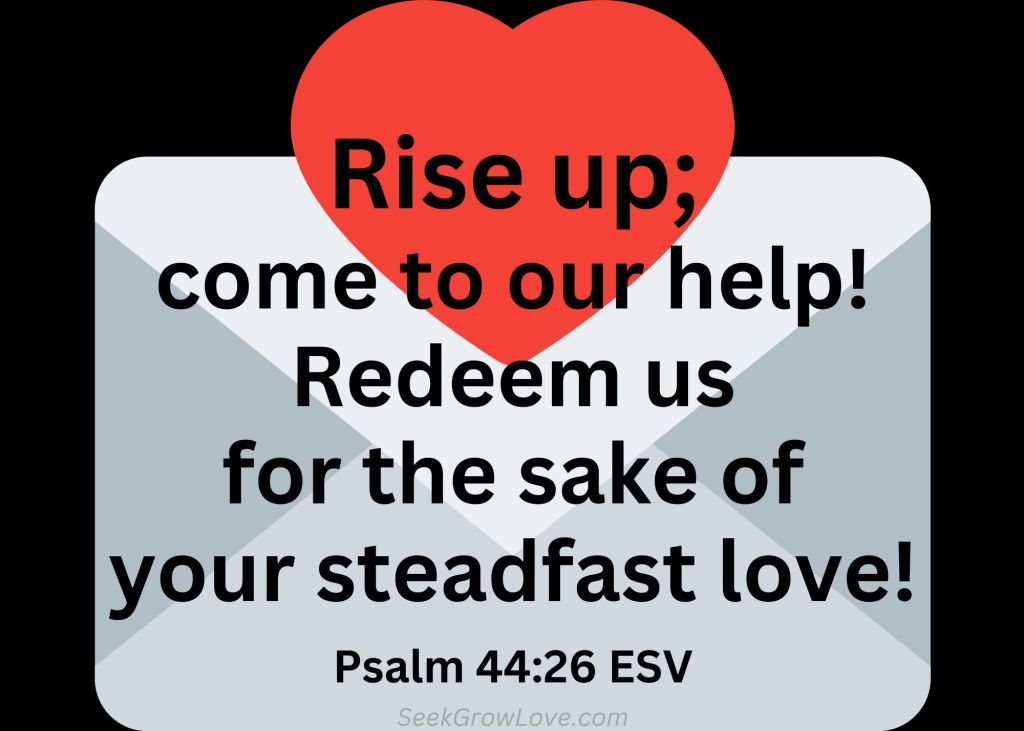
Here, the writer is poetically penning the collective thoughts and doubts of God’s chosen people, speaking directly to God. They need help and answers! Perhaps sometimes we are afraid to tell God what we really think, but He already knows. He created us with emotions and feelings, and I think He wants us to share those with Him. But notice how this psalm ends. It doesn’t conclude by harping on God and turning away from Him. Rather, in verse 26 we observe an optimistic plea as the author remembers how God has always been faithful in the past, and believes that He will yet again show up to help His people: “Rise up; come to our help! Redeem us for the sake of your steadfast love!”

Even in your times of doubting, don’t forget to remember God’s faithfulness. The Bible is packed with true tales of God’s provision, and if you think back hard enough into your own life, I bet you will recognize many times when God came through in your darkest moments as well. 

-Rachel Cain

Reflections: 

Pen your own psalm. In this season of life, would your psalm be mostly praise and triumph, or more lamenting and questioning? Be sure to remember His faithfulness in your life as you close out the psalm. 

Do you journal? It can be a great way to remember God’s faithfulness in your life. It doesn’t have to be elaborate; you can even do a quick bullet journal style. Journaling is a concrete way to look back to see God’s provision in your life. Jump in this week and give it a try! 

Which  part of this psalm speaks most to your heart today? 

What does God want you to know about Him?