
Why We Don’t (or Don’t Need to) Fear

Old Testament: Job 35-37

*Poetry: Psalm 46

New Testament: Philemon Intro, see below


Throughout the Bible, the phrases “do not be afraid” and “do not fear” are repeated over and over.  This phrase is first used in Genesis 15:1, which says, “After these things the word of the Lord came to Abram in a vision, saying, ‘Do not fear, Abram, I am a shield to you; Your reward shall be very great.’”  The last time the Bible says this is in Revelation 2:10, which says, “Do not fear what you are about to suffer. Behold, the devil is about to cast some of you into prison, so that you will be tested, and you will have tribulation for ten days. Be faithful until death, and I will give you the crown of life.”


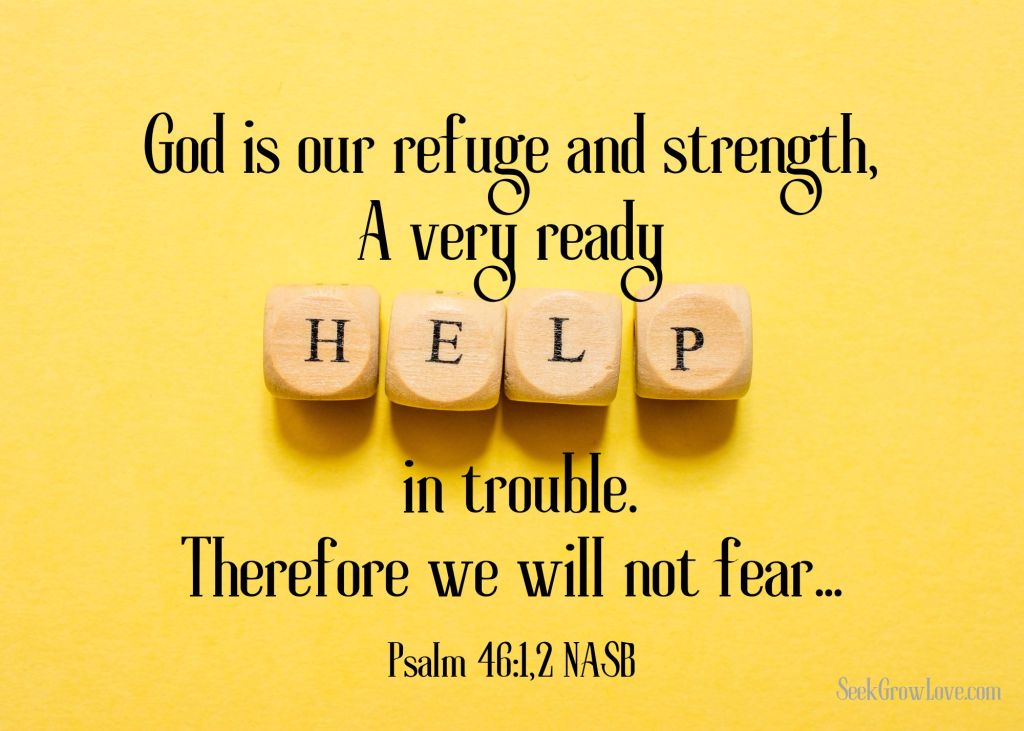
In Psalm 46, we are given the reason why we should not fear.  Verse 1 says, “God is our refuge and strength, A very present help in trouble.”  Psalm 46 says this is the reason we will not fear.  When God is our refuge and strength, nothing can defeat us.  As nothing is stronger than God, when our strength is God, nothing can overpower us.  Therefore, we should not fear anything.  Verses 2-3 continue to tell us that there is no reason to fear, even if the earth should change, the mountains fall into the sea, the oceans roar, and/or the mountains shake.


Further on in the psalm, it says, “The Lord of hosts is with us; The God of Jacob is our stronghold. Selah. Come, behold the works of the Lord, Who has wrought desolations in the earth. He makes wars to cease to the end of the earth; He breaks the bow and cuts the spear in two; He burns the chariots with fire.”  If you didn’t have enough reason to not fear from verse 1, these 3 verses give you even more reasons.  The God who is our stronghold has brought about desolations on the earth against those who have opposed Him.  He has stopped wars and defeated men and their weapons over and over again.  Therefore, there is no longer any reason to fear.  We need to trust in God as our refuge, strength, and stronghold.

-Kaitlyn Hamilton

Reflection Questions

  1. What are your top five fears?
  2. How often does fear interfere with what you think God wants you to be doing or thinking?
  3. It’s easy to say, “Do not fear.” But harder to do. What are some practical daily steps you can take to help your brain overcome fear?
  4. How is God greater than all the things we fear?

Introduction to Philemon

The book of Philemon is Paul’s shortest letter that is included in our Bible.  Paul wrote it while in prison to his dear friend and fellow Christian, Philemon.

Philemon’s slave, Onesimus, had run away, had come to Paul, and had helped Paul while he was in chains for the gospel.  While there, Onesimus became a believer.  This book is Paul’s letter to Philemon urging him to accept Onesimus back, not as a slave, but as a dear brother in Christ; asking that Philemon welcome Onesimus “as you would welcome me.”

This book shows Paul’s mastery of persuasion.  He started by praising Philemon, then laid out a logical argument for kindly accepting Onesimus back, followed by an emotional argument.  Ending with “Prepare a guest room for me, because I hope to be restored to you in answer to your prayers.”  Not only was Paul an amazing missionary, he was a master strategist.

-Steve Mattison

Be Still – Daddy’s Got You

Old Testament: Leviticus Introduction Below
*Psalms Reading: Psalm 46
New Testament Reading: Romans 16

I am a Daddy’s girl, through and through. As a child, you could usually find me hiking with my dad, reading books with him, snuggling up to him, or helping him with a building project. He was so strong, secure, safe. Now, as his terminal illness has progressed, I have much more of a parental role toward him than he does toward me, but I’ll still always consider myself a Daddy’s girl. 

Sometimes I like to sit back and just observe my daughters interacting with my husband too. They fawn over him! They want to attend all the Daddy-Daughter dances together. They draw him sweet pictures regularly. They beg him to scratch their backs to get them to sleep. When they are scared, they run to him for comfort and protection, knowing that he is strong and gentle.

Though in this flawed and sinful world many fathers don’t live up to God’s ideals, we all do have a Heavenly Father who wants to guide and protect us. 

“God is our refuge and strength, a very present help in trouble.” (Psalm 46:1, ESV)  I’ve always loved this verse. It has spoken to the depths of my soul during many tumultuous times in my life. Following these encouraging introductory verses, Psalm 46 proceeds to mention many catastrophic events – the earth gives way, mountains fall into the sea, waters roar, mountains tremble – and calls us to have no fear during these times. Verses 4 through 9 then remind us of the power and provision of our God. 

“Be still and know that I am God.” This verse I have both underlined in my Bible and written in the margins so I will be sure to notice it as I read. It is a good reminder that when all the chaotic events occur (both the ones mentioned in this Psalm as well as any others that happen in my own life), I am still called to find shelter in His stillness and remember that God is on the throne and He is in control. I don’t know about you, but “be still” is a tough command for me to follow; I like to always keep my hands and mind busy. My mind, actually, does not often settle down at all; anxiety has been my constant (uninvited) companion for as long as I can remember. However, when I purposefully choose to be still, basking in the presence of God, I can feel His peace wash over me like a spring rain. It takes a lot of effort, as I am not naturally driven to “be still”, but I’ve never been disappointed following a quiet moment with God; to the contrary, I find a renewed sense of purpose and strength when I remember – rather, KNOW within the depths of my soul! – that He is God.

“‘Be still, and know that I am God; I will be exalted among the nations. I will be exalted in the earth!’ The LORD of hosts with us; the God of Jacob is our fortress.” God is our protector, our fortress… our Daddy who loves us so much! 

-Rachel Cain

Reflections:

1. Pray this Psalm today. Think about it intently as you say each word. 

2. Choose a time this week that you can “be still and know that He is God” – bask in his presence for a while as you praise and pray. 

3. What in your reading today helps you KNOW that He is God? What are His qualities?

In our Old Testament reading, yesterday we finished reading Exodus, tomorrow we will begin Leviticus – here today is our

Introduction to Leviticus

Leviticus is the third book in the Old Testament, and the middle book in the Torah.  Moses wrote Leviticus, which is mostly a record of God dictating His rules to Moses – while the Israelites were camped in front of Mount Sinai.

The recurring theme in Leviticus is, “Be holy, because I [God] am holy”.  Leviticus 20:26 sums up the whole book pretty well, “You are to be holy to me because I, the Lord, am holy, and I have set you apart from the nations to be my own.”

God had rescued the Israelites from slavery to belong to God.  They had served the Egyptians, and now they must serve God.  And in order to do that, they needed to know what God required.

As you read, you’ll be struck repeatedly by the fact that God is holy, and people aren’t.  God gave all these rules because He wanted His people to be holy, and if they followed all these rules, they would be holy.  The story of Nadab and Abihu in Leviticus 10 is a stark reminder that misdirected zeal for God can result in death. 

You will see that reconciliation is possible for those who break God’s laws in ignorance, but only punishment awaits those who defiantly break God’s laws.

You will recognize that some rules were fulfilled in Jesus.  For example, Leviticus 23 describes the “Feasts of the Lord”, which have fulfillment in Jesus.  For example, Jesus fulfilled the 4 Spring feasts on the exact calendar day of the feast.  I suspect the 3 fall feasts will be ultimately fulfilled exactly when Jesus returns.

  • Passover – Jesus *was* the Passover lamb, and was killed on the date of Passover
  • Unleavened Bread – Just as yeast was to be removed from houses, Jesus removed sin to his grave on this date.
  • Firstfruits – Jesus was raised from the dead on the date of the feast of firstfruits.
  • Feast of Weeks (or Pentecost) – The Holy Spirit was poured out on the believers on this date in Acts 2.
  • Feast of Trumpets – I believe this will be the date the last trumpet sounds
  • Day of Atonement – I suspect this may be the date of the Great White Throne Judgement
  • Feast of Tabernacles – I suspect this may be the date of God’s dwelling with men.

Ultimately, I suspect what you’ll recognize is that God is holy, and no matter how hard we try, we just can’t follow all His rules to be holy.  You’ll acknowledge that we couldn’t please God on our own. And will appreciate all the more that God sent his one and only Son to reconcile us to Himself.

-Steve Mattison