

Old Testament: Song of Solomon 7 & 8
*Poetry: Psalm 57
New Testament: Hebrews 2
The words at the beginning of the previous Psalm 52 and Psalm 56 refer to the occasion of David fleeing from King Saul into the hands of Achish, king of Gath. He escaped from there by pretending to be mad (I Samuel 21).
The words at the beginning of this Psalm 57, “David, when he fled from Saul in the cave”, probably refers to the very next verse in 1 Samuel 22:1, where David escaped to the “cave of Adullam”. Eventually his parents joined him there along with about four hundred men who were “in distress”, “in debt”, “depressed”. And he became commander over them”, evidently developing his leadership skills.
Perhaps the bigger the problem, the more opportunity you have to glorify God as you trust his direction in your life. Not to your problem-solving glory, but to your powerful God’s glory.
Be merciful to me, O God, be merciful to me, for in you my soul takes refuge. Show me your grace and favor here, David says. I am alone and discouraged. You are my only refuge. I’m exhausted. I could have died any day this week, but here I am, still running from Saul. What now?
We know life is busy, and we are pulled in many directions. Sometimes it seems that no matter what we decide to do, someone is unhappy — even if they don’t quite kill us. We juggle a lot of extremes and pressures in our lives. What to do?
David seems to carry the chaos of “storms of destruction” on the one hand, and clings to the safety of the “shadow of your wings” with the other hand. What now?
He decides, Yes, I will make my refuge in the shadow of your wings until the storms have passed by. God hides us from danger, gathered beneath his wings. We can survive the competing demands, lifting up our heads, decrying the self-pity. I cry out to God, the Most High, to God who fulfills his purpose for me. He will send from heaven and save me. God will send out his steadfast love and his faithfulness. David certainly knew the battle advantage to holding the “high ground”. His God, the Most High, has heaven at his bidding and will do it all.
Then, like all of us, he looks down in fear and sees lions slinking about outside the cave and people breathing fire around him and men whose teeth are spears and arrows and whose tongues are sharp-edged swords. Are they rushing the cave, jabbing their spears and talking trash? Am I at school? Am I at work? What to do?
But the other fist comes up in shouts of declaration. Even though his enemies had prepared a snare and dug a trap for him, his enemies fell into it instead
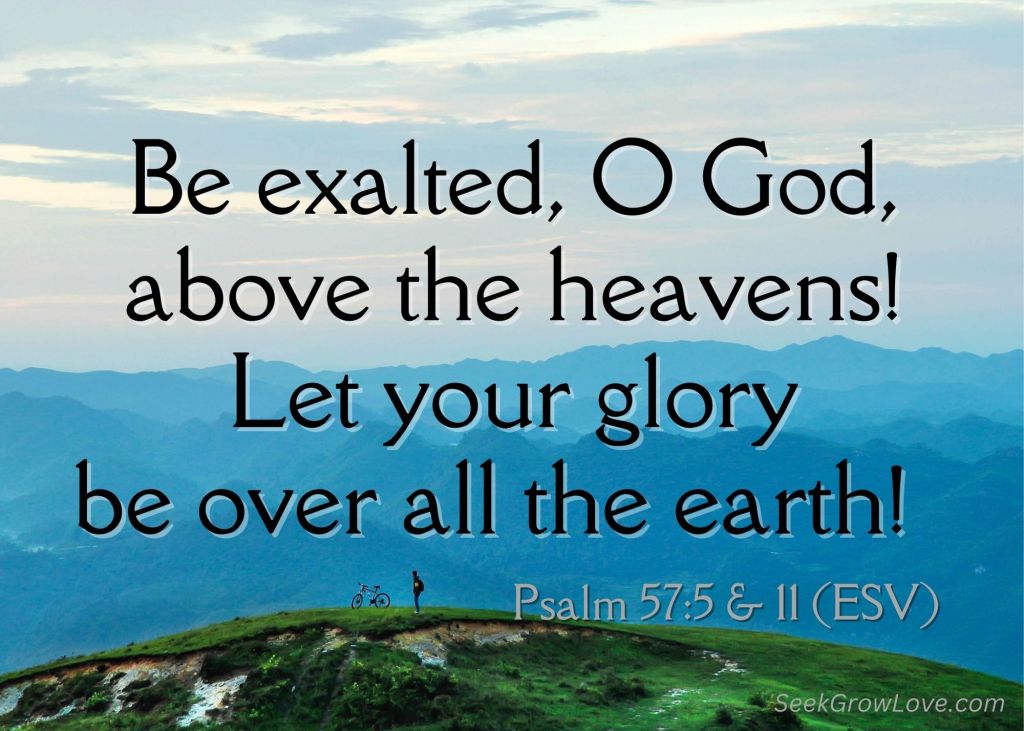
Be exalted, O God, above the heavens
Let Your glory be over all the earth.
With a deep breath he determinedly keeps going, My heart is steadfast, O God, my heart is steadfast. I will sing and make music. Awake! I will awaken the dawn. O Lord I will sing praises to you among the nations. For your steadfast love is great to the heavens, and your faithfulness to the clouds..
David didn’t wait for his circumstances to change before he praised God. He was still in a dark cave with pursuers looking to kill him. But he chose to sing. He was scared, hiding in an earthen cave but praising God anyway, thinking about heavens and clouds, God’s steadfast love and faithfulness! Singing?
Is the desperate issue here “God, change my situation?” or is it “Praise you for being my songbird, gathering me under your wings in love; what do you want me to learn from this?” Perhaps David had a lot to learn from those 400 men. Either way, God was his best resource.
In the New Testament Paul and Silas were beaten and thrown into stocks in a dank prison with many in pursuit (Acts 16:25-34). And they, too, chose to sing. They were still singing, hurting and bleeding, when God’s earthquake shook the prison foundations and loosed all the doors and bonds to immediate freedom. Which led the frightened jailer to cry, “Sir, what must I do to be saved”?
“And they said, “Believe in the Lord Jesus, and you will be saved, you and your household.” And they spoke the word of the Lord to him and to all who were in his house. And he took them the same hour of the night and washed their wounds; and he was baptized at once, he and all his family.” On the one hand, the jailer was facing death and destruction if these prisoners escaped, for Paul and Silas chose to sing and pray. But on the other hand, this man was rejoicing with his family that he believed in God!
Singing? Earthquake? Have you tried that in the midst of your difficulties? Rejoicing? Believing?
Surely technology could give us instant access to our list of praise songs – at any crushing moment – at any rejection – at any physical danger – at any financial crisis –after we call 911.
God IS our refuge. So write a new song. Just sing!
Be exalted, O God, above the heavens
Let Your glory be over all the earth.
The steadfast love of the Lord never ceases
His mercies never come to an end
They are new every morning, new every morning
Great is your faithfulness, O LORD,
Great is your faithfulness.
-Lamentations 3:22-23
Song “The Steadfast Love of the Lord” by Edith McNeill
-Cheryl Ross
Reflection Questions
- What can you learn from David?
- Have you tried singing and praising God in the midst of your struggles and difficulties? If so, did you find any benefit in doing so?
- When will it be helpful for you to remember that your God holds the high ground?
- How can you bring glory to God, today?
 Seek Grow Love