
Loving the Things in the World

OLD TESTAMENT: Jeremiah 10-11

POETRY: Psalm 115

NEW TESTAMENT: 1 John 2

What do you love? Love is such a flexible word. I love God. I love my wife. I love my children. I love my favorite sports teams. I love eating a good fettuccine alfredo. I love ice cream. The way we use the word “love” varies widely on the context.

In 1 John 2, John spends some time contrasting the way that we love the things of the world with our love for God. And while his words may sound harsh, there is a great lesson for us in them:

1 John 2:15-17 (ESV)

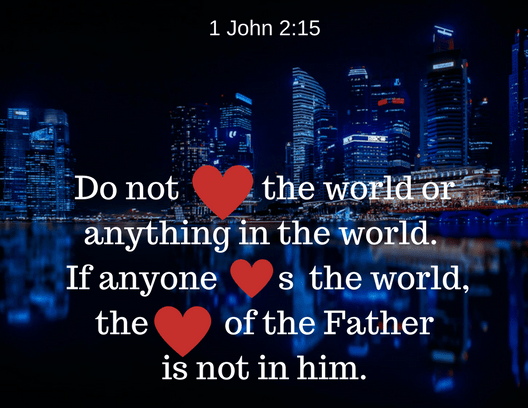
15 Do not love the world or the things in the world. If anyone loves the world, the love of the Father is not in him.

16 For all that is in the world–the desires of the flesh and the desires of the eyes and pride of life–is not from the Father but is from the world.

17 And the world is passing away along with its desires, but whoever does the will of God abides forever.

John commands us to not love the world or the things in the world. Does this mean that we are not to love people, like Jesus commands us to? Of course not! John is using expansive language to remind us of a key point: we are not to love the evil things we find in the world.

There is evil all around us: in the media, on TV, in movies, and on the Internet. We are bombarded with images all day everyday. While they had evil imagery in the ancient world, our modern world far outstrips the ancient world in how easy it is to see evil things and how often we are assailed with these images.

So what is John asking us to do? He is asking us to love the things of God, which means that we should avoid the evil of the world. We all have innate desires in our flesh that are not godly. If we act on those desires, we are separating ourselves not only from God through our sin, but we are also consciously deciding that our way of living is better than living the way God says that we should.

Friends, that is a dangerous place to be. I know that I have walked in darkness at times, enjoying the desires of the flesh and of the eyes. But what I found is that those dark places lead nowhere good. God does not want us to avoid sin because we are good little trained creatures. It’s not like God is running a circus, and we get to play the part of the circus animals, just jumping through hoops of fire to prove to God that we love Him. That’s not it.

God designed life. God designed us. He loves us. He wants the best for us. Just like I tell my children “no” from time to time, that does not mean that I do not love them. I want what is best for my kids, even when something wrong or dangerous looks attractive to them.

Let’s avoid the evil things that our world is trying to sell to us. Let’s be examples of love and light instead. As we do so, we are examples to others of what life will look like in the coming kingdom of God. The kingdom of God and the things of God will abide forever.

-Will Barlow

REflection Questions

Do you have a love for the things of this world that is unhealthy? What can you do to return to a purer love for God?

    Have you ever noticed that when you feed your mind something, it focuses on that concept more and more? How can you guide your thoughts in a healthier direction?

    When people look at your life, can they recognize the kingdom of God? Can they see the fruit of the spirit, evidence of a changed heart and life?

    Using Your Gift

    OLD TESTAMENT: 2 Chronicles 33 & 34

    POETRY: Psalm 115

    NEW TESTAMENT: 1 Peter 4

    Have you ever wondered what gifts you have been given by God? Have you ever doubted that you even HAVE a gift from God? In the middle of 1 Peter 4, Peter gives a simple statement about gifts that should arrest our attention:

    1 Peter 4:10-11 (ESV)

    10 As each has received a gift, use it to serve one another, as good stewards of God’s varied grace:

    11 whoever speaks, as one who speaks oracles of God; whoever serves, as one who serves by the strength that God supplies–in order that in everything God may be glorified through Jesus Christ. To him belong glory and dominion forever and ever. Amen.

    We are first comforted (or perhaps surprised!) to hear that we have received a gift. What are we to do with our gift? We are commanded to serve one another in love — that is the way that we can use God’s grace appropriately.

    Peter also gives two large categories for gifts from God: speaking gifts and serving gifts. Unfortunately, in the modern Western church, most Christians think of the “speaking gifts” when they think of gifts. And so, when asked, “what is your gift?” so many are tempted to think that they do not even have one. But Peter does not teach this, nor do the rest of the Scriptures.  For example, giving mercy is listed as a gift in Romans 12, and administration is listed as a gift in 1 Corinthians 12. The gifts of God come in many shapes and sizes.

    If you are unsure what your gift is (or gifts are!), what can you do? I believe that Peter would encourage you to get more involved in a local congregation of Jesus followers. Try volunteering for a food drive, helping to set up for a special event, or working with the children’s ministry. Do you have any musical ability? Perhaps your worship team could use an extra instrument or voice. Has God put a desire for preaching or teaching in your heart? Ask your pastor how you can develop this desire into something more concrete. Do you have a heart for the homeless, those in prison, single parents, or another disadvantaged group of people in your community? The opportunities for exploration and service are virtually endless!

    Many times, I think we overcomplicate the idea of gifts. We are each unique people, valued by our infinite Creator. None of us are alike in every way. God has especially given you abilities that I may not have, and He has given me abilities that you may not have. And even if we have the same gift type, we will express it uniquely! This is the value and the beauty of the Body of Christ — we are both designed to fit in and belong to the church of Jesus Christ, AND we are designed to stand out in unique ways.

    Ask God to show you what desires He would like you to pursue. As you pursue those gifts, remember that it’s all about Him. It’s His ability, His power — even your life belongs to Him! So love Him with your whole heart and love your neighbor as yourself. As you do, you’ll learn more about Him and more about how He has uniquely gifted and enabled you to do good works that point back to Him. 

    -Will Barlow

    Reflection Questions

    1. Do you have any ideas about the gifts that you have? What can you do to learn more about yourself and about God?
    • What gifts of others do you especially appreciate? How does this practice of thankfulness for others’ gifts help us greater appreciate the Body of Christ?
    • What next steps are you going to take to develop an awareness of your gifts and how they can be used to serve others and glorify God?

    Will Barlow is the head pastor at Compass Christian Church in Louisville, KY. He lives near Louisville with his wife of 15 years (Becca) and three children (Liam, Hannah, and Isaac). Besides theology, he enjoys playing sports, watching sports, and spending time with his family.