God’s BIG Picture

Old Testament: 1 Chronicles 5 & 6

Poetry: Ecclesiastes 3

New Testament: Philippians 4:5

Chapter 3 of Ecclesiastes begins with a long poetic structure on the nature of time. Verse 1 gives the overall premise and theme of the poem, “For everything there is a season, and a time for every matter under heaven.”

There are SEVEN double pairs in the poem (FOURTEEN pairs total), which likely is meant to represent completeness for all the possible human activities and experiences in life. All the pairings are all polar-merisms, where the two extremes of an activity are mentioned to represent all the various combinations and degrees that can exist between them.

The appropriateness of timing is a major theme in wisdom literature. Timing is everything in life. Wisdom promotes knowing how fitting the timing is for a particular activity. The idea that there is a proper time for everything stems from the premise in wisdom literature that God has created the cosmos in such a way that everything follows an orderly path and timing. So, if creation exhibits orderliness and appropriate timing of events, then wisdom would see that intention as being applied to human decisions and life experience as well.

While God has ordered the cosmos in such a way that it follows distinct patterns and activities, Solomon is not saying that such a mechanistic view of the world is meant to be replicated exactly in human life. The various circumstances described in the poem are not pre-determined to happen in the course of life like a formula or preset timeline.

Interestingly, outside of being born and dying, every other circumstance that is described in the poem is one which a person can respond to when they find themselves encountering that occasion. Throughout the poem, it is difficult to pin down exactly what some of the references actually mean. They are mostly generic and therefore can be applied to a wide range of human situations. Furthermore, it cannot be determined if they are meant to be understood concretely (i.e., literally) or figuratively.

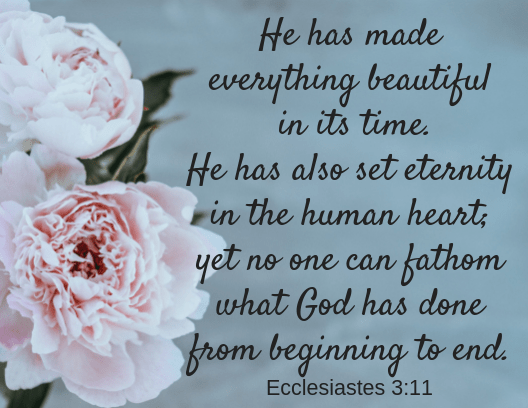
Verse 11 says that God makes “everything appropriate in its time”—what does it mean to be “made appropriate in its time”? This is perhaps one of the most difficult verses in the entire book of Ecclesiastes. It seems that the best way to understand this phrase is to begin with Solomon’s framework of the world in mind where he sees God as the one ultimately in charge in ordering the world. And so, in Solomon’s view, God has structured the world so that everything has its proper time in which everything happens, but the how and when of the appropriateness of the timing is elusive to the human mind. Only God can comprehend how he has made everything to have its own appropriate time.

Along with this complex statement, Solomon says next that God has also “set eternity” in people’s hearts, but not in such a way that they “can find out the work that God has done from the beginning to the end.” What does it mean to “set eternity” in the human heart? The phrase can be taken a couple of different ways, but it seems that the best way to take the phrase is referring to how God has placed a sense of time in the human heart where they are aware of past, present, and future and the duration of events. In a world that is ordered by time, humans can understand “that” there is a time and place in which all events happen, but to grasp the larger picture, to be able to see the whole, escapes the comprehension of humankind.

However, another way to understand this phrase could be that God has placed “a deep-seated desire, a compulsive drive…to know the character, composition, and meaning of the world…and to discern its purpose and destiny.”[1] In essence, God has placed an endless curiosity for understanding and acquiring answers in the human heart. Humans want to know, we crave to know, the answers to the questions we ask. Human beings desire to understand the “beginning” all the way to the “end” in order to control and manipulate it, thereby being able to obtain some profit or gain from their efforts.

But none can be collected. We are not able to discern the plan or pattern that God has set in motion in the world. The intricacies of God’s “work” (why he does what he does) are outside the realm of human investigation (i.e., we can’t find out no matter how hard we search), and therefore, it is beyond human comprehension, and by extension then, human control. And so, while we have “eternity” in our hearts, we are left in a state of bewilderment regarding the mystery of time by which all events happen in life.

What I think we can learn from this is that life is filled with a diversity of experiences and is not something that can be micromanaged. While we can choose how we respond to various circumstances in life, our lives are filled with events that are outside our control. God has ordered the world and life in general in such a way, and we experience life according to that ordering but not in a way that we can understand why everything happens the way it does, when it does. We must trust our lives to God who has infinite wisdom and sees all things. Only he has the “big picture” and knows the end from the beginning. To him be all the glory and praise. Amen.


[1] Walter Kaiser, Ecclesiastes, 66.

-Jerry Wierwille

Reflection Questions

  1. Where in your own life have you experienced “a time for everything”?
  2. How do you think God has put eternity in your heart?
  3. In what ways and understandings is God much much bigger than you?
Nothing New

Old Testament: 1 Chronicles 1 & 2

Poetry: Ecclesiastes 1

New Testament: Philippians 3

1.   Ecclesiastes is wisdom literature

Ecclesiastes is unlike any other book in the OT canon. It is part of the wisdom literature genre, but it is presented in a unique fashion with a different approach than the other wisdom books. Each of the wisdom books in the OT are unique in their style and approach (Job, Psalms, Proverbs, Ecclesiastes, Song of Songs). Nevertheless, there are definitely some aspects of Ecclesiastes that are akin to what is found in the Book of Proverbs.

2.  The approach of Ecclesiastes

Ecclesiastes can be likened to a journal that contains the reflections of one man’s journey through life.

  • It conveys the author’s observations on life.
  • It records his attitudes and feelings as he searches for meaning in life.
  • It sets forth his conclusions after a lifetime of searching.

We could also think of Ecclesiastes as like a travel log or guidebook that was left after a traveler had completed his trip, and he wanted the next traveler to see what lies ahead of them if they follow his path. Thus, it contains all the uncensored observations and learnings of a man along the journey of life that was fully lived with no avenue or pursuit left unexplored. He’s done it all, and he simply tells it like he sees it because he has lived it and knows it.

3. Why is the book called “Ecclesiastes”?

The title “Ecclesiastes” is actually the Greek title given to the book in the LXX (Greek translation of the Hebrew OT done around the 3rd cent. BC). Actually, most of the book names in the OT that we have in our English Bibles today come from the LXX rendering of the Hebrew.

Before we talk about the word “Ecclesiastes,” let’s take one more step back in time to the Hebrew Bible. The title “Ecclesiastes” is translated from the Hebrew word Qohelet, which roughly means “one who calls the assembly” or “one who addresses the assembly.”

And thus, an “ecclesiastes” was a person who sat in or spoke to an ekklēsia (“assembly”). Ekklēsia is the NT word for “church” and the OT word used in the LXX for the “assembly” (i.e., “the congregation”) of Israel.

4. Who is the author?

There is no specific identified author of Ecclesiastes, but it has traditionally been ascribed to King Solomon, the 3rd king of Israel. All we know is that the author identifies himself as the Qohelet (“the Ecclesiastes”) in v. 1. But there are other clues in the book that lead us to conclude that the author is likely King Solomon.

  1. He was a king in Jerusalem (1:1)
  2. He was a/the son of David (1:1)
  3. He considered himself to be the wisest man (1:16)
  4. He was a great builder (2:4-6)
  5. He was extremely wealthy (2:8)
  6. He had a large harem (2:8)

But some scholars have noted that there are a couple of factors that militate against concluding that Solomon was the author, or at least that Solomon wasn’t the one to compose the book.

There are shifts from 1st person to 3rd person, suggesting the possibility of a narrator as the composer of the book, much like the way Gospel writers composed their re-telling of the life and ministry of Jesus by recording his teachings and activity, but Jesus was not technically the author.

But whether Solomon was the direct author, or a later editor compiled his writings into their final form, it seems best to still identify the “Sage” as being Solomon.

5. The Main Theme

Ecclesiastes 1:2-3

“Utterly pointless!” says the Sage;

 “Utterly pointless! Everything is pointless.” 

 3What does a person gain from all his toil

 at which he toils under the sun?

Solomon’s basic premise → “When all is said and done in life, there is nothing that can give a true sense of accomplishment and gratification.” True, it is a very pessimistic outlook on life. Solomon is basically saying that nothing can actually satisfy and provide what we want. Life on a purely human level, no matter how great it is lived, will be pointless. Why is that? Because activity, in and of itself, doesn’t produce anything of lasting and ultimate value.

Have you ever worked really hard and then thought to yourself, “Am I even getting anywhere?” We can work really hard, and yet not feel like what we do is really going to matter. In one sense, this is correct. We can work ourselves to the bone, but all that effort is really not going to produce something that truly lasts or has an enduring value.

One of Solomon’s other points in this opening section is: Nothing is every truly “new.”

Solomon has observed that there really is nothing ever truly new in life. Either people have forgotten what has gone by in the past, and then later rediscovered it, or people were never aware of it in the first place and then think their eventual perception of it is somehow a profound and novel occurrence.

All that life consists of, all the complexities and frustrations it brings, and all the incredible advancements in human knowledge don’t change the fact that life as we know it is basically the same. We may use different tools, be involved in different activities, or use various other means by which we accomplish the tasks of life, but everyone is still occupied with the same basic needs and desires as they always have been. Nothing in the centuries and millennia of human existence has ever really deviated from the original pattern.

-Jerry Wierwille

Reflection Questions

  1. Who do you know who has passed along wisdom after they have “travelled the road”? What did you learn from them?
  2. Are you generally a pessimistic or optimistic person? What do you think of Ecclesiastes 1? What wisdom do you find in this chapter?
  3. Why do you think God wanted Ecclesiastes 1 included in the Scriptures?

Thought Provoking Proverbs

Old Testament: 1 Samuel 17 & 18

*Poetry: Proverbs 10

New Testament: Acts 4

Proverbs 10 begins a new section in the Book of Proverbs where the longer wisdom speeches of chapters 1-9 disappear, and the more traditionally recognized two-line couplets of Proverbs become the predominant form.

The couplet form of most proverbs in chapter 10 and onward is based primarily on the Hebrew poetry structure of parallelism, where two (or sometimes more) lines are related to each other in a particular way. The three dominant types of parallelism are: synonymous, antithetic, and synthetic. The simple way to view these parallelisms is that in synonymous parallelism, the lines are usually saying the same/similar idea in just two different ways; in antithetic parallelism, the lines are usually saying opposing ideas of each other (not necessarily just the opposite); and in synthetic parallelism, the lines function together to present the whole idea of the proverb, where any one line by itself is insufficient to understand the point that the proverb is trying to make.

While the proverbs that are collected in chapter 10 and following rarely have any direct connection from one to the next, something important to note is that certain themes or subjects resurface in various places. So to get an understanding of what Proverbs has to say about a specific topic often requires searching and collecting scattered verses throughout the book and then viewing them together to get an overall picture of what sort of wisdom Proverbs contains on it. But that then becomes the trick with Proverbs, figuring out what they are trying to say.

For example, in Proverbs 10:10, “The one winking his eye causes pain, and the one who is foolish with his lips will come to ruin.” It is not readily apparent what “winking” the eye has to do with causing “pain.” Unless the reader understands that there is an implicit context that must be discerned, they might just walk away scratching their head. We have to ask ourselves, “In what situation would this proverb prove true?” Our basic assumption is that the wisdom of Proverbs is true wisdom, therefore, there must be a context in which the wisdom of the proverb proves to be true. The task of us as readers is to decipher what that context might be. And this is the beauty of wisdom literature like Proverbs, it is very thought provoking, requiring a person to carefully deliberate on it for a while.

To answer the question of what does “winking his eye causes pain” mean in Proverbs 10:10, we must first understand that within the biblical culture, “winking” (or “squinting”) of the eyes represents hostile or mischievous behavior. This sort of gesture is associated with wickedness and is indicative of a person’s evil and malicious intent. Thus, to “wink” indicates that the person is conniving and plotting something deceitful which would bring harm to the unsuspecting victim, and they would not see it coming until it was too late.

-Jerry Wierwille

Reflection Questions

  1. Pick two of the verses in Proverbs 10. Which type of parallelism is each an example of?
  2. What can be learned from today’s proverbs? Did any stand out as something you specifically need to work on or need to remember more often?
  3. Are there any that don’t seem to make sense to you at first? If so, take a little time to do some research on the meaning of this proverb.
  4. Why do you think God included these Proverbs in His Holy Scriptures? What do we learn about God in our Bible reading today?

2500 Years Later

Sunday Intro by Graysen Pack

God's Word RemainsLiving & Active

As we continue our readings in Proverbs (Chapters 22-26 this week), we are going to be leaving a collection of sayings by Solomon that contrast the wise and the foolish.  We’ll then move into a new section of Proverbs, the sayings of the Wise.  These proverbs, unlike previous ones, aren’t written down by Solomon directly but put down to paper by the servants of King Hezekiah years later.


This reveals one of the defining characteristics of Wisdom literature as it’s found in Scripture: it is a product of the dynamic tension that ancient people faced in their day to day lives.  These are sayings that were passed down for generations from the time of Solomon to the days of Hezekiah and then put to paper.  Unlike some portions of the Hebrew Bible, the Wisdom literature found in Psalms, Proverbs, Song of Solomon, Job, and Ecclesiastes are intrinsically shaped by the ways that the Jews of ancient Israel were trying to understand the role of faith in their daily actions.


This is what makes these scriptures deep, meaningful, and particularly relevant to the struggles we still face today.  So, as we explore the Proverbs this week, I encourage you to not see them as a detached set of sayings from a time long gone, but as markers laid out by individuals of faith who found themselves in older variations of the exact same challenges we encounter in our own lives some 2500 years later.