Don’t Slip to the Default

Proverbs 11

Proverbs 11 3 NASB

Today is another comparison between the righteous and the wicked.  This time most of the comparisons are about outcomes.  Although it may already be clear, there is a relationship between wisdom and righteousness.  There is also a relationship between fools and the wicked.  Because of temptation always trying to lead us astray, fools turn towards wickedness, but it takes seeking wisdom to be righteous.

Verse 3 through 6 say:

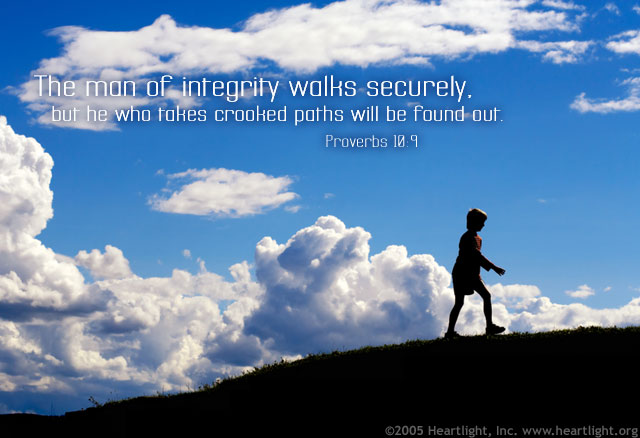
The integrity of the upright will guide them,
But the crookedness of the treacherous will destroy them.
Riches do not profit in the day of wrath,
But righteousness delivers from death.
The righteousness of the blameless will smooth his way,
But the wicked will fall by his own wickedness.
The righteousness of the upright will deliver them,
But the treacherous will be caught by their own greed

We see that the upright or righteous person will be delivered from death.  The fool or wicked person will be destroyed.  The money, possessions or whatever else they have gained from their crooked ways cannot save them.  We see people who have gained wealth and power from all kinds of things that are not pleasing to God.   We see people that appear to have it made who are not seeking God’s wisdom.  We see righteous people who are seeking God’s wisdom go through struggles.  However, It is made very clear that no matter what people gain from their wicked ways, in the end it will catch up with them and they will be destroyed.  In the end, the righteous ones will be delivered.

Another example from this chapter is verses 24-26

24 There is one who scatters, and yet increases all the more,
And there is one who withholds what is justly due, and yet it results only in want.
25 The generous man will be prosperous,
And he who waters will himself be watered.
26 He who withholds grain, the people will curse him,
But blessing will be on the head of him who sells it.

There are people who teach that this is specifically talking about wealth in the current time.  They say that if you give away $10.00, you will get $100.00 in return.  I don’t think that is accurate, and I don’t think it is even a great blessing compared to all the blessings that God does give us.  However, the generous man is the one who is doing what God wants, which makes it a wise decision.  The generous will be blessed.  The miser who withholds everything for himself will be cursed.  I think some of this comes in everyday life.  If someone who is generous and helpful has a problem, often people will help that person.  However, when someone who is greedy and never helps anyone else has a problem, people are unlikely to help that person.

Verses 29 and 30 say:

He who troubles his own house will inherit wind,
And the foolish will be servant to the wisehearted.
30 The fruit of the righteous is a tree of life,
And he who is wise wins souls.

The outcome of seeking Godly wisdom and following in God’s righteousness is life for themselves and for the souls they win.  We have to choose daily to seek after wisdom.  If we make no choice, foolishness and ultimately destruction are the default choice.

Andrew Hamilton

Sometimes the Greatest Discoveries Begin as Problems

Prov 16-3 bike

 Here are 4 ways to help you apply the proverbs to your problems.

 1. Learn how to read this book.

The real nature of most proverbs is not a rule that is used the same way in all circumstances at all times.

 Rather, a proverb is often a recommended way of acting that will be wise in some settings and not in others. Or, a general observation of experience that is very often true and useful, but not always true in every situation. The same act may be wise in one setting, but foolish in another. The same fact may hold in one situation and not in another.

 The same is true of proverbs that state a fact, not just proverbs that call for an act: “absence makes the heart grow fonder” and “out of sight, out of mind.” Or “birds of a feather flock together” and “opposites attract.”

 These are all true proverbs. But they are not always true in every situation.


2. We learn that life is too complex to be lived by proverbs alone. We need wisdom to know how to use the proverbs.

 When the author tells us, back to back, “Answer a fool according to his folly,” and, “Don’t answer a fool according to his folly,” he is teaching us that we need discernment about when to do the one and when to do the other.

 If a sergeant tells his platoon to walk slowly and carefully, and also tells them to run like crazy, he expects them to know that sometimes they are navigating a minefield, and sometimes they are under fire in the open country. You store away both pieces of advice in your mind. Wisdom knows when to use the one and not the other.


3. We learn that proverbs alone do not make a fool wise.

A perfectly good proverb in the mouth of a fool does not make him wise. It makes him useless at best.  Proverbs alone don’t make fools wise.

 What does help us become wise? A mixture of (1) storing up proverbs and other forms of revealed wisdom, (2) meditation on them, (3) serious prayer for God’s help, and (4) a divine gift of wisdom.

 Proverbs alone don’t make you wise. You must be wise to use proverbs wisely


4. We learn that we should store up reasons why a proverb might be useful sometimes and not other times.

In other words, store up this truth: there are times when it will be pointless to answer a fool, because it will only drag you into his folly. It’s best to just let him make a fool of himself and be discredited rather than ruining your own usefulness.


But also store up this truth: there are times when he is not just making a fool of himself, but also is drawing dozens, or thousands, into his folly so that he feels justified and wise in his foolish ideas. You need to step in and expose him as foolish for the sake of others, and for his sake.

Pastor Andy

Commit to Live Wisely

We are all on a journey, a quest.  Somewhere between our quest for truth and facts, and our desire for virtuous character, lies a quality that is rarely considered these days: wisdom. Wisdom is competence with regard to the complex realities of life. It is the ability to know what is the best thing to do in the majority of life situations which the accepted moral rules do not clearly address. The course of our lives is greatly determined by the many daily choices we make, and the Book of Proverbs is a guidebook to help us navigate those choices wisely.

The two major themes which are interwoven and overlapping throughout Proverbs are wisdom and folly. Wisdom, which includes knowledge, understanding, instruction, discretion, and obedience, is built on the fear of the Lord and the Word of God. Folly is everything opposite to wisdom.

I will be taking you through chapters 13-16 and the verse that best encapsulates all of those chapters is Proverbs 16:3: “Commit to the LORD whatever you do, and your plans will succeed.”

What plans are you pursuing and are they on the wise path?  Join us on this path of discovery this week.

~ Andy Cisneros


Wisdom from The Princess Bride – And Solomon, Of Course.

Ecclesiastes 5-8

ecclesiastes-5-10

Wednesday, February 1

I promise, King Solomon is going to offer us wise, uplifting counsel.  It’s just not going to be in today’s reading. Today’s themes are the futility of work ( we’ve heard that before), the wisdom of solemn considerations, the overall unfairness of life.
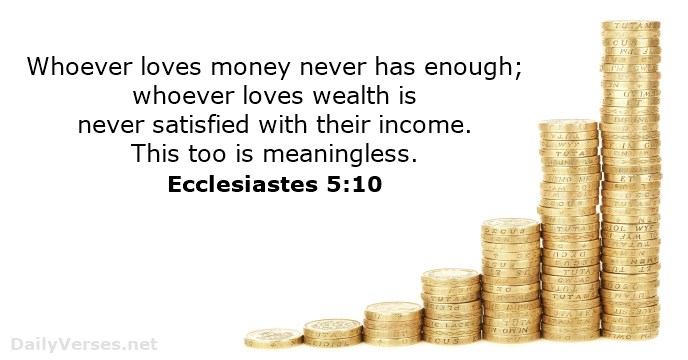
Chapter 5 opens with a warning to not pretend to please God with foolish words or hasty vows.  Solomon then warns against hoarding riches.  In verse 10 basically Solomon is saying, Mo’ money, Mo’ problems.
He does end the chapter with the positive observation that finding joy in one’s work and activities is a gift from God. If we are occupied with gladness of heart from God, we don’t have time to reflect, sadly I suspect, on the days of our lives.
Chapter 6 restates what Solomon said in chapter 4. In fact, in both he states that it would have been better to never have been born (verse 3 in chapter 4 and verse 3 in chapter 6) than to live a futile life.
I love verse 7:1.  We always celebrate the birth of a baby, in part, for all the hope the baby represents.  We celebrate not the death at the end of a person’s life, but rather the fulfillment of that hope.  Solomon is saying this celebration is better than the one at birth. In addition to celebrating that person, it reminds us of our own mortality and the need to make our time matter.  The following verses add to this thought.
When I was at Ball State for a whole semester, I was terribly homesick.  I found verse 7: 8, “The end of the matter is better than its beginning, and patience is better than pride.”  I wrote it on a piece of paper and pinned it to the wall.  It reminded me to be patient, the semester would end soon and it would certainly be better than the beginning. I would learn something from this awful experience.  I don’t remember where I thought the pride  part fit in, but it made sense to me at the time! This verse meant a lot to me and got me through that semester.
Most of Chapter 8 seems to suggest that King Solomon believed that if you do good, you will be rewarded.  But some of the verses (10 and 14) point to the fact that sometimes the wicked are rewarded and the good are punished.  I have several friends who go to tanning beds.  I have several friends who do not.  Would you believe two of my friends and I, who have never seen the inside of a tanning bed, are the ones who got skin cancer!!!! Talk about not fair! I am not saying tanning is wicked or that I want my tanning friends to get skin cancer, but it is frustrating to do all the “right” things and still suffer.  I think King Solomon understands my frustration. : )
I suspect Solomon would agree with the grandfather in The Princess Bride.  “Who says life is fair, where is that written?”  It certainly isn’t written in this chapter (or any scripture for that matter)!  God has never promised His children an easy or “fair” life.  Solomon knew that.  But he also knew that serving God is the only way to give meaning to life.  He will reassure us of this in tomorrow’s reading.
Until then, Maria Knowlton

When asked to give a short bio of herself Maria said, “I have one great husband, two wonderful kiddos, and will be a nurse in 12 months!”.  Those who know Maria would also add that she brings joy and life to every project she attacks (be it heading up the school science fair, providing first aid at Family Camp, being a spokesman for Indiana Donor Network, attending nursing school, or teaching at church in northern Indiana).  She is a model of faithfulness as she points others to her faithful God. 


(Photo credit: https://dailyverses.net/ecclesiastes/5/10/esv)

My Mouth – Wise or Foolish?

Proverbs 8-10

proverbs10_9


Monday, January 23

In/Out, Hot/Cold, Wet/Dry, Over/Under, Near/Far.  Beginning at a very young age opposites are a great learning tool.  Toddlers learn what wet is because it is the absence of what dry is, and vice versa.  Wise Solomon similarly employed the power of opposites throughout the book of Proverbs.   Wise/Foolish is the ultimate lesson of contrasts.  But in teaching the multitude of differences between wise and foolish numerous pairs of opposing opposites are introduced: joy/grief, diligent/lazy, wealth/poor, love/hatred, nourish/die, choice silver/little value, length to life/years cut short, refuge/ruin, and righteous/wicked.  A very clear picture emerges of what is indeed wise and what is not.  And with the picture comes a strong desire to find myself more and more camped out on the side of the wise.  But how do I do that?

Mouth, lips, words, tongue – it becomes obvious that wisdom is not just for the mind and following God is not just for the heart.  Our mouths must play the part, too.  Some great verses in Chapter 10 are aimed at the use of the mouth.

10:11 – The mouth of the RIGHTEOUS is a fountain of life,  but violence overwhelms the mouth of the WICKED.
10:21 – The lips of the righteous nourish many, but fools die for lack of judgment.

10:31 – The mouth of the righteous brings forth wisdom, but a perverse tongue will be cut out.

10:32 – The lips of the righteous know what is fitting, but the mouth of the wicked only what is perverse.

And, we not only read of how to use our mouth – there is a helpful reminder when NOT to use it as well . . .

10:19 – When words are many, sin is not absent,
but he who holds his tongue is wise.

Dear God – May I use my mouth as a fountain of life that nourishes many – those in my house and in my church, neighborhood, school, social media and employment.   May the words I speak (as well as those I chose not to say) give life and point others to you.   Help me know when to keep my mouth shut – putting an end to useless arguments, pride, put-downs,  harmful dissension,  potty mouth, “little white lies”, and big black ones, too.  Help me be more intentional about how and when I use my words – that they might draw me closer to you and to becoming what you desire for me.
In Jesus Name, Amen.

God Bless Your Reading,
Marcia Railton
(Photo credit: http://www.verseoftheday.com/en/09102013/)