
Leviticus 8-10
Leviticus is usually the most difficult book for people to read through, specifically because so many of the rituals from the ancient time of the Israelites don’t apply anymore. Many Christians when they come to this book in their Bible reading plans enter “skimming mode”, and brush over most of the content. However, we may be surprised at just how important this book really is when it comes to experiencing the presence of God. In order to understand how significant Leviticus really is, we need to look at the end of Exodus to grasp the story.
“Then the cloud covered the tent of meeting, and the glory of the LORD filled the tabernacle. Moses was not able to enter the tent of meeting because the cloud had settled on it, and the glory of the LORD filled the tabernacle.” – Exodus 40:34-35 NASB1995
The story up to this point has been God desiring to be with His people, but when His glory finally does come to earth in the tabernacle, even Moses isn’t able to experience it fully… Leviticus is the answer to the problem. Through the rituals and the laws that Leviticus spells out for the Israelites, they are able to fully experience God’s presence. What is really cool about this book is that it worked: when we come to the following book of Numbers, Moses is finally able to enter into the tabernacle and see God’s glory.
“Then the LORD spoke to Moses in the wilderness of Sinai, in the tent of meeting, on the first of the second month…” – Numbers 1:1 NASB1995
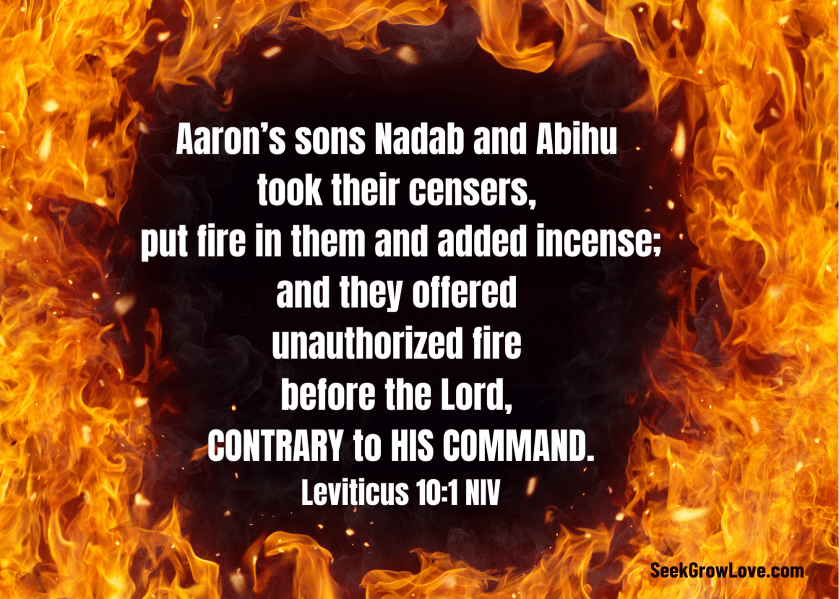
Moving forward, I hope that you will have a renewed appreciation for this often misunderstood and skipped-over book, especially as we discuss our chapters today. Through the first seven chapters, God has been telling Moses and his brother Aaron about all the very specific details they need to follow in order to bring forgiveness of sins into the Israelites’ lives. When we come to chapter eight today, they begin to put these instructions into practice: however, not everyone follows the clear instructions from God and suffers for it. Aaron’s sons, Nadab and Abihu, didn’t follow the proper procedure for worshiping before God, choosing to offer “strange fire” (10:1) onto the altar. Because they didn’t follow God’s instructions, they were struck dead and stand as an example for everyone that will worship afterwards.
We learn that God takes worship SERIOUSLY: to “worship” Him in an unworthy manner will not be tolerated. He told Moses and Aaron, “By those who come near Me I will be treated as holy, and before all the people I will be honored.” (10:3) He is a good God and Father who tells us exactly what we need to do, but will punish those who choose to “try it their own way”, especially those in positions of religious authority. No matter what, when we come to worship before our God and before our Savior, Jesus, we need to treat it as a serious matter, and seek to bring them total glory. True worship goes far beyond what type of music is played (hymns or contemporary), what order of service our church has “always used”, and beyond how we “feel” after the service: true worship is about God and Jesus being honored and exalted. If you don’t have that as your primary focus, nothing else matters.
-Talon Paul
Reflection Questions
- Give some examples of how the world “tries it their own way” instead of following God’s instructions. When have you “tried it your own way” instead of following God’s instructions?
- We aren’t told what Nadab and Abihu might have been thinking as they were experimenting with their ‘strange fire’. Whar are some possibilities?
- Instant death is not always the consequence for acting contrary to God’s commands. What are some other consequences you have seen or experienced for acting contrary to God’s instructions?
- Why do you think God places such great importance on worship, and worship done right? How do we come into His presence today?
 Seek Grow Love