
2 Kings 9-11
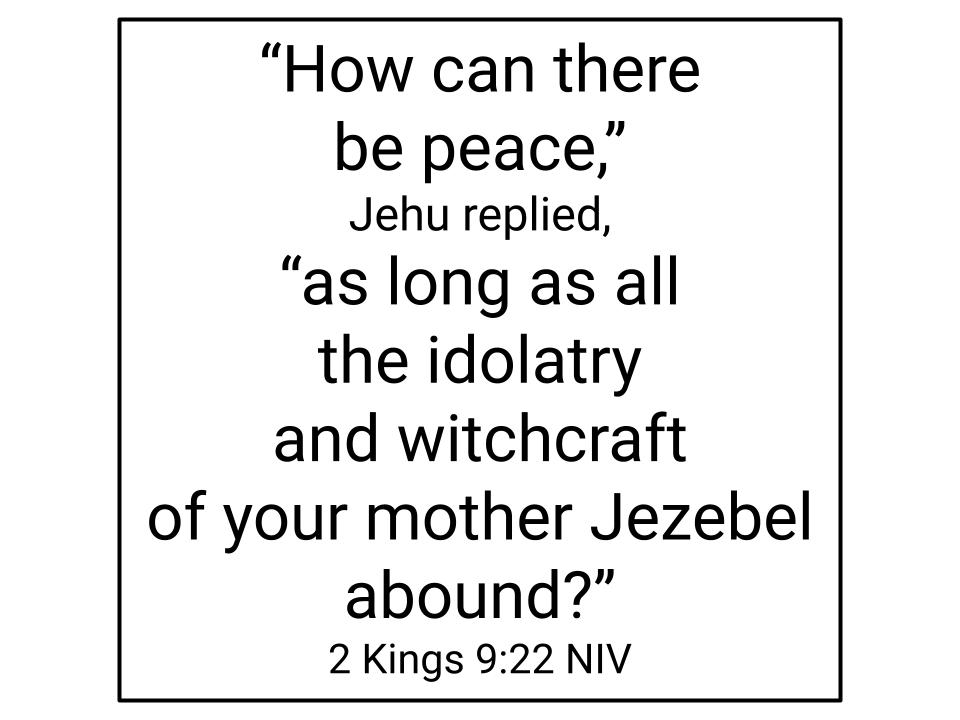
In Second Kings chapters 9-11 we read largely about the obedience of King Jehu in attempting to remove idolatry from Israel. In the midst of that content there is an interesting concept that rings fairly true to today. In Second Kings 9:22 Joram asks Jehu if he has come in peace. Jehu responds, “How can there be peace as long as all the idolatry and witchcraft of your mother Jezebel abound?” Jehu is clearly communicating that peace does not come between God and evil. Our application should be a bit cautious, but clear.
Some would take a verse like this to somehow support a Christian committing an act of violence against an unbeliever. This is not a proper application of this concept and should not be condoned. Rather, it is important to recognize that there is a difference between the ways of God and the ways of evil, and those who support the ways of God will be different than those who support the ways of evil. King Jehu recognized that the ways of Joram were opposed to the ways of God so there would be no peace between them.
In the New Testament we find language that concurs with this concept. Philippians 3:20 says, “But our citizenship is in heaven. And we eagerly await a Savior from there, the Lord Jesus Christ”. First Peter 1:1 says in part, “To God’s elect, strangers in the world, scattered through Pontus…” Once we become a believer, we align ourselves with God and His plan and ways. This causes us to become strangers in the world, as we are different than the world. Our citizenship is no longer of the world, but rather we become citizens of heaven. Our eternity will be on the earth, after Jesus restores it through the millennial kingdom. This is why Paul says at the end of Philippians 3:20, “And we eagerly await a Savior from there, the Lord Jesus Christ”. However, our hearts and lives belong to God, who currently resides in heaven. Our citizenship is with God in heaven, not of this earth.
Therefore, there is not peace between us and the world. We are different. Our lives should look different and we should be different than the world. I believe this is the connection we can make to King Jehu’s response of clearly communicating that peace does not come between God and evil.
How should we respond then? We should recognize that our lives are different from the world. Sometimes that will cause awkwardness in our lives. I attempt to hold pretty clear boundaries for the movies, shows, videos, or even reels I will watch. If someone sends me a link of a video to watch I will ask about what it is and the content of it. I sometimes ask if it includes any of the things I attempt to not visually consume. This causes tension or awkwardness socially. But I know it is best for me to be different in this way.
However, even though there is not peace between God and the world, we should still strive to live at peace with others. Romans 12:18 says, “If it is possible, as far as it depends on you, live at peace with everyone.” My response to King Jehu’s question should not lead me to go against God’s call to peace found here. I live a different life than the world, but I also strive for peace with others, that I might show them the love of God each day of my life. In doing this, I may win one for Christ!
-Michael Cisler
Reflection Questions
What are ways in which you can live more for God, and therefore not be at peace with the world?
How can you show others around you that you are intentional about living at peace with all people?
In what ways can we cope with the tension that sometimes is created by living at peace, but being different?
 Seek Grow Love