
Numbers 7-8
*Psalm 16
Mark 1
-Devotion by Andy Cisneros (SC)
Good morning! Yesterday we meditated on Psalm 16:4. Where David underlines his radical preference for God by putting it negatively. He values God so highly, he will not dare to run after other gods. “The sorrows of those who run after another god shall multiply; their drink offerings of blood I will not pour out or take their names on my lips.” In other words: it is sheer stupidity to turn away from the all-satisfying God only to embrace gods that leave you sorrowful in the end. No, I will never do that. I won’t even put their names on my lips.
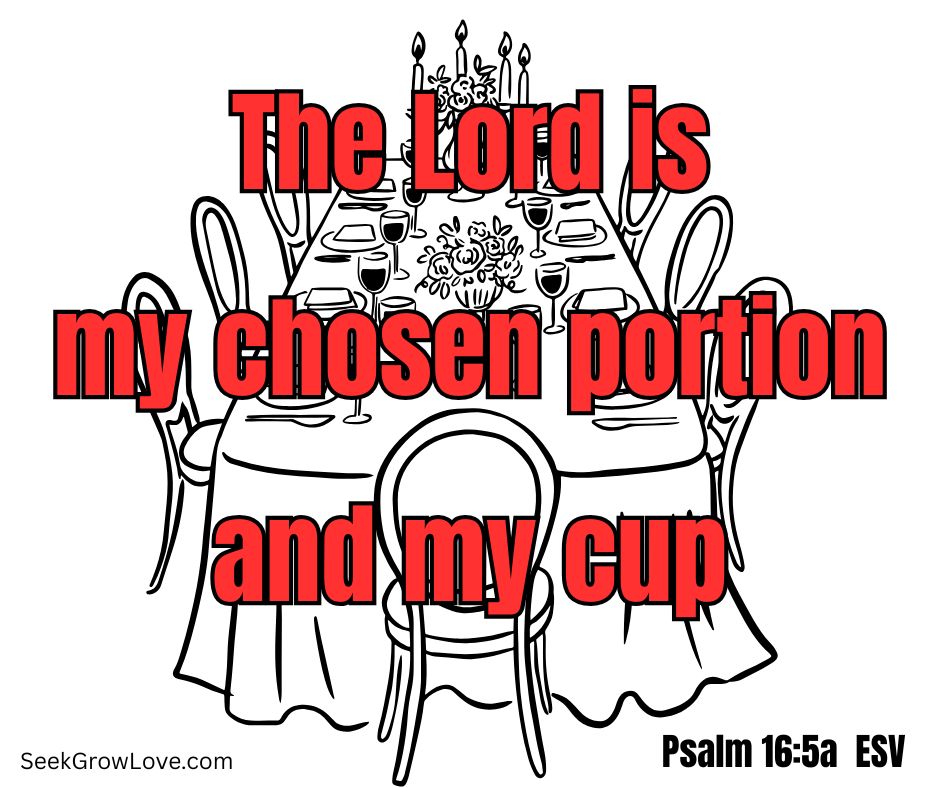
Then in Psalm 16:5, he returns to the declaration of verse 2: “I have no good apart from you.” Here he puts it positively: “The Lord is my chosen portion and my cup.” In other words, if there are a hundred portions of food and drink spread out on the table, and one of them is the LORD himself — he is my choice. Nothing satisfies; nothing nourishes and sustains — the way he does. He is my greatest good. My treasure of all treasures. My highest pleasure. My chosen portion of sirloin. My cup of finest wine.
Then later in verse Psalm 16:5, he returns to what he has said in verse 2. He said, “I say to the LORD (Yahweh), ‘You are my Lord (Adonai).’” He declared that God was his master and higherup or sovereign. Here in verse 5 he does the same: “You hold my lot.” In other words, when the dice are rolled, and the straws are drawn, and the wheel is turned — whatever happens to us comes from the hand of God. God holds my lot. God decides it. God rules over it. God is my sovereign, and I am glad to have it so. I don’t just affirm it nonchalantly; I live in it with excitement.
In Psalm 16:6, he shouts out what this means for him. Because God holds his lot, “The lines have fallen for me in pleasant places; indeed, I have a beautiful inheritance.” The “lines” here are probably borderlines, the borders or boundaries God has appointed for him. They may be figurative, or literal, or maybe both. I tend to say the borderlines may be figurative because the phrase “pleasant places” is a single Hebrew word that means “pleasures.” It’s the very same word as the one in Psalm 16:11 translated “pleasures”: “At your right hand are pleasures forevermore.” The translation here in Psalm 16:6 should maybe be: “The lines have fallen for me in pleasures, I have a beautiful inheritance.” The “pleasant places” (of verse 6) may be not so much good acreage in Palestine, but the place at God’s right hand, as verse 11 says. “The lines have fallen for me in pleasant places” would then be: “Your sovereign goodness has fenced me in to God himself. The borders of my life are boundaries around where God is.” And when he adds, “I have a beautiful inheritance,” the ultimate meaning would be: God. God is my inheritance, and He is beautiful. That’s where Psalm 16:11 leads us. Where are you being led today?
Reflection Questions
- Is God your inheritance? If so, why is that a beautiful inheritance? If not, why not?
- What does it mean to you to say, “The LORD is my chosen portion and cup”?
- How would you describe your relationship with God, how valuable He is to you, and what benefits you receive because of your relationship with Him?
Prayer
Dear Lord God, help me to see how incredibly worthy You are to receive my praise, worship and adoration. Help me to see, but never experience, where I would be without You. Help me to not take You and my relationship with You for granted. May my life show that You are my portion and my cup – I chose You and You sustain me and give me all I need for life. I rely on You. Thank You for being my God.
 Seek Grow Love