The Covenant Story Begins

Genesis 12-15

Genesis 12 1 CSB

Genesis 1-11 details the heartbreaking story of a perfect world and people, created lovingly by God, turning away from him to pursue the desires of their heart. The consequences for this sin is great, but like the rainbow after the flood symbolizes, the redemption God provides is also great. In Genesis 3, God promises a future savior who will fight for and redeem mankind. In today’s reading, we see the plan set in place since the beginning start to take shape.


In Genesis 12, God tells Abram, a man from Ur (in Mesopotamia), “Go out from your land, your relatives, and your father’s house to the land that I will show you. I will make you a great nation, I will bless you. I will make your name great and you will be a blessing. I will bless those who bless you, and I will curse those who treat you with contempt, and all the peoples on earth will be blessed through you” (vv. 1-3).


These verses are so important, because in them, we see the storyline of the redemption begin. God chose Abram, the man from whom the Jewish people would be descended, and made a covenant or promise with him. If Abram followed God’s plan, then he knew that he would be blessed by God. This covenant was built on and changed over the course of scripture, but ultimately, it is still being fulfilled even now through Christ’s death on the cross. Abram began the chain reaction that led to Christ’s birth, death, and resurrection. Because Abram listened to God, we are blessed through him.


Abram is a prime example of a faith filled life. He didn’t know anymore of God’s plan than just to go and leave everything that he knew. Despite this, he eagerly followed God. This pattern of obedience continues throughout the rest of his life. When presented with God’s new covenant, the promise of salvation in Christ, do we faithfully trust that he will keep his promises? Do we faithfully obey when we hear his call?


As we read through the Bible this year, keep an eye out for the word covenant. God continues to refer to both this first promise and the promises he made after this as he faithfully pursues his covenant people.
Cayce Fletcher
You can read or listen to today’s passage at https://www.biblegateway.com/passage/?search=Genesis+12-15&version=CSB
Tomorrow’s passage will be Genesis 16-18 as we follow the 2020 Chronological Bible Reading Plan

The Struggle with Sin Continues

January 3 – Genesis 8-11 

Genesis 9 20 NIV.png

Genesis 8-11 is a story of great hope and promise, and also a tragedy that reminds us all of our brokenness before God. After the great flood that God brought on the earth to remove all the sinful people, He is now ready to start over with Noah and his family. God gives them the same commands that He gave to Adam and Eve: “be fruitful and multiply, and fill the earth.” (9:1) The story appears to have taken care of humanity’s disobedience; unfortunately, that’s not the case. Noah apparently is just as sinful as everybody else, falling into a drunken stupor, and then something suspicious happens with his son, Ham. While we don’t know exactly what happened in this scene, we do know that it was sinful, as Ham’s son is cursed because of what took place.


This story should remind us all of just how broken we truly are. Although we have been redeemed by God through Jesus’ sacrifice and have escaped from the Final Destruction through his death, we still fall short and sin against our God. (Romans 3:23) The apostle Paul tells us his own struggle with sin, by stating that “I am not practicing what I would like to do, but I am doing the very thing I hate.” (Romans 7:15) He continues and says that, although his status is “in Christ”, his body still struggles to do the right things and falls into sin (Romans 7:18-25).


If you have accepted Christ, you are now experiencing a tension within yourself: the battle between the Spirit and the flesh (see Romans 8). Although you know that you have been saved by Jesus Christ, and desire to do the right thing, your “flesh” still struggles with sin. This is a constant struggle that we will face until Jesus comes back to finally deal with sin completely, in our hearts and in the world. This is a struggle that is painful and reminds us daily that “no one is righteous” before God (see Romans 3:9-12). However, it is a blessing, since God’s Spirit is working within us to clean up the areas where we are still dirty with sin.


Today, I challenge you to be aware of the decisions that you make. Is this something that is in line with God’s Spirit, or is it something that would be considered a “deed of the flesh”? (Galatians 5:16-25) Does the action I am about to take bring life or death? Does it build others up, or does it tear them down? Is it beneficial to my faith, or is it a barrier?


As you struggle along this journey of the Christian path, I want to encourage you that the hardship is absolutely worth it in the end! God loves you and is with you through this!


Talon Paul


Print your yearly reading plan here –  2020 Chronological Bible Reading Plan

Read, or listen, to today’s passage here – https://www.biblegateway.com/passage/?search=Genesis+8-11&version=NIV

The Cure for Death

January 2 – Genesis 4-7

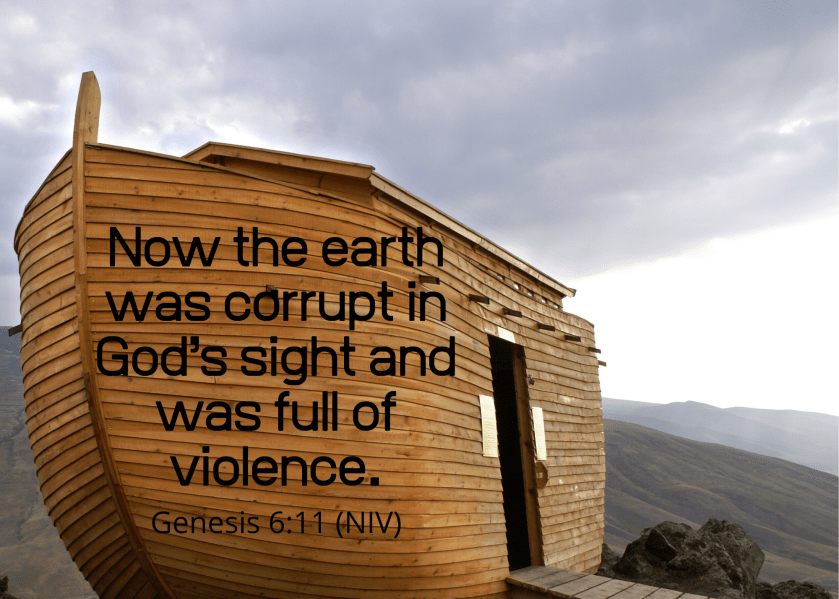
Genesis 6 11 niv

The tragedy of the Garden of Eden continues, as we see the effects of the humans’ disobedience played out in a very real way. Brothers begin to kill each other, women are taken as “prizes to be won”, destruction throughout God’s creation grows exponentially, and even angels begin to break their commitment to God, coming down to mate with human women! (Depending on your interpretation of Genesis 6) God’s solution is to “clean the slate” and destroy humanity with a flood, starting from scratch with Noah and his family. It is surprising that things got this bad, right? Well, maybe it’s not as surprising as we may think…


We are told in 2 Peter 2:4-10 that this event happened “as an example” of what will happen when God returns to earth again; sinful humanity will be destroyed again, leaving only “the righteous” left on earth to inherit God’s Kingdom. In 1 Peter 3:18-22, we are told that we have the opportunity to be saved from this destruction through the sacrifice of Jesus and responding in faith by being baptized. Thankfully, we are also told in 2 Peter 3:3-9 that God is being patient with us all about bringing this destruction, desiring that everybody in the world come to repentance and faith in Jesus, so that they can be saved.


While this may seem like a very dark devotion, it should motivate us and make us appreciate the sacrifice that Jesus made even more. It is only because of Jesus’ willingness to die on our behalf that we have the opportunity at salvation in God’s Kingdom (see Ephesians 2:8-10), not because of anything we have done. God has been gracious and provided us a way out of destruction through His son, all because He loves us and wants to spend eternity with us.


This story should also motivate us to share this message with our loved ones, giving them the opportunity to be saved as well. If you had the cure for cancer, would you keep that information to yourself, or would you share with everybody that you came into contact with? This message is even greater than that; it is the cure for death itself, and a promise for immortality. Why are we not sharing with people every chance we get?


As you go about your day today, I want you to remember three things from this story:

  1. Your actions have real consequences, so think before you act
  2. God loves you and has provided a way for you to spend eternity with Him
  3. You need to love someone enough today to share the gospel with them, giving them a chance at salvation


As you consider and act on these three things, I will be praying for you!

Talon Paul


Day 2 of 2020 Chronological Bible Reading Plan

Today’s passage can be read or listened to at BibleGateway (https://www.biblegateway.com/passage/?search=Genesis+4-7&version=NIV)


Believing the Lies

January 1 – Genesis 1-3

Genesis 3 4 (NIV)

The opening chapters of Genesis play out like a graphic novel, presenting us with the dream scenario where the world is perfect, God is dwelling among His creation, and human beings are in perfect relationship with each other and their Creator. Unfortunately, the scene does not last very long, as the human beings forget their Creator and disobey, bringing an end to God’s perfect world. They start to blame each other, are ashamed of the way that they look, and are separated from God’s presence. It is a terrible tragedy, but one that we still experience today.


At the very core of this story, and the reason that the humans disobeyed God, is because they believed a lie rather than the truth of their Creator. The serpent in the garden promised the humans that if they ate of the forbidden fruit, that they would “be like God, knowing good and evil.” What is tragic about this story is that the humans are already like God, being made in His image (1:26-28)! They did not believe the words spoken by their Creator, and instead, let the lies spoken by the serpent define and destroy them.


Unfortunately, this isn’t just a story of the past, but a daily struggle that every human being faces today. The teenage boy is told that he isn’t worth anything because he failed to perform well at a sporting event. The young girl is told that she is ugly because she doesn’t match what the pictures show in the magazines. The elderly man is told that he is no longer useful since he can’t operate the same way as he could in his youth. The barren woman is told that she has no purpose because she struggles to bear children in this world. And the list continues to go on and on…


These are all lies that the serpent still tells God’s creation, in order to drive them into despair and death (see John 10:10). We see and feel this on a daily basis; we all buy into the lies of the serpent, forgetting the truths that God pronounces over each of us. Scripture tells us that God loves us (John 3:16), that He has plans for us (Jeremiah 29:11), that we are chosen in Christ (Ephesians 1:4), that we are forgiven of our sins in Jesus (Romans 8:1), and that God made each and every one of us in a very special, personal way (Psalm 139:13-14).


Today, I want to encourage you to listen to the truths of your Father and forget the lies you’ve been told. You are valuable. You are precious. You are loved. You belong to Him. God cares deeply for you, and wants you to come into a real relationship with Him like our ancestors had in the Garden of Eden. Come before Him through the blood of Jesus and rest, knowing that your Creator tells you the truth.


Talon Paul


Day 1 of the 2020 Chronological Bible Reading Plan


Here’s a link to BibleGateway.com where you can read, or listen to, today’s passage:

https://www.biblegateway.com/passage/?search=Genesis+1-3&version=NIV


The End of the Patriarchs (Genesis 48-50)

At the end of their lives the patriarchs bless their children.  The ancients believed words matter.  If you asked them, “What’s wrong with the world?”  or “Why is the world broken?” they would answer, “The curse.”  What’s wrong with the world is that God cursed it–using words.  So, how should we expect the world to find healing and redemption?  How does God plan to undo the consequences of our first parent’s rebellion?  He blesses.  First he calls Abraham and blesses him.  Abraham calls Isaac and blesses him.  Isaac calls Esau, but Jacob impersonates him to receive the blessing.  Even so, now Jacob has come to die and he wants to pass on the  blessing to his twelve sons who will become the twelve tribes of Israel.  Somehow or other, God is going to use this dysfunctional Abrahamic family to initiate his master plan of redemption that will one day culminate with making everything wrong with the world right.  Jacob is here playing his part in God’s agenda.

What’s interesting about how he blesses his children is that for several of them, the blessing sounds more like a curse.  For example, to Levi and Simeon he says, “Cursed be their anger…I will divide them in Jacob and scatter them in Israel.”  Through Jacob’s words, God is prophesying about the future.  Indeed Levi was scattered throughout the tribes and Simeon was absorbed into Judah.  What’s so fascinating about the blessing is that Israel passes over his first born, Reuben, as well as his second and third born, Simeon and Levi, and he jumps to boy number four–Judah.  He compares Judah to a lion and then says, “The scepter shall not depart from Judah, nor the ruler’s staff from between his feet” (Genesis 49.10).  This prophesy is rather staggering as we look forward to the rest of the bible.  The great king David and his successors were from Judah.  Ultimately, Jesus, himself, descended from Judah.  So, how did Jacob know which of his children would hold the scepter?  The odds of guessing it right are only one in twelve–about 8%.  God was working with this man of faith to know what to say and whom to say it to.  Jacob might be old, be he is still walking with God, right up until his last breath.

After Jacob dies, we learn about how Joseph forgives his brothers rather than taking vengeance into his own hands.  Ultimately, Joseph himself arrives at death’s door.  We read in the New Testament hall of faith the following about Joseph:

Hebrews 11.22
By faith Joseph, at the end of his life, made mention of the exodus of the Israelites and gave directions concerning his bones.

Out of everything that Joseph went through, his heroic perseverance and faith in God, this is what he is remembered for.  When he came near to death, that same Abrahamic promise that had burned in Israel’s heart, blazed in Joseph’s as well, even while he came to the end of his life.  He expressed his faith by this last request:

Genesis 50.24-25
24 And Joseph said to his brothers, “I am about to die, but God will visit you and bring you up out of this land to the land that he swore to Abraham, to Isaac, and to Jacob.”  25 Then Joseph made the sons of Israel swear, saying, “God will surely visit you, and you shall carry up my bones from here.”

Look at the faith of this man!  He’s suffered so much in the course of his life and yet he never gave up on God.  He had been elevated to the highest office in the land, next to Pharaoh, and he still retained his faith.  In the end, God’s promises to Abraham, Isaac, and Jacob would not die.  One day he would return to the land of his childhood.  It would be centuries, but eventually, when the Israelites came out of Egypt, they carried Joseph’s sarcophagus with them through the desert and laid him to rest in the promised land.  Whether you experience hardship or prosperity, be like Jacob and Joseph and keep faith your in God’s promises to bring the kingdom.

Faith to the End (Genesis 46-47)

In these chapters Israel and his children and grandchildren migrate to Egypt, totaling seventy people.  They left the parched promised land behind and came to live under the care of Joseph.  I can understand why Israel was reticent to move down.  He remembered the stories of his grandfather, Abraham, about how God had promised to give him the land of their sojourning.  He was now 130 years old and had lived in Canaan most of his life.  Imagine living through over a century of nomadic shepherding, seeing bounty and famine, ups and downs, good times and bad ones.  Should he just ride this one out or should he uproot his entire extended family and move them to Egypt.  What would this mean about the covenant God made with Abraham, Isaac, and him?  If he leaves, does that mean he is giving up on God?  This is probably why God came to Israel in the night.  He spoke to him and told him not to be afraid to go down to Egypt and that he would go down with him.  After God assured him, Israel packed up the family and went to Egypt.  There, this group of nomads would incubate, growing from seventy to well over a million souls.

When Israel finally came face to face with Pharaoh he said, “The days of the years of my sojourning are 130 years.  Few and evil have been the days of the years of my life, and they have not attained to the days of the years of the life of my fathers in the days of their sojourning” (Genesis 47.9).  Israel had suffered greatly throughout the course of his life.  He duped his blind father under his mother’s advice to steal his brother’s blessing and then ran away to hide out in a foreign land.  While living with his uncle, he got duped himself repeatedly.  Laban constantly changed his wages and performed a switcheroo on his wedding night, substituting Leah for Rachel.  After twenty years of toiling under Laban’s greedy gaze, he finally broke free.  Terrified of meeting his angry brother Esau, Israel journeyed back home.  Fortunately his brother was no longer out for blood and the two established peace.  However, his overt favoritism of his one wife over the other three led to severe relational pain.  So jealous were his sons of the way Israel treated Joseph that they resolved to murder the lad and tell their father a beast tore him to pieces.  Although they sold Joseph into slavery, they still told their father his favorite son was dead.  Israel grieved for Joseph for days, months, years, and decades.  Indeed, his life was full of suffering: some self-inflicting and some just happenstance.

Yet, this is not the end of the story.  Israel may not have unlocked the secret to “Your Best Life Now,” but he did retain the faith of Abraham.  He may have poisoned his family relationships with favoritism, but he remembered the promise of God.  At the end of 147 years, he found himself on his deathbed in a foreign land, far from the land of God’s covenant.  As a result, his last request was simple.  He had Joseph swear to him, “Do not bury me in Egypt, but let me lie with my fathers.  Carry me out of Egypt and bury me in their burying place” (Genesis 47.29-30).  This seemingly insignificant and inconvenient request, is actually the indication of Israel’s tenacious faith.  He has seen a lot in his century and a half, but in the end he stayed true to the covenant.  He believed in his bones that God would give him and his descendants that land, and his last request was to receive a proper burial in the promised land.  Although he had suffered more than most in his life, he never gave up on God.  As a result, he will participate in the resurrection of the just and one day he will inherit that land as God promised.  I wonder, how deep is your faith?

Sat, Aug 6: Genesis 43-45

What would your steward say of you and your God?

As I read this portion of Joseph’s story, my attention gravitates towards one of the background characters – Joseph’s steward. He’s mentioned multiple times in Chapter 43, verses 16-25. A steward, similar to a modern day personal assistant, knows their master’s or employer’s business. But not just their professional business, often their personal and private business as well. It seems as though any given month you can see on a tabloid cover that some celebrity’s assistant or child’s nanny has some fresh dirt to smear the reputation with or “reveal the truth” about. But as we read in these verses, Joseph’s steward actually knows God by name and encourages Joseph’s brothers in verse 23 – “Don’t be afraid, Your God, the God of your father, has given you treasure in your sacks…” Joseph’s private and public life were in alignment. There wasn’t any discrepancy. His life was about serving God and those closest to him were able to recognize it.

So what does this mean for you and me? Well, lots. But I want to keep this short, so I’ll just share a quote I found and hope that it inspires you to be authentic and let your light shine before men.

bethany quote

“Live Your Life” image by Rose Sexton on quotesgram.com


Many Blessings,

-bethany ligon

Fri, August 5: Genesis 40-42

Those Pivotal Circumstances – and Influencing Others!

bethany chains

Hands in Chains” by George Hoden


Yesterday we took a look at how God used Providential Relationships to impact Joseph’s faith and today we’re looking at the Pivotal Circumstances in Joseph’s life. The life of Joseph is one of my personal favorites to read about. Every time, I am struck by his ability to remain positive and faithful even in the most dire of circumstances.

Others may disagree, but I think that one of the most Pivotal Circumstances in his life is when Joseph is in prison at the same time as the cupbearer and baker to interpret their dreams. We read in Genesis 40:6-7 that Joseph took notice that these two prisoners were dejected and he spent just a few minutes of his day listening to them tell him their dreams. Had Joseph just minded his own business, he would have lost on the opportunity to interpret those dreams and later on, interpret Pharaoh’s dreams as well. And had he not been able to tell Pharaoh to prepare for the famine that was to come, Joseph may have lost out on the chance to reunite with his family and oh yeah…save the entire Israelite community’s future.

Whatever your current circumstances are like, whether you are able to enjoy each and every day or your life feels like you’re trying to hold on to a 1600 pound bucking rodeo bull, your life can influence the lives of those around you. Be aware of how you conduct yourself because others are paying attention. If that sounds like some added pressure you aren’t sure how to deal with right now, you can have confidence that God will provide everything you need to not just been sustained, but THRIVE.

“And we know that in all things God works for the good of those who love him, who have been called according to his purpose.” — Romans 8:28

“And God is able to bless you abundantly, so that in all things at all times, having all that you need, you will abound in every good work.” — 2 Corinthians 9:8

Many Blessings,

-bethany ligon

Thursday, August 4: Genesis 37-39

Who Are Your Providential Relationships?

bethany beach

Footprints in the sand” by Andrew Huff is licensed under (CC BY-NC 2.0)

During our week at FUEL, we had the chance to examine five different ways that God uses to GROW our faith. It was on Wednesday that we took the time to hear the stories from Josiah Cain and Sean Finnegan of how Providential Relationships can impact the growth of our faith.

As we begin reading the epic story of Joseph in Genesis 37, we see multiple examples of the various relationships Joseph had and we begin to see how each played an important part in the development of his faith. Because of his relationship with God, Joseph was given some outrageous dreams for what his future would hold. Because of his relationships with his brothers, Joseph was sold off into slavery and taken to Egypt. Because of his relationship with Potiphar, Joseph had an unfortunate false accusation of misconduct and was sent off to prison.

When we think about Providential Relationships, it’s easy to have a narrow focus and just concern ourselves about the relationships that are easy and non-confrontational. But within these chapters we see how difficult relationships are often the ones that push us closer to God.

So if you’re in a difficult relationship right now (maybe it’s someone at school or work, or even a family member), take heart. God is near. He is guiding you every step of the way. Seek His wisdom to know what to say and how to act. Trust in God’s faithfulness to provide for your every need.

Many Blessings,

-bethany ligon


Wednesday, August 3 – Genesis 34-36

So you’ve committed to reading through the Bible…why? What’s the point? Are you reading to say that you’ve actually read through the book? Are you reading because someone dared you? Are you reading to learn more about the history of the religion?

BethanyJournal

Photo credit: @BethanyLigon (2016)


Or…are you reading because you are seeking after God? Does your soul thirst for His presence? Are you craving a different way of living?

As I read Genesis 35, I’m struck by what I read in the first few verses. Jacob has this intimate relationship with God. He has REAL conversations with Him. And these REAL conversations that Jacob has with God, initiate REAL change/action in his life.

  • Jacob up and moves his family
  • Jacob directs his family to get rid of all the man-made idols that they have accumulated
  • Jacob sets up an altar to God

When was the last time that you 1) had an encounter with God that was undeniable and 2) caused real change in your life?

As you participate in this Bible reading plan, it is our hope that you experience God in a new way and that your life is forever changed for the better because of the time that you are investing. And the best part is that you are not alone in this journey. You have a community of people doing the same thing that you are. If you have questions, concerns, or other issues that are on your mind, please reach out. We all want to GROW together.

Many Blessings,

-bethany ligon