The Great Search

Old Testament: Job 28 & 29

Poetry: Psalm 43

New Testament: Titus 1


We all consider certain things to be impossible for us, whether or not it is impossible for others.  Some may consider painting a picture that looks nice impossible.  Others may think that building a house is impossible.  But, these things are not impossible for everyone.  We know that there are people we could call to help with these things.


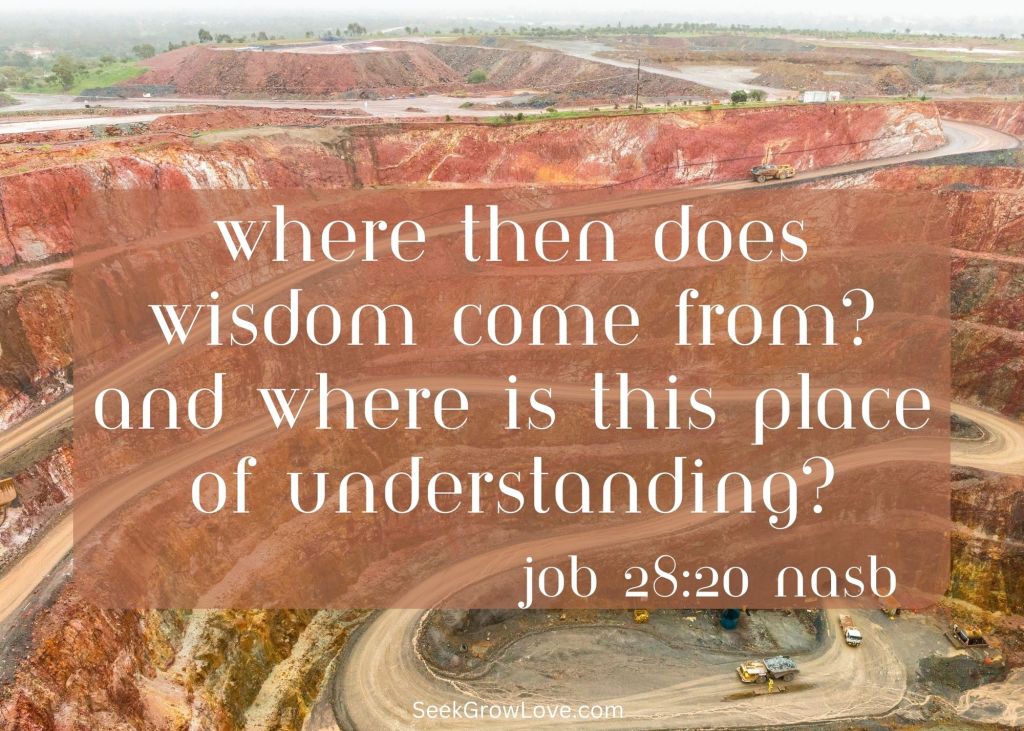
In Job 28:1-11, Job describes a task that may be considered impossible by some people: the search for gold and silver.  Man searches endlessly for this gold and silver, where the birds have not seen it and the lions have not walked.  It seems almost impossible for the man to ever find these treasures he seeks.  Yet, the man keeps searching after it, not giving up.  At the end of this section, we see that the man finds the hidden treasures and brings them forth into the light.  This task wasn’t impossible.  It wasn’t even the hardest task that man could seek to achieve.


In Job 28:12-28, we hear of an even more impossible task for man to try to accomplish: the search for wisdom.  Verses 13-19 show just how impossible this task is.  It is not found in the land of the living, the deep, or the sea.  It is more valuable than gold, silver, onyx, topaz, or any other valuable treasures.  Wisdom cannot be compared to any of these valuables.


If finding any of these treasures is almost impossible, as shown in verses 1-11, how hard must finding wisdom be with its value?  Where can we find wisdom?  Job 28:28 answers this question and says, “‘Behold, the fear of the Lord, that is wisdom;  And to depart from evil is understanding.’”  This seemingly impossible task is made possible by the fear of the Lord, with which wisdom is found.


In each of our searches for wisdom, we need to do two things.  First, fear the Lord.  In multiple places throughout the Bible, it says that the fear of the Lord is the beginning of wisdom.  Second, we need to ask God for wisdom.  In James 1:5-6, it says, “But if any of you lacks wisdom, let him ask of God, who gives to all generously and without reproach, and it will be given to him. But he must ask in faith without any doubting, for the one who doubts is like the surf of the sea, driven and tossed by the wind.”  

-Kaitlyn Hamilton

Reflection Questions

  1. What do you find valuable? What value do you personally place on wisdom? Job says, “the price of wisdom is beyond rubies.” (Job 28:18b). What would you say the price of wisdom is beyond?
  2. Describe the relationship between God and wisdom? What might Job mean when he says, “God understands the way to it (wisdom) and he alone knows where it dwells…he looked at wisdom and appraised it; he confirmed it and tested it.” (Job 28:20, 27)
  3. Where is wisdom NOT found? Where specifically do you search for wisdom?

Thirsty

Old Testament: Job 25-27

Poetry: Psalm 42

New Testament: Titus Introduction, below


“As the deer pants for the water brooks,
So my soul pants for You, O God.
My soul thirsts for God, for the living God;
When shall I come and appear before God;”

Psalm 42 starts off with a piece of beautiful imagery.  The writer of the Psalm compares himself to a deer who is thirsting for water.  Deer – like all living creatures – need water to survive.  However, deer may use the plants they eat as a supplement to the water they need, in order to lessen the amount of times they need to find a water source.  Most deer need to drink water daily, especially if they have been running around lots.  By the time a deer chooses to look for water, it is extremely thirsty.


In the comparison of the desire for God and a deer panting for water, we see a deep longing.  To want God as extremely as a deer wants water is incredible.  The author, by writing this, admits that he cannot live without God, just as a deer cannot live without water.  He is not saying that he would like to follow God some of the time when it is convenient, but instead is saying that he needs God every single day of his life.  Do you realize and accept that you need God every moment of your life to survive?  Are you looking for Him in your life as eagerly as a deer searching for a singular water source to get it through the day?


Further on in the Psalm, the author says, “Why are you in despair, O my soul?  And why have you become disturbed within me?  Hope in God, for I shall again praise Him  For the help of His presence.”  He explains that he thirsts for God because of the help of His presence.  The author acknowledges that hoping in God is like a deer being refreshed with a drink of water.  Are you seeking after God and hoping in Him like a deer panting for the water?

-Kaitlyn Hamilton

Reflection Questions

  1. Do you find yourself longing for God everyday?
  2. When you are thirsty for more of God what do you do, where do you go, what quenches your thirst?
  3. What do you do when your soul is in despair? Where do you find hope?
  4. How can you share God with someone who is thirsty?

Titus Introduction

Paul wrote the book of Titus to his mentee, Titus, Paul’s “true son in our common faith,” whom Paul had left in Crete to strengthen the new churches there and to appoint elders in every town.  Paul detailed the qualifications of an elder in Titus 1:5-9.

Paul reminded all Christians to say “No” to ungodliness and worldly passions, and to live self-controlled, upright, and godly lives while we wait for Jesus’ return (which Paul also called our blessed hope).  Paul also told Titus to remind the people to be subject to rulers and authorities, to be obedient, to be ready to do whatever is good, etc.

Finally, in Titus 3:9-11, Paul pointed out that Christians should have unity, where he said, “But avoid foolish controversies and genealogies and arguments and quarrels about the law, because these are unprofitable and useless.   Warn a divisive person once, and then warn him a second time.  After that, have nothing to do with him.  You may be sure that such a man is warped and sinful; he is self-condemned.”

-Steve Mattison

Being Refined

Old Testament: Job 22-24

Poetry: Psalm 41

New Testament: John 21

The process of refining gold or silver is very long and tedious, as they, when mined, are found with many impurities. To get rid of these impurities, these metals are heated to the extreme temperatures of the metal’s melting point. This allows the impurities to rise to the surface of the gold or silver, as the impurities are much less dense than the actual metal. The impurities can then be removed from the metal to the best of the ability of the refiner. After doing so, this process is restarted to continue trying to get rid of even more impurities that remain within the gold or silver.


Throughout the Bible, the testing of people’s faith is constantly compared to the refinement of metals, such as gold or silver. We all face many trials within our lives as we try to live out a life of faith. In James 1:2-4, it says, “Consider it all joy, my brethren, when you encounter various trials, knowing that the testing of your faith produces endurance. And let endurance have its perfect result, so that you may be perfect and complete, lacking in nothing.” James tells us all that we must take joy in knowing that our trials and testing of faith produce a good result in us. For these difficult times create endurance, and endurance creates in you perfection and completion. Note that James did not say that we were going to encounter a singular trial to produce endurance, but instead stated that we would encounter various trials to achieve the result of perfection and completion.


Job knew the same thing that James did. He knew that the trials that he was facing were going to bring him forth to be more perfect and complete from his endurance. While we do not know the exact length of time Job suffered, we do know that he must have had great endurance to face all of his trials. In Job 23:10, he said, “But He knows the way I take; When He has tried me, I shall come forth as gold.” Job knew that he was going through a process of refinement. He was being made more perfect and complete, becoming a piece of gold with fewer impurities. Knowing that he was going through refinement didn’t make any of the trials less for Job, but it did give him hope for the end of them at which he would be a refined person, more like God.


Job is not the only human who has and will face refinement of their faith. Each and every one of us will go through trials that test our faith. In Isaiah 48:10, it says, “Behold, I have refined you, but not as silver; I have tested you in the furnace of affliction.” Job was not put in an actual furnace of fire to be refined, and neither will we. But, we will all face the furnace of affliction in a way to refine our faith. Job was confident in the end result of his refinement by suffering. Are you as confident as Job that when the trials come you will stand in the end as a piece of refined gold?

-Kaitlyn Hamilton

Reflection Questions

  1. Is there a trial you have emerged from more “refined” than you were before? What did you gain through the difficult process? Can remembering that process and result help give you joy when you encounter the next trial?
  2. Sometimes, rather than being refined in a trial, people just melt, or the impurities seem to multiply. What makes the difference? How can you work towards using difficult times to improve and become more godly?
  3. What role does God take in your refining process?

Restoration in God’s Time

Old Testament: Job 19-21

Poetry: Psalm 40

New Testament: John 20

There is an expression about starting a family that has passed down from one generation to the next that goes something like this: “If you wait to start having children until you’re ready, you will never have them.”  There is much truth in this.  While you can prepare for being a parent by accumulating wealth, knowledge, and supplies, no one can really be prepared to take care of a tiny, fragile human 24 hours a day without on-the-job training.  Being that my wife and I’s first experience of inexperience was with twins, we felt conservatively confident that we could manage it when we found out child three was going to be a singleton birth.  However, I wasn’t ready for what would happen prior to Violet being born.

As I mentioned in the first blog in this series, my health spiraled out of control a couple months ago, which culminated in a scary visit to the ER.  Out of all the doubts and worries that penetrated my mind, I wondered how I would be an effective father when my heart was beating rapidly and I couldn’t catch my breath putting my children in their car seats. God, why now? My Heavenly Father and I talked a lot about it, and He gave me peace in my restlessness. How I see it now.  He placed me there to deliver me.  He broke me then to prepare me for my present. He worked through the people around me to heal me for my growing family. His timing is always perfect, and I wish I always saw it this clearly.

“I waited patiently for the Lord; he turned to me and heard my cry. He put a new song in my mouth, a hymn of praise to our God.” – Psalm 40:1,3

Throughout the course of this week, we have focused on Trusting God’s plan. He will most certainly take us where we need to go to align our steps closer to His.  It is possible we need to spend time in the desert to clearly focus on what God is calling us to. Sometimes, we need a season of mourning to remember His promise of the life to come. It could be that we need our possessions removed to see every good and perfect gift. God makes it clear He will deliver us, but He sets the schedule. He does not hang healing over our heads so we learn a lesson.  He helps us to see Him more clearly, and He uses both our struggle and restoration as a testimony to Him.  The words of Job ring true with this when he states, “I know that my Redeemer lives, and that in the end He will stand on the earth. Yet in my flesh I will see God.” (Job 19:25-27)  While this speaks of a promise to come, literal restored men and women being with their God, we can also see God as He works in us in the seasons of feast and famine.

“‘Woman, why are you crying? Who is it you are looking for?’… Jesus said to her, ‘Mary.’ She turned toward him and cried out in Aramaic, ‘Rabboni!'” – John 20: 11, 16

God has promised to hear our cry, so why are we bemoaning? Why are we crying?  We don’t grieve like those who have no hope.  There is nothing that can be taken away that God cannot restore one-hundred-fold. Our Rabboni, Jesus Christ, is the firstfruits, and we will be restored like Him at the hour the Father has set.  We cannot accumulate enough wealth, knowledge, or supplies to be prepared  for every downfall or pitfall set before us, but in our dire circumstances, we can wait on the Lord for He will renew our strength in his perfect time.

-Aaron Winner

Reflection Questions

  1. As part of your personal testimony, can you tell of a time God has used both your struggle and your restoration to draw you closer to Him?
  2. What does waiting patiently on the Lord look and sound like?
  3. From God’s word and/or from your own life, what have you learned about God’s timing?
  4. What has God shown you about Himself in your Bible reading today?

Holding Fast to Hope

Old Testament: Job 17 & 18

Poetry: Psalm 39

New Testament: John 19

The world is filled with a great deal of uncertainty and challenges, much like a battlefield.  At many times, life is so filled with ambushes and snares that we should abide by the military mantra, “expect the unexpected.”  Consequently, if we live our lives dodging bullets and treating everyone like they are the enemy, we may survive but we aren’t following orders.  You can desert God’s plan and work on one of your own but the glory of God cannot be yours without taking his marching orders.  Whatever unforeseen opposition comes our way, we shouldn’t change our battle plan.  We have to expect the expected, meaning what we hope for does not change by any circumstance that is thrown our way.  Our hope only grows closer in these circumstances, and our faith brings clarity in tumultuous times.

“Nevertheless, the righteous will hold to their ways, and those with clean hands will grow stronger.” – Job 17.9

In the midst of Job’s trials and sufferings, Job speaks that the righteous are true to their pledge.  The same hope exists in times of peace and times of war.   However, when we are battle-tested and endure, our faith is made stronger, much like tree roots that dig deeper into the soil during a storm. There will be waves of doubt and despair that will combat our hope, but when we are firmly planted in the ground with a source of Living Water, there is nothing that can make us shakeable, to lose the fruit of the Spirit that we bear.

“But now, Lord, what do I look for? My hope is in you.” – Psalm 39:7

Conversely, in the fog of war, there is confusion.  The next step can seem unclear. In the midst of doing ministry, fighting off sin, or disciplining your children, we must look to the Lord. His solutions are not based in our fleeting circumstances.  His answers are not temporary solutions to momentarily cover our wounds. His resolution will be based in eternity.  Our hope is in the one whose hands hold the world. We are secure in seeking Him because He is unchanging.  He clears the fog and leads us by our faith and not our sight.

“When he had received the drink, Jesus said, ‘It is finished.’ With that, he bowed his head and gave up his spirit.” – John 19:30

We must always bear in mind that Jesus Christ completes this hope.  He believed, he hoped that His death on the cross would not only lead to resurrection for himself, but resurrection for us all who put our faith in Him.  He fulfilled the hope of so many who were looking for a Messiah in the Old Testament, and he completes the hope of us all who desperately need a Savior.  What a great hope is this that while we still struggle with our sins, Christ has already died for us as an offering, so we can be in His kingdom.  The cross defeats addiction.  The cross defeats abuse.  The cross defeats poverty.  The cross defeats shame.  The cross defeats sin.  The cross defeats every power in this age, including the enemy of death.  It is in the power of the cross that we have a hope, so we can march on with our banner held high proclaiming the hope that we have and instilling fear in our enemies.

-Aaron Winner

Reflection Questions

  1. Where do you put your hope? How would you describe it to an unbelieving neighbor?
  2. What can someone who feels they are in a hopeless situation learn from Job, David and Jesus?
  3. What do you learn about God from today’s passages?

Finding Strength in the Struggle

Old Testament: Job 15 & 16

Poetry: Psalm 38

New Testament: John 18

It is easy to get to the end of our rope, to find that our cup is empty.  In moments like these we became frustrated at best.  Our weakness makes our goals out of our grasp.  Thankfully, we have someone on our side that can give us strength in our struggle and can fill our cup once more so we are not only capable, but we are ready to meet whatever challenge He has set before us.  So the question is, how can we access this power? Here are some scriptures to remind us to stop looking into ourselves but seek the strength of the Lord.

Cry out to the Ever-Present God:  We serve a God that is in every place at every moment. That means when his children cry out, He will answer them and can come quickly to their aid.  He welcomes our prayers, and our conversations with Him give us strength because we are reminded exactly who we are connected to.

“Where can I go from your Spirit? Where can I flee from your presence? If I go up to the heavens, you are there if I make my bed in the depths, you are there.  If I rise on the wings of the dawn if I settle on the far side of the sea, even there your hand will guide me, your right hand will hold me fast.” Psalm 139:7-10

“Lord, do not forsake me; do not be far from me, my God.  Come quickly to help me, my Lord and my Savior.” – Psalm 38:21-22

Embracing Jesus as Our Advocate:  In our trials and tribulations,  we can find strength knowing that Jesus Christ is at the right hand of God, and He understands our struggles. By petitioning in His name, He is mediating for us.  Because of this connection, we can speak directly to our Heavenly Father, and furthermore, access the power of His Holy Spirit, which has the power to comfort, heal, and protect those who are washed in the blood of the Lamb.

“Even now my witness is in heaven; my advocate is on high. My intercessor is my friend as my eyes pour out tears to God on behalf of a man he pleads with God as one pleads for a friend.” – Job 16:19-22

“Therefore [Jesus] is able to save completely those who come to God through him, because he always lives to intercede for them.” – Hebrews 7:25

Surrendering to God’s Will:  When we submit to the will of God, we are emulating Christ our Savior. Jesus submitted to the will of God every step of the way leading up to His death. God calls us all to be martyrs, not that we all give our lives on a cross, but that we all sacrifice our wills and intentions for Him.  God may call us to do a hard thing, but He also gives us the strength to accomplish it when we submit to His will.  His alone is sovereign and He alone can empower us to endure.

“Jesus commanded Peter, “Put your sword away! Shall I not drink the cup the Father has given me?” – John 18:11

-Aaron Winner

Reflection Questions

  1. Of the three steps Aaron shared: Cry Out to the Ever Present God, Embrace Jesus as Our Advocate and Surrender to God’s Will, which comes hardest for you?
  2. What would it look like for you to do each of these steps in whatever situation you find yourself in this week? What is the benefit to each of these steps?

Glad in God’s Guidance

Old Testament: Job 13 & 14

Poetry: Psalm 37

New Testament: John 17

Whether it is my teenagers at school or my three-agers at home, much of my day is filled with offering corrections for behavior. I have often wondered how many times I say “no” within the course of 24 hours.  As both a teacher and a father, I know that the guidance that I offer is constructive and for the benefit of my children, but rarely is it received with thanks. I get it. When I am offered criticism, even more so when it is justified, I am defensive.  If I would put the same effort in my adjustment as I did my defense, I would find myself rapidly growing professionally, personally, and spiritually. For every one of us, we should be glad of just criticism with good intentions because someone has decided to improve us instead of letting us remain as we once were.

“Though He slay me, I will hope in Him. Nevertheless I will argue my ways before Him. This also will be my salvation, For a godless person cannot come before His presence.” Job 13:15-16

More than anyone else, our Heavenly Father is interested in improving the quality of our life we have now to prepare us for the life to come.  When we are in a rut, He doesn’t let us lay in the muck and the mire.  Our God is actively working on our hearts, imploring us to read His Holy Word or listen to His people speaking truth into our lives. Either one of these can be a tough pill to swallow. According to Hebrew chapter 4, the Word of God is a two-edged sword that cuts deeps, separating the bone and marrow.  It isn’t merely a flesh wound, but a fatal strike against our spirit of selfishness in order to die, so Christ may live in us. (Gal 2:20)

“They are not of the world, even as I am not of it. Sanctify them by the truth; your word is truth. As you sent me into the world, I have sent them into the world. For them I sanctify myself, that they too may be truly sanctified.” – John 17:16-19

But are we glad for this guidance? Are we asking for these amendments to be placed into our lives? Maybe this is where we need to change our prideful spirit in order to trust in God’s plan and walk closer to Him.  This means letting go of our justifications for the negligence and sin we continue to carry in our lives.  If you really are putting your hope in God Almighty, let Him slay your heart. He  is beckoning you to forgive your neighbor. He is challenging you to share the Gospel with your friends. He is calling you to set aside your ambition and choose church.  He is imploring you to seek help for addiction. He is challenging your will and way, so He can help you live your life more abundantly. 

“Take delight in the Lord, and he will give you the desires of your heart.  Commit your way to the Lord; trust in him and he will do this:  He will make your righteous reward shine like the dawn, your vindication like the noonday sun.” Psalm 37:4-6

The desires of our heart are on the other side of God’s guidance. To delight in God is to live the life He is setting before you.  Trust the process because the Lord will give you gains like no other. He will vindicate and exonerate those who choose Jesus Christ, His Son, above anything else.  Rejoice and be glad that our Heavenly Father is offering direction to help each one of us stay on His straight and narrow way that leads to the coming Kingdom.

-Aaron Winner

Reflection Questions

  1. What is your typical response to constructive criticism or guidance? Is your response sometimes prompted by selfishness or pride rather than truth?
  2. What do you think of Aaron’s statement: “More than anyone else, our Heavenly Father is interested in improving the quality of our life we have now to prepare us for the life to come”?
  3. How can you better seek God’s guidance, receiving it with gladness and acting upon it?

Resting in Unfailing Love

Old Testament: Job 11 & 12

Poetry: Psalm 36

New Testament: John 16

There are few moments as peaceful as gazing at the stars on a clear evening.  While it is easy to feel insignificant as you consider expanse and distance of space, it can, ironically, make you feel closer and connected.  I contemplate how Abraham looked at the same stars as a promise of a nation, David pondered the same heavens in the Psalms, and wise men looked to the same sky to follow the sign that a Savior had been born.  While this backdrop has slightly changed since its inception from God, it is a constant source of contemplation of our Creator.

“Your love, Lord, reaches to the heavens, your faithfulness to the skies. How priceless is your unfailing love, O God! People take refuge in the shadow of your wings.” – Psalm 36:5, 7

How wonderful to know that our God’s love reaches to the heavens. It literally can find us up in a plane, on a rocket, or wherever the technology of our generation takes us; moreover, his love reaches as far as the heavens, meaning it can find us in any location at any time.  The same is true for his faithfulness.  It endures in any situation, setting, or circumstance.  This combination creates not only a love that can find us, but also a love that can sustain us.  The Love of God is our refuge.  He is our shelter from the storm and the sustenance through scarcity.  Jesus Christ speaks to the weariness of living in the present evil age when he pleaded, “Come to Me, all who are weary and burden, and I will give you rest (Matt 11:28).” In the ransom of our Savior, and in the comfort of the Spirit of God, we can find rest.

“”I have told you these things, so that in me you may have peace. In this world, you will have trouble. But take heart! I have overcome the world.” – John 16:33

Rest isn’t shut-eye.  It isn’t “me” time.  Finding rest in the unfailing love of God means spending time walking and talking with our Father.  If you want rest, set your alarm a few minutes early to pray over your day and your mission field.  If you want rest, offer praise to God in the middle of the night in the exhaustion of new parenthood.  If you want rest, spend your break at work reading a devotion.  If you want rest, ask for direction in your next steps under the stars. Even though we are guaranteed trouble in this life, when we live in the shadow of our God, we can solace in His enduring love in any time, in any condition, and in any place.

-Aaron Winner

Reflection Questions

  1. What do you already know about the stars and heavens God has created? You might enjoy doing even just a few minutes of research on the stars. What impresses you most about the starry night sky God created?
  2. Have you experienced the rest and peace Jesus the Son of God offers? If you have, how would you explain it to someone who hasn’t? If you haven’t, how can you put yourself in a position to come to Jesus, listen to him and receive his peace and rest?
  3. How can you arrange your day – and night – to find more opportunities to find rest in the unfailing love of God?

(I am sorry this is arriving so late in your email inbox. I thought I had published this morning – but apparently had shut the computer before it completed. My apologies.)

Transcendental Wisdom

Old Testament: Job 9 & 10

Poetry: Psalm 35

New Testament: John 15

I have never been mechanically minded.  I really don’t have a clue how engines or electronics work.  I know gas goes into a car and electricity goes to a TV, but I don’t really know what happens after that.  Inevitably, as a lower middle class family, something is bound to stop, break, and make a questionable noise. In these moments, I really don’t have a clue on where to begin. Thankfully, I live in the information age.  Some saints out there have encountered the same problem and recorded a video of him/herself repairing it.  Time and time again, I follow their instructions step by step, and, with a pretty good success rate, I make the repair without truly understanding every element along the way.

“He performs wonders that cannot be fathomed, miracles that cannot be counted.” – Job 9:10

“How then can I dispute with him? How can I find words to argue with him? Though I were innocent, I could not answer him; I could only plead with my Judge for mercy.” – Job 9:14-15

God makes it clear that we neither have the capacity nor the clearance to know all the inner workings of what is to come.  Job comes to this realization turned revelation that he isn’t, nor can he be, on the same level as God.  God not only created the universe and its governances, but also actively works in it, ordaining His will upon man. His work is endless, infinite, and interconnected through the story of salvation. So when we are faced with trials, decisions, and repair, He alone is the expert that we turn to.  Through His scriptures or through petition in prayer, God offers insight into a wisdom that transcends all others.If we want to know more, we, the branches, must stay connected to the vine, Jesus Christ. He has already given us revelation in the Gospels and through John, detailing the events leading up to the return of Christ.

“I am the vine; you are the branches. If you remain in me and I in you, you will bear much fruit; apart from me you can do nothing.” – John 15:5

“So my soul shall rejoice in the Lord; it shall rejoice in His salvation. All my bones will say, “Lord, who is like You, who rescues the afflicted from one who is too strong for him, and the afflicted and the poor from one who robs him?” – Psalm 35:9-10

Conversely, we don’t have to understand it all.  We can’t, at least not right now on this side of the Kingdom of God.  We have to follow the Fixer in faith, knowing that picking up the correct part number and knowing the specific function are less important than the repair that needs to take place in our hearts to get us back up and running.  In Psalm 35, David demonstrates this to us by calling upon the promises of God to sustain him and defeat his enemy.  He doesn’t ask to know how to move the pieces, He only wants to know the Mover better.

He knows what is on the other side of the mountain, therefore the steps He chooses for us lead us to His Kingdom. If we never received a new revelation and if God never revealed His specific will for us, we already have access to the saving knowledge of Jesus Christ, alongside the prescription to live a life for Him. This is eternal, transcendental wisdom, and thank you God for revealing it to us.

-Aaron Winner

Reflection Questions

  1. Do you spend enough time contemplating the majesty and greatness of God? What wonders and miracles can you thank Him for today?
  2. How often do you try to raise yourself to God’s level – or lower God to yours? What are the dangers of each?
  3. What wisdom has God already shared with you and how? What is currently beyond your capacity and clearance? Praise God for being who He alone is.

The Illusion of Control

*Old Testament: Job 7 & 8

*Poetry: Psalm 34

*New Testament: John 14

It is not unusual for me to carry around a Ziploc bag full of fruits and vegetables as I meander across the cafeteria crunching through school lunch. A few years ago, I made changes for the sake of my health, improving my diet and exercising regularly.  I dropped some weight, I felt better, and I was healthier in my late 30s than in the whole of my 20s.  I had finally mastered my body once and for all; however, this control was an illusion.

Early this summer I experienced significant changes to my health.  My heart was beating out of control.  I went from marathon running to huffing and puffing up the short flight of stairs at my house.  I was sweaty, panicked, and dropping pounds no matter what I ate. I was heading, as I now know, full-throttle into a thyroid storm and quickly losing the gains that I had worked so hard to maintain. It was then I was given this sobering reminder: I’m not in control; not even a little bit.

Throughout the course of this week, my goal is to focus on trusting God’s plan.  The rain equally falls on the just and the unjust, but we often fix our gaze on our wet shoes in the puddles and mud. This is where we find Job in Chapter 7.  He ponders the calamities that befall him, and even torment him in his sleep.  He is looking for a reason that God has placed him in this circumstance and even “targeted” him (v.20), removing his wealth, health, and happiness.  In what looks like an ironic spin of Psalm 8, Job asks “What is mankind, that you make so much of them? That you give them so much attention?”  It is a fair question.  Why would God place so much attention on my life, seemingly ruining it, especially when I have put in so much time, effort, and energy into making something good?

We find our focus in the lens of eternity. When we surrender our lives to Christ, our possessions, our status, our health, and the whole of our lives are assets of the Gospel message.  There is profound peace in the perfect plan of our Heavenly Father, but it requires us to relax the white knuckle grip we have over the course of our life.  We must surrender in faith, fully trusting that our storm, our season, our suffering is for the glory of God.   Psalm 34 states when we seek the Lord, our fears are quelled (v. 4) and in His time, he will deliver us (v. 6, 17, 19, & 22). While it is hard not to let our hearts be troubled (John 14:1), God is still good in our struggle, and for many of us, more present to taste and see it, when we are broken, poor, ill, hungry, or in peril.

When things seem out of control, we have to realize they were never in our hands.  Thinking we have the power to redeem or fix our struggle alone means we are intoxicated with our own glory, one that will ultimately fail.  Conversely, if we hand our lives over to Christ, declaring our lives are forfeit for His glory in faith, God will use us in a way that will infinitely diminish what we can accomplish by ourselves.  Thank God, I am not in control, and His perfect will can redeem us all.

“I will extol the Lord at all times; his praise will always be on my lips. I will glory in the Lord; let the afflicted hear and rejoice.” – Psalm 34:1-2

-Aaron Winner

Reflection Questions

  1. What do you think and feel when you hear you are not in control?
  2. What evidence do you have to prove you are, or are not, in control?
  3. How can you bring glory to God, even if your feet are in (or have been in) a muddy puddle?