Jew vs. Gentile

Old Testament: 2 Samuel 1 & 2

Poetry: Proverbs 17

New Testament: Acts 11

We pick it back up in Acts with chapters 10 and 11 that tell a story and then the retelling of the same story. These chapters play an integral part in the big picture of God’s plan.  It’s the beginning of the fulfillment of the part of the New Covenant that extends God’s promises to the Gentiles. It was a turning point for the early church because it recorded the moment that Gentiles were officially accepted as children of God. Peter was given a vision that all food was clean because it was made by God. This represents the changes from the Old Covenant to the New Covenant. Therefore, the Jewish Christians are no longer under the same laws that was presented to the Israelites in the Old Covenant. Now, the church could include the uncircumcised and non-Mosaic law followers. Additionally, we see the Gentiles receiving the gift of the Holy Spirit and the different gifts that come with God’s power. Now, God-fearing Gentiles no longer have to be excluded on the basis of not being circumcised or under the law. This message from God was aimed to unite those who followed God and believed in Jesus. This allowed the Jewish Christians and the Gentiles who feared God and professed Jesus as their Messiah to be united together under the New Covenant.

This was such an important message because the Jews prided themselves on being an exclusive group that looked down on those who were uncircumcised and not under the Mosaic law. Romans 3 addresses this issue that the Jews struggled with. Paul comes to the conclusion that both Jews and Gentiles are sinful and equally in need of a Savior. This concept should have greatly humbled the Jews because of how they perceived their status as God’s chosen people. They elevated themselves and compared their ‘righteousness’ to the wickedness of the world. What they didn’t fully comprehend was that God holds those who know more about Him to higher standards. God presented his people with the Mosaic law and a contract in Deuteronomy 28 that is full of blessings and curses that God would distribute depending on how the Israelites obeyed God. The final and worst curse was being exiled to a foreign nation. And from this side of history, we know that the Israelites were in fact sent into exile because of the faithlessness of Israel, and worse even, the unfaithfulness of Judah. The ten northern tribes of Israel were exiled in 722 B.C. by Assyria and the southern two tribes of Judah were exiled in 586 B.C. by Babylon.

Even during the exile though, God was still working for the good of Israel. His prophet Jeremiah prophesied about the future hope of a New Covenant. Jeremiah 31:31 says, “ ‘The days are coming’, declares the LORD, ‘when I will make a new covenant with the people of Israel and with the people of Judah. It will not be like the covenant I made with their ancestors when I took them by the hand to lead them out of Egypt, because they broke my covenant, though I was a husband to them’, declares the LORD. ‘This is the covenant I will make with the people of Israel after that time,’ declares the LORD. ‘I will put my law in their minds and write it on their hearts. I will be their God, and they will be my people.” This clearly shows that the New Covenant was intended for the Jewish people first. God desires hearts that are devoted to Him. The Jews broke the first covenant with their disobedience and worship of idols. So, God created the plan of sending Jesus to establish a New Covenant by dying on the cross. But the Jews rejected this Messiah that God sent. As a result, this New Covenant focused more on the heart of the recipient. It was based on loving God and accepting Jesus as Christ instead of following the Mosaic law. Therefore, the Gentiles who loved God and accepted Jesus as the Messiah automatically became equals to the Jewish Christians. God cares much more about the heart than he does about statuses.

The complete unification of God’s people will ultimately be fulfilled in the Kingdom when all nations, tongues, and tribes will be represented. Revelation 5:9 says, “And they sang a new song, saying, ‘You are worthy to take the scroll and to open its seals, because you were slain, and with your blood you purchased for God persons from every tribe and language and people and nation. You have made them to be a kingdom and priests to serve our God.’ ”

Peter was chosen for the task of preaching to the Gentiles and convincing the Jews that God had included the Gentiles in his promises. He sums it up in chapter 10:34 by saying, “I now realize how true it is that God does not show favoritism but accepts from every nation the one who fears him and does what is right.”

The big theological lesson from these chapters is that God desires all people to be in His Kingdom, so He extends his love and grace to the Gentiles. His desire all along was that Israel would be witnesses of God to the world and would bring the nations to Him. But the Israelites found out early on that it was very difficult to bring others to God when you are not following God wholeheartedly yourselves. This did not keep them from repeating the same mistakes. This does not mean that the church or the Gentiles replaced Israel. Instead, these two chapters present the extension of the New Covenant to the Gentiles even though it is still offered to any Jew who would accept Jesus.

Through studying the relationship between the Jews and the Gentiles in regard to the New Covenant, we can see that both are still offered the blessings and promises of the New Covenant. The Jews were not pushed out of the New Covenant at the inclusion of the Gentiles. Thankfully, God has enough blessings to give to all those who love and follow Him wholeheartedly and believe in His Son.

-Makayla Railton

Reflection Questions

  1. How would this vision from God change the whole structure of the early church?
  2. How do these chapters help us put the rest of the Bible in perspective?

Trusting in the Guidance of the Lord

Old Testament: 1 Samuel 29-31

Poetry: Proverbs 16

New Testament: Acts 10

In the book of Proverbs, we find a treasure trove of wisdom that has the power to transform our lives. Chapter 16 is no exception, offering profound insights that speak directly to our hearts and the way we navigate this world. Today, let us take a closer look at verse 3, which encourages us to commit our work to the Lord, knowing that He is the one who establishes our plans.

In a society driven by achievement and self-reliance, it is easy to fall into the trap of thinking that success is solely dependent on our own abilities and strategies. We may spend countless hours meticulously crafting our plans and pursuing our goals, forgetting that we are called to acknowledge God’s sovereignty and seek His guidance in all that we do. However, Proverbs reminds us that true success comes from surrendering our efforts to the Lord.

Committing our work to the Lord involves recognizing that He is the ultimate authority and the source of all wisdom and understanding. It requires us to approach our tasks, aspirations, and dreams with an attitude of humility, acknowledging that apart from Him, we can do nothing of lasting significance. We are called to submit our plans to His will, seeking His guidance and trusting that He will align our desires with His purposes.

By entrusting our work to God, we are liberated from the burden of self-reliance and the anxiety that often accompanies it. We can rest in the assurance that the Lord, in His infinite wisdom and love, will establish our plans. This does not mean that we will be exempt from challenges or difficulties along the way, but it does mean that God will faithfully guide us, direct our steps, and use our efforts for His glory.

When we commit our work to the Lord, we invite Him to be an active participant in every aspect of our lives. We open ourselves up to His guidance and leading, allowing Him to shape our plans according to His perfect will. Our work becomes an opportunity to partner with God, to be instruments through which His purposes are fulfilled in this world.

As we reflect on Proverbs chapter 16, may we be encouraged to surrender our ambitions, our dreams, and our work to the Lord. Let us seek His wisdom, trust in His guidance, and find peace in knowing that He is the one who establishes our plans. By entrusting ourselves to Him, we embark on a journey of purpose and fulfillment, where our lives become a testament to His grace and faithfulness.

-Austin Kizer

Reflection Questions

  1. In what areas of your life would it be wise to surrender your plans to the Lord? What does that look like? What thoughts and feelings does it create? Pray for help in doing so.
  2. What does true success look like? Is it possible apart from God and His plans?
  3. What will God reveal to you about Himself in your Bible reading today?

Who’s the Messiah?

Old Testament: 1 Samuel 27 & 28

Poetry: Proverbs 15

New Testament: Acts 9

We will continue to look at some theological themes from the book of Acts by studying the story of Saul’s conversion. When you look at the big picture, we can see Jesus chasing Saul and transforming his life into one that aligned with God’s will for his life. Saul truly believed that he was doing God’s will by persecuting Christians and the early church. From a Jewish perspective, we can understand why Saul thought this. Jesus came claiming to be the Messiah, but the Jews did not accept Jesus as the Son of God, just as it was prophesied. But in chapter nine of Acts, we see Jesus appear to Saul on the road to Damascus as he reveals to him his identity as the Messiah. Jesus chose Saul to preach the name of Jesus as the Messiah to both the Gentiles and Jews. I love this because it shows how much God and Jesus can use us for their Kingdom work when we let them. They have the power to transform lives. The power to turn persecuting Saul into preaching Paul.

Saul is instructed to preach that Jesus is the Son of God (8:20). He was instructed to teach the Jews in the synagogues that the Jesus they rejected was the Savior whom they were waiting for. At no point is Saul told to preach that Jesus was God in human form. The Jews knew their prophecies and understood that the Messiah would save the world as a representative of God, not as God himself. So when it says that Saul preached Jesus as the Christ, the Jews should have understood this to mean that Jesus was the chosen human savior to complete God’s work on earth. Additionally, Jesus had the perfect opportunity to explain to Saul who he was. Saul asked who was speaking to him, and Jesus simply replied with, “I am Jesus, whom you are persecuting.” If Jesus were trying to get Saul—a practicing Jew with power and authority among the Jewish community—to understand that he was God, then he would have said something that clarified and explained how he was a god in flesh. Sometimes we can learn a lot from what is not said in the Bible. Verse 22 says, “Yet Saul grew more and more powerful and baffled the Jews living in Damascus by proving that Jesus is the Messiah.” If Saul proved to the Jews in Damascus that Jesus was the Messiah, then they simply would have understood it from a Jewish theological perspective. Saul did not even attempt to change or ‘correct’ their understanding of the Messiah, he simply revealed who the Messiah was. Current Jews today are still waiting for their Messiah to return because they missed it the first time. Therefore, they believe that God is one, and not a triune God. This idea of three entities would be considered idolatry from a Jewish perspective, because from the very beginning, God has revealed himself to his chosen people as the one true God. This means that the early church and apostles would have had to correct thousands of years of ‘incorrect’ theology if they wanted to preach that Jesus was God. Instead, the book of Acts stays consistent with the rest of the Bible, and preaches that Jesus was the Messiah.

Although looking at a chapter and studying what it leaves out does not necessarily prove anything, we can see that the Bible is consistent in the fact that there is no explanation of who Jesus is other than a human that God sent to be the Messiah, the Christ, the Son of the living God. Therefore, from a Trinitarian perspective, Acts would be a book full of missed opportunities to preach true theology to the Jews. But since God does not make mistakes, Acts is a beautiful book of theological truths that align with the rest of Scripture and paint a picture of Jesus as the Messiah that the Jews should have known and loved.

-Makayla Railton

Reflection Questions

  1. How does one let Jesus transform their life?
  2. How has the definition of Messiah changed over the years from the Jewish understanding to modern mainstream Christianity?

Running to Do God’s Work

Old Testament: 1 Samuel 25 & 26

Poetry: Proverbs 14

*New Testament: Acts 8

Acts is quite possibly my favorite book of the Bible because of its emphasis on theological truths. Acts also shows us the amazing effects that occur when we are following God wholeheartedly and preaching to others sound theology. The book allows us to get an insider look on what the early church looked like and the rapid growth that occurred as the apostles preached the name of Jesus to the Jews in hopes of convincing them to accept him as the Messiah.

The story of Philip and the Ethiopian shows a beautiful example of how God places people in the right place at the right time. In this case, quite literally. God used Philip to come alongside the Ethiopian at the exact moment that his heart was ready to receive the truth.  We see a clear contrast from Simon the sorcerer whose heart was “not right before God”. Simon desired a profit for himself over the truth that God could give. On the other hand, the Ethiopian was reading the Scriptures and seeking to understand it.

The Ethiopian devoted his life to serve the king of Ethiopia by becoming a eunuch so that the king’s throne and family would not be threatened. He was a very high-ranking Ethiopian who was an important official in charge of all the treasury of the queen of the Ethiopians. This is an important piece of information since this high-ranking man, from a different country, made the decision to travel to Jerusalem to visit the temple and worship God. Therefore, he desired and even went out of his way to worship the true God, even though it was a different god than his people worshiped. This may indicate that he had even converted to Judaism. And somewhere along the way he got his hands on a precious copy of the book of Isaiah, which would have been much harder to acquire back then. And as many of us can relate to, he was having a hard time understanding what he was reading. He wanted to know more about the passage and who it was referring to because he could have related to it personally as a eunuch. At this point in the story, Philip listened to God and literally RAN to go do what God wanted him to do. This shows Philip’s heart in doing God’s will wherever God places him.

When it comes to theology, we can see how God took a gentile who feared God and gave him the opportunity to accept Jesus as the Messiah. I love what this says about God. The Ethiopian was not one of God’s chosen people in the definition of nationality. But God saw one of His children struggling to understand His word, so He sent Philip to help reveal the Messianic text of Isaiah the prophet to the Ethiopian so that he could accept the truth of the Messiah. Here we see the beginning of the Gentiles being grafted into the family of God when the Ethiopian accepts the message of Jesus and becomes baptized. This also shows how important the message of Jesus as the Messiah is to God.

-Makayla Railton

Application Points:

The spiritual health of our heart matters. (Be like the Ethiopian, not Simon the sorcerer!)

God desires us to be in His Kingdom and He desires us to help others get there. (Be like Philip!)

Who You Walk With

Old Testament: 1 Samuel 23 & 24

*Poetry: Proverbs 13

New Testament: Acts 7

Proverbs 13:20 says, “The one who walks with the wise will become wise, but the one who associates with fools will suffer harm.”

Out of all the proverbs in this chapter, let’s ruminate on this one for a few minutes. The meaning of the proverb is simple enough on the surface: you become wise if you hang out with people who are “wise,” but you will suffer harm or get in trouble if you hang out with “fools.” Nevertheless, the depth of the meaning comes in understanding why the proverb is true, and also the difficulty it poses for actually applying it in our lives. What do I mean? I am saying that the proverb is simple in what it is stating, but the concept behind why what it says is true is very deep and rich.

This proverb touches on a reality of our lives that is so often overlooked or minimized, and that is, how other people can influence and change our behavior. One of the most powerful forces in the formation of human psychology and sociology is peers. The people our age that we spend the most time with are some of the most influential people in our lives. We tend to subconsciously adjust our ways of speaking, acting, and even preferences to align with what others around us are doing and think is “cool.”

The phrase “the one who walks with the wise” is an idiom that describes spending significant time with and to be in close association with a wise person. “Walking” together is a way of saying doing life together. And friends are definitely people that you “do” life with. But it is not just friends that the proverb has in mind, it is specifically a person who is “wise.” Wisdom comes with age, and so if you are relatively young, then a “wise” person is probably much older than you. And while older people might not rank high on the “cool” factor in the eyes of young people, they possess a vast amount of wisdom to young people in comparison.

If your friends exhibit godly speech and conduct in their lives, then that is part of wisdom, and they are exerting a positive influence on you, whether you consciously realize it or not. But if your friends talk behind peoples backs, rebel against authority, use vicious words to tear others down, steal, lie, or any other number of wicked patterns of behavior, then they are a “fool,” and they will likely either rub off on you or pressure you to be more like them (because they will ridicule you if you don’t or just stop hanging out with you because they think you are “lame”).

The apostle Paul mentions this principle in 1 Corinthians 15:33 when he writes, “Do not be deceived: ‘Bad company corrupts good morals.’” His warning expresses the same wisdom as the second line of the proverb. If you associate yourself with “fools” you are bound to get corrupted and become like them. It only takes one bad apple to spoil the whole bunch.

Take a moment to think about if you are spending time with a “bad apple,” and if so, whether you notice how that relationship is negatively affecting you. Because one way or another, it is. If you find yourself thinking that you need more positive influences in your life, then maybe it is time to start walking with someone who is “wise” so that you too can become “wise.”

-Jerry Wierwille

Reflection Questions

  1. How would you honestly describe the people you spend the most time with? Take a moment to think about if you are spending time with someone who is negatively affecting you. What are your options? Which is the best one?
  2. Who do you know who is wiser than yourself? What can you do this week/month to spend more time with that person? Set it up.
  3. How can you be a wise friend to others rather than being a bad influence that leads them (and yourself) to harm?

A Hot Head

Old Testament: 1 Samuel 21 & 22

* Poetry: Proverbs 12

New Testament: Acts 6

Proverbs chapter 12 has some very interesting proverbs that can walk us deeper into understanding the wisdom and knowledge that begins with the fear of Yahweh (cf. 1:7; 9:10). One of those proverbs is 12:16, which says, “The anger of a fool is known at once, but a prudent person conceals dishonor.”

Picking up on the conjunction “but” that connects the two lines together, this suggests that the parallelism in this proverb is likely antithetic, meaning the two lines are expressing opposing ideas. In the first line, the main idea is that the “anger of a fool” is readily apparent (i.e., “known at once”). The question we always need to ask ourselves when reading wisdom literature, especially Proverbs, is, “How is this proverb true?” In other words, “What circumstance could this proverb be accurately describing?”

Have you ever known someone who had a short temper? And what was the characteristic behavior of this individual that earned them this reputation? Probably they got angry easily, right? The first line is identifying that a fool is someone who has no control over their temper and quickly erupts at the smallest provocation. They are a “hot head” just waiting to blow. Given the wrong remark or facial expression from others, their attitude can turn sour in an instant and their anger flares up like a barrel fire.

On the contrary to this foolish behavior, the “prudent person,” who exercises self-control and discipline and has a “cool head” about them, “conceals dishonor.” Thus, unlike the fool that vents their anger immediately, unable to rule their emotions but makes an open show of their contempt, the “prudent person” covers over, overlooks, or does not give attention to the dishonorable actions of others. They do not respond in a like manner with unrestrained, emotionally charged reactions.

Thus, the point of the proverb is that a wise person recognizes the best way to handle criticisms or insults and does not react impulsively or irrationally by stooping to meet the fool at their level.

Have you ever just wanted to let someone have a “piece of your mind”? I sure have, and I bet you have too. But the self-restraint required to not vent one’s frustration or anger is part of living with wisdom. Did you know that learning how to rule over your emotions was exercising godly wisdom? It may not “feel” as good in the moment as it would if you yelled at the other person, but wisdom is not about what “feels” good—it is about what is good and right to do that glorifies Yahweh and aligns with his intention for how life is best lived. Therefore, the wise person must deny the temptation to give in to destructive emotions, like uncontrolled anger, that would inflict harm on others. Wisdom teaches how to build strong, healthy relationships and ways of interacting that promote peace and godliness. And that entails being able to keep one’s emotions in check.

-Jerry Wierwille

Reflection Questions:

  1. Give some examples of how temper can interfere with living a life that glorifies Yahweh. Any come to mind when you were the one with the hot head? How could it have played out differently with more self-control?
  2. How can you work on more self-control and discipline? Ask Yahweh, too.
  3. What does Yahweh value?

Thought Provoking Proverbs

Old Testament: 1 Samuel 17 & 18

*Poetry: Proverbs 10

New Testament: Acts 4

Proverbs 10 begins a new section in the Book of Proverbs where the longer wisdom speeches of chapters 1-9 disappear, and the more traditionally recognized two-line couplets of Proverbs become the predominant form.

The couplet form of most proverbs in chapter 10 and onward is based primarily on the Hebrew poetry structure of parallelism, where two (or sometimes more) lines are related to each other in a particular way. The three dominant types of parallelism are: synonymous, antithetic, and synthetic. The simple way to view these parallelisms is that in synonymous parallelism, the lines are usually saying the same/similar idea in just two different ways; in antithetic parallelism, the lines are usually saying opposing ideas of each other (not necessarily just the opposite); and in synthetic parallelism, the lines function together to present the whole idea of the proverb, where any one line by itself is insufficient to understand the point that the proverb is trying to make.

While the proverbs that are collected in chapter 10 and following rarely have any direct connection from one to the next, something important to note is that certain themes or subjects resurface in various places. So to get an understanding of what Proverbs has to say about a specific topic often requires searching and collecting scattered verses throughout the book and then viewing them together to get an overall picture of what sort of wisdom Proverbs contains on it. But that then becomes the trick with Proverbs, figuring out what they are trying to say.

For example, in Proverbs 10:10, “The one winking his eye causes pain, and the one who is foolish with his lips will come to ruin.” It is not readily apparent what “winking” the eye has to do with causing “pain.” Unless the reader understands that there is an implicit context that must be discerned, they might just walk away scratching their head. We have to ask ourselves, “In what situation would this proverb prove true?” Our basic assumption is that the wisdom of Proverbs is true wisdom, therefore, there must be a context in which the wisdom of the proverb proves to be true. The task of us as readers is to decipher what that context might be. And this is the beauty of wisdom literature like Proverbs, it is very thought provoking, requiring a person to carefully deliberate on it for a while.

To answer the question of what does “winking his eye causes pain” mean in Proverbs 10:10, we must first understand that within the biblical culture, “winking” (or “squinting”) of the eyes represents hostile or mischievous behavior. This sort of gesture is associated with wickedness and is indicative of a person’s evil and malicious intent. Thus, to “wink” indicates that the person is conniving and plotting something deceitful which would bring harm to the unsuspecting victim, and they would not see it coming until it was too late.

-Jerry Wierwille

Reflection Questions

  1. Pick two of the verses in Proverbs 10. Which type of parallelism is each an example of?
  2. What can be learned from today’s proverbs? Did any stand out as something you specifically need to work on or need to remember more often?
  3. Are there any that don’t seem to make sense to you at first? If so, take a little time to do some research on the meaning of this proverb.
  4. Why do you think God included these Proverbs in His Holy Scriptures? What do we learn about God in our Bible reading today?

Will you Accept her Dinner Invitation?

Old Testament: 1 Samuel 15 & 16

* Poetry: Proverbs 9

New Testament: Acts 3

An interesting comparison is made in Proverbs 9 between two personified figures called “Lady Wisdom” (v. 1) and “Lady Folly” (v. 13). An elaborate scene is painted where Lady Wisdom is said to have prepared a great feast and is inviting everyone in the town to come eat her delicious food. Part of her invitation to dine with her involves exhorting people to leave behind their “naïve ways” so that they can live. If they come and eat with her, they will gain understanding.

The first questions that one might ask are, “Why is Lady Wisdom throwing a party? And what does eating at someone’s house have to do with learning to make good choices in life?” Those are great questions! The answer is that the first part of the chapter where Lady Wisdom is inviting people to come dine with her is an ancient custom where someone who accepts an invitation to a meal is agreeing to be associated with that person and also open to their company and influence in their life. Essentially, Lady Wisdom is asking you to welcome and embrace her as a friend and a trusted counselor by coming to dine at her table.

Secondly, if you want someone to lend you their ear and hear what you have to say, what better way to do that than to throw a party and have everyone come over. Now, the whole scene of going to the house of Lady Wisdom for dinner is clearly a metaphor for going to her and allowing her to feed you with her wisdom so that you will become wise.

One of the most important proverbs of all is 9:10, “The fear of Yahweh is the starting point of wisdom, and the knowledge of the Holy One is the starting point of understanding.” This is an incredibly simple but profound statement: “fear of Yahweh is the starting point of wisdom”. Wisdom begins with the “fear of Yahweh,” and if wisdom begins with the “fear of Yahweh,” then everything else builds from there.

The Hebrew word translated “fear” can mean “to be afraid,” (i.e., terrified), but it can also mean to have “reverence” or “respect” for someone or something. The “fear of Yahweh” mentioned in the Proverbs 9:10 is the second definition and refers to living with a proper awareness and mindfulness of the reality of Yahweh’s rule over all creation, which includes his authority and power to not only govern the universe and all things that happen within the cosmos, but also as the owner of all truth and understanding about life. Yahweh is the source of all knowledge, and no right understanding about how to best live can be attained apart from him. Only when we live with the “fear of Yahweh” can we begin to understand wisdom and knowledge, for only when our hearts are properly oriented toward Yahweh will we be able to receive his grace in sharing with us the wisdom and knowledge that only he can bestow.

            But there is another dimension to the “fear of Yahweh,” and that is that it also entails the idea of loyalty and faithfulness. Living with the “fear of Yahweh” involves adjusting our lives so that we are in a right relationship with Yahweh; it means to understand life and all knowledge through that covenant relationship. Fearing Yahweh (i.e., showing reverence) is demonstrated by loyalty and faithfulness through loving him and obeying him by living according to his commandments and statutes. Thus, by submitting to Yahweh and abiding in a covenant relationship with him, we prove that we honor, love, and revere him.

Are you willing to dine with Lady Wisdom and learn the “fear of Yahweh” and be on the road to living with wisdom? I hope so, it is going to be the beginning of the greatest adventure you will ever have.

-Jerry Wierwille

Reflection Questions

  1. Are you willing to dine with Lady Wisdom and learn the “fear of Yahweh” and be on the road to living with wisdom?
  2. Do you “fear” – revere and respect Yahweh enough? What is the danger in not fearing Him? What can you do to show more reverence and respect?
  3. What can you learn about Yahweh in today’s reading?

The Successful Approach to Life

Old Testament: 1 Samuel 13 & 14

*Poetry: Proverbs 8

New Testament: Acts 2

Proverbs chapter 8 is an extended poem on Wisdom. The chapter is filled with personification where Wisdom is described as being alive and “calling out” to people (v. 4), and “uttering” words of truth and righteousness (v. 7). Also, Wisdom is described as something that is extremely valuable. In fact, she is elevated above any costly material such as silver, gold, and precious gems (vv. 10-11). Nothing can be compared to her. She is the most important treasure that could ever be found.

Why is it that wisdom is so valuable? Everyone knows that it is better to be wise than to be foolish. But what does having wisdom in life actually do for you? Wisdom is more like an outlook and mode of operating than a formula or blueprint. When you have wisdom, you look at life differently, which in turn, causes you to think differently, and thus, act differently. The choices you make in life will be different when you have wisdom. But what is the real difference, you might ask? The difference is that living with wisdom points you in the direction of Yahweh and builds a habit in your life of looking at things from Yahweh’s perspective rather than just our own.

You can think of having wisdom as having the ability to make the right choice and act in the right way in any given situation. Now, that might sound like wisdom is just a bunch of “rule following.” But that can’t be farther from the truth. Wisdom is not about “rules” but about perspective and patterns of thinking and acting. If you want to be successful in school, if you want to find a good spouse, if you want to get a promotion at work, if you want to have money, if you want to know how to deal with difficult people, and so many other aspects of life, wisdom teaches us the way to develop an approach to life that can yield joy, success, and prosperity.

You might be thinking, “Now hold on…are you saying that Wisdom guarantees that I will marry the person of my dreams, be successful, and have lots of money?” The answer is “no.” Wisdom doesn’t automatically yield these things in your life. In vv. 17-19, it says, “I [Wisdom] love those who love me, and those who desire me will find me. 18Riches and glory are with me, enduring prosperity, and righteousness. 19My fruit is better than gold, even better than refined gold, and my gain is better than silver.” If you want to have a good romantic relationship with someone, if you want to have money, and if you want to be successful in life, wisdom prepares and teaches us the principles that can help get us there. There is no guarantee in life that things will go your way if you live with wisdom. But I can guarantee that they will definitely not go your way if you are a fool.

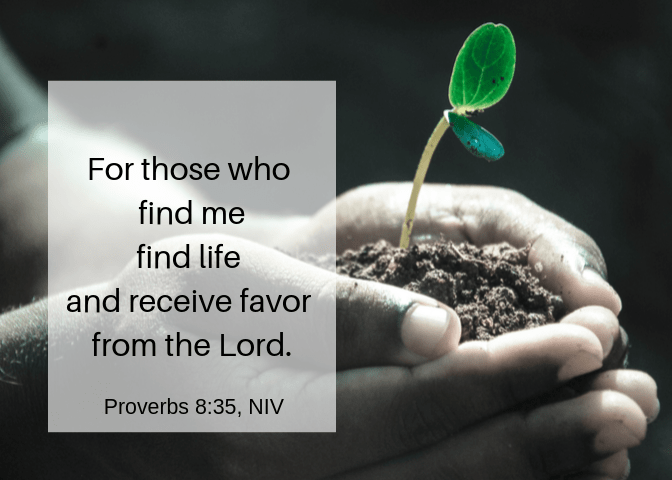
In the closing part of the chapter, Wisdom says that those who follow her teachings (i.e., “keep her ways”) are “blessed” and will “find life” and “obtain favor” from Yahweh. That alone is a good reason to listen to Wisdom!

-Jerry Wierwille

Reflection Questions

  1. Who is one of the wisest persons you know? Describe them. Do any parts of Proverbs 8 remind you of this person?
  2. What are some of the wisest choices you have made? What was the result of each decision? What foolish choices have you made? What were the results of those choices? What upcoming decision do you have to make? How can you work at making a wise decision?
  3. What is your favorite verse(s) in Proverbs 8? Write it out and keep it somewhere you will see often this week. Pray for wisdom.

A Heart that Desires Wisdom

Old Testament: 1 Samuel 11 & 12

*Poetry: Proverbs 7

New Testament: Acts 1

Proverbs 7 is a warning to young men and women about the dangers of sexual desires when they are not pursued properly within God’s intended design, which is within the covenant of marriage. It is written from the viewpoint of a father warning his son about not being enticed by women and drawn away after them. There is an assumption in the text that the young man is marriage, and the warning is about being lured into an adulterous affair with a woman who is not his wife, referred to as the “strange” or “foreign” woman because she is “strange” or “foreign” to his covenant of marriage—she is an outsider.

While this extended speech in Proverbs 7 is aimed at marriage faithfulness and loyalty, its application extends beyond that. Faithfulness and loyalty are not necessary in just a marriage relationship, they are necessary in any relationship, whether it is a family relationship, friendship, or even professional relationship. Anyone will quickly come to learn the importance of faithfulness and loyalty if they betray a relationship and break that bond of trust and commitment. In a family, privileges might be taken away from you. In a friendship, the other person may not confide in you any longer. In a professional relationship, you might lose responsibility, or worse, lose your job entirely.

In Proverbs 7:1-4, the father is telling his son to hold on to his teaching and instruction. The metaphor that he uses is to “bind” them on your fingers,” and “write them on the tablet of your heart.” Furthermore, the son is to treat Wisdom as like a sibling—someone who is part of your family. The purpose for this figurative language is to reinforce the attitude that the son is supposed to have toward Wisdom and living with the fear of Yahweh. Not only that, but the admonition of the father is to also build desire for Wisdom. And the explicit purpose is “in order to keep you from the strange woman, from the foreign woman who flatters with her words” (v. 5).

I think that having a heart that desires Wisdom is vitally important for young people to develop. The world is filled with foolishness, especially in regard to sexuality. It implicitly condones a “do whatever feels good” mindset that is completely opposed to God’s intended way for humans to view sex and to enjoy it. But if a young person doesn’t listen to Wisdom, but follows the ways of the world and allows themselves to be enticed and led astray into sexual passions, they will inevitably suffer and learn the hard way that the world’s way of living is not what produces healthy, loving relationships that lead to the life-long commitment of marriage where sex is intended to be fully explored and enjoyed as God designed for it to be.

-Jerry Wierwille

Reflection Questions

  1. What dangers are warned of in Proverbs 7?
  2. What are some examples of worldly foolishness in the area of sexuality? Why are these problems?
  3. How can you increase your faithfulness and loyalty?