
In Conclusion…

Ecclesiastes 11-12

Psalm 106

1 John 5

-By Paula Kirkpatrick (MN)

Picture a beautiful sunny day in the countryside.  Fluffy white clouds move across the blue sky as a gentle wind blows.  A young shepherd boy named David, tending his father’s flock of sheep, is enjoying the beauty of God’s creation surrounding him.  He attentively cares for the sheep, assuring water and green pastures are available to them, keeping a watchful eye out for dangerous animals that could threaten them. 

As David did his work each day, he often composed songs of praise to God, singing and playing his harp.  His whole life was attuned to his heavenly Father, honoring and following Him.

It’s not hard to see why David, the shepherd boy, was chosen to be the next king of Israel to replace Saul.  His seven older brothers passed by the prophet Samuel, but none of them were God’s choice.  It was young David, out in the field, tending the sheep, communing with His Creator, who was eventually anointed as the next king of Israel.  Why? 

“God sees not as man sees, for man looks at the outward appearance, but the Lord looks at the heart.”  (I Samuel 16:7b)

David did not live an easy life.  After Samuel anointed him as the next king of Israel, he would not take the throne for 15 years.  During that time, he experienced astounding victories and merciless defeats.  He killed the detestable giant Goliath, yet fled for his life from jealous King Saul.  He was praised by throngs of people for his mighty triumphs in battle, yet committed moral failure with Bathsheba, even having her husband killed in battle. 

Yet throughout David’s life, the Lord was by his side.  From the young shepherd boy to the ailing, aged king, he sought and served God; repentant when he sinned, faithful until the end of his life. 

Ecclesiastes 12:1a proclaims, “Remember also your Creator in the days of your youth.”    David did that, lived that.  His strong, steadfast relationship with his Lord enabled him to withstand life’s trials and challenges. 

In Psalm 37:25, aged David declares, “I have been young, and now I am old; I have not seen the righteous forsaken.”

Whatever age we may be, God will not abandon us. 

BUT, IF YOU ARE YOUNG, I say this with heartfelt conviction.  NOW, is the time to serve the Lord.  DON’T WAIT!

He is always there to listen. 

“This is the confidence which we have before Him, that, if we ask anything according to His will, He hears us” (I John 5:14)

He is always there to help you with your problems. 

“For whatever is born of God overcomes the world; and this is the victory that has overcome the world—our faith.” (I John 5:4)

He is always there to love you. 

”We have come to know and have believed the love which God has for us. God is love, and the one who abides in love abides in God, and God abides in him.” (I John 4:16)

Let God’s overwhelming love envelop you.  Respond with gratitude and resolve to serve Him faithfully.

“For this is the love of God, that we keep His commandments; and His commandments are not burdensome.” (I John 5:3)

As the writer of Ecclesiastes concludes his discourse, he offers the same guidance. 

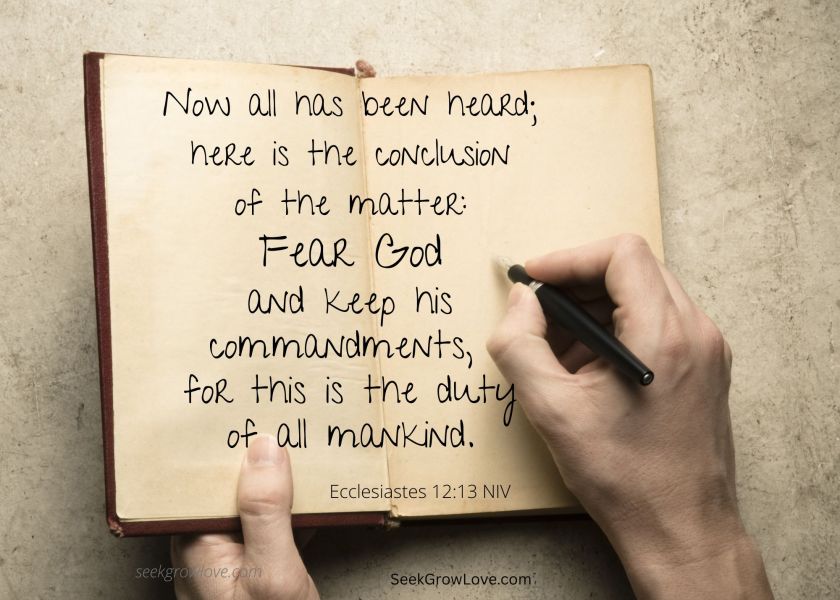
“The conclusion, when all has been heard, is: fear God and keep His commandments, because this applies to every person.”  (Ecclesiastes 12:13)

Reflection Questions

  1.  Why is it important to “remember” and serve God when we are young? 
  2.  In I John 5:3 and Ecclesiastes 12:13, how does the love of God and fearing God      compare, in keeping His commandments?  

Prayer

Dear God of Heaven & Earth – I praise You for Your always superior wisdom, love and righteousness. Thank You for Your amazing creation and the miraculous gift of life and Your presence. May I faithfully serve You, fear You, love You all my days. Help me to speak truth and the good news, always guiding others in knowing You, keeping Your commands and preparing for Your Son’s incredible and coming return. In his name I pray, amen.

Will you Accept her Dinner Invitation?

Old Testament: 1 Samuel 15 & 16

* Poetry: Proverbs 9

New Testament: Acts 3

An interesting comparison is made in Proverbs 9 between two personified figures called “Lady Wisdom” (v. 1) and “Lady Folly” (v. 13). An elaborate scene is painted where Lady Wisdom is said to have prepared a great feast and is inviting everyone in the town to come eat her delicious food. Part of her invitation to dine with her involves exhorting people to leave behind their “naïve ways” so that they can live. If they come and eat with her, they will gain understanding.

The first questions that one might ask are, “Why is Lady Wisdom throwing a party? And what does eating at someone’s house have to do with learning to make good choices in life?” Those are great questions! The answer is that the first part of the chapter where Lady Wisdom is inviting people to come dine with her is an ancient custom where someone who accepts an invitation to a meal is agreeing to be associated with that person and also open to their company and influence in their life. Essentially, Lady Wisdom is asking you to welcome and embrace her as a friend and a trusted counselor by coming to dine at her table.

Secondly, if you want someone to lend you their ear and hear what you have to say, what better way to do that than to throw a party and have everyone come over. Now, the whole scene of going to the house of Lady Wisdom for dinner is clearly a metaphor for going to her and allowing her to feed you with her wisdom so that you will become wise.

One of the most important proverbs of all is 9:10, “The fear of Yahweh is the starting point of wisdom, and the knowledge of the Holy One is the starting point of understanding.” This is an incredibly simple but profound statement: “fear of Yahweh is the starting point of wisdom”. Wisdom begins with the “fear of Yahweh,” and if wisdom begins with the “fear of Yahweh,” then everything else builds from there.

The Hebrew word translated “fear” can mean “to be afraid,” (i.e., terrified), but it can also mean to have “reverence” or “respect” for someone or something. The “fear of Yahweh” mentioned in the Proverbs 9:10 is the second definition and refers to living with a proper awareness and mindfulness of the reality of Yahweh’s rule over all creation, which includes his authority and power to not only govern the universe and all things that happen within the cosmos, but also as the owner of all truth and understanding about life. Yahweh is the source of all knowledge, and no right understanding about how to best live can be attained apart from him. Only when we live with the “fear of Yahweh” can we begin to understand wisdom and knowledge, for only when our hearts are properly oriented toward Yahweh will we be able to receive his grace in sharing with us the wisdom and knowledge that only he can bestow.

            But there is another dimension to the “fear of Yahweh,” and that is that it also entails the idea of loyalty and faithfulness. Living with the “fear of Yahweh” involves adjusting our lives so that we are in a right relationship with Yahweh; it means to understand life and all knowledge through that covenant relationship. Fearing Yahweh (i.e., showing reverence) is demonstrated by loyalty and faithfulness through loving him and obeying him by living according to his commandments and statutes. Thus, by submitting to Yahweh and abiding in a covenant relationship with him, we prove that we honor, love, and revere him.

Are you willing to dine with Lady Wisdom and learn the “fear of Yahweh” and be on the road to living with wisdom? I hope so, it is going to be the beginning of the greatest adventure you will ever have.

-Jerry Wierwille

Reflection Questions

  1. Are you willing to dine with Lady Wisdom and learn the “fear of Yahweh” and be on the road to living with wisdom?
  2. Do you “fear” – revere and respect Yahweh enough? What is the danger in not fearing Him? What can you do to show more reverence and respect?
  3. What can you learn about Yahweh in today’s reading?