My Bible notes explain that Psalm 74 is from the time of the exile, after the nation of Israel had been destroyed and the temple left in ruins and the promised land completely ravished. The first half of the Psalm is a recounting of how the sanctuary of the Almighty was decimated by the enemy. The second half of the Psalm is a cry out to God to do something about it. Verse 12 is the pivot point between the two halves.
As I read Psalm 74, my inner first-born older-sister voice says something like, “Well, what do you expect? Your insolent behavior was basically an invitation to the enemy to come and wreak havoc. You opened the door to the temple wide open with your disobedience. And now you realize your mistake and want God to fix it???”
As if I never did anything foolish. Not once have I been disobedient. And I never have had to deal with the consequences of my poor choices. Nor have I ever asked God to come to my rescue and defend me when I got in over my head. Nope, not at all. Not me.
Maybe this Psalm hits a little too close to home. Because there have been so many times when my disobedience has left me on my knees. I said something that shouldn’t have been said; I ignored God’s voice telling me to walk the other way; I refused to forgive; I thought too highly of myself. And when I realized what I got myself into, the only thing I could think of doing was crying out to God for help.
While God fully desires us to be obedient, he knows our human nature and capability to mess things up from time to time. He wants us to call out to Him. He longs for us to recognize our need for Him. So even when we open the door of our hearts to something less than God’s best and our lives are turned inside out and upside down, He will come and restore us to who we are meant to be.
Thank you God, for being full of mercy and grace and hearing me when I call out. Thank you God, for not turning your back on me when my mess is a result of my foolishness. Thank you God, for loving me unconditionally, that even though I may have to suffer the consequences of my actions, you redeem me.
-Bethany Ligon
Reflection Questions
When has your disobedience caused the need for restoration?
Is there an area of your life that you have already experienced God’s restoration? What did it look like when it was in ruins? What does restoration look/feel like?
What has God revealed about Himself in today’s Bible reading?
What is the longest that you have prayed for something? A couple of days? A few weeks? Multiple months? Several years? Maybe a decade or two?
For me, I prayed for something for over ten years. The words may not have been on my lips each day or recorded in my journal on a regular basis, but it was in my heart for a very long time. There were times when I looked around and wondered why God wasn’t answering this prayer. Why did he seem to be responding to others before me? Why did it appear that even nonbelievers were ‘living their best life’ and here I was, trudging along, waiting for God to do something.
Eventually, I saw an answer to my prayer. It didn’t come in a way that I anticipated, but God answered. Hallelujah!
I find myself in another long-term praying situation. Every once in a while I see a glimpse of what I hope for, but it doesn’t last for long. It’s frustrating. At times I feel powerless because nothing I seem to do makes any difference. At other times, I am jealous of others who have what appears to be what I am asking God for.
As I read Psalm 73, I identify some with the author in his observations that life just doesn’t seem fair. But I have come to realize that when I am looking at ANYTHING other than God, my perspective, my attitude, my desires, become skewed.
When I am intentionally seeking after God, my confidence in His plan and timing grows; my heart’s desires change, my thoughts are transformed. I become spiritually stronger and sustained when I stop comparing my life to the world and start trusting that God has bigger and greater plans in store for my future.
So for now, I will lift up my hands and reach out to my Father who will take hold and provide all that is needed while I wait for an answer. And even if that answer doesn’t make sense, doesn’t seem fair or doesn’t match my timeline, I can trust that His way is better than my way and He alone is enough.
-Bethany Ligon
Reflection Questions
What is the Psalmist’s attitude and focus in the first half of Psalm 73? What is his attitude and focus in the second half? What is the turning point? What are your favorite verses in this Psalm?
When does life seem unfair to you? What is your typical response? Even when the situation remains the same, how can your attitude and focus change?
What do you learn of God and His characteristics in today’s Bible reading?
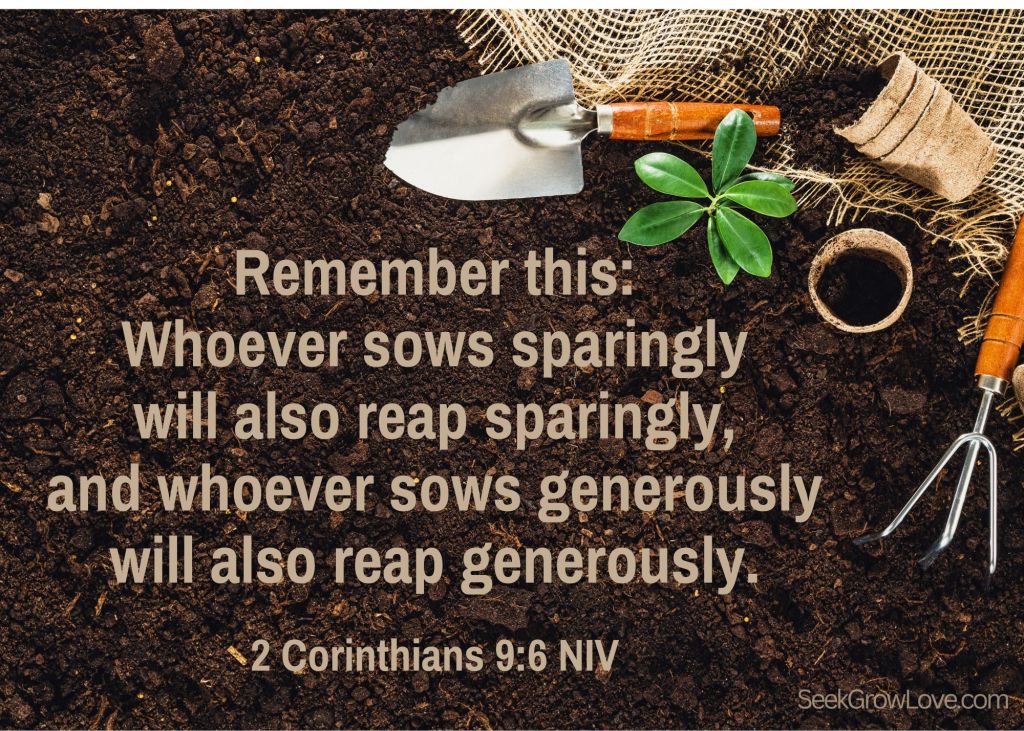
Giving generously is like sowing seeds in a garden. Just as a farmer must plant a plentiful amount of seeds to reap a bountiful harvest, Christians must give generously to receive God’s blessings. In 2nd Corinthians 9, Paul emphasizes the importance of giving with a willing heart, not out of compulsion or obligation. When we give with a cheerful heart, it is like planting our seeds in rich soil, knowing that they will grow into a plentiful harvest.
Furthermore, just as a garden requires consistent care and attention, our giving requires consistent effort and a dedication to meeting the needs of others. Paul reminds us that our giving is not only an act of obedience to God but also a way to meet the needs of others. When we give generously, we are like gardeners tending to our plants, making sure they have enough water, sunlight, and nutrients to thrive. Our giving provides the necessary resources for those in need to grow and flourish.
Like a garden, our giving should also be done with a spirit of thanksgiving and praise. When we give with a joyful heart, we are like flowers blooming in the sun, displaying their vibrant colors and beauty. Giving generously not only blesses those in need but also brings glory and honor to God. It is like a garden bursting with life and color, a testament to the abundance of God’s grace and provision.
Finally, just as a garden produces a bountiful harvest, our giving produces a harvest of righteousness. When we give generously and joyfully, we are like farmers reaping a plentiful harvest, knowing that God’s blessings will overflow in our lives. Our giving is a tangible way to demonstrate our faith and commitment to following Christ’s example of selflessness and generosity.
In conclusion, 2nd Corinthians 9 teaches us that giving generously is like sowing seeds in a garden. Just as a garden requires consistent care and attention, our giving requires consistent effort and a dedication to meeting the needs of others. When we give with a cheerful heart, it is like planting our seeds in rich soil, knowing that they will grow into a plentiful harvest. May we be inspired by the simile of the garden to give generously and joyfully, trusting in God’s abundant provision and blessings.
-Austin Kizer
Questions for Reflection
How can you cultivate a heart of generosity and joy in your giving?
In what ways have you seen God bless your giving, whether it be in material provision or in the transformation of lives?
What steps can you take to consistently care for and tend to the needs of those around you?
What has God revealed about Himself in your Bible reading today?
As I began reading Psalm 71 I immediately took to heart the first sentence, “In you, LORD, I have taken refuge.” How many times do we have troubles and look to things other then God? We look to our friends, our families, sometimes video games, sugar, so many things when our first response should be to look to God. Our writer goes on to ask God to be his rock of refuge, to which I can always go. We can go to Him anytime day or night. Sometimes I wake up in the middle of the night because something is bothering me. While I know my husband would not get upset if I woke him, it is not something I want to do. But guess what, God is there! He is always with us.
The Psalm goes on to ask about not casting him away when he is old, not forsaking him when his strength is gone. He asks God for help. He says he will always have hope and he will praise God more and more. He will tell of his saving acts all day long. He will praise Him with the harp, the lyre, his lips and his tongue. The writer of this Psalm really knew that God is AMAZING!
All of this made me think of a few things. First, as I said earlier, God is aways with us. I have a great support system and God has put wonderful people in my life to help me navigate the craziness of this world but do I put God aside and try everything else first and then go to Him? I know I do sometimes, then I realize I should have gone to Him first. Many times when I go to him first, he puts the right help in front of me to navigate my problem and sometimes he tells me I just need to wait on it.
Second, when he is talking about his enemies, I think of the enemies that are trying to take us away from God. They will stop at nothing to tear us from the love of God. Verse 4 says “Deliver me, my God from the hand of the wicked, from the grasp of those who are evil and cruel.” We need to stand firm in our faith, seek God, spend time in His word, and be careful that we don’t get pulled away. It is so easy to walk away, to spend time away from God. We need to be purposeful in our walk with Him so we are not tempted to walk away.
Lastly, he is praising God. We need to praise God for all he has given us. My husband says he is part of the joyful noise club. I am too, I don’t have a beautiful voice but the Bible doesn’t say we have to have a beautiful voice, it says to make a joyful noise. It also doesn’t say we need to be Bible scholars to speak his word or tell others of the great things He does. Verse 17 says, “I declare your marvelous deeds.” Go out and declare His marvelous deeds in your life.
-Jeani Ransom
Questions for reflection:
How do you take refuge in God? Do you seek others first or God first?
How can you show your praise to Him today?
What marvelous deeds has He done for you? Who can you share them with?
Balaam is an interesting character – as is of course his famous articulate donkey. He must have been a very well-known and successful diviner – or pagan prophet – for Balak, the king of Moab, to send delegations twice to bring Balaam to curse the Israelites.
Balaam is not an Israelite. He does not serve the Lord Almighty. However, in these two chapter (Numbers 21 & 22) it appears he does a better job of listening to the Lord God and following his directions than most of the Israelites whom God had rescued from Egypt. From the Israelites who had experienced God’s mighty saving hand at work we have heard a whole lot of grumbling, complaining, and belly-aching as well as questioning God’s power and intent, His love and His faithfulness and His chosen leaders. In contrast, here we have the pagan prophet Balaam who (currently) seems to be following God’s every directive: Stay, Go, Speak. And Balaam does it. Perhaps Balaam has heard some of the stories coming out of the Israelite camp: the ground opening up to swallow the rebellious, the plagues of sickness and death, the water from the rock, the quail three feet deep, the sons of the priest burned to death by fire from heaven. As a sorcerer/diviner/soothsayer he has got to be more than a little curious about this God and all He can do. We do know Balaam heard his donkey speak to him (God truly can give His words to anyone, or anything) and God opened Balaam’s eyes. In response, Balaam speaks. And at this time, he speaks for God. It is as if he has no choice, just as his talking donkey had no choice. And so Balaam delivers God’s words:
“Even if Balak gave me all the silver and gold in his palace, I could not do anything great or small to go beyond the command of the Lord my God.” (22:18)
“But I can’t say whatever I please. I must speak only what God puts in my mouth.” (22:38)
“Did I not tell you I must do whatever the Lord says?” (23:26)
How silent the world would be if we erased all the words spoken that were NOT what God put in our mouths. This thought has been going through my mind the past couple of days (perhaps making it harder to write this devotion). Who of us can say (for very long), “I must speak (type) only what God puts in my mouth”? How would my house and marriage and work and church be improved if every word from my mouth first was reviewed to see if it was worthy of God’s seal of approval – “These words were brought to you by God”? I have said some pretty stupid, wrong, hurtful words that were definitely NOT from God. And, they get me into trouble and further from where He wants me to be. I know there are also many times I have failed to say what God HAS wanted me to speak.
Unfortunately for Balaam, his story doesn’t end there. Unfortunately for Balaam, his heart and motives and ethics were not in line with his words from the Lord. It is not enough to speak what is right while doing what is wrong. As we continue reading in Numbers we will learn more about Balaam. In the meantime, you might be interested in also checking out what some New Testament writers had to say about Balaam: 2 Peter 2:15, Jude 11, Revelation 2:14.
Dear God, please open my eyes and give me the words you want me to say. THOSE are the words I want to speak. Help me live your words and show You to the world.
-Marcia Railton
Reflection Questions
Re-read carefully the words that God put into Balaam’s mouth (23:7-10 & 18-24). What does God want to be made known about Him and His people? What do you think God wants you to tell others about Him? How? Where? When?
How can you guard against saying the right thing but doing the wrong thing?
What does God reveal about Himself in your Bible reading today? Why is that important?
In Numbers 20-21 we encounter the Israelites at the end of their journey as they wrap up their years in the wilderness and prepare to enter the promised land of Canaan. Unfortunately, before they do that, we see a purging of a generation of people who had rebelled, distrusted, and quarreled with themselves and with the LORD. In Chapter 14 God had instructed them that only Joshua and Caleb would enter the promised land, and now we see God was serious. In Numbers 20:1 Miriam dies, in verse 12 Moses is told he will not be entering the promised land, and by the end of the chapter Aaron is dead. No special privileges here for being a priest, a leader, or related to a special someone who “was a really good person most of the time”.
In recent years I’ve heard more and more talk about generations. Terms like X, Y, Z’s, Millennials, Zillennials, Baby Boomers. All have their strengths and weaknesses, and since I fall right in-between two, depending where I am or what is being said, I might want to associate with one more than another. That is because there are stereotypes of generations, but none are always accurate nor are they particularly important or beneficial. No matter what, as a body of Christ, we are an intergenerational people, and research continues to show the benefits of multigenerational worship and education. The year of your birth simply does not have anything to do with who we are in Christ. What does matter is our faith in Jesus and being a follower of him. In today’s reading, we see a generation dying out who knew God, yet had managed to waste the better part of 40 years not doing much to please Him, but doing a great job finding things to fight and complain about. We are currently living in a world where fights and complaints are the norm, and also one where our life expectancy is dropping. Many people born in recent generations have a lower life expectancy than their parents did. We are on this earth for a finite time, and unless we live until Jesus returns, we will “rest with our fathers” the same way people have been doing since the days of Numbers.
But, the story of Numbers doesn’t just end with death and burials, and ours doesn’t have to either. Joshua and Caleb (and crew) did get to the Promised Land. And we see more symbolism again in this idea since Yeshua can be translated as Joshua in Hebrew (our OT character leading them to the promised land) and when translated into Greek/from Greek can be translated as Jesus (our NT character through whom we have hope of our promised land in the kingdom). There is lots more out there to learn about as far as name studies if that interests you which I’ve learned a bit more about through a friend who has “Yeshua is my king” stickered across his back window. I couldn’t help ask about that one the first time I met him!
Another thing I found interesting as I read Numbers 20-21 is that a lot of the pagan enemies they are fighting on their way to the promised land are their “relatives”. The Edomites come from Esau (who was later named Edom), the Moabites and Ammonites come through incestuous relationships through Lot, and for that matter, all of them go back to Noah’s three sons! But, it didn’t matter if you were a descendant of Abraham or a relative of someone who once believed in the one true God. The people who entered the promised land were those who trusted and relied on Him, humbling themselves to allow Him to lead. Everyone else who didn’t worship the one true God as he instructed them to, set apart and holy according to his expectations. . . they were enemies. It didn’t matter if they had heard YHWH, the God of Israel, was powerful and real and they were a little scared of him. It mattered if they honored and obeyed him, and they certainly did not. While family trees can be interesting, that is about all they are good for when it comes to things of eternal perspective. The fact that your great grandpa was an elder who walked 10 miles uphill to go to church every Sunday doesn’t matter, and whether or not your relatives called themselves Christians or you attended church as a kid does not matter for your future. What matters is that in your present, regardless of which generation you are from or how much longer you may have left on this earth, you humble yourself before God and let Him lead. The wilderness surrounds us, but the promised land to come is real.
Yesterday I ended with a verse I really liked about Jesus being the sacrifice for sins for all of us, for the whole world for all time. No more sacrifices required, and we are cleansed and forgiven. That is beautiful and true. But, the verse immediately following is too. It tells us how God expects us to respond to that gift and is a good way to wrap up our studies in Numbers this week I think.
“And by this we know that we have come to know him, if we keep his commandments.” (I John 2:3, ESV)
-Jennifer Hall
Reflection Questions
What did this Israelite generation have going for them? What were strikes against them? What most important thing did they keep forgetting?
Right now, this week, have you been more like Joshua and Caleb – intent on trusting a great big God who saves and will lead you into the Promised Land – or the generation that will not survive the wilderness – losing sight of God’s greatness as you focus instead on complaining, arguing, living in fear and negativity and quarreling with the Lord? Are there any changes that need to be made starting today?
What does God reveal about Himself in the passages we have read from His Holy Word today?
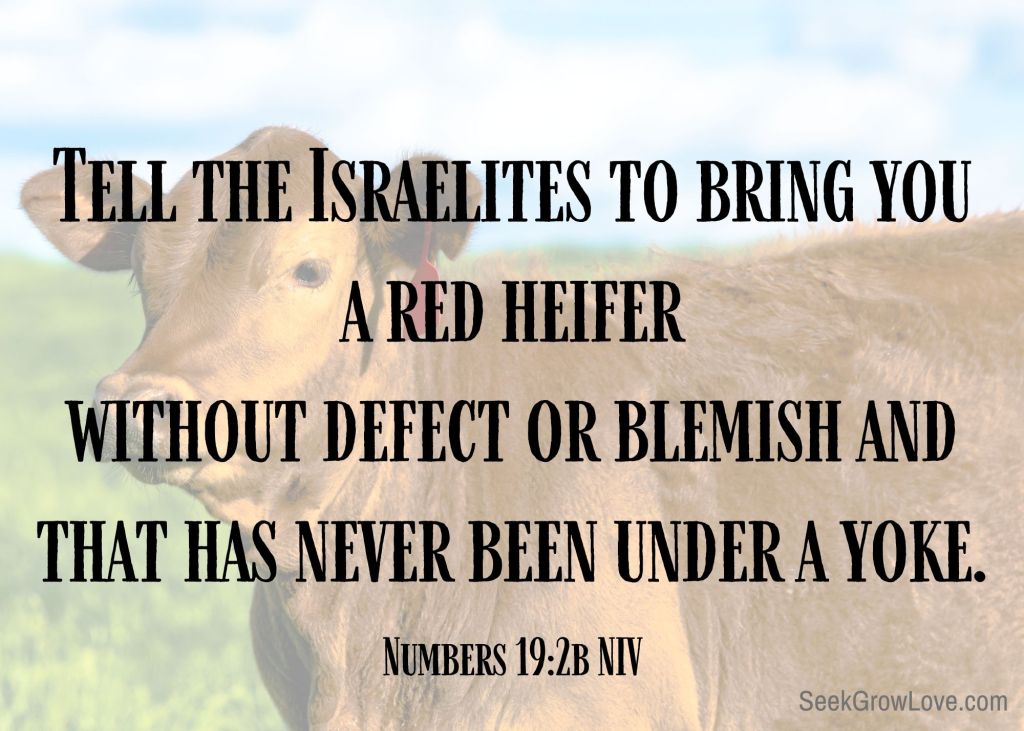
Numbers 18-19 continue laying out God’s specifics for his tabernacle with things like priestly duties, purification procedures, and one topic covered in detail in Chapter 19 is the sacrifice of the red heifer. This sacrifice is unique from others, and worth taking the time to look at a bit. The sacrifice of the red heifer was different than other animal sacrifices laid out in the law of Moses.
For one, this was a female animal instead of male. Also, this one was to be slaughtered outside the camp, burned in all of its flesh and blood (and dung!) with a few specific additions to the fire including cedar, hyssop, and scarlet wool. (Interestingly, I realized that I now have some hyssop popping up that I planted last year, and I added cedar shavings to the garden this past week. But, no scarlet wool and no red heifers around here!). It seems this sacrifice was extremely specific and unique, and definitely similar to some things we see in Jesus’s sacrifice for us. If you want to read more about the symbolism and foreshadowing from the red heifer to Jesus, it is certainly out there. And, without looking too hard, we can definitely see connections including Jesus being killed in all of his flesh/blood outside of the temple, being perfectly flawless, being offered hyssop on the cross, being a sacrifice for our sins the way the red heifer was for the Israelites, etc., etc.
Evidencing that Old Testament stories are still relevant for us today, according to the Temple Institute, five blemish-free red heifers from Texas arrived in Israel in September 2022. Some view this acquisition as a step forward to the functioning of the new temple and related to Bible prophecy. No matter what, it is interesting to see how this reading from Numbers is still related to current events, and humbling to think what Jesus was willing to sacrifice for all of us.
“My little children, I am writing these things to you so that you may not sin. And if anyone sins, we have an Advocate with the Father, Jesus Christ the righteous; and he himself is the propitiation for our sins; and not for ours only, but also for those of the whole world.” (I John 2:1-2, NASB)
-Jennifer Hall
Reflection Questions
How was Jesus’ sacrifice different from the red heifer sacrifice – and different from all the other Old Testament sacrifices? What do all these sacrifices have in common?
What can we learn about God through our Bible reading today?
Today’s reading in Numbers takes us back to the scene of the Israelite crimes of complaining, grumbling, and not trusting God. If you have been reading in Numbers at all this week, you will know we’ve seen plenty of these in action already, and Numbers 14-15 is full of plenty more. It is interesting to consider that it’s not like the Israelites’ negativities had been ignored or that they were serving them well up until now. It had been the complete opposite, and there had been plenty of consequences already. Smitten with a plague with quail still in their teeth, a fire sent down from the LORD, Miriam struck with a leprous disease, delayed travels in the desert, etc. Yet, the Israelites were at it again.
In verse 3 we see a phrase that I am guessing hits close to home. “Why did the LORD…?”.
In this case, the Israelites weren’t asking, “If the LORD is real, why did he….” They knew he was real and didn’t doubt that. But, as believers in the LORD, like us, they struggled to trust Him when things were tough and when they couldn’t see what our sovereign God knows. They focused on their doubts, worries, discomforts, and did not humble themselves and rely on God who had told them what His plans were for them. Along the way, things were hard. It is a broken, imperfect world full of problems just like the desert wilderness. Sometimes they are beyond our control. Sometimes they are because of our attempts to control. Enemies are real. Plagues and diseases are still a thing. Sin is rampant. But, while problems can seem to prevent us from seeing anything else sometimes, even then, we have an all-powerful, all-knowing, perfectly loving Father taking care of us through it all.
And so did the Israelites. Reading further in chapter 14 we see Moses, Aaron, Caleb, and Joshua seeking to follow God even through the difficulties, and encouraging others. We see the LORD forgiving when asked in verse 20, and eventually, some Israelites did get to the promised land! Canaan still had some problems as far as promised lands go, but the promised land awaiting us in the coming kingdom of God is one without tears, sickness, and sorrow. Nothing to grumble and complain about at all.
Let us trust God to know best since compared to Him . . .we know a lot less! I like the last verse in Numbers 15 to help facilitate trust, love, and honor toward God. Even in the hard stuff.
“I am the Lord your God, who brought you out of Egypt to be your God. I am the Lord your God.”
(Numbers 15:41, NIV)
-Jennifer Hall
Reflection Questions
Seriously consider your own negativity. In what situations, and toward whom, do you find your negativity festering or exploding? How is this affecting your relationship with others and with God? Spend some time talking to God about this problem and what you can do to improve.
How has the Lord shown Himself – and His desire and supreme qualifications to be your God – in your life thus far? What has He brought you out of? (Numbers 15:41)? What has He brought you into? Trusting in Him, what is yet to come?
What do you know about the Lord your God because of your reading in His Scriptures today?
In the Numbers 12-13 reading today we start with what appears to be some sibling rivalry. Miriam and Aaron are sharing some negative murmurings about their brother Moses (verses 1 and 2) in what appears to be some pride or opposition to his leadership. Years after watching him float down the Nile river in a basket to safety to later lead the Hebrews out of bondage in Egypt, Miriam now sounds envious. But, while she and Aaron are whining for attention, verse 3 indicates quite a contrast in Moses. Moses was more humble than anyone on the face of the earth!
In this case, the word used for “humble” is a Hebrew word used of Israel itself many times in the OT, suggesting someone who is “poor, lowly, meek, depressed in circumstance, may be oppressed by rich and powerful. “
But, it appears that the LORD, who of course heard everything Miriam and Aaron said and thought, was displeased with what was in their heart. He rebukes their attitudes and speaking against His chosen servant. Miriam ends up with a leprous skin disease, banned from the camp for 7 days, and caused yet another bump along the road of the Israelites’ pursuit of the promised land. But, there was forgiveness and the chance to move forward, and in chapter 13 we find the Israelites starting to explore Canaan.
This story seems an example of what we see in Proverbs 3:34:
Proverbs 3:34, ESV: Toward the scorners he is scornful, but to the humble he gives favor.
Miriam and Aaron in all their human efforts to be recognized, putting down others along the way, ended up chastised and scorned. Moses was in God’s favor. And while the definition we read of the word humble doesn’t sound all that appealing in some ways, God’s favor certainly does. We know verse 3 commends Moses for his humility, and as we seek to find God’s favor, it seems evident that being humble, lowly, and meek are crucial.
Numbers 13 starts with the exploration of the long-awaited Canaan, and in fact they finally saw the milk, honey, and fruit! But, they also saw the. . . men of great size! Forget that milk and honey! Did you hear about all those “-ites” mentioned in verse 29? And so, they spread some bad reports, show fear, and felt like grasshoppers in comparison. But, of course the LORD is not a grasshopper, and the LORD had told them where they were going, so we’ll have to keep reading this week to see what happened. And if you are looking for an interesting topic to study, check out the various thoughts/research available on the Nephilim mentioned in verse 33. Pretty interesting stuff!
-Jennifer Hall
Reflection Questions
Who do you know who could be added to the list of most humble?
How would you rank yourself on the humility/pride meter? What can you do to improve (lower?) your score? What is hardest for you about taking a lowly, meek attitude?
What are God’s views and actions toward the humble and the prideful? What else do you learn about God in your reading today?
Continuing in our Old Testament reading of Numbers 10-11 today, if you happen to have a silver trumpet handy feel free to get it out. For that matter, if you really want to act out Numbers 10, grab your hammers and make two trumpets of silver because this passage starts with a blast -remembering that the LORD is God.
In the reading yesterday we learned how the Israelites happened to be traveling around at this time in the wilderness. If the cloud above the tabernacle moved, they moved. If it settled, they stayed. In Numbers 10:12, the cloud lifted and the Israelites headed out. From one desert to another, landing in the Desert of Paran this time. There they made some plans, divisions, and ended with rest.
Numbers 11 starts to get a little uglier. Whining, grumbling, hunger for meat (or “intense cravings” mentioned in verse 4), a consuming fire at Taberah, and even wanting to go back to lives as slaves in Egypt?! The people were displeased. The LORD was displeased with them. Whining kids are just the worst. I deal with a lot of kids at work, I was a kid, and I have a kid. There is something about the hideous voice decibel, the facial expressions, the drama, ungrateful, self absorbed nature of whining that makes us cringe. In this story it also made God “singe”! If we complain in our head, God knows it. If we whine in a whisper, God hears it. If we blast a nasty social media post, God sees it. And, the LORD is displeased.
Moving beyond the grumblings in chapter 11, verses 21-23 remind me a little bit of the doubting we see prior to the miracles of feeding the 4000 and 5000 in the New Testament. Would all the fish in the sea be enough Moses wondered? The LORD answered clearly in verse 23, and in verse 31, approximately 3 FEET of meat rained down from the sky for an area as wide as a day’s walk! Umm, yes, it was enough. He is enough. Trouble was, the Israelites hadn’t thought so, and this chapter ends with a consequence for that.
Interestingly, tonight starts Purim which is a day when the Jews do various things to remember the story of Esther. Because of that, I found myself thinking of some connections between Esther and this reading. In the story of Esther the “bad guy” is Haman, likely a descendant of the Amalekites…..an Arab tribe that lived in the Desert of Paran where the Israelites hung out in today’s reading. Kinda interesting. Also, yesterday’s reading ended with instructions on Passover remembering the story of God’s provision saving the Israelites through the exodus, and Purim is a day remembering the story of God’s provision saving the same people through Esther. Plus, Esther lived in royalty not known as a Jew initially, similarly to how we see Moses starting his life as prince of Egypt.
Whether we read Numbers, Esther, or something else, we can remember that the LORD is sovereign, He wants us to remember Him, to trust Him, and to be set apart for Him. And if you want to look up some fun Purim ideas, there are plenty. At our house tomorrow in fact, I’ll have a “Girls Bible Club” of little ladies blowing noisemakers when they hear Haman’s name, eating Hamantaschen, reading the story of Esther. . . and hopefully. . . not complaining!
-Jennifer Hall
Reflection Questions
What do you find yourself whining, grumbling or complaining about? What might God be thinking or feeling or even doing as a result of your whining/grumbling/complaining/bad attitude?
What are some of the things the Israelites were forgetting when they were grumbling? How could a better memory help us complain less? What can we do to boost our memory?
What has God shown about Himself in today’s reading? What do you learn about the length of His arm?








 Seek Grow Love