In Mark chapter 6, Jesus summons his disciples to go on a boat to Bethsaida, while he stays behind on land to pray. Their boat got to the middle of the lake, and Jesus, seeing them, started walking towards them. Little did they know, he was walking on water towards the boat. After seeing him, they immediately thought he was a ghost and were terrified. Seeing them frightened, he immediately said, “Take courage! It is I. Don’t be afraid.”
Jesus, with the power of His Father God, walked on water, which is not normal in any way, but Jesus told them to not be afraid. Do you sometimes find it hard to trust in God? It might be during a hard test, you might be in a difficult situation with your family or friends, or maybe you’re a new brother or sister of Christ who is struggling to find their purpose in the world. Trusting in God can lift a heavy weight off your shoulders. Faith is a lot like a muscle. The more we exercise our faith, the stronger our trust in God becomes. When we practice and train ourselves to have more faith, it becomes easier to have trust, and to rely on God. So ask yourself, are you willing to practice trusting in him?
-Hannah Bormes
Reflection Questions
When was the last time you exercised your faith muscle? How did it work out for you?
In what current situation would Jesus tell you to not be afraid? Why? How can exercising your faith muscles help you lessen your fear?
What might God be asking you to do with His power?
This will be a shorter one and something to reflect on throughout the day. Something that can be applied to everyone’s life in a different way. In this chapter there is a great windstorm. Personally, I hate storms, ask anyone who’s been near me when one happens, I tense up and want to just get away from it, they terrify me. And it terrified the disciples too. They proceed to wake Jesus up who calmed the storm. He asks them after “Why are you so afraid? Have you still no faith?”.
If we look at our own lives, we also have storms. Most of them won’t be actual storms that can shake a house or uproot a tree, but things in our own lives that cause worry and doubt. They will differ from person to person and even day to day. I’m also sure some of my storms would look like little spouts of rain compared to the hurricanes others face. But look at what Jesus said, “Why are you so afraid?”. I can’t pretend to know what everyone who reads this is going through. But ask yourself – why are you so afraid? Is what you’re afraid of that important in the grand scheme? Take a step back and look at it.
And the second thing Jesus asks them, “Have you still no faith?”. Have you no faith that you can prevail? Have you no faith that there is one greater than us who cares for each one of us personally, one who loves each of us? Have you no faith there is a Kingdom coming that will put an end to every storm you face? You can prevail. Have faith in that, and have faith there is and always will be one stronger than you that you can always trust to be there.
As you go through your day reflect on your own storms and ask yourself “Why are you so afraid? Have you still no faith?”
-Philip Kirkpatrick
Reflection Questions
What do you find yourself afraid of? Why? What causes you to worry or doubt? Why? Is there a better way to look at what causes you fear, worry and doubt?
Do you know “someone” larger than your fears that you can always trust? How has he proven he is trustworthy?
How can we each work at growing our faith so it is stronger in the storms?
Who do you know who has a strong faith you can learn from?
When I was a young pastor’s wife in my 20’s and 30’s, I had many older role models in our congregations. These special saints had been faithful through the years despite the challenges and sorrows of our present world. They trusted God’s direction and His goodness, and they were still devotedly serving Him at church and in their everyday lives.
I, (and my pastor-husband), valued and yes, cherished the encouragement and support they lovingly gave us. How I long to see them again!
Various dear ones come to mind—the balding Wisconsin farmer, cracking jokes, yet tender-hearted; the precious old Indiana couple who held hands in church, except when they held my year-old son while I played the piano for the worship service; dear Missouri ladies who “loved” on my children and us; the welcoming Minnesota saint who hugged me at our first meeting, and could outwork women thirty years younger!
Psalm 71, one of our readings for today, has brought to mind these beloved individuals, as well as many others, who we were blessed to know and love in the pastorates we served. An apt title for this Psalm could be “Prayer of an Aged Saint.”
The writer of this Psalm begins by saying he has taken refuge in God, and he asks for deliverance. He turns to God to rescue him, basing his trust on the help he has received from Him down through the years.
“For You are my hope; Lord God, You are my confidence from my youth. I have leaned on you since my birth; You are He who took me from my mother’s womb; My praise is continually of You.” Verses 5 and 6
Then, the Psalmist confirms he is no longer a youth.
“Do not cast me away at the time of my old age; Do not abandon me when my strength fails.” Verse 9
Even at his advanced age, our writer once again faces an enemy. “Wrong doer, ruthless man”, (verse 4); “adversaries” (verse 13) are some of the words used to describe this enemy.
And yet his ultimate trust in God’s intervention in his life is evident.
“But as for me, I will wait continually, And will praise You yet more and more. My mouth shall tell of Your righteousness And of Your salvation all day long; For I do not know the art of writing. I will come with the mighty deeds of the Lord God; I will make mention of Your righteousness, Yours alone.” Verses 14-16
The Psalmist’s worship turns into a declaration, a witness of the greatness of God. And it doesn’t end there.
“God, You have taught me from my youth, And I still declare Your wondrous deeds.
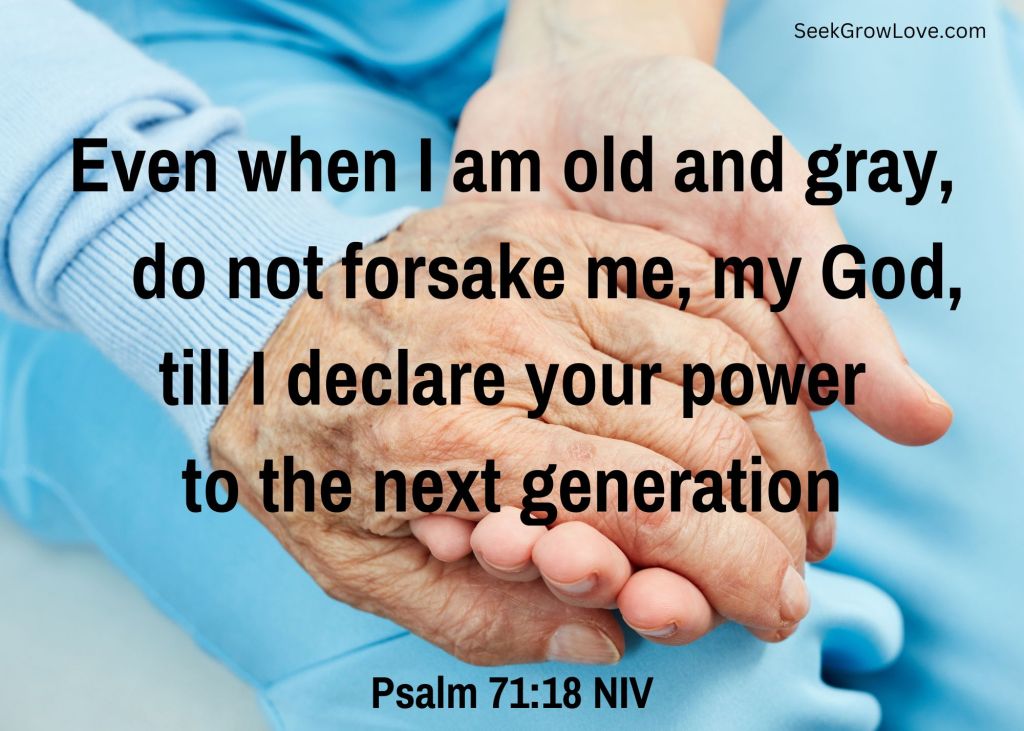
And even when I am old and gray, God, do not abandon me, Until I declare Your strength to this generation, Your power to all who are to come.” Verses 17 and 18
Throughout the writer’s entire life, from his youth to his old age, God has been present and working in his life. And now, as he nears the end of that life, his firm desire is to declare God’s strength and faithfulness to succeeding generations. He wants the younger individuals that are part of his life, or simply have observed his life, to understand the ultimate “goodness of God.”
Once, I too, was young. Now, I can identify with the writer of this Psalm. How good and faithful our mighty God has been to me. He has rescued me from troubles. He has daily strengthened me. He has been my Rock (verse 3) when all else failed.
The dear saints in our pastorates that I grew to love, left a legacy of faith for me and others. I pray my life is also “declaring God’s strength to this generation.”
Paula Kirkpatrick
Reflection Questions
Do you have an older Christian who is a role model to you?
Have you told those role models what they mean to you?
The Psalmist says he doesn’t know the art of writing, so he needs to make mention, to declare, God’s righteousness and strength. Think about ways you can talk about and show your friends and loved ones what God has done in your life.
Hebrews chapter 11 is very well known and a powerful and beautiful piece of writing, maybe on a level with 1 Corinthians 13. What Paul wrote in 1 Corinthians 13 about love is more often quoted in wedding services, out of context, than used to discuss the situation at Corinth. Something similar may be true with what Hebrews 11 says regarding faith. Good use is made of the passage to discuss faith, but perhaps comparatively not much of the time in the context of what Hebrews is about. It is extremely easy to break this passage away from the rest of what was written by Herb (my name for the author of Hebrews, for simplicity).
New Testament Greek had no chapter breaks, or even paragraph breaks. When authors of that time wanted to establish a change in topic they needed to do so with their words. Herb does a lot with inclusio, also called bracketing, which used repeated words to emphasize a section of text. The presence of these repetitions helped people who were following along with a work while hearing it out loud – and those attempting to memorize it. For hundreds of years very few people had access to written copies of these works and often they depended on listening to them spoken aloud, perhaps even from memory. (In seminary I had a teacher who assigned students to memorize a Psalm and recite it. Part of the point was to gain some sense of what it was like to hold scripture in your mind and speak it aloud. He was pleased and surprised when a student took up the challenge of learning Psalm 119 and succeeded.) There is an inclusio in Hebrews 11:2 and 39 created with the Greek for “to witness” which sets apart that chapter and shows our chapter break to be reasonable.
But Herb did not discuss “faith” only in chapter 11. The Greek word for “faith” appears in Hebrews a total of 32 times: in 4:2; 6:1, 12; 10:32, 38, 39; then in chapter 11 (24 times); 12:2; and 13:7. Outside chapter 11 the references to faith almost all involve Herb expressing concern about believers having proper faith in Christ. You can also see a cluster of four references around chapter 11 which show how Herb set up that chapter and then picked up from it to move into the next part of the letter.
For these devotions we generally read a single chapter but if you wish after reading this devotion you could reread the text, backing up a few verses to include part of chapter 10 as a lead-in to chapter 11. First, I want to highlight a few more words to pay attention to that appear in both Hebrews 10 and 11.
In Hebrews 10:34 a Greek word for “better” appears which Herb uses 13 times in Hebrews. That is far more than elsewhere in the New Testament, but It obviously fits with the tone of the book, which keeps saying that Jesus is better than one thing or another. The word then gets used in 11:16, 35, and 40.
In Hebrews 10:36 a Greek word for “receive” appears for the first time in Hebrews. It will be used twice more, in 11:19 and 39.
Also in Hebrews 10:36, a Greek word for “promise” appears, the eighth of 14 uses. The remaining six times are in 11:9 (twice), 13, 17, 33, 39.
Breaking down the list, “faith” is mentioned in the end of chapter 10, all through chapter 11, and at the start of chapter 12. Three other words connect the end of chapter 10 to chapter 11, suggesting that Herb set up points he was going to make in the faith chapter: “receive,” “better,” “promise.” You could back up to Hebrews 10:32 and read on through 12:2 to see how these words are emphasized together.
If you choose to, you could also do a second exercise, for a different way of looking at things, considering these facts:
In Hebrews 10:32 a Greek word for “endured” / “endure” appears. It is used four times in Hebrews, here and in 12:2, 3, and 7.
In Hebrews 10:36 a Greek word for “patient endurance” or “perseverance” appears. It is used only here and 12:1.
So two words about ‘endurance’ bridge the end of chapter 10 to the start of chapter 12, for a total of six appearances. This suggests that while Herb didn’t choose to emphasize endurance on the part of the Old Testament figures chapter 11 discusses he wanted to emphasize endurance on the part of the Christians he wrote to. This will become very clear if you try another read through starting at Hebrews 10:32 perhaps, but this time skip over chapter 11 entirely and read to 12:7.
Hebrews 11 has a remarkable message about many great examples of faithfulness from the past who trusted God to be reliable and now serve as examples to us. Many people speak of the great acts of faith that these people engaged in, but that is not how the chapter describes them. It says that they “gained approval” from God for their faithfulness (v. 2, 39). In terms of Herb’s actual message these figures from the past are case studies in endurance, people who did not shrink back. Herb finally emphasizes not what they received through faith but what they did not receive, because none of them got what they were waiting for, which is interesting as it shows their common understanding of what to expect and that they did not allow thousands of years of waiting to throw off their patience (v. 39). We also see that the list of named figures stops with David and Samuel, in the time of the tabernacle. Some of the other figures are identifiable as from later times, such as the reference in verse 33 to “shut the mouths of lions,” which is plainly Daniel, but they remain unnamed.
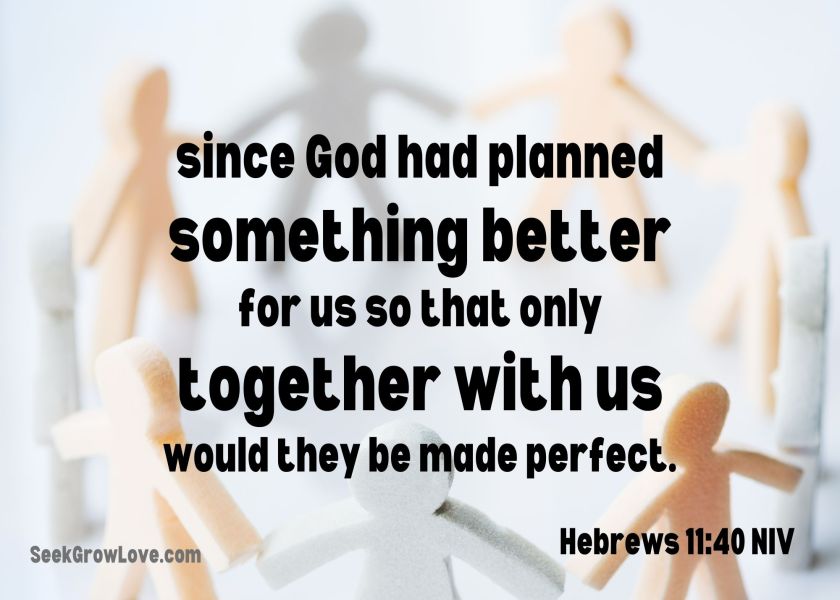
Verse 40 is the kicker for this chapter, of course. “God provided something better for us, so that apart from us they would not be made perfect.” This is now the twelfth of fourteen uses of this language about perfection in Hebrews (the next will be in 12:2, the last in 12:23). It is remarkable the lengths that have been gone to in some interpretations to have this language make sense, without having the return of Christ and the resurrection hope be significant for the Old Testament saints and the church, together. But the repeated (and, in my Bible, underlined) words of the chapter prompt us and we can’t ignore them – receive better promises – there is no reasonable explanation where some part of the Church has already inherited what God planned to give us. We are a body, undivided, faithful, and patient. “Christ the first fruits, after that those who are Christ’s at his coming.” (1 Corinthians 15:23).
Lord, you have made lovely poetry, and remarkable prose. Yours are the greatest inventions, incredible art, the purest flavors, colors and lightning. I praise your creativity, and I await the wonders of the more perfect world that awaits when your son returns to earth. All I know now is the damaged version of what you intended. Some of what you first made still shines through, and it is amazing to me. Let me grow in faith in you always, for you are almighty and perfectly trustworthy. Amen.
-Daniel Smead
Reflection Questions
1. Imagine if chapter 11 really were not in Hebrews. What would we be missing?
3. Have you ever tried to memorize part of Hebrews 11? With its repeated pattern about “faith” it seems set up for that purpose, but modern Americans don’t tend to try memorizing much. What advantages do you see to memorizing scripture? How do you decide what scripture to memorize?
3. Do you expect that faith is easier to hold to if you have people encouraging you to be faithful? How have you tried to be encouraging today? What things do you find encouraging?
What makes a firefighter run into a burning building to save a human life? What makes a police officer run towards gunfire rather than away from it? What makes a nurse care for a patient with a contagious virus? What makes a soldier live in constant danger in a far away land? What makes a father or mother risk their own life in order to save their child? These are common examples of bravery. We often take these sorts of things for granted. We often just assume that someone will be there to save us when we are in trouble. However, these acts of bravery and self-sacrifice are counter intuitive. Why would someone risk their own life to save another person, even a stranger? Why would you run into a burning building or knowingly expose yourself to a deadly disease? Why would you count your own life as nothing for the sake of another? We have here a special kind of love and a special kind of courage. Normal human beings can do incredible things.
Hebrews chapter 5 teaches that Jesus is our High Priest by virtue of His sacrificial death upon the cross. Hebrews portrays Jesus in a very human way. Jesus was well acquainted with the human experience. In fact, the experiences of Jesus made Him worthy to be our high priest. Hebrews 4:15 reads of Jesus, “For we do not have a high priest who cannot sympathize with our weaknesses, but One who has been tempted in all things as we are, yet without sin.” He was tempted just like we are. Hebrews 5:2 writes of the high priest, “…he can deal with the ignorant and misguided, since he himself is beset with weakness…” For this reason, according to Hebrews 4:16, “Therefore let us draw near with confidence to the throne of grace, so that we may receive mercy and find grace in the time of need.” For Jesus knows the human experience. He knows that it is not easy to choose right over wrong. He knows that the right choice is not always the easy choice.
Hebrews 5:7 reads, “In the days of His flesh, He offered up both prayers and supplications with loud crying and tears to the One able to save Him from death, and He was heard because of His piety.” This verse relives that most dramatic moment in Jesus’ life as He prayed in the garden of Gethsemane. After observing the Passover with His disciples in the upper room, Jesus and company retired in the darkness to a garden located on the Mount of Olives. Jesus knew what was about to happen. He was about to be betrayed. He was about to be judged by corrupt men. He was about to be humiliated. He was about to be nailed to the cross and killed. Even knowing what was going to happen didn’t make it any easier for Jesus. There Jesus prayed to His God, “Father, if You are willing, remove this cup from Me, yet not My will, but Yours be done.”(Luke 22:42) As He labored in prayer and poured His heart out to His Father, great drops of sweat dropped from His brow like blood. An angel strengthened Him as He prayed. For the Father had asked Him to willingly give His life for the sake of the whole human race. Jesus, we know made the choice to obey God when it would have been easier not to obey God. God was asking Jesus to give everything, all that He had. Was it courage? Was it bravery? Was it faith in His Father?
Notice the content of Jesus’ fervent prayer in Hebrews 5:7: “He offered up….prayers….to the One able to save Him from death, and He was heard because of His piety…” That verse might make us pause for a moment. For, Jesus in one sense was not saved from death. He was crucified. He died and was placed in a tomb. However, “being saved from death” is a reference to the resurrection of Jesus. His Father saved Him from being dead. Jesus gave up everything and God restored it all…..and even more. This act of obedience even in the face of death was a remarkable moment in human history. It was not just facing death. It was facing death with the expectation that life would be restored by God Himself. Jesus trusted God, His Father, with His life. Hebrews 5:9 says of Jesus, “Having been made perfect, He became to all those who obey Him the source of eternal salvation.” Jesus is the model and example of what God created all human beings to be. Namely, Jesus trusted God with His life. He obeyed God even when it was dangerous. He obeyed God even when it was easier not to obey. God wants you to trust Him with your life. God wants you to believe His promise of resurrection. God wants you to put your life in His hands. God is calling us normal human beings to do incredible things.
-Scott Deane
Reflection Questions
How would you describe the relationship between God and Jesus described in Hebrews 5?
What does eternal salvation mean to you? What does it mean to you that Jesus died for you to receive it?
How did Jesus show us how to trust God? How did Jesus show us how to obey God? How are you doing following Jesus’ example?
There is an expression about starting a family that has passed down from one generation to the next that goes something like this: “If you wait to start having children until you’re ready, you will never have them.” There is much truth in this. While you can prepare for being a parent by accumulating wealth, knowledge, and supplies, no one can really be prepared to take care of a tiny, fragile human 24 hours a day without on-the-job training. Being that my wife and I’s first experience of inexperience was with twins, we felt conservatively confident that we could manage it when we found out child three was going to be a singleton birth. However, I wasn’t ready for what would happen prior to Violet being born.
As I mentioned in the first blog in this series, my health spiraled out of control a couple months ago, which culminated in a scary visit to the ER. Out of all the doubts and worries that penetrated my mind, I wondered how I would be an effective father when my heart was beating rapidly and I couldn’t catch my breath putting my children in their car seats. God, why now? My Heavenly Father and I talked a lot about it, and He gave me peace in my restlessness. How I see it now. He placed me there to deliver me. He broke me then to prepare me for my present. He worked through the people around me to heal me for my growing family. His timing is always perfect, and I wish I always saw it this clearly.
“I waited patiently for the Lord; he turned to me and heard my cry. He put a new song in my mouth, a hymn of praise to our God.” – Psalm 40:1,3
Throughout the course of this week, we have focused on Trusting God’s plan. He will most certainly take us where we need to go to align our steps closer to His. It is possible we need to spend time in the desert to clearly focus on what God is calling us to. Sometimes, we need a season of mourning to remember His promise of the life to come. It could be that we need our possessions removed to see every good and perfect gift. God makes it clear He will deliver us, but He sets the schedule. He does not hang healing over our heads so we learn a lesson. He helps us to see Him more clearly, and He uses both our struggle and restoration as a testimony to Him. The words of Job ring true with this when he states, “I know that my Redeemer lives, and that in the end He will stand on the earth. Yet in my flesh I will see God.” (Job 19:25-27) While this speaks of a promise to come, literal restored men and women being with their God, we can also see God as He works in us in the seasons of feast and famine.
“‘Woman, why are you crying? Who is it you are looking for?’… Jesus said to her, ‘Mary.’ She turned toward him and cried out in Aramaic, ‘Rabboni!'” – John 20: 11, 16
God has promised to hear our cry, so why are we bemoaning? Why are we crying? We don’t grieve like those who have no hope. There is nothing that can be taken away that God cannot restore one-hundred-fold. Our Rabboni, Jesus Christ, is the firstfruits, and we will be restored like Him at the hour the Father has set. We cannot accumulate enough wealth, knowledge, or supplies to be prepared for every downfall or pitfall set before us, but in our dire circumstances, we can wait on the Lord for He will renew our strength in his perfect time.
-Aaron Winner
Reflection Questions
As part of your personal testimony, can you tell of a time God has used both your struggle and your restoration to draw you closer to Him?
What does waiting patiently on the Lord look and sound like?
From God’s word and/or from your own life, what have you learned about God’s timing?
What has God shown you about Himself in your Bible reading today?
It is not unusual for me to carry around a Ziploc bag full of fruits and vegetables as I meander across the cafeteria crunching through school lunch. A few years ago, I made changes for the sake of my health, improving my diet and exercising regularly. I dropped some weight, I felt better, and I was healthier in my late 30s than in the whole of my 20s. I had finally mastered my body once and for all; however, this control was an illusion.
Early this summer I experienced significant changes to my health. My heart was beating out of control. I went from marathon running to huffing and puffing up the short flight of stairs at my house. I was sweaty, panicked, and dropping pounds no matter what I ate. I was heading, as I now know, full-throttle into a thyroid storm and quickly losing the gains that I had worked so hard to maintain. It was then I was given this sobering reminder: I’m not in control; not even a little bit.
Throughout the course of this week, my goal is to focus on trusting God’s plan. The rain equally falls on the just and the unjust, but we often fix our gaze on our wet shoes in the puddles and mud. This is where we find Job in Chapter 7. He ponders the calamities that befall him, and even torment him in his sleep. He is looking for a reason that God has placed him in this circumstance and even “targeted” him (v.20), removing his wealth, health, and happiness. In what looks like an ironic spin of Psalm 8, Job asks “What is mankind, that you make so much of them? That you give them so much attention?” It is a fair question. Why would God place so much attention on my life, seemingly ruining it, especially when I have put in so much time, effort, and energy into making something good?
We find our focus in the lens of eternity. When we surrender our lives to Christ, our possessions, our status, our health, and the whole of our lives are assets of the Gospel message. There is profound peace in the perfect plan of our Heavenly Father, but it requires us to relax the white knuckle grip we have over the course of our life. We must surrender in faith, fully trusting that our storm, our season, our suffering is for the glory of God. Psalm 34 states when we seek the Lord, our fears are quelled (v. 4) and in His time, he will deliver us (v. 6, 17, 19, & 22). While it is hard not to let our hearts be troubled (John 14:1), God is still good in our struggle, and for many of us, more present to taste and see it, when we are broken, poor, ill, hungry, or in peril.
When things seem out of control, we have to realize they were never in our hands. Thinking we have the power to redeem or fix our struggle alone means we are intoxicated with our own glory, one that will ultimately fail. Conversely, if we hand our lives over to Christ, declaring our lives are forfeit for His glory in faith, God will use us in a way that will infinitely diminish what we can accomplish by ourselves. Thank God, I am not in control, and His perfect will can redeem us all.
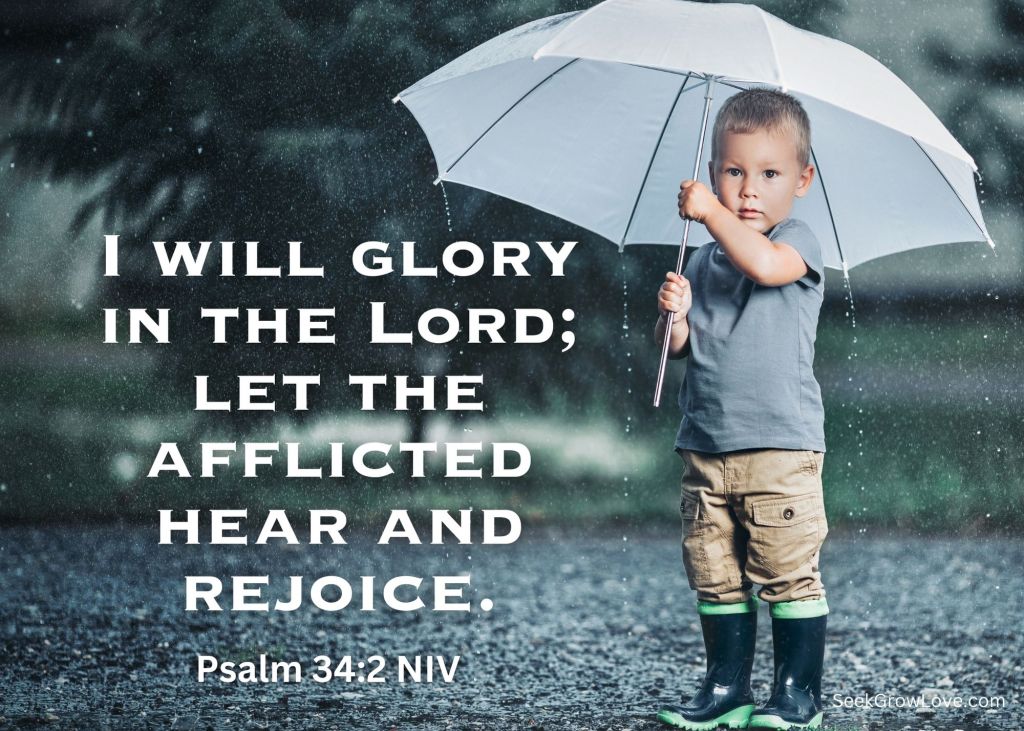
“I will extol the Lord at all times; his praise will always be on my lips. I will glory in the Lord; let the afflicted hear and rejoice.” – Psalm 34:1-2
-Aaron Winner
Reflection Questions
What do you think and feel when you hear you are not in control?
What evidence do you have to prove you are, or are not, in control?
How can you bring glory to God, even if your feet are in (or have been in) a muddy puddle?
It’s Friday. Have you stuck with me so far? We’ve tackled some challenging subjects this week. Most of the subjects have had to do with things that lead us away from God- from fear to pride to greed. So many things have the potential to turn our hearts away from God. It can be disheartening at times.
We talked earlier this week about the fastest growing religious group in America, the nones- those who say they have no religious affiliation or faith. Today, I want to address another group, the Dones. The Dones are people who have been highly committed believers, perhaps very active in Churches and ministries who have gotten to a place in their lives where they are just done. Maybe they are a pastor or Church leader who has poured out their life and energy into helping others and then experienced resistance or mistreatment, or other forms of suffering and they simply said “I’m done” and walked away from their ministry or their church.
I know. If you are a committed leader in the church and you get frustrated by people who treat you badly, it’s tempting to give up and say I’m done. These people aren’t necessarily abandoning their faith in God to pursue a sinful lifestyle of adultery, drunkenness or debauchery. They simply quit gathering with other believers in worship. They might pray and read their Bibles in the comfort of their living room or back porch, but they aren’t in the fray with their sleeves rolled up active in ministry any more. They are frustrated, depleted, disillusioned and disheartened and they are done with ministry or church or religion.
A couple of today’s texts address this. Psalm 11 addresses the challenge of disillusionment in the people of God. It asks the question: “When the foundations are being destroyed, what can the righteous do?” Some Christians have worked hard to help build the Church, make disciples and take a stand against sin and unrighteousness in the world, but as we look at what’s happening, the world seems to be winning and the Church is losing ground. We are seeing some of the foundations of basic morality crumble – basic issues of what is right and wrong, what it means to be a human person as a male or female created in the image of God, the meaning of the covenant or marriage and family – all of these basic elements of faith and life are being contested and undermined. The very foundations of society are being undermined right before our eyes. It’s easy to become disheartened and give up.
Psalm 11 says: “How then can you say to me, ‘Flee like a bird to your mountain.’” In other words, the temptation in the face of all of these attacks against the Church and God and morality and our ministry could be to simply fly away like a bird to the safety of the mountain, far from the battle. Go stick your head in the sand. Give up. Become apathetic about religion or God or the Church and ride the clock out. Or throw yourself headlong into achieving worldly pleasure or success (see yesterday’s devotion on money and happiness.)
Psalm 11 gives this following reminder when the temptation arises to fly away.
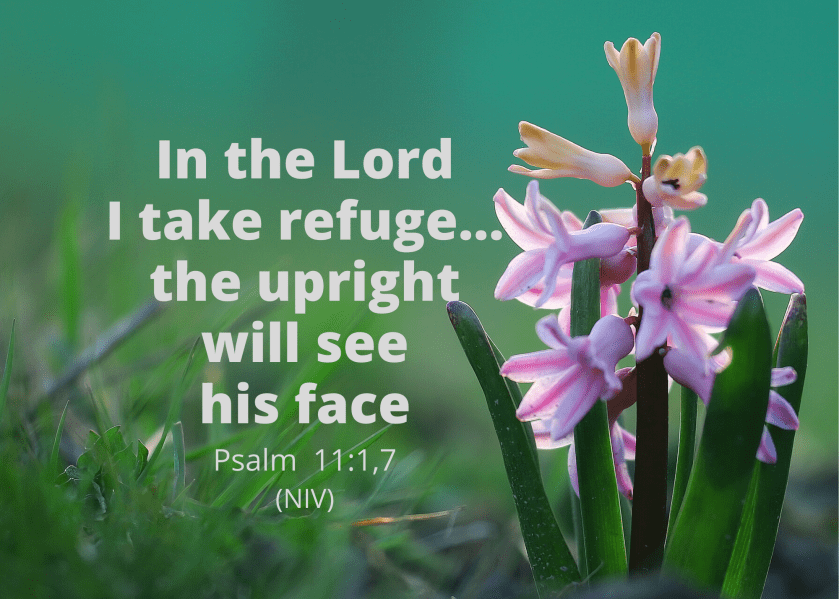
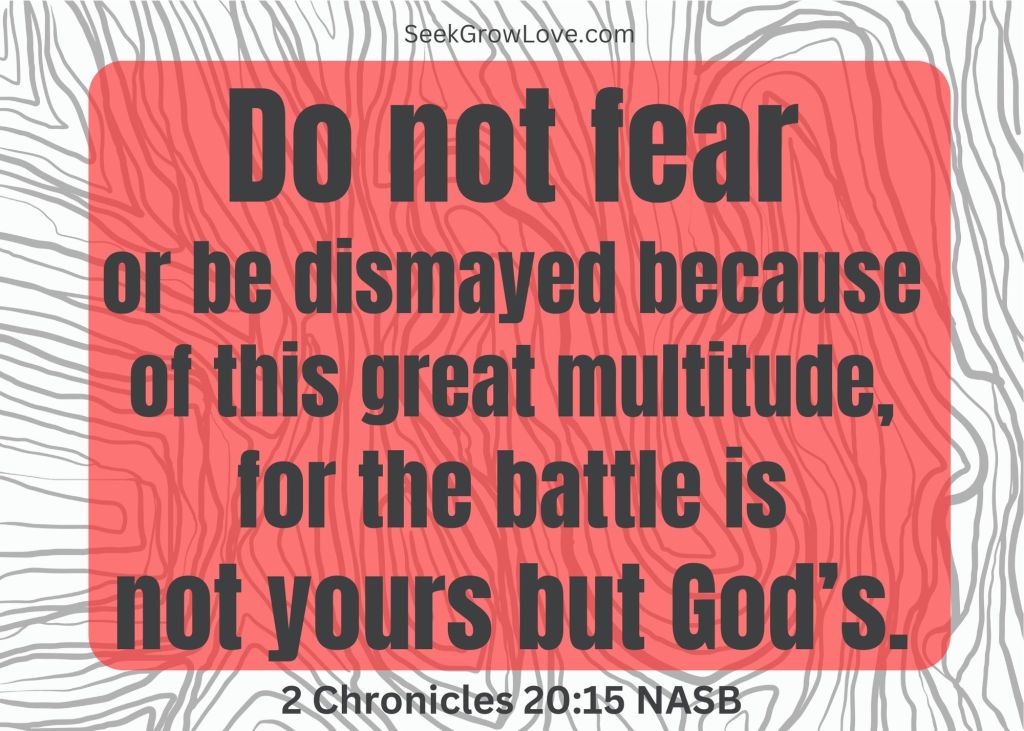
“In the Lord I take refuge.” Our refuge is in God, not in running away to safety away from the battle. Remember our reminder from earlier this week when God sent his prophet to Jehoshaphat- “The Battle belongs to the Lord” Let us take refuge in God, but let us not run away from the battle.
“The Lord is in his holy temple; the Lord is on his heavenly throne.” Trust that God is still there. God hasn’t gone anywhere. God hasn’t abandoned us and flown away, he’s there, he’s watching, he’s engaged and he’s working his plan through us, through the church, through the proclamation of the gospel. We can keep doing what we are called to do because we know that God is still on the throne.
“For the Lord is righteous, he loves justice; the upright will see his face.” God cares about what is right and just and good and that day will come when we will be at rest and peace. In the mean time, we may experience our share of suffering while we serve God. But we trust that the day is coming when we will see God’s face and receive our full blessing.
And just a word from the reading in 2 Timothy. Paul uses the word suffering many times in this reading. Paul knew a thing or two about suffering. Much that he wrote came while he was sitting in a prison cell somewhere suffering because of his faith in Jesus Christ. For Paul, suffering was not something to be avoided at all costs but the price of doing business as a disciple of Jesus. Paul wore his suffering as a badge of honor. He considered it a privilege to be able to suffer while serving Jesus in ministry. I admit that I haven’t quite hit that level of faith yet. I’m not a fan of suffering and I don’t like it when my ministry efforts are met with resistance or failure. I don’t like seeing people that I tell about Jesus reject Jesus or see formally faithful FUEL attenders or church members join the ranks of Nones and Dones. But I do recognize that Jesus warned us that being his disciple in this sinful world has costs and challenges and can be painful. After nearly 40 years of ministry, I have a few scars of my own. But I’m not ready to fly away and join the ranks of the Nones and Dones. I share Paul’s faith: “That is why I am suffering as I am. Yet this is no cause for shame, because I know whom I have believed, and am convinced that he is able to guard what I have entrusted to him until that day.” (2 Timothy 1:12) I hope that you know him too and are convinced. Keep yourself in the faith.
-Jeff Fletcher
Reflection Questions
Do you know any Nones or Dones? Have you tried asking them to join you as part of an active faith community? If not, will you?
Have you ever been tempted to join the ranks of the Dones? What has kept you from flying away?
Are you in danger of becoming a Done? What steps do you need to take to stay fully committed and connected to a body of believers?
Ever since I was a little kid I’ve had trouble with my ears. I had surgery on my ears several times before I was 8. I almost completely lost the hearing in my right ear- before the surgery the doctor told my parents that the infection was so bad when he got in there he might have to completely remove the contents of my ear rendering me completely deaf in that ear. Fortunately, he was able to save my hearing. But I’ve still had struggles. The most irritating thing for me these days is my ears are itchy inside. When they start itching I pull out the q-tips and scratch away—such sweet relief. But then the next morning they itch again. I went to my ear, nose and throat doctor and he looked inside and asked, “How often do you use q-tips?” “Every day,” I said. “You need to stop!” And he explained the reason why. Your ears naturally produce oils to keep them lubricated so they don’t dry out. When you use q-tips it removes the oils, your ears dry out and become irritated… and itchy. The thing I do to relieve the itchy ears – q-tips, is the cause of them continuing to be itchy. The solution. Stop using q-tips for a few days, allow the oils to return and lubricate the ears, and they will stop itching. If I could just trust him and endure a few days of itchy ears without q-tips, then they would stop itching. Problem solved.
The first few days were miserable. They itched so bad. All I wanted to do was use a q-tip to scratch, but I resisted. After a few days, sure enough just like the doctor promised, the itching stopped. I had learned something new that made my life better. Until I forgot. Old habits die hard. I took a shower and used a q-tip to dry out my ears (he told me to use a hair dryer instead). The scratching felt familiar and good, and pretty soon my ears dried out and got itchy again.
Change can be hard. I can be a slow learner about some things, like q-tips and itchy ears. In today’s reading we see Jehoshaphat could be a slow learner about some things as well. In yesterday’s reading we saw that he got into trouble when he violated God’s instruction and entered into an unequal alliance with the king of Israel, and how it led to some problems. Jehoshaphat learned a lesson, repented of his actions and things became better for a while. He learned to trust God instead of trusting in an alliance with Israel’s idol-worshipping King Ahab.
In today’s reading, we see how fully Jehoshaphat learned that lesson and learned to trust God.
First, Jehoshaphat receives a report that a vast army of Ammonites and Moabites and others are coming to attack. Jehoshaphat becomes “alarmed” at the news. Does he reach out to the Israelites to become his allies? That’s normally what would happen. (My ear itches, I’ll do what I always do and grab a q-tip). But Jehoshaphat learned a valuable lesson in the last story. So instead of entering into an alliance which God has forbidden, he decides to ask God for guidance.
Jehoshaphat calls for a fast and all the people of Judah came together to seek God’s guidance. They prayed to God: “God, we don’t know what to do, our eyes are on you.” Notice it says all the men, women, and children stood before God in an act of humility, reverence, and solidarity, seeking his guidance and direction.
Then something amazing happened. God answered them. The Spirit of God came on Jahaziel, the prophet, who then brings a word from God. The message is clear: “Don’t be afraid or discouraged for the battle belongs to God. Trust that God will defend you against your enemies.” God instructs them to go toward their enemies, stand firm, and then watch what God will do. Israel responded by worshipping and praising God with singing.
What happened next? God set an ambush against them and then, the enemies of Judah all turn on each other and destroyed each other. The people of Judah came to the overlook as God instructed so that God could show them the destruction of their enemies. They collected the plunder and it took them 3 days to haul the plunder back to Judah. As a result, their other enemies were afraid of God. God gave Jehoshaphat peace. (No more itchy ears when you follow the doctor’s orders and quit using the q-tips).
But old habits are hard to break sometimes. Jehoshaphat forgot to remember. Jehoshaphat made another alliance, and again there were consequences: “Eliezer son of Dodavahu of Mareshah prophesied against Jehoshaphat, saying, ‘Because you have made an alliance with Ahaziah, the Lord will destroy what you have made.’ The ships were wrecked and were not able to set sail to trade.” 2 Chronicles 20:37. Out came the q-tips again.
Jehoshaphat isn’t the only slow learner. This, it turns out was a pattern for generations of God’s people. God would give people instructions, the people didn’t fully trust God and tried to do things their way, God sent consequences to discipline them, the people didn’t like the consequences so they repented and started obeying God. Things got better for the people…. Until they once again forgot to trust God and tried to do things their own way and the cycle repeated itself over, and over and over again.
Fortunately, God was patient with slow-learning Jehoshaphat, and with slow-learning Judah. Fortunately, the same God is also patient with us. Psalm 103:8-12 reminds us:
“The Lord is compassionate and gracious, slow to anger, abounding in love.
He will not always accuse, nor will he harbor his anger forever;
he does not treat us as our sins deserve or repay us according to our iniquities.
For as high as the heavens are above the earth, so great is his love for those who fear him;
as far as the east is from the west, so far has he removed our transgressions from us.”
Through Jesus Christ God mercifully provides us with a saving way to turn from our faithless and disobedient ways, to learn to trust and follow God’s ways. Learning to trust God fully is a journey that can take time. We still are tempted to grab that q-tip and begin scratching away at those itchy ears. But if we can learn to simply trust God’s ways, no matter how itchy the ears or scary the invading armies might seem, we can trust and know that God will show us a way to peace and joy (and unitchy ears.)
-Jeff Fletcher
Reflection Questions
Why do you suppose Jehoshaphat’s “itchy ears” was his difficulty depending on God and not alliances with other kings?
What are some of your “itchy ear” areas where you have difficulty trusting God’s ways and try to do things your way (which usually makes things worse?)
What is one step you can take today toward trusting God in this area of your life?
Paul’s 3-month stint on Malta feels like a fever dream. Paul, the crew, and his fellow prisoners aboard the ship find refuge on a not-so deserted island, Malta. The indigenous people of Malta welcome their cold and wet selves with open arms and “unusual kindness” (Acts 28:2), building a fire to warm them. As Paul tends to the fire, a venomous snake bites him. The people of Malta are quick to assume that he is a murderer getting the justice he deserves. Of course, Paul just shakes the snake off like it’s no big deal. Miraculously, Paul doesn’t drop dead and his wound doesn’t even swell. Having witnessed this miracle, the people are now convinced that Paul is a god.
After three days of enjoying the Maltese hospitality, Paul visits a man who was sick to minister to him:
It happened that the father of Publius lay sick with fever and dysentery. And Paul visited him and prayed, and putting his hands on him, healed him. And when this had taken place, the rest of the people on the island who had diseases also came and were cured (Acts 28:8-9, ESV).
What was an unplanned setback turned into an opportunity for healing and sharing the gospel. God had a purpose for this season—the same season that Paul could have overlooked as an unnecessary and unpredictable setback on his journey to share his testimony in Rome.
Joseph, who was no stranger to suffering and had a life full of mishaps, once declared:
As for you, you meant evil against me, but God meant it for good, to bring it about that many people should be kept alive, as they are today (Genesis 50:20, ESV).
In the same way, God meant Malta for good. Paul’s influence seems to have changed the entire trajectory of this little island. Now, in modern times, it seems half the island is named after Paul. The little island off the coast where Paul supposedly washed ashore, the cave where Paul supposedly stayed, cathedrals, catacombs, and parishes each boast his name. Historians have found that the timing of Paul’s visit lines up very closely to the timing of Malta’s adoption of Christianity. Skeptics find this link uncanny; I find it divine.
There is purpose in every season, even when you can’t yet see it. Just like He did with Paul, God is redeeming parts of your story. Where you see setbacks, He sees opportunity.
-Mackenzie McClain
Reflection Questions:
The people of Malta were “unusually kind” to Paul and his fellow shipmates. Who in your life needs your unusual kindness?
How have you seen God redeem parts of your story? How has he turned setbacks, failures, or heartbreaks into good?
What parts of your story can you still surrender to God?





 Seek Grow Love