Astronomical Measures

Old Testament: Joshua 9-10

Poetry: Psalm 49

New Testament: 1 Corinthians 4

My inner science nerd was more excited than a kid in a free candy store last week as I donned my (un)fashionable cardboard glasses in preparation for a once-in-a-lifetime event: for the first time in over 200 years, my Midwest residence would be within the path of totality for a total solar eclipse – an alignment promised to not reoccur in this area for three quarters of a century. Seven years ago, we watched a partial eclipse (around 90% totality) from our home, which was very… underwhelming. However, after learning that there is a vast difference between even 99 and 100% totality, I bought into the hype and prepared for amazement. We hosted a watch party on our church property and our friends even flew in from Alaska to experience it with us! The weather was abnormally lovely for April. As the coverage increased, we detected a cool wind breaking through the warm air, and then street lights began to light up. Then, the millisecond that it reached total coverage, a wave of deep twilight blanketed the field and an evening chill washed over us; I could instantly sense the distinct change in my peripheral vision from behind the safety of my glasses. For about 3 minutes, we eschewed our disposable spectacles as we stared into the void of the sun, soaking in the uniqueness of a mid-afternoon that felt like a near-midnight. We were awed by the surreal experience and applauded the workmanship of our Creator! And then, as suddenly as it had been hidden, the sun again commenced its glorious shine, changing the temporary night back into day. 

Our reading in Joshua today tells of another rare astronomical event – “the sun stopped in the middle of the sky and delayed going down about a full day” while Joshua fought the Amorites. There are many theories about what actually went down on the day the sun didn’t, from an annular eclipse (which even secular scientists agree did occur in Canaan around that time) to a variation in rotation speed and everything in between (you can start your rabbit hole dive here), but what is most important is that God did something very miraculous to help Joshua win the battle. God was on Joshua’s side, and he took “astronomical” measures to help Joshua do what God had called him to do. Joshua and his men put forth the effort as wise and persistent soldiers, but they called on God for a miracle to help them win the battle – and He did, in an awesome display of His power. “There has never been a day like it before or since, a day when the LORD listened to a man. Surely the LORD was fighting for Israel!” (Joshua 10:14, NIV)

God fought for His people, and God fights for us. God is on our side, and He loves to show up in mighty ways. BUT… God usually expects us to be actively involved as well. Joshua had to go out and fight the battle – many of them, actually – and God showed up, often miraculously. This is a good reminder for our own lives. God has given us gifts and abilities, and He wants us to be engaged and active in this life. (For example, we don’t really have a legitimate reason to complain about not having a job if we’ve never submitted any applications, right?) Sometimes the best and only thing we can do is pray and let God work, but often, we will pray while we fight right there on the battlefield, trusting in God’s supernatural provision. He still performs miracles! 

In whatever battles you will face, remember that God is with you and still works in miraculous ways. Keep your eyes open to see His handwork in your life! 

-Rachel Cain

Reflection: 

– Watch for God moments in your day and thank him for them. It might be something as small as a daffodil field to bring a smile to your face as you drive to work, or as large as seeing God’s might during a solar eclipse. Either way, praise Him in all those moments! 

– How can you depend on God more to fight your battles? How might God be calling you to be more engaged in the battles yourself?
Keep Walking

OT – Joshua 5-6

Poetry – Psalm 47

NT – 1 Corinthians 2

Keep walking, but you won’t knock down our wall. 

Keep walking, but she isn’t gonna fall! 

It’s plain to see your brains are very small 

to think walking will be knocking down our wall.

– the Pea soldiers, from Veggie Tales “Josh and the Big Wall”

I’ve never been in the military (even preschool gymnastics was beyond my capabilities, and let’s just say I was usually a last pick in gym class), but even I can imagine that the mighty Israelite soldiers felt mighty silly walking around the city once a day for six days. Just walking behind the ark. And blowing some trumpets. Wow, fierce. I wonder if they wondered what God was thinking? Had they accidentally signed up for the (mostly-silent) marching band instead of the military? But on the seventh day – seven is the biblical number of completion – they marched around the city seven times, and then, a different kind of trumpet blast sounded, and Joshua ordered everyone to shout. And then, the wall collapsed. The mighty, impenetrable wall of the great city of Jericho, along with everything inside (save Rahab and her family), became a pile of rubble. Yet again, the people obeyed what seemed like ridiculous commands for an impossible task, and God worked through it all. I don’t know why God chose to take over Jericho in such a strange way, but I bet part of the reason was to display His awesome power and make sure everyone knew that He was the One True God. 

Psalm 47 even sounds like a song of praise that might have been shared after conquering Jericho: “He subdued the nations under us… He chose our inheritance for us… God has ascended amid shouts of joy, the LORD amid the sounding of trumpets…”

All of our lives should reflect back to the power of God. In our New Testament reading today, Paul also says, “My message and my preaching were not with wise and persuasive words, but with a demonstration of the Spirit’s power, so that your faith might rest not on men’s wisdom, but on God’s power” (I Cor 2:4-5) Just like when God made it clear that it was only by His power – not the marches and shouts – that the walls fell down, God likes to use ordinary, untrained people to do His biggest work, so His might is evident through their humility. 


God displays His power by working in big ways through us. He doesn’t NEED us; after all, God created the whole world without any input from mankind! But He wants to use us as part of HisStory, to help tell the world the greater message of His saving power. Will you join in the Greatest Mission of all time? 

-Rachel Cain

Reflection Questions

  1. How will you join in the Greatest Mission of all time?
  2. How/when have you seen God at work doing what seemed impossible in a way that you wouldn’t have expected? Who did He use in the mission?

God is Trustworthy

*Old Testament Reading:  Deuteronomy 31

Poetry Reading:  Psalm 42

New Testament Reading:  Romans 11 

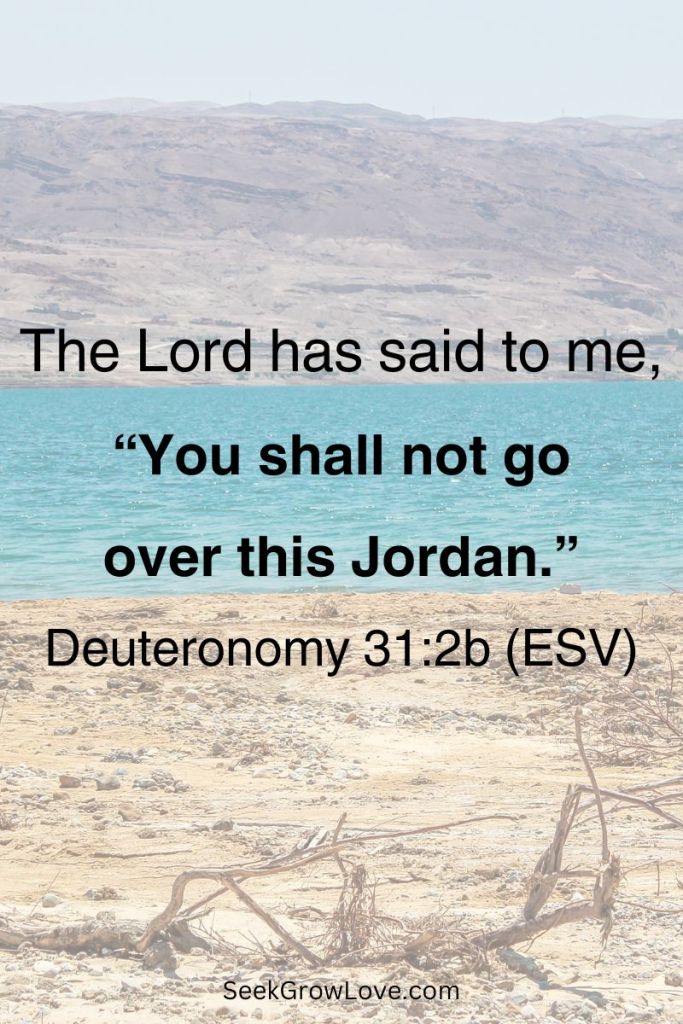
“The Lord has said to me, ‘You shall not go over this Jordan.’“  – Deuteronomy 31:2b (ESV)

Deuteronomy 31 begins with Moses acknowledging his advanced age (120 years) and telling the Israelites that he will no longer be their leader.  Deuteronomy 31:2b says, “The Lord has said to me, ‘You shall not go over this Jordan.’“  Moses does not get to enter the promised land because he broke faith with God – but he does get to see it from a mountain before he dies (Deuteronomy 32). We learn in this brief statement that God’s word WILL hold true, He had told Moses he wouldn’t get to enter (Numbers 20:12) and His stated consequences will apply (helpful parenting tip).

This might seem overly harsh, but it helps us trust that what God says will happen, will happen.  Moses accepted this consequence from God and went on to give the Israelites some parting words.  He begins with telling them to be strong and courageous (verse 6) and reminds them that God will never leave them.  Then he commissions Joshua to lead the people and tells him to be strong and courageous and that God will never leave him.  He tells the Levites to read the law every seven years, specifically so that the next generation will hear it and fear God (verses 12-13). 

After God reminds Moses that he’s going to die soon, He tells him that the Israelites will break His covenant.  How sad that must have made Moses!   God then has a final instruction for Moses.  In verse 19a God says to Moses, “Now therefore write this song and teach it to the people of Israel” and verse 22 says, “So Moses wrote this song the same day and taught it to the people of Israel.”

What was so important that it was one of the last things God wanted Moses to do for Him?  You can read the song itself in chapter 32, but basically it was a warning to the Israelites.  The song Moses was instructed to write begins with a reminder of God’s faithfulness, then moves to their future failures and turning away from God and then of God’s punishment that will follow. 

So what can we learn from this passage that was directed very specifically at the Israelites of that day? 

First, can people trust us when we speak?  Do we do what we say we will?  It is important to know that we can trust God.  It is also important that we are trustworthy.

Second, it’s easy to look at the Israelites and think, “What was wrong with them?  God told them how they would fail Him and they didn’t stop it from happening!”  However, if we are honest with ourselves, we do the same thing.  God has told us in Romans 3:23 that, “all have sinned and fall short of the glory of God”.  We all sin.  We all turn away from God.  But the good news is that God is there, waiting for us to turn back to Him!

Amy Blanchard

Reflection Questions

  1. It is important that we are trustworthy.  Do your actions line up with your words? 
  2. Just like the Israelites needed to not get stuck in the place of accepting and acknowledging their sin but doing nothing about it, we are not to sit there, either.  God tells them in verse 21 that, “this song shall confront them as a witness”.  What confronts you when you reject God’s plan for you?  Do you heed the warning?

It’s All Good Now

Old Testament: Deuteronomy 25 & 26

Poetry: Job 40

*New Testament: Romans 8

 “And we know that for those who love God all things work together for good, for those who are called according to his purpose.”  – Romans 8:28 (ESV)

Of all the books of the Bible, Romans is my favorite. Chapter 8 may very well be my favorite chapter in the book for many reasons. It starts with the declaration that there is no condemnation for those who are in Christ Jesus, and it ends with the encouraging reassurance that there is nothing in all of creation that can separate us from the love of God. In between, however, is a great life verse that provides comfort and hope regardless of your situation or circumstance.

Romans 8:28 says, “And we know that for those who love God all things work together for good, for those who are called according to his purpose.”

It is just as important to understand what is not said as it is to understand what is said. Paul does not say that all things are good but rather all things work together for good. It is often a matter of time and/or a change of perspective to see that the bad things that happen end up working for your good. I can speak specifically to that being the case. My salvation story depends on it.

On Easter Sunday in 1995 I was invited to come to church and help the men cook breakfast for the congregation. It was a tradition that had been going for a while and continues to this day at Pine Grove Bible Church. I was not a member or even a Christian at that time but as a former short order cook and someone who enjoys hanging around with other guys I agreed to come and help.

As a result of me driving in early to help cook, we had two vehicles at church and then two vehicles at my in-laws as we celebrated Easter dinner. When it was time to leave, my wife Amy and our two children were going to get in the car she was driving and I would get in mine to head home. I asked my almost 7-year-old son David if he wanted to ride with me and he said no. I told him we could beat mom home and he could ride in the front seat (this was pre-airbag times) and so he agreed to hop in with me. This was not a common occurrence as he often would sit in the middle of the back seat loosely buckled and leaning forward between the front bucket seats to entertain his incredibly crabby sister. As fate would have it, we made a stoplight that Amy and Stephanie did not, so we did indeed arrive home first.

I was busy unpacking the leftovers and Easter baskets (at that point we had the only two grandchildren, so it was always a bonanza for them) when I noticed a message blinking on the answering machine. It was Amy, calling from someone’s cell phone (very few people had them back then) letting me know that she had been in an accident and the car had flipped and she was very shaken up. I couldn’t hear Stephanie crying in the background (if any of you reading this were around at that time you know that she was always crying in the background) so I grabbed David and raced back to the accident site.

When I got there, I saw her mangled car in the ditch on its side facing the wrong way. I recall heading to the squad car and then desperately clinging to my 18-month-old daughter as tears ran down my face. I came to find out that a car traveling in the opposite direction had a blowout, lost control, and ended up hitting them almost head on. Thankfully, Amy was able to turn quickly enough to have the car hit her by the driver door, slide down the side to the rear wheel well where it caused the car to flip 180 degrees over and backwards. It was an Easter miracle that neither Amy nor Stephanie was seriously injured.

The accident was not good, in fact it was bad, very bad, as Amy still suffers neck pain as a result. But, given the ability to look back, I can honestly say that it worked for the good. I was working in a sales job where I was gone most nights and the realization that what mattered most to me could have been lost in the blink of an eye caused me to quit that job that next week. Wanting to spend more time with my family caused me to start attending church and Wednesday night Bible study and eventually I gave my life to Christ.

Now, nearly 29 years removed from that horrible accident I can see God’s hand working through all things, even accidents, for the good of those He has called according to his purposes. Trust in His timing, God is good!

Todd Blanchard

Reflection Questions

1. Can you identify a specific time in your life that seemed devastating at the time (i.e. job loss, death, relationship ending) but now you can see how it shaped you into who you are today?

2. Who do you know that is going through a tough time that you can share your story with?

3. How can you remind yourself to trust in God’s timing for your life?

Why NOT Me?

Old Testament Reading: Deuteronomy 23 & 24

*Poetry Reading:  Job 39

New Testament Reading:  Romans 7

­­­­­­­­­­­­­­­­­­­

If you’ve been reading along in Job you have watched terrible tragedy come upon Job time after time.  You have seen his friends come to be with him.   You have heard those same friends accuse Job of sinning; all of their advice coming from the perspective that he needs to repent in order for God to end his punishment.  You have also heard Job defend himself, holding fast to his innocence.  He boldly tells his friends what he would do if God would answer him. 

  • 23:4-7:  I would lay my case before him and fill my mouth with arguments. I would know what he would answer me and understand what he would say to me.  Would he contend with me in the greatness of his power?   No; he would pay attention to me. There an upright man could argue with him, and I would be acquitted forever by my judge.
  • 31:35-37:  Oh, that I had one to hear me!  (Here is my signature! Let the Almighty answer me!)
        Oh, that I had the indictment written by my adversary!   Surely I would carry it on my shoulder;
        I would bind it on me as a crown; I would give him an account of all my steps; like a prince I would approach him.

Job 39 is part of a “rant” by God that puts Job in his place.  God first joins in the conversation between Job and his friends in Job 38:3, “Dress for action like a man; I will question you, and you make it known to me.”  God repeats this in Job 40:7, “Dress for action like a man; I will question you, and you make it known to me.” 

We will look at God’s reply and Job’s response in a couple of days.  Today, I want to focus on a few other thoughts. 

First, God is BIG and we are small. 

  • Omniscient – God is all-knowing – we are ignorant
  • Omnipotent – God is all-powerful – we are weak
  • Omnipresent – God is everywhere, all the time – we are limited

We need to keep these differences in mind at all times.  This is what allows us to fully trust in God and His plan for our lives. 

Second, we need to have a proper perspective of our lives on this earth. 

  •  2 Timothy 3:12a:  “Indeed, all who desire to live a godly life in Christ Jesus will be persecuted
  • John 16:33:  “I have said these things to you, that in me you may have peace. In the world you will have tribulation. But take heart; I have overcome the world.”

Both of these verses are directed to those who are in Christ.  The Bible’s perspective is that we will face trials and persecution.  It is much more difficult to face those trials when we have the perspective that it shouldn’t happen to us.  Sin, evil, suffering – these are normal for this life.  They should be expected.  If we are in Christ, our perspective and expectations should be that these things should happen to us.

Having the right perspective of who we are compared to God and what expectations we should have regarding life in this age will help us trust God as we face whatever circumstances come our way. 

Amy Blanchard

Reflection Questions

  1. Do you accept that you are ignorant, weak, and limited….at least in comparison with God?  He wants us to depend on Him, to trust in Him, and to let His power be seen in us (2 Corinthians 12:7-10).  To do this, we need to begin to see how great God is.
  2. I desire to live a godly life.  I am in Christ.  I still don’t want to be persecuted.  However, I am trying to accept that if I am living a godly life, I will face persecution.  Are you trusting God to bring you peace in your troubles? 

How will your story end?

Old Testament: Numbers 14

Poetry: Job 13

New Testament: Acts 27

One of our readings today has a very good ending. One of our readings today has a very bad ending. The story with the very good ending could have ended very differently and many lives could have been lost at sea, including Paul’s. The story with the very bad ending could have ended very differently and many lives could have been saved including the ten spies who died in a plague and all those over twenty years of age who died in the wilderness.

I won’t retell the stories here. Make sure you read the account of the grumbling Israelites who listened to the ten scared spies instead of the two faithful ones in Numbers 14, and see what the consequences were for their actions and especially their attitudes. It is a powerful chapter that would have a huge devastating effect on the lives of every single Israelite young and old.

And also read the detailed account of Paul’s voyages towards Rome which included hurricane strength storms that went on for days with no sun or stars. Read of God’s promise to Paul in the midst of the storm.

God could have saved all onboard Paul’s ship by simply stopping the storm. But He didn’t. He let them endure the storm that raged for days. Maybe He was building character and perseverance and teaching the other 275 onboard to listen to Paul and Paul’s faithful God. Perhaps He was preparing the Malta islanders to receive all the castaways who would miraculously survive as well as receiving the good news of the God that saves. Maybe he was giving Paul one more great adventure and answer to prayer before arriving in Rome.

God could have sent earthquakes, fire or plagues to instantaneously wipe out the Amalekites and Canaanites so the Israelites wouldn’t need to face opposition and could just march in and take the land God promised to them. But He didn’t. We don’t always get to hear the mind of God and reasons He has for doing it His way, but in this case we do get one interesting reason I wouldn’t have thought of in Deuteronomy 7:21-24.

Do you believe the promises of God? Do you trust Him enough to not grumble against Him when there are obstacles in the way? Do you believe that safety and rest are on the other side of those storm clouds? When you face storms, trials and opposition it is not because God doesn’t care or He is not powerful or smart enough to have avoided the speed bump. Can we trust God knows more than we do and the troubles we face are not too big for Him? We tend to get into pretty big trouble when we decide we know more than God and we want to do it our way instead or we are too scared to go where He guides. Will we listen to the Joshuas, Calebs and Pauls who remind us of God’s promises and His power to provide, when we obey? Or will we grumble against our God in fear of what is in front of us?

How will your story end?

It depends on your view of God and what you do in the storms. Will you believe Him? When the easy way is enticing, when the opposition is scary, when the storm is big, will you remain faithful to God remembering the promises He has given? Will you remember how big and great your God is?

-Marcia Railton

Reflection Questions:

  1. What promises has God given to you? How do they help you when you are scared or unsure of the future?
  2. What obstacles have you encountered on the way? How have you grumbled against the Lord which leads to rebellion?
  3. How can you build your trust in Him so you aren’t tempted to join the masses when they grumble and rebel and try to jump ship but you stand strong with the Joshuas and Calebs and Pauls.
  4. How do you see your story ending?

Closed Doors

Old Testament: Leviticus 24 & 25

Poetry: Job 2

New Testament: Acts 16

Have you ever gotten your fingers pinched, or crushed in a door? Ouch. That stings. Have you ever watched as someone walked (or ran) right into a closed door, falling backwards? I watch a lot of preschoolers – it’s a regular thing. Some handle it well, and dust themselves off as they go on, sometimes even laughing. Others need to take some time on the floor (and sometimes in my arms) to get over the shock and pain.

Have you ever been excitedly making plans of how your day, your trip or your life would go – only to find closed or closing doors. Maybe your fingers gets pinched in the process, or maybe your whole body and spirit are totally knocked out from a closing opportunity you were planning on and excitedly anticipating?

There are a lot of closed and closing doors in Acts 16. Paul and his companions (including Silas and Timothy at this point) were at the beginning of Paul’s second missionary journey. It is helpful to look at a map as you read Acts 16:6-10 to see what is really going on with Paul’s travel plans. (I also found William Schlegel’s Satellite Bible Atlas handy). Verse 6 says the Holy Spirit kept them from preaching the word in the province (not continent) of Asia. This indicates that they had wanted to, were planning on, and would have taken the gospel message to the province of Asia. That sounds like a very good thing! But, Asia became a closed door – because of the Holy Spirit. The map shows that the province of Asia would have been to their west as they were traveling. The very next verse says that at the border of Mysia (indicating that they did indeed continue traveling after their first way was blocked), “they tried to enter Bithynia, but the Spirit of Jesus would not allow them to” (Acts 16:7 NIV). Bithynia would be to their east. Closed door, again! Can’t go west, then, further down the road they can’t go east.

It would be interesting to know what these closed doors looked like. Maybe government red tape and passport issues that prevented travel to certain areas. Maybe a prophecy or just plain “bad feeling” about proceeding in the intended direction. Maybe advice from others regarding weather or disasters or unrest ahead. Maybe we will know one day what their closed doors were. Probably you can see what your closed doors are. What has kept you from the day, the trip or the life you envisioned? Maybe you have become discouraged because of all the things you were planning on doing, that aren’t working out right now as you had planned. If so, keep reading Acts.

It’s easy to ask, “What’s up, God? Don’t you want these on-fire evangelists to carry your word to the world?” How many closed doors are we supposed to come across and still keep going? It is so easy to let road blocks and closed doors defeat us, but Paul kept traveling, wherever he could. Can’t go to Asia, can’t go to Bithynia, let’s try heading to Troas. He was rewarded with a vision of a man from Macedonia calling out for help. The Bible tells us, when Paul received the vision, “We got ready at once to leave for Macedonia, concluding that God had called us to preach the gospel to them.”

So off to Macedonia they went. And what adventures – and lots of open doors – awaited them in Macedonia! There were new churches and hearts God was preparing in Philippi and Thessalonica and Berea (all cities of Macedonia). But God had planned that they would hear the message from Paul and his companions. He just needed to get Paul to them. If God had allowed Paul to enter Asia or Bithynia when they had wanted to, Lydia and the Philippian jailer and so many others would have been left waiting.

God’s plans were better than Paul’s . God’s plans are better than ours. His open doors are the best. His closed doors are closed for a reason – and that is okay – even good – even when it pinches a bit or throws us to the ground for a spell. Get up and try another door. Keep traveling and testing doors. The one He wants you to go through will indeed open. And behind THAT door are adventures and blessings that He has prepared for you – and people that He has prepared for you to carry the good news to. Don’t miss out on finding the open doors because you are sulking at the closed ones.

(Note on Holy Spirit and the Spirit of Jesus: both of these spirits were blocking Paul’s way at different times. I think it is not saying these are the same – but they did have the same purpose which was to get Paul to where God wanted him by keeping Paul from going other places, at least for now (later he would travel to Asia and work with the people who God had prepared at that time). Just as God and His Son are two side by side in heaven right now, they are active in the same spiritual battle for saving lives by sending their spirits to guide, empower, and close and open doors. It’s kind of like getting two superheroes on your side instead of just one.)

-Marcia Railton

Reflection Questions:

  1. Do you sometimes tell yourself that your plans are better than God’s? How can you trust Him more?
  2. What doors have been closed that you were anticipating traveling through? How did you handle it?
  3. What doors have been opened that you hadn’t been anticipating or planning? What blessings would you have missed out on if you had taken the closed door route instead?

Little Money but Lots of Good

Old Testament: Leviticus 1

Poetry: Psalm 37 (all week)

New Testament: Acts 4

Psalms 37 is one of my favorite psalms. It holds a special place in my heart. When I saw there was a whole week dedicated to this passage, I knew for which week I wanted to write. This week we also will look at some exciting and pivotal moments of the early church. Finally, we start Leviticus. As someone who enjoys culture and history, I appreciated these passages in Leviticus as they gave insight to what life was like for the early Israelites. Without further ado, let’s dive in!


I am poor. I do not say this to gain pity, but rather as a matter of fact. I make
$17.50 an hour working full time at a daycare. I live by myself, with no roommates to split rent. I’ve got a senior dog who is on a special diet and needs joint supplements. I’ve got car payments, insurance, internet bills, and an expensive prescription medication I need every month. I am the woman in the grocery store with her phone–not texting but using the calculator feature to ensure I stay under budget. I have a second job teaching dance to give myself a small savings cushion. I tithe and trust God. I do this living from paycheck to paycheck life for one simple reason: I love my job!


I have been teaching preschool for the past five years. I am in my second year of
having my own classroom of five year olds to prepare for Kindergarten. I have a
college degree and could make more money elsewhere, but I truly enjoy what I do. I also feel I am using my God given gifts to serve my community. So, while I am poor, I chose to be. This makes my situation easier as I am not stuck like so many in real poverty are. There was a time, though, when I did not have as much financial peace as I do now.


There are videos going around on social media of women who make adult content bragging about how much money they have and showing off their amazing homes. When I discovered these videos, I was infuriated. Here I was struggling to get by, while these women who were deliberately going against God lived worry free. What’s more is they had a surplus of money to give away! There are even videos of them passing out cash to random strangers or handing out mystery electronic gifts. How I would love to be able to surprise bless people like that. My anger turned to jealousy. It was not as if I was jealous of some amazing singer, actress, or athlete whose hard work and talent was deserving of the monetary recognition. The internet has made it easier than ever to create adult content. Many of these women were the same age as me. We both had access to the internet. It was not a matter of opportunity but of morality that separated us. My jealousy soon turned to bitterness. I felt like I was suffering for doing the right thing.


Through my studies in scripture I came to realize this was not a new concept; that those who live lives of sin may also live lives of luxury. The first few verses of Psalms 37 address this:


Don’t worry about the wicked or envy those who do wrong. For like grass.
they soon fade away. Like spring flowers, they soon wither. Trust in the
LORD and do good, then you will live safely in the land and prosper. (verses
1-3 NLT)


The writer addresses the financial differences between those who follow God and those who do not: “It is better to be godly and have little than to be evil and rich. For the strength of the wicked will shatter but the LORD takes care of the godly.” (verses 16 & 17 NLT). Throughout this passage the writer refers to a future reward. It is described as “an inheritance that lasts forever” (verse 18 NLT). We know this to be the Kingdom of God. This writer urges God’s people to refrain from anger but trust in a future land of prosperity and peace. It took me a while, but eventually, I began to let go of my frustrations and take the advice in Psalms 37 to not fret and worry about the success of the wicked. Soon, the bitterness, jealousy and anger I felt faded away and was replaced by a quiet peace in God.


Psalms 37 tells of a great future for those who trust in God. Jesus brings news of
this future in the Gospels. It is the promise of this same future that gave the early church members boldness when they first began facing persecution as we see in Acts 4. My prayer for you is on days when the world seems full of evil and
unfairness, you too will hold fast to the promise of eternal inheritance and future glory in the Kingdom of God.

-Emilee Ross

Reflection Questions

  1. What are your feelings when you see evil people prosper? What can you gain from Psalm 37?
  2. Do you have the promise and hope of an inheritance that lasts forever? If so, what difference does it make in your life now? If not, do you want it?
  3. What is the problem with putting your trust in money? What is better than money?
  4. On a scale of 1-10 how would you rate your own trust in God? Would you like to see it grow? What do you already know about God’s character? How can you learn about His character? How have you seen God provide?

When Giving it All is a Wise Investment

Old Testament: Genesis 37 & 38

Poetry: Psalm 16

New Testament: Matthew 13:44-46

Some of my favorite commercials have come from the Klondike Bar ice cream company. Their catchphrase is “What would you do for a Klondike?”, followed by some of the most extreme examples of people doing something to get their ice cream bar. One of my favorite commercials involved a man willing to shave off one of his eyebrows and looking ridiculous for the ice cream (I apparently am not willing to do much, because I’ve never actually eaten one).


We are asked a similar question in our devotion today, but not involving ice cream: this involves the kingdom of God. In Matthew 13, the kingdom of God is compared to two gentlemen willing to sell everything that they possess to acquire it, like a hidden treasure or a precious pearl. They recognize two things: the kingdom of God is something of tremendous value, and that everything they own cannot compare with its marvelous wonder. Although they are sacrificing much, they are making the wisest investment of their life. Imagine if you had the opportunity to possess a winning lottery ticket that would give you 100 million dollars: all it would take is to sell all your possessions… would you take that deal? Would that lottery ticket not be able to buy back everything you had and more?


See, Jesus also promised that if we give our lives for the kingdom of God, we would receive a hundred times as much in this life and in the next age (see Matthew 19:27-30). He wasn’t asking us to simply give up everything just because he felt like it: he promised infinitely more than we could ever imagine, if we would simply trust him and follow his kingdom-way. You would
be making the wisest investment of your life if you chose the kingdom of God over every possible path that this life has to offer, and you would gain much more than this life could ever offer. So, “What would you do for the kingdom of God?” What are you willing to risk for eternal life?


Perhaps a more direct question is in order as well: “What are you NOT willing to risk for the kingdom of God?” We all have something we hold dear, whether that be personal possessions, a deeply-held family connection, or a desired career path. There are some things that will be difficult to let go of to pursue Jesus and the kingdom of God, but that’s the point: he wants you FULLY committed, willing to give him everything because he gave everything for you. This is something that we must consistently ask ourselves and reflect on what we are holding back from our Lord.


What would you do for the kingdom of God?


Talon Paul

Reflection Questions

  1. Both men in today’s parables recognized the kingdom of God as something of great value. What value do you place on the kingdom of God? Why?
  2. What have you already given up to pursue Jesus and the Kingdom of God?
  3. What are you having a difficult time letting go of in order to gain the kingdom of God? 
  4. Explain how giving it all can be a wise investment.
  5. What is the wisest investment you can make with your day today, and with the week ahead of you, if you are fully committed to living for the kingdom? 

A Golden Thread

*Old Testament: Genesis 27 & 28

Poetry: Psalm 11

New Testament: Matthew 11

Jumping into our Old Testament reading today of Genesis 27-28, we find ourselves among a muddy set of characters. Isaac, Rebekah, Jacob, and Esau are quite the dysfunctional family in a lot of ways. As a kid I heard the story of Jacob and Esau many times, and I remember coming home from Sunday School one week quite indignant as to why the “liar” got the blessing.  That just didn’t make sense to my immature brain which was picking up information from stories in isolation, and in many ways, is still working on weaving them all together. Jacob and his manipulative mother had stood out to me as being the “bad guys” in the story since they were busy lying, sneaking around, wearing hairy disguises, whipping up really good goat stews that just might taste like something Esau’s hunting could have contributed to, and yet somehow, they got away with it. What good Sunday school teacher would have the moral of the story be “lie, cheat, and steal and you’ll be blessed”?

 Now when I read this story, I realize….it’s kinda like war. Ultimately, like most stories of human beings, all of the characters are wrong in different ways at different times and full of mistakes. In this case, at times they were all conniving and trusting in themselves to fix problems versus trusting God wholly and His sovereign plan.  While Rebekah had been told the older would serve the younger, she certainly hadn’t been told to take matters in her own hands and assume she had to be manipulative and conniving to achieve what God himself had already told her was going to happen. Nor had Jacob been instructed to trick and lie to his father. And Esau certainly was not just an innocent victim with his misplaced priorities like bowls of red stew and pagan wives. Interestingly, according to commentaries, Isaac lived 40 more  years after giving the blessing to Jacob. I always pictured him on his deathbed in this story, but apparently he had another 40 years to see what unfolded! 

God had a plan, a promise, a land and blessings to give, despite this family’s actions, not because of them. The story of this imperfect crew in Genesis 27-28 falls after Abraham has died. They are descendants of the promises given to Abraham already, and in Chapter 28, Jacob hears those promises reiterated again to him personally. As promised, not because his costume was really good and his lying skills were top notch, Jacob’s descendants are bountiful, and form the biological lineage of King David and our Messiah, Jesus. Genesis in fact, is a book full of beautiful promises, and not just promises found in interesting tales of old, full of characters who like red stew. They are full of incredibly relevant promises for any Christian today, and are absolutely central to the gospel message. For that matter, these passages are also very relevant to current events today and a land that we must trust to God’s sovereign plan. He doesn’t need our plotting, manipulating, and worrying.  Not only that, He doesn’t want them. God alone knows the who, what, when, where, why, and how of it all. Jesus will return. The meek will inherit the earth. 

In trying to come up with an analogy for the importance of the promises of Genesis in relationship to the gospel, and how they impact what we live for, hope in, and are sustained by, I realized Anthony Buzzard, a faithful teacher of the Abrahamic faith, had already done it for me. In an article I ran across recently in his Focus on the Kingdom magazine, I found comfort and inspiration in his golden thread description:

Underlying the entire Bible story, running like a golden thread through Scripture, is the promise made to Abraham that he would receive, as a reward for his obedience to God’s call to leave Ur of the Chaldees, prosperity, progeny, and property. This amazing, divinely promised guarantee of success, which Christians are invited to share as spiritual children of Abraham, is summed up in the compact phrase “the blessing of Abraham.” This beautiful and memorable phrase is found only twice in Scripture, in Galatians 3:14 and Genesis 28:4. This provides the essential link between the two Testaments.

The article, The Land Promise to Abraham and His Descendants: The Key to the Whole Bible Plot, can be read here.

May He also give you the blessing of Abraham, to you and to your descendants with you, so that you may possess the land where you live as a stranger, which God gave to Abraham.

 New American Standard Bible (La Habra, CA: The Lockman Foundation, 2020), Genesis 28:4.

in order that in Christ Jesus the blessing of Abraham would come to the Gentiles, so that we would receive the promise of the Spirit through faith. 

 New American Standard Bible (La Habra, CA: The Lockman Foundation, 2020), Galatians 3:14.

Reflection Questions:

What can you do to facilitate more trust in God and less tendency to manipulate and control circumstances in your life and around you?

How can you weave more of the “golden thread” of the promises to Abraham into your mind, heart, and life and learn more about what those are?

Have you ever had goat stew? 🙂 

-Jennifer Hall