
His Love & Discipline

Jeremiah 26-29

Jeremiah 26 2b 3 NIV sgl

I love God’s optimism.  Sometimes God reminds me of a Jewish mother, always looking for the best in her son.

“Three Jewish mothers are sitting on a bench, arguing over which one’s son loves her the most. The first one says, “You know, my son sends me flowers every Sabbath.

“You call that love?” says the second mother. “My son calls me every day!”

“That’s nothing,” says the third woman. “My son is in therapy five days a week. And the whole time, he talks about me!”

God is optimistic like that: “Tell them everything I command you; do not omit a word. Perhaps they will listen and each will turn from their evil ways. Then I will relent and not inflict on them the disaster I was planning because of the evil they have done.” (Jeremiah 26:2-3).

God was more than ready to forgive them.  God had no desire to punish His people.  He gave them every opportunity to repent.  But instead of heeding the warnings of Jeremiah and changing direction, they wanted to kill the prophet.  Jeremiah was eventually spared, but the people still failed to listen to his warning and repent.  Babylon ultimately did conquer them and carry them back to Babylon in Exile.

Jeremiah warned that the exile would last 70 years.  Another “prophet” named Hananiah came back and said that in just 2 years they would all be back and everything would be okay.  Hananiah flat out lied.  He was spreading fake news (see yesterday’s devotion).  It ended up that Hananiah is the one who died and his prophecy did not come true.

Once the exile began there was no turning back.  But God had a plan for that time in exile.  It was actually to protect his people.  Just as their years of captivity in Egypt enabled Israel to grow from just a few people into a great nation capable of taking possession of the promised land, this time of exile was intended to be a time for God to both cleanse the land from idolatry and cleanse God’s people from their idolatrous ways.  While the exile might have felt like a punishment and a judgement, and it was, it was actually intended by God to help bring his people back to righteous living.

When a parent punishes a child, the healthy parent is not getting any joy from seeing their child suffer.  The old expression “this is going to hurt me a lot more than it hurts you” has a real basis in truth.  A loving parent punishes, or better – disciplines, their child out of love.  The child has been acting in ways that are ultimately harmful to themselves and they need correction.  After numerous warnings and Israel’s failure to heed those warnings and repent, God had to take bold corrective action.  But the intent and purpose is love.  They needed to be purged of their idolatrous practices which included sacrificing their children to the gods of the age.

The exile was intended by God to purge them of their idolatry and purify them as a people.  As they were living in Babylon they were to live as good citizens.  They were to “seek the peace and prosperity” of the place in which God had brought them (Jeremiah 29:7).  Babylon was certainly not a perfect place and had its own share of godlessness and evil, but God’s people were to live peacefully and seek the good of Babylon while they were there.

I would encourage you to read carefully the letter that God had Jeremiah send to the exiles in Babylon found in chapter 29.  This is instructive for Christians today.  As Christians in the world today, we are ultimately children of God, citizens of God’s coming Kingdom.  Our King is Jesus and he is currently in heaven, waiting for the day when he will return to earth and establish God’s kingdom.  So our citizenship is currently in heaven.  When our king comes and the earth is transformed, our citizenship will be here on the renewed earth.  Until that time, as we live here we are resident aliens.  I may be a US citizen in the United States in name, but ultimately, I am a citizen of God’s Kingdom living here as a stranger and foreigner.  Peter calls us exiles.  You and I are exiles living here just as the Jewish people were exiles living in Babylon in Jeremiah’s time.

As exiles here we should practice the same things that Jeremiah told the Jews in Babylon to do as exiles there.  We should get married, have families, increase in number and pray for the place we are living.  We are to continue the creation mandate given in Genesis 1- “be fruitful and multiply, fill the earth and subdue it etc…”  As Christians living here in exile we use our gifts to make the place in which we are living a better place.  Babylon was not perfect, but the people of God living there were to contribute to it being a better place to live.  America or Canada or wherever you happen to live is not a perfect place, but you as a Christian should live in a way and use your gifts and energy to make it a better place, until Jesus comes again and we are no longer in exile but enter into the fulness of the Kingdom of God.

Note that eventually, God brought judgment against Babylon.  That empire fell to the Medes and the Persians, and it was the Persians that made it possible for the people of God to return from exile to the promised land.  Let us seek the best for wherever we live, but when God decides to bring judgment against that place, it is all part of his plan, and he will watch over His people who remain faithful to him wherever we are.  And in the end, all will be well.

Pastor Jeff Fletcher


Today’s Bible passage, Jeremiah 26-29, can be read or listened to at https://www.biblegateway.com/passage/?search=Jeremiah+26-29&version=NIV

Tomorrow’s reading will be Jeremiah 30-31 as we continue the 2020 Chronological Bible Reading Plan



A Fake News Detector

Jeremiah 23-25

Jeremiah 23 21 22 NIV sgl

The Cambridge Dictionary has recently added a new entry: Fake News.  Fake news is defined as: “false stories that appear to be news, spread on the internet or using other media, usually created to influence political views or as a joke.”

President Trump can probably be given a lot of credit for making this term a part of our everyday lexicon.  But fake news is nothing new.  In fact, it’s been around since the days of Adam and Eve and the serpent.  When the serpent told Eve, “You shall not surely die” if she ate from the forbidden fruit, the serpent was spreading fake news.

During the time of Jeremiah there was a lot of Fake News going around Jerusalem and throughout the land of Judah.  The fake news was being spread by people who claimed to be speaking God’s truth.  They were prophets and priests and other religious leaders who were telling everyone, “Everything is going to be okay, nothing to worry about, the king has everything under control.”  The problem was, everything was not going to be okay, there was plenty to worry about and there was absolutely nothing that their king could do to stop it.  Those messengers of fake new were peddling a false hope to the people of God, and they were doing a lot of harm.  God said that they were actually strengthening the evildoers so that they don’t repent.  They were doing the exact opposite of what God wanted.

Against the backdrop of fake news that was being spread by false prophets, God called Jeremiah to be a voice of truth with a clear message from God.  Amidst all the claims of “everything is going to be okay”, Jeremiah said to the king and other political leaders as well as the priests and religious leaders, “Woe to the shepherds who are destroying and scattering the sheep of my pasture, declares the Lord.”  Woe, is a word of warning, it is a word of condemnation, it is a word of judgment.  God is declaring judgment against the civil and religious leaders in Jerusalem who are allowing God’s people to practice idolatry and all kinds of evil.  God is declaring judgment against the kings who are entering into alliances with the surrounding empires, hoping that Egypt or Assyria will protect them against their enemies.

God had been extremely patient with His people.  Psalm 103 reminds us that God is “slow to anger.”  God had sent a steady succession of prophets to speak truth and warn His people to stop worshipping idols and stop looking to their neighbors to be their protectors.  God sent prophet after prophet to call his people to repent.  Jeremiah alone had been prophesying for 23 years, warning people to repent.  Yet they still failed to listen.  They chose instead to listen to the fake news that was being spread by the false prophets who were saying everything is going to be all right.  God said that they actually “prophecy the delusions of their own minds” (23:26) and that they are spreading “reckless lies.”  “Each ones words are their own message.”

Truth is very important to God.  He wants His people to speak the truth.  Jesus would later say, “I am the way, the TRUTH and the life, no one comes to the father but by me.”  Paul reminds us that we are to practice speaking the truth in love.  Telling the truth whenever everyone else is spreading fake news is an act of love.  For Jeremiah to courageously stand up year after year in the midst of false prophets telling lies should inspire us today to not be afraid to stand up and speak the truth.  Of course, to speak the truth we must make sure that we are hearing it from God.  We must keep our eyes in God’s word and our heart tuned in to God’s spirit and we should filter everything we hear and think through the filter of God’s revealed truth.  That takes both courage and dedication, and time.  Are you willing to invest the time into hearing and discerning God’s truth?  Do you have your fake news detector fully operational?  Are you willing to speak God’s truth in love, even if it feels like you are a lone voice and nobody is listening?

Pastor Jeff Fletcher


Today’s Bible passage, Jeremiah 23-25, can be read or listened to at https://www.biblegateway.com/passage/?search=Jeremiah+23-25&version=NIV

Tomorrow we will read chapters 26-29 of Jeremiah as we continue through the 2020 Chronological Bible Reading Plan

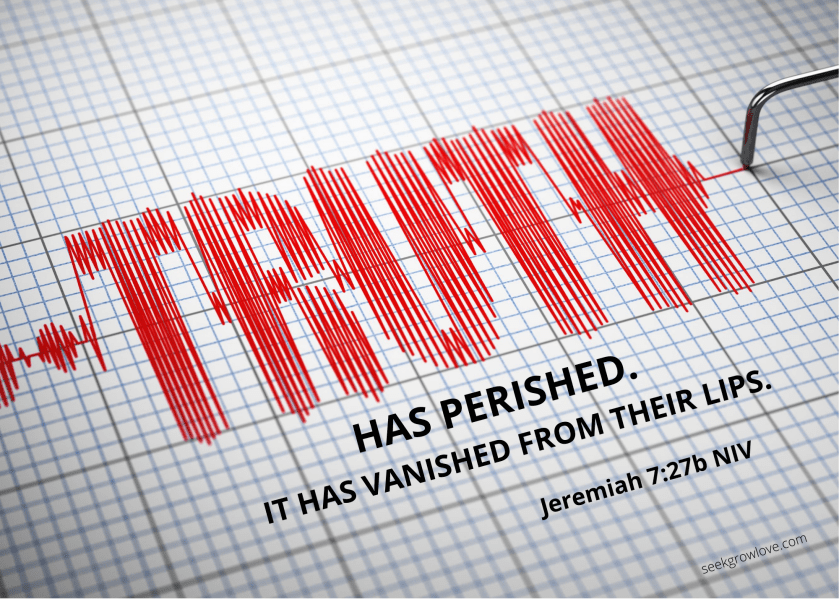
“Truth has Perished”

Jeremiah 7-9

Jeremiah 7 27b NIV

In this world we come across many lies on a daily basis. Through misleading advertising, exaggerated and twisted news stories, social media, and what the masses say, we are introduced to many forms of dishonesty. Sometimes it is difficult to know what to think or what to believe. This can also take a somewhat dangerous turn when we start to believe the lies we are told. Sometimes the truth makes us uncomfortable. Therefore, it is easier to accept the lies and trust in that which makes life and our decisions a little simpler. We begin to trust in deceptive talk.

This is a topic that is written about in Jeremiah chapter 7. The LORD tells Jeremiah to relay to the people that they should not trust in deceptive words. God says that such words are worthless. The actions that believing in such nonsense bring about not only pulls us away from God, but also brings shame upon ourselves.

Sometimes we may view our faith as an entre that we order from a restaurant. We read the menu and instead of accepting the dish as it is, we decide we need to tweak it. We want it to fit our taste and what we want. So, we ask the waiter or waitress to leave the onions off the burger. We may even ask that instead of a beef patty, could it be replaced with a chicken patty? And maybe instead of a bun, we ask for lettuce. We also ask to substitute the fries for a baked potato. At the end of our ordering process, our entre looks completely different. Instead of a burger with fries, we have chicken with a salad and baked potato.

It is easy for us to treat the Bible in the same way. We may like this passage and this one, but not that one. So, we keep what we like and ignore what makes us uncomfortable. We then begin to believe this deception that we have told ourselves and that perhaps others have told us as well. The world might even tell us what we should and shouldn’t believe in the Bible. This is what the people of Israel did as well. They began to forget the ways of the LORD. They did what they wanted and what suited them. They still would go to the temple, though, and say that they were safe there. They wanted God to bless them, but they didn’t want to put in any effort. They believed the other nations and followed the gods of those people. They allowed themselves to be deceived and misled.

Let us take this as a lesson. We can learn from the mistakes of the people in this passage. We have to actively search for the truth. We can dig into scripture. We can, as written in Proverbs 7:3, write it on the tablets of heart. Through doing this we can determine what is true and right. We can avoid believing in the worthless words of deceit.

Hannah Deane


Today’s Bible passage, Jeremiah 7-9, can be read or listened to at https://www.biblegateway.com/passage/?search=Jeremiah+7-9&version=NIV

Tomorrow’s reading will be Jeremiah 10-13 as we continue on our 2020 Chronological Bible Reading Plan