God’s Promises are Not Empty Words

Deuteronomy 17-20

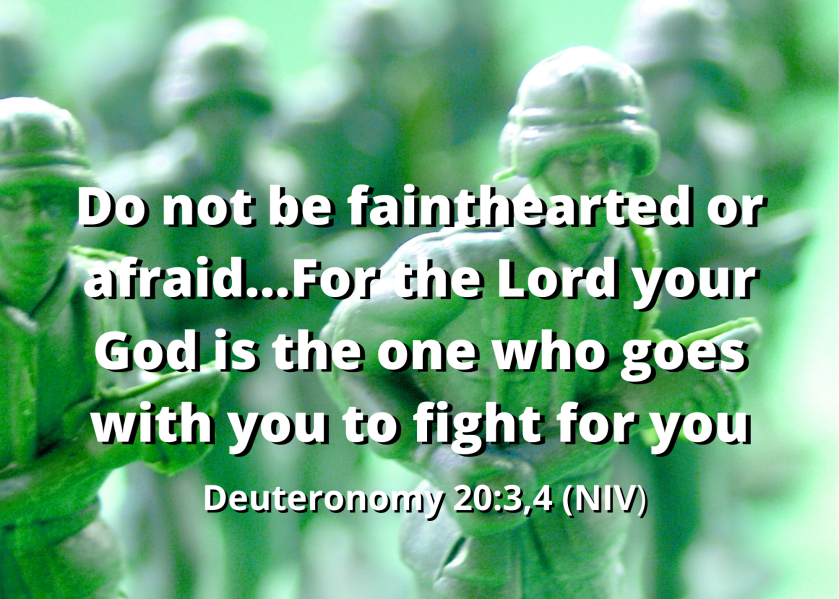
Deut 20 3 4 NIV

We’re going to continue our study of Deuteronomy today by looking at a principle that, although given specifically to the Israelites, also has application today.

Let’s look in chapter 20.

“When you go to war against your enemies and see horses and chariots and an army greater than yours, do not be afraid of them, because the LORD your God, who brought you up out of Egypt, will be with you.  When you are about to go into battle, the priest shall come forward and address the army.  He shall say: “Hear, O Israel, today you are going into battle against your enemies.  Do not be faint-hearted or afraid; do not be terrified or give way to panic before them.  For the LORD your God is the one who goes with you to fight for you against your enemies to give you victory.”

Promises in Action

First, it’s kind of cool to see examples of God’s people claiming this promise and God doing exactly what he promised. (Because frankly, more often than not, we see disobedience, don’t we?)  In 2 Chronicles 32, Assyria invades Judah and Hezekiah does all the typical stuff to prepare for war.  He consults his military advisors, makes some strategic moves, has weapons and shields made.  Then he addresses the soldiers with these words;

“Be strong and courageous.  Do not be afraid or discouraged because of the king of Assyria and the vast army with him, for there is a greater power with us than with him.  With him is only the arm of flesh, but with us is the LORD our God to help us and to fight our battles.”

Want to know what God did?

“And the LORD sent an angel who annihilated all the fighting men and the leaders and officers in the camp of the Assyrian king. So he withdrew to his own land in disgrace.”

Moses’ successor, Joshua, also reminded God’s people of this very promise before his death in Joshua 23.

“…the LORD your God fights for you, just as he promised.”

God will fight for you

Wondering how this principle applies to us today?  After all, I don’t know about you, but our church doesn’t have its own military battalion.  Paul tells us in Ephesians 6 that our battles are against the “powers of this dark world and against the spiritual forces of evil in the heavenly realms.”  He further encourages us to “be strong in the Lord and in his mighty power.”

Whatever you are battling today, God will fight for you.

Even if you are out-manned, out gunned, or have every reason to run….don’t.

Be like Hezekiah—consult advisors, make a plan, do what you can do.  And then remember,

“The LORD your God is the one who goes with you to fight for you against your enemies to give you victory.”


Susan Landry


Today’s Bible reading can be read or listened to at https://www.biblegateway.com/passage/?search=Deuteronomy+17-20&version=NIV

Tomorrow’s reading will be Deuteronomy  21-23 as we continue the 2020 Chronological Bible Reading Plan


Susan lives in balmy Minnesota with her favorite person, Greg, and (except for this year) their two sons.  She teaches, tutors and writes.  You can find her blog, The Sparrow’s Home, online at thesparrowshome.com  Some of Susan’s favorite words include grace, kindness, and authenticity.  Also snuggling.

Why Give to God?

Deuteronomy 14-16

Deut 16 16b NIV

I kind of love Deuteronomy.

Although it contains a lot of laws and instructions that were specific to the Israelites, I find that many of the themes of God’s instruction to them can apply to us as well.  The ‘why’ behind many laws and rituals is at the heart of God’s best for all of us.

Our section today offers a couple of those that we’re going to peek at.

Tithing

In chapter 14, God instructs the Israelites about tithing, saying,

“Be sure to set aside a tenth of all that your fields produce each year.  Eat the tithe of your grain, new wine and oil, and the firstborn of your herds and flocks in the presence of the LORD your God at the place he will choose as a dwelling for his Name, so that you may learn to revere the LORD your God always.” 

Do you see that little nugget at the end?

So that.

Little phrases like that often lead to big insights.  Here, it leads us to the ‘why’ behind God’s instruction on tithing.  We all know that God needs nothing from us.  Everything already belongs to him.  The purpose of giving to God from the top (instead of the leftovers) is for us to learn to revere God.  To honor him.  To trust him.

Saying we honor and revere and trust God means nothing if we don’t show it. And when we do show it by putting him first in this way, it can provide a lens that shapes every other area of our lives.

What am I offering God?

We see another giving principle pop up in chapter 16.

“No man should appear before the LORD empty-handed.  Each of you must bring a gift in proportion to the way the LORD your God has blessed you.”

This instruction was given specifically regarding three of the appointed feasts that the Israelites celebrated.  But I believe that the principle applies to us as well.  We see the proportion principle repeated in Jesus’ illustration of the widow’s offering and in Paul’s teaching on sowing/reaping generously (Luke 21, 2 Corinthians 9).

But beyond that, how would it change our church-going experience, our daily Spiritual life even, if we kept that first sentence in mind:  No one should appear before the LORD empty-handed.

Am I coming to God, offering him my monetary giving, but also my time…my talents?

What are you bringing today?


Susan Landry


Susan lives in balmy Minnesota with her favorite person, Greg, and (except for this year) their two sons.  She teaches, tutors and writes.  You can find her blog, The Sparrow’s Home, online at thesparrowshome.com  Some of Susan’s favorite words include grace, kindness, and authenticity.  Also snuggling.


Today’s Bible reading can be read or listened to at https://www.biblegateway.com/passage/?search=Deuteronomy+14-16&version=NIV

Tomorrow’s reading will be Deuteronomy 17-20 as we continue the 2020 Chronological Bible Reading Plan


Don’t Choose the Curse

Deuteronomy 11-13

Deut 11 26 NIV

We make choices all day long – little things and big things.  What will I eat today, what will I wear, how long will I study, should I stay late at work, should I work out, should I read my Bible (and read my SEEKGROWLOVE) in the morning or at night… You get the idea; there are a lot of choices. In fact, a Psychology Today article stated that some sources suggest that the average person makes 35,000 choices per day.

In Deuteronomy 11, the Israelites are presented with a choice. In verse 26, it states, “See, I am setting before you today a blessing and a curse—the blessing if you obey the commands of the Lord your God that I am giving you today; the curse if you disobey the commands of the Lord your God and turn from the way that I command you today by following other gods, which you have not known.”

This sure seems like a “no brainer choice”. The blessing is so wonderful. Moses goes into detail of how incredible it will be to live in communion with the Lord God in this land of abundance. In chapter 12, he describes a scene that we might imagine as the perfect Thanksgiving, “There, in the presence of the Lord your God, you and your families shall eat and shall rejoice in everything you have put your hand to, because the Lord your God has blessed you.”

How could they choose the curse? Our God gives His people many warnings of why they may wander away from Him. One is curiosity of other religions. His people will ask, “How do these nations serve their gods? We will do the same.” Remember that these religions even burned their children in the fire as sacrifices to their gods. Let’s consider the difference from choosing idols rather than choosing to follow the One True God. Those who follow His commands will come into His presence with their family, feasting and rejoicing. Those who choose idols will sacrifice their own children.

I can’t imagine anything worse than a parent allowing this to happen to their child. The LORD warns them that some of them may face evil prophets or even family members that entice them. Even if large groups of people like a whole town decide that it is ok to be wicked, they must resist and follow the LORD.

You see we have these same choices today. Let’s decide that no group of people, no person, nothing should be chosen over our God. Out of our love, we will obey Him and do what is right in His eyes.


Rebecca Dauksas

Today’s Bible passage can be read or listened to at https://www.biblegateway.com/passage/?search=Deuteronomy+11-13&version=NIV


Tomorrow’s Bible reading will be Deuteronomy 14-16 as we continue the 2020 Chronological Bible Reading Plan


Anti-Anxiety

Deuteronomy 8-10

Deut 8 6 7a NIV

Imagine that you are an Israelite that has been taking in all the words of your leader Moses. You have listened as he has given your history. You have committed to love God with all your heart, soul and strength. You have determined to follow the commands, decrees and laws that the Lord directed Moses to teach you. Soon it will be time to enter the land and possess it. You have heeded the warnings of idol worship. You have envisioned this good land flowing with milk and honey. Moses told you of all the good things that wait inside the land, but your mind also fills with doubt. You must face the nations that are physically stronger than you are. As you lie in bed, your mind races over what lies before you. It is then that you remember what else was said. “If you pay attention to these laws and are careful to follow them, then the Lord your God will keep his covenant of love with you, as he swore to your ancestors. He will love you and bless you and increase your numbers.” You decide this is in the LORD’s hands, you settle in, smile and go to sleep.


We are sometimes faced with the same dilemmas that the Israelites faced. We live in an uncertain world. We daily experience the results of this fallen world-war, pain, sickness, … We can easily become anxious and worried. But God also provided us with a great teacher who gave us instruction. Jesus Christ told his disciples, “All authority in heaven and on earth has been given to me. Therefore go and make disciples of all nations, baptizing them in the name of the Father and of the Son and of the Holy Spirit, and teaching them to obey everything I have commanded you. And surely I am with you always, to the very end of the age.” Our Heavenly Father and His Son are with us. They are aware of our situation. We may have to face difficult and uncertain circumstances, but they are with us as we go through them. We are certain of this, if we are faithful to them, they will always be with us.

Just like the Israelites we will set our minds on the words of God. We will remember that we live on “every word that comes from the mouth of the Lord.” Even in our chaotic world, we should observe the commands of the Lord our God, walk in obedience to Him and revere Him because the Lord our God is bringing us to a good land. This land where righteousness dwells will reside in a new heaven and new earth.

Rebecca Dauksas


Today’s reading can be read or listened to at https://www.biblegateway.com/passage/?search=Deuteronomy+8-10&version=NIV


Tomorrow’s reading will be Deuteronomy 11-13 as we continue the 2020 Chronological Bible Reading Plan


Reasons to Obey

Deuteronomy 5-7

Deuteronomy 5 33 NIV

I had an oppsortunity to teach the importance of keeping the Name of God holy a few weeks ago. A five year old was loudly saying “God” clearly showing that she was surprised by something that was going on. I helped her understand that because we love and respect God that we would never use His name this way. Thankfully that is the last time that she has expressed surprise in that manner.

But this experience reminded me of Moses. He was not only the person that was bringing the people the Law-he wanted them to understand and practice it. We may hear that we should not misuse the name of God, but when we really enter into a genuine, loving relationship with God, we would only use His name with sincere words from our heart.

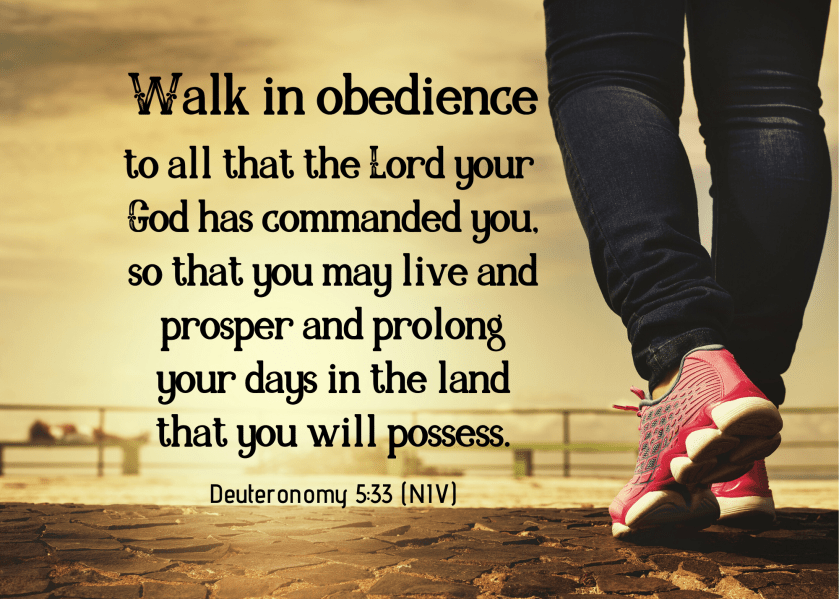
In Deuteronomy 5, Moses summoned all Israel in order to recount the decrees and laws to them. He wanted the Israelites to learn them and follow them. He reminded the people that they were involved in a covenant with God.  The Law showed the Israelites which actions were right and wrong. God wanted them to know how to live as His holy people. He wanted them to know how to interact with Him and others. He wanted them to “walk in obedience to all that the LORD your God has commanded you, so that you may live and prosper and prolong your days in the land that you will possess.”

God still wants us to “live and prosper” today. We are His people, His family.

When we experience God’s love our motivation for doing what is right is produced from a place of love. (Deuteronomy 6) Christ later explained the greatest commandment of the Law. Jesus said, “Love the Lord your God with all your heart and with all your soul and with all your mind. This is the first and greatest commandment. And the second is like it: ‘Love your neighbor as yourself. All the Law and the Prophets hang on these two commandments.” (Matthew 22:37-40)

Rebecca Dauksas


Today’s Bible passage can be read or listened to at https://www.biblegateway.com/passage/?search=Deuteronomy+5-7&version=NIV

Tomorrow’s reading will be Deuteronomy 8-10 as we continue the 2020 Chronological Bible Reading Plan (1) (1)


Learning from Obedience & Disobedience

Deuteronomy 3 & 4

Deut 4 9 NIV

We live near apple country. In the fall we have driven to the mountains and visited apple orchards. The taste of ripe apples from the tree is amazing. The apple trees are pretty hanging with the delicious varieties of apples and the views are really beautiful. In Deuteronomy 3, Moses is told that he can “Go up to the top of Pisgah and lift up your eyes to the west and north and south and east, and see it with your eyes, for you shall not cross over this Jordan.” Imagine Moses standing on the mountain looking at the Promised Land. He would not enter the land because of his former disobedience. I think this consequence was important for the Israelites. Moses was so close to God and was an example for the entire Israelite community. He was their appointed leader and they followed his example. They could also learn from his disobedience. Experiencing this consequence of not entering the land probably made a big impact on the Israelites and Joshua. In fact, God tells Moses to “charge Joshua and encourage him and strengthen him, for he shall go across at the head of this people, and he will give them as an inheritance the land which you will see.”

I grew up with siblings. I had an older brother and sister and I learned from their example. If they did something good at school or church, they were rewarded with awards and praise. It was great because I learned what I should do by their example.

In Deuteronomy 4, Moses is giving his all to make the people understand the importance of obedience to the LORD. Not only will the Israelites and their children be blessed by obeying, but if they keep the decrees and laws they will have wisdom and understanding. They will set an example for other nations. People will hear these statutes and say, “Surely this great nation is a wise and understanding people. For what great nation is there that has a god so near to it as is the Lord our God whenever we call on Him? Or what great nation is there that has statutes and judgments as righteous as this whole law which I am setting before you today?”

Our personal obedience to God can be a positive example for others. Obedience leads to blessings for us and for others.

Rebecca Dauksas


Today’s Bible passage can be read or listened to at https://www.biblegateway.com/passage/?search=Deuteronomy+3-4&version=NIV

Tomorrow’s reading will be Deuteronomy 5-7 as we continue the 2020 Chronological Bible Reading Plan


Most Important Message to Pass On

Deuteronomy 1 & 2

Deut 1 3 NIV

If you only had a short time to live, what would you communicate to those in your circle of influence? I know that is a tough question. I think most of us would want to express our love for special people in our lives, our thanks to those that helped us in life, we might share what we found to be valuable and important in life, we would want to give encouragement and insight…at the top of our list-we would want others to know the importance of a loving, close relationship with God through Christ.

Moses is close to the end of his life as Deuteronomy begins and he has much to convey to the Israelites.  He wants them to learn from the past, he wants them to be prepared for what lies ahead and most importantly, he wants them to rely on God. In the book of Deuteronomy, the title of “the LORD our God” together with “the LORD your God” occurs almost 300 times along with many uses of “the LORD”. Moses wants the Israelites to rely on the LORD. He reminds them that in the wilderness they saw how the “LORD your God” carried you just as a man carries his son. He reminds them that the “LORD your God” went before them to lead the way and gave them places to camp. He was there in fire by night and cloud by day to show them the way to go. Moses wants the Israelites to trust God.

Unfortunately, my dad and mom are no longer living, but one of their messages to me was to trust God. I am eternally grateful for that message. We may lose loved ones through life, but God is always with us and we can trust Him.

Rebecca Dauksas


Today’s Bible passage can be read or listened to at https://www.biblegateway.com/passage/?search=Deuteronomy+1-2&version=NIV


Tomorrow’s passage will be Deuteronomy 3-4 as we continue the 2020 Chronological Bible Reading Plan


Living Like a Levite

Numbers 35 & 36

Rebecca Mon pic

Imagine that today is your regular day of worship at your local church. You grab your Bible and head out to the church. You walk into the Social Hall and there is the guy who usually arrives early setting up folding chairs. You place your Bible on the table and begin unfolding the chairs while talking with him. Another person enters and starts making the coffee and turns on the heat. The room already feels warm which is nice on this chilly day. The Pastor walks in from his office and asks how your day has been so far. Soon people start arriving. A few Youth Workers enter carrying some bags filled with crafts for the kids to make. They are headed toward the Youth Room. The room begins to fill up as more people enter. A couple of praise team members smile as they walk through carrying guitars and making their way to the sanctuary. People sip coffee and others just sit, talk and laugh. Everyone settles in as the Pastor hands out a list of prayer needs and praises. A couple of people share updates on the Missions collection and the food drive. After prayer, the teacher begins to share a lesson about the importance of the Levites. You discover that the Levites served the LORD in many ways including taking care of the Tabernacle and the Temple. The Levites from the family line of Aaron served as the priests for the Israelites. Some were in charge of the treasures of the house of God and dedicated gifts. Some served as guards and others were musicians and singers. They were also the only Israelite tribe that received cities, but were not allowed to be landowners “because the Lord the God of Israel Himself was their inheritance”.


Ok, so why imagine this scenario? Because our reading is about the Levites and as servants of God, we have a lot in common with them. This special tribe was chosen to serve the Lord. These servants used their God-given talents to serve the LORD in their community. How amazing that we have this same opportunity today. We are gifted in different ways and possess different talents, but all of these can be used in our service to God. Our willingness to serve is evidence of our love for God and others.

God honored this tribe in Numbers 35. The Lord told Moses to command the Israelites to give the Levites towns to live in, pasturelands for their cattle and all their other animals. The Levites received forty-eight towns with six of the towns as cities of refuge, to which a person who killed someone could flee. God displays His provision and grace not only to the tribe of Levi, but for all those in the Israelite community. Hebrews and foreigners could flee to the city of refuge for protection and justice. The LORD also provides protection for the inheritance of the individual tribes in Chapter 36. In the example of Zelophehad’s daughters we see that God valued the individual inheritance of each tribe. When we see how God’s commands and regulations were offering provision and grace to the community and the individual, it makes us realize how awesome He is. It makes us want to give of ourselves. It makes us want to serve, to live like the Levites.

Rebecca Dauksas


Today’s Bible passage, the last two chapters of Numbers, can be read or listened to at https://www.biblegateway.com/passage/?search=Numbers+35-36&version=NIV


Tomorrow’s reading will be the first two chapters of Deuteronomy as we continue the 2020 Chronological Bible Reading Plan

You Are Here

Numbers 33-34

Numbers 33 53 NIV

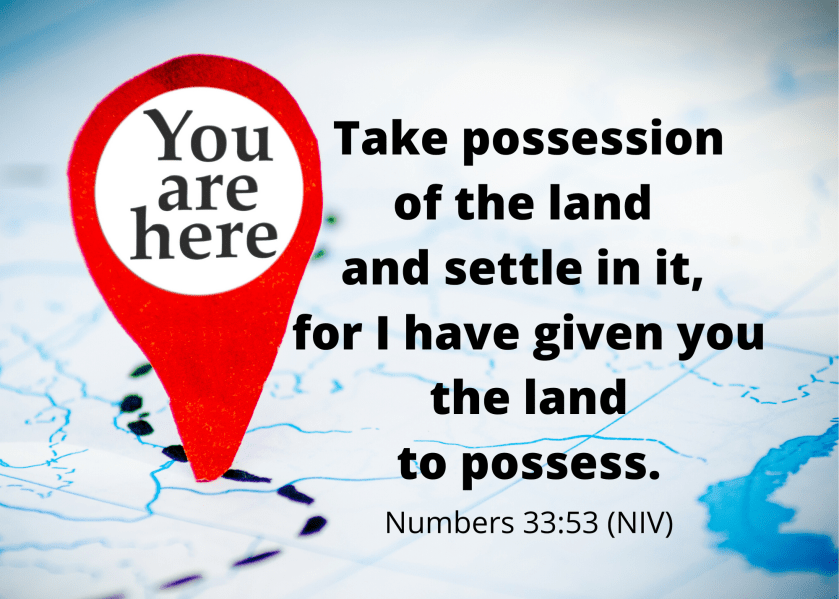
I like “You Are Here Signs” and I am always pulling up navigation on maps. In a mall or an amusement park, I can quickly see where I am going and how to get back to the place where I parked. The Lord offers us spiritual navigation as well. In James we are told to do what the word says. It states, “whoever looks intently into the perfect law that gives freedom, and continues in it—not forgetting what they have heard, but doing it—they will be blessed in what they do.” We are to look intently into the scriptures (study) and do (apply) what we discover. We are offered blessing from this. So why do we miss out? I am afraid that we are sometimes like the Israelites were. But thankfully we have this account of their lives to be an example to us. We don’t want to imitate this generation of people whose hearts went astray and did not know God’s ways (Psalm 95:10).

In Numbers 33, Moses recorded the Israelites’ journeys at the command of the LORD. You can even find online maps that visually show their journey and wandering.  This 40-year journey could have been traveled in days. It was approximately the distance I currently am from Chattanooga, TN. According to maps, only a 70-hour walk. Moses recorded where they had physically been and God provides direction on what they are to do next. They are to take possession of the land, drive out the inhabitants and settle in it. The next generation was being offered the opportunity to receive the land. The boundaries are established and the leaders are put in place to assign the land (Numbers 34).

The Israelites face the choice of allowing the Canaanite societies steeped in abominable practices like child sacrifice and cult prostitution to remain or to begin a nation that faithfully looks to God and practices His commands.

In our lives today, we are faced with the choice to let society give us our moral standards or to connect so closely with God that He is directing our moral standards. When we fully trust and love our God we can know that He is leading our lives. He shows us where we are and He encourages us to keep moving toward our inheritance of the kingdom of God.

“Listen, my beloved brethren: did not God choose the poor of this world to be rich in faith and heirs of the kingdom which He promised to those who love Him?” James 2:5


Rebecca Dauksas


Today’s Bible passage can be read or listened to at https://www.biblegateway.com/passage/?search=Numbers+33-34&version=NIV

Tomorrow’s reading will be Numbers 35-36 as we continue the 2020 Chronological Bible Reading Plan


Faithful

Numbers 31-32

Numbers 32 18

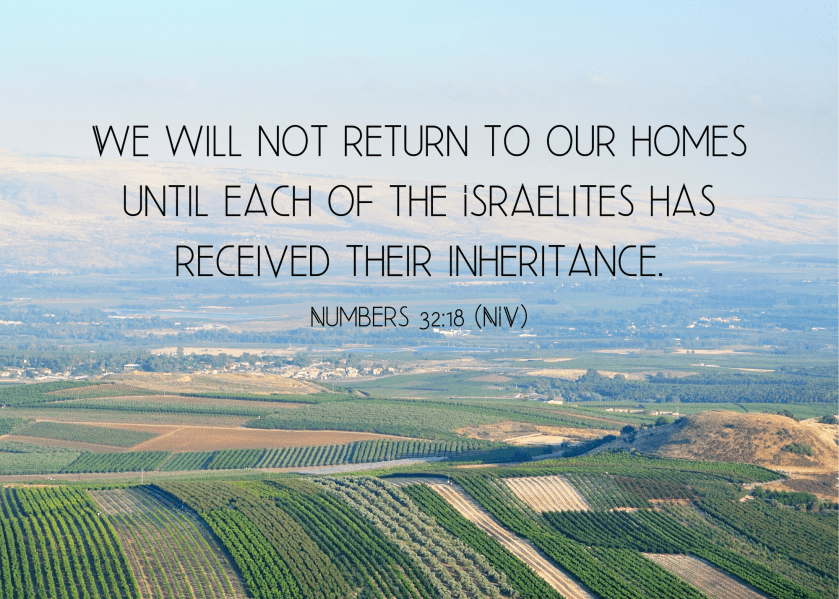
In the second half of Numbers, we have seen plenty of dissatisfaction from the people of Israel. Even Moses was fed up with the complaining of the Israelites. As his life was drawing to a close, he had no patience for any more unfaithfulness. So when the tribes of Reuben and Gad requested to take their homes before crossing the Jordan, he assumed the worst. As it turned out, at least in this instance, these tribes had their hearts in the right place. They were actually satisfied with what they already saw, and God honored their request.
Moses’ reaction is understandable given what he has gone through with Israel. After forty years of wandering and waiting to enter Canaan, a request to not enter the land would have been foolish. Similarly, if Reuben and Gad failed to fight alongside their brother tribes, it would have constituted treachery. But the tribes were merely asking the Lord to provide, not complaining about what they didn’t have. And they did prove faithful to their commitment to fight throughout the campaign in Canaan.
For Reuben, Gad, and a segment of Manasseh, the battle began early. They drove out the enemy, an important requirement for faithfully claiming the land. They even changed the names of the cities to remove the stigma of false gods as well as the people who worshiped them.
What Moses originally suspected as a sinful act became a breath of fresh air in the book of Numbers. Where others had complained, these tribes asked from the Lord. Where others served their own interests, these tribes were willing to leave their families in order to serve their brothers. And where others were drawn to false gods and foreign worship, these tribes drove out the enemy. The key difference was faith. These tribes trusted the Lord to give generously to meet their needs, and that faith produced obedience in their hearts and deeds. Even when Israel seemed desperate or disappointing, God was always in complete control. He doesn’t get overwhelmed by anything, even disobedience. Remember that as your faithfulness waivers or your situation worsens, God’s love and faithfulness remains. When you feel like a failure or threatened by anything at all, know that God’s grace is sufficient, and His faithfulness is assured. Your circumstances will change, but your God will not.
Andy Cisneros
Today’s reading can be read or listened to at https://www.biblegateway.com/passage/?search=Numbers+31-32&version=NIV
Tomorrow’s reading will be Numbers 33-34 as we start the 11th week of the 2020 Chronological Bible Reading Plan