
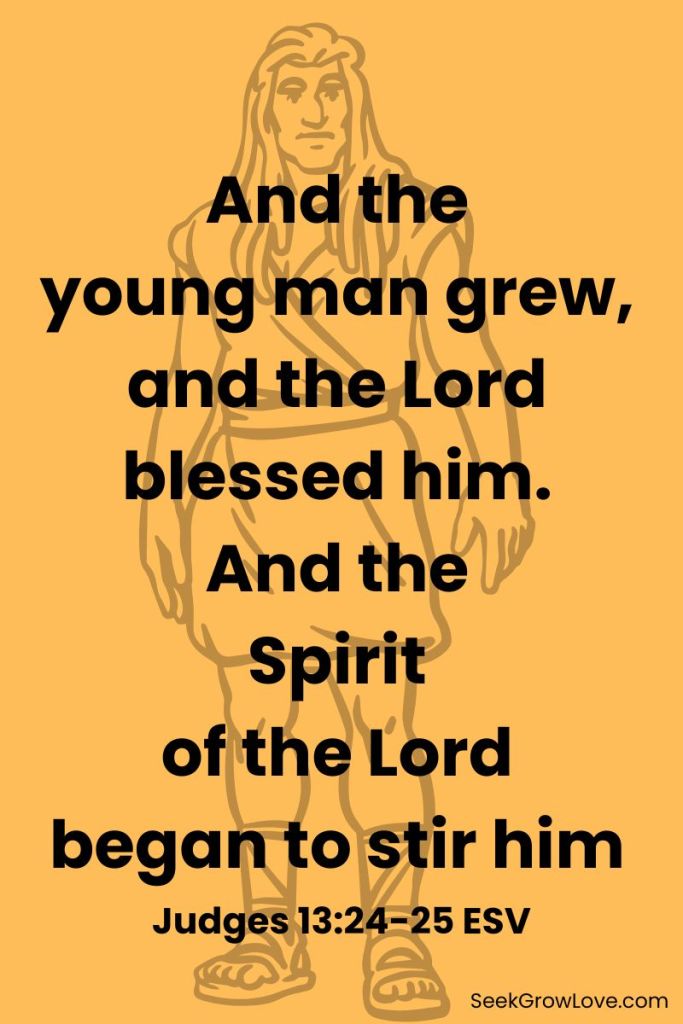
Samson

Judges 13-16

Judges 13-16 contains the story of Samson, who led Israel for twenty years. I was raised knowing of Samson and his story, but little me didn’t know all the “extra” information these chapters contained. In fact, we had a black lab german shepherd mixed dog that we named Samson (which suited him the more he destroyed the things he “played with” and the stronger he became). Since I was younger, I don’t remember my parents ever needing to trim/cut his hair, but now I wonder if they ever did. Regardless of my lack of memory, Samson taught my brother and me a good lesson about being responsible and caring for something that might run away (though it took awhile to actually learn these things because we were both hard-headed or “strong-willed”). And here’s a fun fact: he did run away. To me, it felt like I had been betrayed by the dog I loved, and although in Samson’s case Delilah betrayed him (16:18), God worked through his betrayal. 

Samson, my dog, eventually returned home after our neighbors found him playing with their animals. But, in the time between not knowing what happened to him and reappearing, I learned how it felt to miss the dog I once had. I’m sure Samson missed the God-given strength he once had when he tried to break free from his bondage and had his eyes gouged out. The phrase, “You don’t know what you’ve got till it’s gone,” certainly comes to my mind for both scenarios (and I’m more grateful that I can still see). In Job 1:21 we find a very similar concept, “And he said, “Naked I came from my mother’s womb, and naked shall I return. The LORD gave, and the LORD has taken away; blessed be the name of the LORD.”

God filled Samson with His spirit many times in these chapters, and even though it led to the deaths of many people, God used him to lead, judge, and preserve the nation of Israel. Philippians 2:13 states, “for it is God who works in you to will and to act in order to fulfill His good purpose.” The Spirit of the LORD in Samson (and in us as Christians) is an extension of YAHWEH’s power and authority. Hill & Walton’s A Survey of the Old Testament states, “the Spirit gave people the ability or authority to do what they normally could not have done.”  And in Matthew 19:26 we read about Jesus telling his disciples that with man some things aren’t possible (in proper context he was discussing being born again), but with God all things are possible (and we, with God, can be an extension of Him and born again too). Our story, like Samson’s, will likely conclude with death (though I pray that ours doesn’t end by bringing down a building over top of us). However, God, through His son Jesus Christ, has made a way for us to be saved by grace through faith, not of ourselves or our works, but through Him and His son to soon be in His presence for eternity. Samson prayed to the LORD and the LORD answered. And we too should pray to the LORD and await His instructions and directions.

-Jeffrey Seiders

REFLECTION Q’s

  1. In times when you felt betrayed, how did you react? How did God eventually work it out for your good? If God hasn’t worked it out yet, reflect on ways God can use your betrayal for your good.
  2. What are some things in your life that make life easier for you? Is there something that you use daily and overlook that you could be grateful to God for?
  3. In what ways are you letting God and His spirit enter your life? Are there places in your life that you don’t let God and His spirit work in your life? How can you work on these areas?
  4. How often do you take time to pray for the LORD’s instruction and direction?
Utter Betrayal

Old Testament: 2 Samuel 15

Poetry: Proverbs 3

New Testament: Ephesians 1

We have had a particularly rough week with our four year old son. He has been pushing hard on the boundaries of our well-established routines. One more episode. One more toy. One more minute. One more game. One more snack. One more destination. Seemingly an infinite amount of times my wife and I have offered correction in punitive, redirective, and rehabilitative forms.  In particular, these insistences led to an implosion at bedtime a few days ago.   In that moment, his unrelenting barrage was a challenge to my authority as a parent, and down swung the hammer. I know this is only the beginning. Each of the remaining years of my life as his father, both his will and his physical strength will increase, and it will be well within his power to usurp me when there is more at stake than a night of rest.

This is where David finds himself with his son, Absalom. This prince wanted just one more thing, the kingship for himself. He was skipped in favor of Solomon, leading him down a path of familial betrayal, worthy of a primetime drama. Furthermore, this act of mutiny runs even deeper.  Absalom was pitting himself against God’s anointed. This leads to deep emotional turmoil for David. A king who wishes to remain in power should squash any hint of rebellion; however, David submits to his role as a father and more importantly, trusting God to provide him with an answer and response which can be found in 2 Samuel 15:25: “Carry the ark of God back into the city. If I find favor in the eyes of the Lord, He will bring me back and let me see both it and His dwelling place.  But if he says, ‘I have no pleasure in you,’ behold, here I am, let Him do to me what seems good to Him.’”

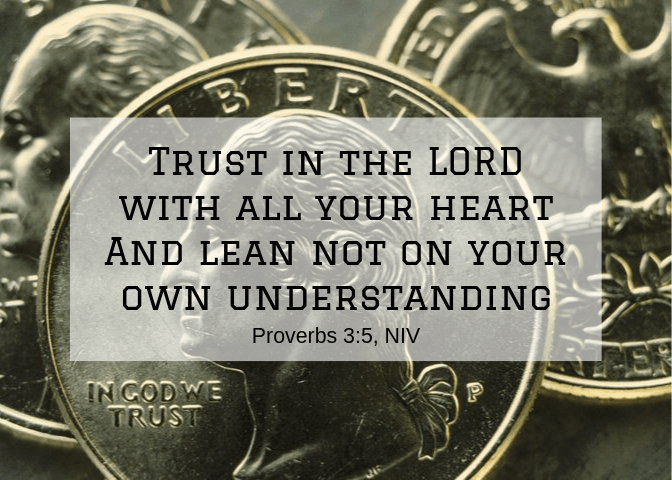
When faced with betrayal David did not respond with bitterness nor retaliation. He tested his methods in the fires of the Heavenly Father, trusting in the sovereignty of God over the product of pride.  Did this put David in a strategically weak position?  Absolutely, but David’s goal was not to snuff out an insurrection, but to ultimately realign himself with Absalom and restore him back into his presence. When I see David in this moment, I see a father I want to be, but I also see the actions of someone who mimics the attributes of God. Proverbs 3:5-6 beckons our battle with betrayal with this well-known wisdom “Trust in the Lord with all your heart, and do not lean on your own understanding. In all your ways acknowledge Him, and He will make straight your paths.” While we cannot test with the presence of God existing in an ark, we do have the Holy Spirit living in us. We don’t bring the hammer first, but are merciful, gracious, compassionate, faithful,  slow to anger, and abounding in love and forgiveness (Psa. 86:15)

Let us never forget that we are, first, the ones that have trespassed against God and have spilled the blood of Christ. Yet those in Ephesus in the first century and those across the world today who put their trust in Jesus have the same greeting:“[God] has blessed us in Christ with every spiritual blessing in the heavenly places, even as He chose us in Him before the foundation of the world, that we should be holy and blameless before Him.” (Eph. 1:3b-4) In our betrayal there is a sovereign and loving plan that brings restoration, so that none might perish but all may have everlasting life (John 3:17). Stephen, whose stoning is attributed to the action of Ephesians’s author, might tell you to trust the process, taking action and direction from God and choosing his goodness over vengeance.

From time to time, a good Father will bring down the hammer, and in fact, Our Sovereign God’s final attribute is not leaving the guilty unpunished. Nevertheless, when feeling there is a knife in our back or heart, our first and foremost reaction should be to lean on the Heavenly Father not on our hubris.  In this way, we go beyond obedience and restoration to an earthly parent or monarch. We become an example of our Creator, bringing obedience and restoration to Him that provides an eternal answer to utter betrayal, restoring us to His family line and an enduring rest.

-Aaron Winner

Reflection Questions

  1. What is your experience with betrayal? Were you the betrayer or the betrayed? Was bitterness and/or retaliation involved? What can you learn from David in 2 Samuel 15?
  2. If you are a parent or you know a parent, how can parents mirror God’s mercy, grace, compassion, faithfulness,  slowness to anger, and abounding in love and forgiveness ? Why are those attributes important to establish? What role does the hammer, justice and judgment play?
  3. When did you trust in God by not following what human nature says is right? How can this be helpful in a situation that you face today?

My Strength

Old Testament: Judges 16 & 17

Poetry: Psalm 59

New Testament: 1 Corinthians 14

In this devotion I want to delve into a chapter in Psalms. What we see is David sharing a dark time in his life, one of the things that makes it difficult is people turning on him. One of the hardest things in life is having people you trust betray you. Jesus dealt with this same thing when Judas betrayed him.

Have you ever had to deal with a betrayal? What did you do in that instance? Many people unfortunately want to take revenge. Others spin into a depression, but David gives us strong advice on how to handle adversity. He tells us to allow God to protect us and keep us strong. He likens God to a strong tower that we can take refuge in. In Psalm 59 David is in his house surrounded by Saul’s soldiers who were sent to kill him.

The Psalm is both a prayer and a praise for God’s saving help. Psalms 59 is an important chapter because it reminds us of God’s unfailing love. David was hunted by people whose love had turned into jealousy which drove them to try to kill him. David had trusted friends and the king who he considered a mentor who all turned against him.

As humans, relationships are so important and necessary. We all hope and strive for dependable, long-lasting relationships but that’s not always the case. We all have dealt with broken relationships. Maybe it was the loss of a friendship, a break up, a church split, or family estrangement. At some point everyone deals with finding out that someone was not a trustworthy, dependable person like you thought. This is the hard side of human relationships. Humans are far from perfect, people will disappoint you and you will disappoint others. Regardless of the state of your relationships in this world, God’s relationship to you is unchanging and unfailing.

-Brooke Cisneros

Reflection Questions

  1. Have you ever felt betrayed? What was your response?
  2. When have you turned to God for strength when human relationships disappointed you? What did you find in Him?
  3. What do you appreciate about God’s unchanging and unfailing character? How will you praise Him for this?