Set His Heart to Study

OLD TESTAMENT: Ezra 7-8

POETRY: Psalm 142

NEW TESTAMENT: John 15:1-17

About 60 years after the first Babylonian exiles returned to Jerusalem, Ezra, appointed by King Artaxerxes, returned to Jerusalem with a new wave of exiles. His mission was to renew Israel’s commitment to following God’s Law. 

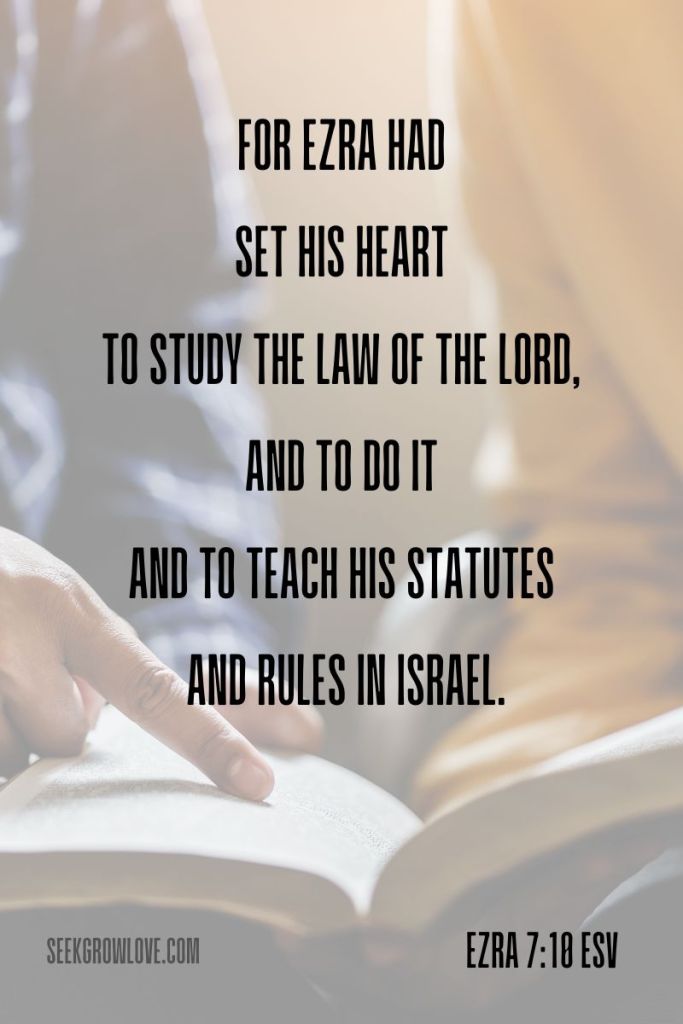
For Ezra had set his heart to study the Law of the Lord, and to do it and to teach his statutes and rules in Israel. (Ezra 7:10)

For Ezra had set his heart…

At the time this passage was written, there was no Hebrew word for brain and no concept of its role in the body. Instead, biblical authors used the word heart (lev or levav) to describe both our emotions and thoughts. Here, when Ezra says he “sets his heart” on studying the Law, he means dedicating his entire being to knowing and following God’s Word.  

You will seek me and find me, when you seek me with all your heart. (Jeremiah 29:13 ESV)

…To study the Law of the LORD…

The Law, or Torah, refers to the first five books of the Old Testament. It contains 613 laws that establish a covenant between Israel and God. God promises that following His way will lead to blessing. 

This Book of the Law shall not depart from your mouth, but you shall meditate on it day and night, so that you may be careful to do according to all that is written in it. For then you will make your way prosperous, and then you will have good success. (Joshua 1:8 ESV)

…And to do it… 

While being able to recite all 613 laws would be impressive, knowledge without application is futile. It’s significant that not only does Ezra know the Law, but he also commits himself to following it. 

But be doers of the word, and not hearers only, deceiving yourselves. For if anyone is a hearer of the word and not a doer, he is like a man who looks intently at his natural face in a mirror. For he looks at himself and goes away and at once forgets what he was like. But the one who looks into the perfect law, the law of liberty, and perseveres, being no hearer who forgets but a doer who acts, he will be blessed in his doing. (James 1:22-25 ESV)

…And to teach his statutes and rules in Israel.

This is where Ezra’s preparation meets his ministry. As a “scribe skilled in the Law of Moses” (Ezra 7:6), his knowledge of the Torah is complete. His mission is to teach the Torah to restore Yahweh’s rule and reign in Jerusalem.

And these words that I command you today shall be on your heart. You shall teach them diligently to your children, and shall talk of them when you sit in your house, and when you walk by the way, and when you lie down, and when you rise. You shall bind them as a sign on your hand, and they shall be as frontlets between your eyes. You shall write them on the doorposts of your house and on your gates. (Deuteronomy 6:6-9 ESV)

May we be like Ezra. May we set our hearts to study God’s Word, to live it out, and to teach its message to a world in need of revival. 

-Mackenzie McClain

Reflection Questions

  1. What have you set your heart on? What is your entire being dedicated to? How is this displayed in your life?
  2. What is the value of setting your heart on studying the law of the Lord (and now the whole word of the Lord made available throughout the 66 books not just the first 5 Ezra had the privilege of knowing)?
  3. Do you find it easier to study God’s law or to do it? Can you have one without the other?
  4. What ministry has God called you to? Who do you know that you can teach what you know about God and His Word?
Sometimes the Greatest Discoveries Begin as Problems

Prov 16-3 bike

 Here are 4 ways to help you apply the proverbs to your problems.

 1. Learn how to read this book.

The real nature of most proverbs is not a rule that is used the same way in all circumstances at all times.

 Rather, a proverb is often a recommended way of acting that will be wise in some settings and not in others. Or, a general observation of experience that is very often true and useful, but not always true in every situation. The same act may be wise in one setting, but foolish in another. The same fact may hold in one situation and not in another.

 The same is true of proverbs that state a fact, not just proverbs that call for an act: “absence makes the heart grow fonder” and “out of sight, out of mind.” Or “birds of a feather flock together” and “opposites attract.”

 These are all true proverbs. But they are not always true in every situation.


2. We learn that life is too complex to be lived by proverbs alone. We need wisdom to know how to use the proverbs.

 When the author tells us, back to back, “Answer a fool according to his folly,” and, “Don’t answer a fool according to his folly,” he is teaching us that we need discernment about when to do the one and when to do the other.

 If a sergeant tells his platoon to walk slowly and carefully, and also tells them to run like crazy, he expects them to know that sometimes they are navigating a minefield, and sometimes they are under fire in the open country. You store away both pieces of advice in your mind. Wisdom knows when to use the one and not the other.


3. We learn that proverbs alone do not make a fool wise.

A perfectly good proverb in the mouth of a fool does not make him wise. It makes him useless at best.  Proverbs alone don’t make fools wise.

 What does help us become wise? A mixture of (1) storing up proverbs and other forms of revealed wisdom, (2) meditation on them, (3) serious prayer for God’s help, and (4) a divine gift of wisdom.

 Proverbs alone don’t make you wise. You must be wise to use proverbs wisely


4. We learn that we should store up reasons why a proverb might be useful sometimes and not other times.

In other words, store up this truth: there are times when it will be pointless to answer a fool, because it will only drag you into his folly. It’s best to just let him make a fool of himself and be discredited rather than ruining your own usefulness.


But also store up this truth: there are times when he is not just making a fool of himself, but also is drawing dozens, or thousands, into his folly so that he feels justified and wise in his foolish ideas. You need to step in and expose him as foolish for the sake of others, and for his sake.

Pastor Andy

The Right Path – Proverbs 16

Prov 16-22

Part 2

How do you find the right path?  According to the Proverbs its the word.  Whose word?  God’s word. 
 
20 He who gives attention to the word will find good,
And blessed is he who trusts in the Lord.
Okay, great!  You now recognize God’s word as wisdom.  What now?
Applying God’s wisdom.  It does not help you to know where the source of wisdom is from if you don’t apply it.  Chapter 16 seems to be pointing us to application of God’s word.  Look at a few of these verses:
18 Pride goes before destruction,
    a haughty spirit before a fall.

20 Whoever gives heed to instruction prospers,
    and blessed is the one who trusts in the Lord.

21 The wise in heart are called discerning,
    and gracious words promote instruction.

23 The hearts of the wise make their mouths prudent,
    and their lips promote instruction.

28 A perverse person stirs up conflict,
    and a gossip separates close friends.


I picked a few verses from chapter 16 to show you that these verses only work if you apply them.  If you put it into practice.  That’s why I like what the writer put in verse 31. 

31 Gray hair is a crown of splendor;
    it is attained in the way of righteousness.

I like this verse because 1.  I have a lot of grey hair 🙂 but more than that I think what he is saying is that when you continue to apply wisdom consistently (day after day, year after year) you can look back at your path and see the pitfalls that you missed because you chose wisdom over folly.  What a joy it is to have walked the right path, to have rallied right and to be able to look back and say thank you God for protecting me.  I have been married 19 years to an amazing woman.  I love her more today than I did when we first got married because we have stacked together great accomplishments in those years.  We have a bond through good times and bad times and have trust and love that only comes through time.  That’s what I want for you.  Apply wisdom.  See it work in your life.  be consistent and see that God’s way is better than man’s.  God bless and I am praying for you.

Pastor Andy