
Your Enemies

Jonah 4

Tuesday, November 8, 2022

A couple years ago in a class at our youth event FUEL, I was in a class that focused on the idea of forgiveness. In the class we were watching a video by Bob Goff, a Christian author and lawyer, recounting his case against a witch doctor preying on the children of a few tribes in Africa. To make a long story short, Bob was able to assist in getting a witch doctor named Kabi jailed for the mutilation of a child. Unfortunately this crime was nothing new, but this time the child lived! This is definitely a story that is worth looking into after this, but let’s pick it back up in a little bit.

I want to turn to the life of Jonah the prophet. Despite the fun story many of us heard as kids I don’t think Jonah was a good prophet! He disobeyed directly what God had told him to do and expected God to simply vanquish his enemies. When he arrived at Nineveh, Jonah gave a half hearted message “Forty more days and Nineveh will be overthrown.” And that’s all he said yet, it worked. When the people of Nineveh heard this they repented and mourned and decided to serve God, including their king.

When Kabi was jailed it seemed like a win, but an interesting thing happened. The enemy of this story, Kabi, acted in the same way Nineveh did. Kabi wanted to repent and turn to God!

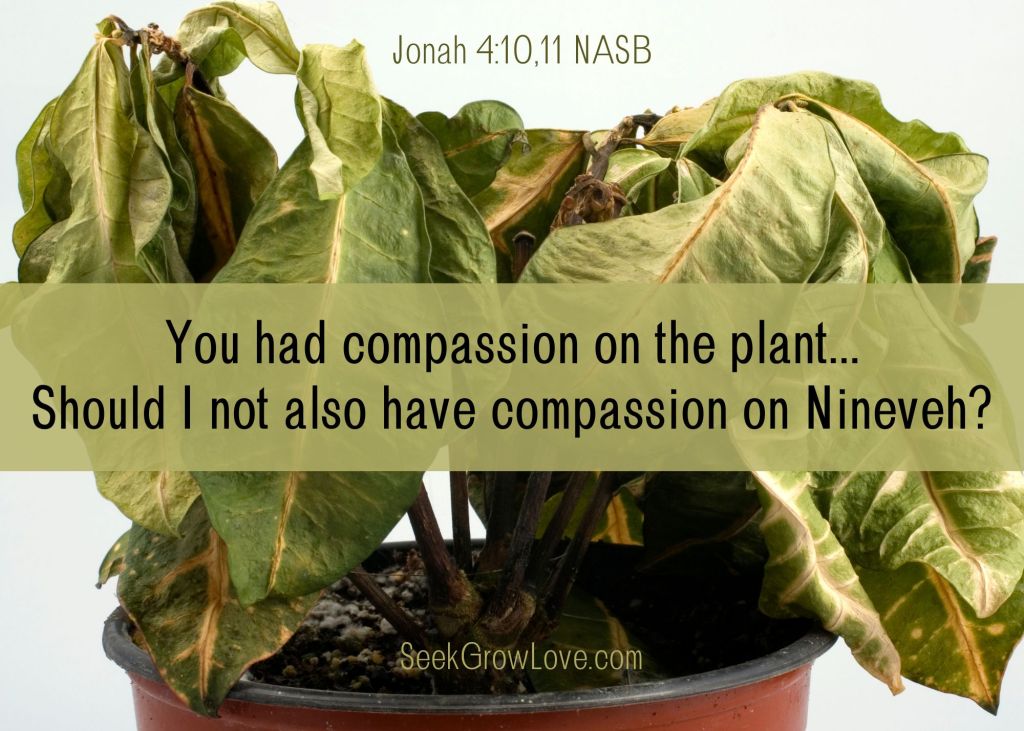
When God decided not to punish Nineveh, Jonah was angry. He went on a hill and built a lean-to shelter and God grew a plant to shade Jonah. God then sent a worm to  kill that plant so that the hot sun and scorching winds would wear Jonah down. Jonah 4:9-11 reads “ ‘Is it right for you to be angry about the plant?’ ‘It is,’ he said. ‘And I’m so angry I wish I were dead.’ But the LORD said, ‘You have been concerned about this plant, though you did not tend it or make it grow. It sprang up overnight and died overnight. And should I not have concern for the great city of Nineveh, in which there are more than a hundred and twenty thousand people who cannot tell their right hand from their left—and also many animals?’”

When I was told Kabi was allowed to repent of his sins I was actually furious. I thought the most evil thing imaginable had been done and now this man gets to repent! But let’s look at the parallels. That plant was God’s to give and God’s to take away, just like our own grace given to us by God. The message of Jonah four is to be a reflection on our own lives and ask, “Are you okay with serving a God that loves your enemies?” And if not? He loves them anyway. Considering we’re not always on God’s side doing what he asks of us, it might just be a good thing.

-John Evans

Reflection Questions

  1. Are you okay with serving a God that loves your enemies?
  2. What was God’s desire for Jonah? For Ninevah? What is God’s desire for you? For your enemies?
  3. How can you grow closer to God’s desire for you?
  4. How will you show compassion to your enemies?

Quit Something

Ezekiel 34-36

Ezekiel 34-36

Thursday, March 30


“It’s Thursday.  Quit being who you were.” – Bob Goff


Bob Goff, the author of “Love Does”, has a weekly ritual.  It’s called “Quit Something Thursday”.  Each Thursday, Bob Goff quits something to free up time or shake things up.  He has quit having an office.  He now works on a lobster boat he refers to as the Goffice.  He quit leaving phone messages to minimize the time that is wasted with the back and forth.  He throws away furniture, and has even resigned from the board of a non-profit charity.  Now the idea is not to back out of your prior commitments and become a wild-card liability for the people around you.  Instead, the idea is to give God room to show you something new. Bob Goff suggests quitting habits that keep us from being the best we can be.  On a more moderate scale, he suggests we might quit keeping score, quit sorting through our failures, or quit believing you are who you used to be.


So how does this relate to our reading today?  In Ezekiel 34 the sheep were scattered because the shepherd did not care for them; the shepherd only cared for himself.  However, we learn from Ezekiel 34:2-4 that it is the responsibility of the shepherd to care for the flock.  Instead, the shepherd “eat[s] the curds, clothe[s] [him]self with the wool and slaughtered the choice animals, but [he]did not take care of the flock. [He] did not strengthen the weak or heal the sick or bound up the injured.   [He has] not brought back the strays or searched for the lost” (Ezekiel 34:2-4).  The shepherds are too caught up in their own lives, their own ideas, their own health and fortune, that they lost sight of their purpose.  If not a shepherd, where is their identity? Thankfully God takes action and tells of the time when David (David’s line) will be the shepherd and God himself will be their God.  We see parts of the kingdom here on earth now, and we wait excitedly for the return of Jesus and the kingdom on earth.


We, too are shepherds tending to a flock.  As Christians who are no longer on milk, we have a flock to tend to.  We have a Church who needs us to show up in more ways than to simply fill a seat on Sunday.  As the shepherd cares for the flock, and strengthens the weak, we are called to do the same.


So the question becomes: what are you going to quit so that you can tend to your flock? Is your plate overfilled? How will you re-evaluate your obligations so that they align with your true priorities? It’s Thursday – quit something! I am going to quit washing my clothes because it takes up valuable time I could be investing in others…kidding mom, I really do wash my clothes.  But in all seriousness, I will quit placing so much emphasis on how others perceive me, and instead trust that the identity I have in Christ will carry me where I need to go.  What will you quit?


“We can’t change much if we don’t quit much” – Bob Goff


-Amber McClain