
Church

matt 18 20

We hear all the time that church attendance is down. It is. We could share the statistics, but we don’t need to. If you haven’t heard that, look around you. Church buildings, once central to communities, now stand empty or are used for other purposes. Restaurants, stores, and even more annoyingly, community and kids’ events are now regularly open/held on Sunday mornings without thought. But, why shouldn’t they be if attendance or business doesn’t decrease? And if you aren’t sure from observation alone, there are plenty of statistics out there to satisfy the most analytical of researcher. Home churches have increased in recent years, but even this increase doesn’t begin to make up for the decrease in overall church attendance. This certainly brings several questions such as “Why don’t people attend church?” or “Why have people left the church?”. . .but also. . . “What is the church?”

In our English language and contemporary society, the word “church” generally conjures up ideas of a building. Maybe a white building with a steeple and an organ. Maybe a cathedral, centuries-old with beautiful stained glass. Maybe a megachurch with full band, coffee shop, and million-dollar electronic equipment. Whatever the picture in our minds. . .it is generally far different from the meaning of the Biblical “church” and its references to the church family.

 “Remember those who led you, who spoke the word of God to you; and considering the result of their conduct, imitate their faith.” (Hebrews 13:7)

Be on guard for yourselves and for all the flock, among which the Holy Spirit has made you overseers, to shepherd the church of God which He purchased with His own blood.” (Acts 20:28)

Let the word of Christ richly dwell within you, with all wisdom teaching and admonishing one another with psalms and hymns and spiritual songs, singing with thankfulness in your hearts to God. (Colossians 3:16)

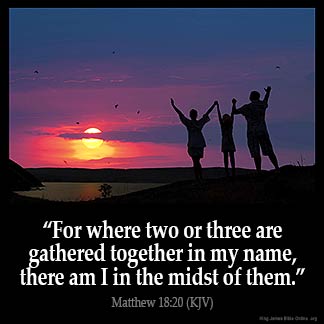
“For where two or three have gathered together in My name, I am there in their midst.” Matthew 18:20)

“. . .let us consider how to stimulate one another to love and good deeds, 25 not forsaking our own assembling together, as is the habit of some, but encouraging one another; and all the more as you see the day drawing near.” (Hebrews 10:24-25)

“These all with one mind were continually devoting themselves to prayer. . .” (Acts 1:14)

“They devoted themselves to the apostles’ teaching and to fellowship. . .All the believers were together and had everything in common. They sold property and possessions to give to anyone who had need. Every day they continued to meet together in the temple courts. They broke bread in their homes and ate together with glad and sincere hearts, praising God and enjoying the favor of all the people. And the Lord added to their number daily those who were being saved.” (Acts 2:42-47)

In scripture, the Greek word “ecclesia” refers to the group of believers. . .and clearly the content of scripture indicates that it doesn’t matter where that group meets, but who that group is. We are God’s children united in one church, one body.  We may “attend” a wedding or funeral, but we ARE the church. If we separate from the church, the body is injured. And if we think that church is something we “do” or somewhere we “go”, then we injure the body and minimize its potential. Our church family is our most important family and within it is the way we are called to seek the kingdom and spread the gospel.  If we wonder why people don’t attend church, or don’t do more than show up for a “service” and leave, perhaps we need to look at ourselves and encourage one another to amp it up a bit with a few of these things. Actions can speak louder than words sometimes, and it doesn’t help anyone to simply bemoan the state of society and the lack of church attendance and tell someone they should “come to church”. Instead, let us share it by remembering those who led us and imitate, be on guard, be thankful, teach, admonish, forgive, share, stimulate, encourage, persevere, and prioritize. We love our church, and we love even more the hope of one day being in the kingdom in a perfect, Christ-led body together. That day is ever-approaching. Let us not give it up now.

–Brian and Jennifer Hall
Church History

Colossians 2 8

“History is a set of lies agreed upon.”   -Napoleon Bonaparte

Well, there is some truth there for sure. . . and he’s been gone a long time. . .imagine how many more lies have been decided upon?!

One place where we can for sure see this idea coming into play is within church history. Church history isn’t taught much in schools for a variety of reasons. And, it isn’t taught much in churches for of a variety of reasons. History can be dry and not everyone needs to be a “history buff”, but it is also exciting in many ways. There is some super interesting and incredibly important information there. In it lies the foundations of our spiritual belief systems, Christian practices, and some fascinating facts demonstrating that human-driven beliefs overpowering God-driven instruction is not a “contemporary challenge”. There is nothing new under the sun.

Recently, we purchased a book called, The God of Jesus by Keagan Chandler. This book is clearly written by an individual who has sought to find the needle of truth in the haystack of history, and though we’re not done, it is a helpful resource so far. He challenges the reader that, “. . .the only thing more regrettable than a religious academia which doesn’t care that its most characteristic philosophies are found nowhere in the mouth of Jesus and routinely in the teachings of pagan mystics, is a devoted majority which does not know it at all” (p. 270).

That is so true. The majority of us don’t know the history of our religious philosophies, and for some who know. . .they choose not to care. One interesting piece of church/world history is seen when Chandler reminds us that “Incarnation. . .the assumption of human form by a god is an idea common in religion. . .India and Egypt were especially rich in forms of incarnation. . .Incarnation is found in various phases of Greek religion” (p. 359). Hence. . .a few years later, “Christians” fight amongst themselves, hold a few councils to decide that Jesus, God’s son, must actually be the incarnate God who came to earth as a baby in human form, and later deciding that everyone had better believe that or be willing to die as a blasphemer for saying Jesus is our Messiah but not God himself. It is very interesting to see the gradual assimilation of pagan cultural beliefs infiltrate in just this one area (and there are so many others), and we continue to see this cultural penetration every day in our own lives. If we as the church continue to absorb the traditions and beliefs of everyone around us and not root them solely in God’s word and obedience to Him, then we are certainly not learning much from the lessons of history. You see, history matters. We don’t want to keep doing the same thing and expect a different result or just be hamsters running in a wheel going nowhere.

We can’t cover church history in one day, but we can challenge ourselves to study it. Read. Investigate. Ask others. Grow. Seek to learn. In school and at museums, we learn about things like slavery and the Holocaust so we can understand how wrong that was and to “prevent it from happening again”.  But, do we ever look at the history of our own religion or our own spiritual beliefs with the same intentions. We are flawed. We can’t be in control of creating belief systems or everything will fall apart. We are subjects of His created system. And while He has allowed confusion and problems for a time now. . .a day of perfection is coming for those who He knows and calls where we will understand all things and will no longer be exposed to lies.

“See to it that no one takes you captive through hollow and deceptive philosophy, which depends on human tradition and the elemental spiritual forces of this world rather than on Christ.” (Colossians, 2:8, NIV)

“For the wisdom of this world is foolishness in God’s sight. As it is written: ‘He catches the wise in their craftiness’” (1 Cor.3:19, NIV)

“Do not be wise in your own eyes; fear the LORD and shun evil.” (Proverbs 3:7, NIV)

My message and my preaching were not with wise and persuasive words, but with a demonstration of the Spirit’s power, so that your faith might not rest on human wisdom, but on God’s power.                   (1 Corinthians 2:4-5, NIV)


-Brian and Jennifer Hall