
How the Story Ends

Matthew 28

January 28

This week has been rough. My daughter was sick; it’s been snowy and cold; my younger kids are in a “destroy-the-house-and-dad’s-sanity” kind of mood. To top it all off, these have not been easy devotions to write, and probably not easy to read. Judgements and woes, apocalypses and parables, betrayals, regrets and death. 

But that’s not how the story ends. 

If you’ve ever had the pleasure of watching Jesus Christ Superstar, a musical by Andrew Lloyd Weber, and if you’ve seen the original version, something is striking about the end. It ends with them burying Jesus after the crucifixion. The name of the final song is “John Nineteen:Forty One”, a sweeping and somber orchestral piece. That verse reads : “Now in the place where he was crucified there was a garden, and in the garden a new tomb in which no one had yet been laid.” It’s poetic and tragic and sad and moving and compelling. 

But that’s not how the story ends.

Life can be hard. Sometimes it’s our kids or friends having a cold, which today means a “COVID scare”; but sometimes it’s our mom or dad diagnosed with something terminal. Some days are snowy and cold; sometimes a coldness creeps into our souls that shuts out the world around us. Sometimes our physical house is a disaster; sometimes our emotional home, the relationship within the walls, seem broken beyond repair. 

But that’s not how the story ends. 

On the first day of the week, two women who loved and cared for Jesus go to where his body was laid. They know the location, they were there when the door was sealed just days ago. But the body isn’t there. An angel, in the form of a man, says to them “Do not be afraid; for I know that you are looking for Jesus who has been crucified. He is not here, for He has risen, just as He said. Come, see the place where He was lying.” And they are told to go to Galilee, for that’s where they and all the disciples will see him. But before that, he greets them on the road. And he says “Do not be afraid; go and take word to My brethren to leave for Galilee, and there they will see Me.”

But that’s not how the story ends. 

See, Jesus meets them in Galilee. And he gives them a command. In the Greek, the only command is “make disciples.” That is the commission we are given, given to every Christian since the resurrection until the last moment. Is what you are doing in life making disciples? Jesus says that they should make disciples by going, by baptizing, by teaching them. Those are indispensable parts of the commission. But it doesn’t mean “go on a mission trip and baptize and teach someone over there.” It means “whoever isn’t a disciple, go to them, love them, pray for them, if they accept the message baptize them, and then as they walk beside you in life teach them.” That’s the great commission. 

But that’s not how the story ends. 

Jesus tells them that he will be with you, WITH US, ALWAYS. He says he will not forsake us, even until the end of the age. That means that as long as this world endures, Christ is with us. There will be a day where we may not be alive, and we will sleep, awaiting resurrection. But Christ will bring a new age in. 

But that’s not how the story ends.  

Because the story doesn’t end

Instead, because of the resurrection of Jesus to life, because God has shown with power that Jesus was the genuine article, the real deal, the true Messiah, then when he said that we who believe in him will have eternal life in his name, that is a guarantee we can trust. Those who follow Jesus begin their story now, will begin a new stage in the resurrection, but their story will continue on forever. We will truly be able to write our last chapter as “They lived happily, eternally, ever after.”

And that’s how our stories will start

-Jake Ballard

Questions for Reflection and Discussion

  1. Take a moment to think about, journal about, and pray about where you are in your story. Are things really good, and you are connected to your loved ones and God, thriving and growing closer together? Or is your story really difficult to read right now, much less live through? Are you asking the author of our stories to show you how HE reads your story? Would our life look different if we examined it from God’s eye? What would change because of the perspective? What would stay the same? How might this view alleviate your anxiety and worries?
  2. The great commission should fill us with hope and purpose, not shame and guilt. Jesus has died so our sin, guilt, and shame might be nailed to the cross. Jesus is raised to empower his followers to make disciples for the good of the world. How can you start to fulfill the great commission today? Are you ready to change the world through the power of God? Do you believe that God wants and expects you to be radically fulfilling the calling to make disciples, no matter your age, your schooling, your gender, your race, or any other factors?
  3. If you want the true beginning of your story to read “They lived happily, eternally, ever after…”, then will you accept Jesus as your Lord and Savior today? Will you repent of sin and trust that he has forgiven them? Will you trust that he will never leave you nor forsake you but will be with you “until the end of the age” and into the age after that?
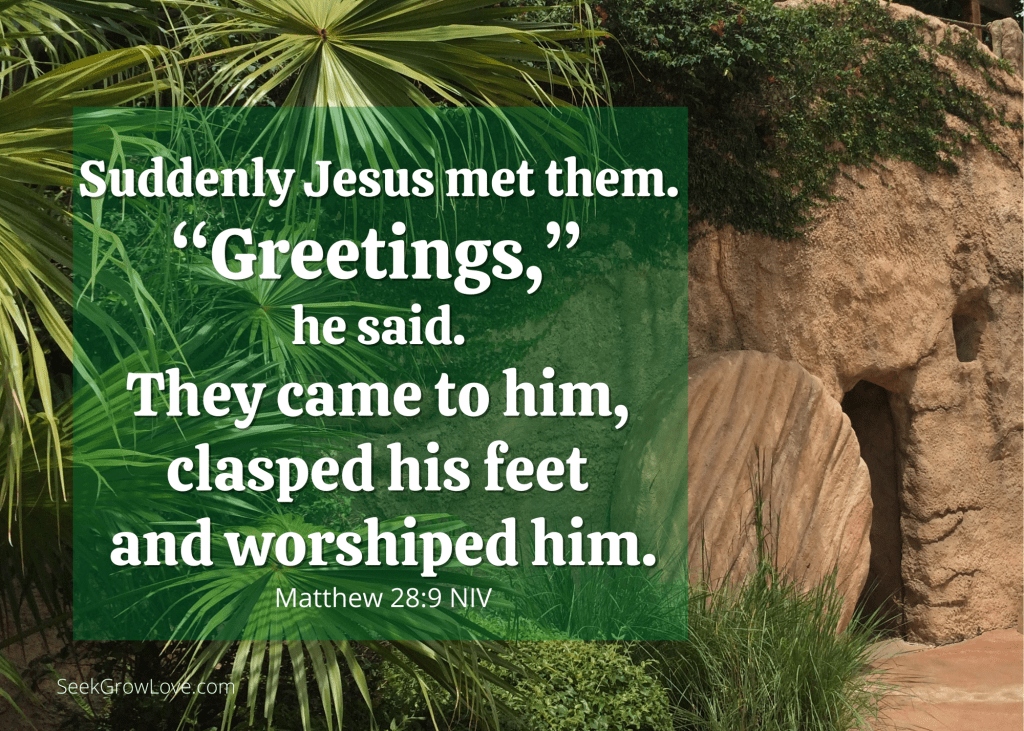
Resurrection Changes Everything

Today’s Bible Reading – Matthew 28 and Exodus 5-6

                During the 20th century among the more liberal wing of Christianity it became fashionable to interpret the Bible in a less literal more metaphorical way.  The story of the resurrection of Jesus was regarded not as historical fact but something that happened inside the disciples of Jesus that gave them hope.  The Episcopal bishop John Shelby Spong famously wrote of the resurrection of Jesus as a myth which opened the disciples’ eyes to the reality of God and the meaning of Jesus Christ. (whatever that means).

                John Updike is a well regarded novelist and poet, not a theologian, but he uses the tools of a poet to counter the theological attempts to reduce the resurrection of Jesus to a simple myth.  In his poem Seven Stanzas at Easter he writes:

Make no mistake: if He rose at all
it was as His body;
if the cells’ dissolution did not reverse, the molecules
reknit, the amino acids rekindle,
the Church will fall.


It was not as the flowers,
each soft Spring recurrent;
it was not as His Spirit in the mouths and fuddled
eyes of the eleven apostles;
it was as His flesh: ours.

The same hinged thumbs and toes,
the same valved heart
that-pierced-died, withered, paused, and then
regathered out of enduring Might
new strength to enclose.

Let us not mock God with metaphor,
analogy, sidestepping, transcendence;
making of the event a parable, a sign painted in the
faded credulity of earlier ages:
let us walk through the door.

The stone is rolled back, not papier-mâché,
not a stone in a story,
but the vast rock of materiality that in the slow
grinding of time will eclipse for each of us
the wide light of day.

And if we will have an angel at the tomb,
make it a real angel,
weighty with Max Planck’s quanta, vivid with hair,
opaque in the dawn light, robed in real linen
spun on a definite loom.

Let us not seek to make it less monstrous,
for our own convenience, our own sense of beauty,
lest, awakened in one unthinkable hour, we are
embarrassed by the miracle,
and crushed by remonstrance.

John Updike

https://www.poemhunter.com/poem/seven-stanzas-at-easter/

                What Updike so poetically states is that the resurrection of Jesus is no myth, no allegory, it actually happened.  Jesus’ dead corpse physically rose up from the tomb in which it had been buried.  Jesus was really raised to everlasting life.  The first disciples of Jesus would certainly have agreed whole-heartedly.

                Today’s passage from Matthew 28 is one of four Gospel accounts of the resurrection of Jesus.  Each of the Gospels, Matthew, Mark, Luke and John include and omit different elements of the story.  This is always true of witnesses.  In a trial or a new article when multiple witnesses are interviewed they will tell the story in different ways and include and exclude data.  Each person sees and experiences things from their own unique perspective.  In fact, if all witnesses say exactly the same thing in exactly the same way it raises suspicions that they got together and colluded beforehand what their statement was going to be.  Eye-witness accounts should have different details.  But the overall story should be the same.  This is true with the story of Jesus’ resurrection.  Each of the Gospels gives different details and some alter the chronological order of events, but they are all in agreement of the important facts- Jesus physically rose from the dead and there were numerous eye-witnesses.

                Outside of the Gospels, the Apostle Paul also offers his own testimony.  In the book of Acts Paul encountered the risen Christ while he was on his way to Damascus to persecute the Church.  And later, Paul wrote to the Corinthians about the resurrection of the dead:

For what I received I passed on to you as of first importance: that Christ died for our sins according to the Scriptures, that he was buried, that he was raised on the third day according to the Scriptures, and that he appeared to Cephas, and then to the Twelve. After that, he appeared to more than five hundred of the brothers and sisters at the same time, most of whom are still living, though some have fallen asleep. Then he appeared to James, then to all the apostles, and last of all he appeared to me also, as to one abnormally born. (I Corinthians 15:3-8, New International Version).

                Paul makes it clear that not only is the death of Jesus foundational to Christianity but so is his resurrection that was witnessed by more than 500 people including Paul.  According to the Old Testament Law it took two or three witnesses to confirm something as factual.  More than 500 witnesses is way more than necessary to confirm a fact.  Jesus really did rise from the dead.

                Paul then connects the resurrection of Jesus to the resurrection of all people.

12 But if it is preached that Christ has been raised from the dead, how can some of you say that there is no resurrection of the dead? 13 If there is no resurrection of the dead, then not even Christ has been raised. 14 And if Christ has not been raised, our preaching is useless and so is your faith. 15 More than that, we are then found to be false witnesses about God, for we have testified about God that he raised Christ from the dead. But he did not raise him if in fact the dead are not raised. 16 For if the dead are not raised, then Christ has not been raised either. 17 And if Christ has not been raised, your faith is futile; you are still in your sins. 18 Then those also who have fallen asleep in Christ are lost. 19 If only for this life we have hope in Christ, we are of all people most to be pitied.

20 But Christ has indeed been raised from the dead, the firstfruits of those who have fallen asleep. (I Corinthians 15:3-8)

Paul says here that if there is no resurrection of Jesus and no resurrection of the followers of Jesus, then we are wasting our time talking about faith.  The true, bodily resurrection of Jesus is no myth, it is central to our faith and it changes everything.

The Apostles certainly believed it was true.  They took up Jesus’ commission to go into all of the world and proclaim the good news that Christ has died and Christ has risen, and Christ will come again.  You and I are part of that same tradition.  We are called to pass along this same truth.  It is who we are.  Jesus Christ really did rise from the dead.  Jesus Christ really is coming again to raise those who have died and are asleep in their graves from death to everlasting life.  That is our hope and joy.  That is the foundation on which to live your whole life.

-Jeff Fletcher