
Old Testament: Esther Intro below
Poetry: Psalm 25
New Testament: John 5
We saw in John 4 yesterday how Jesus challenged and expanded the boundaries of who can experience the living water, and where worship can happen. Now in John 5, we see him challenging the existing notions of when God should be experienced.
We think of the temple as sacred space, meaning it was a special place where God’s presence lived in a special way. What the temple was to physical space, the Sabbath was to time. The Sabbath is sacred time, like the temple in day form. It was a special day of rest set aside to focus on God, which invited his presence.
The Sabbath was important to the Jews, so they did their best to follow the laws in scripture concerning it. With all the right intentions, they developed traditional rules about what could be done on the Sabbath that were more strict than what was stated in scripture. This way, they wouldn’t even come close to breaking the laws. It was like driving 30 MPH in a 55 MPH zone so you don’t get pulled over for speeding.
There is a difference between following the letter of the law and following the spirit of the law. The letter of the law in a 55 MPH zone means if you go over 55 MPH, you might get pulled over and probably have to pay a fine. But what is the spirit of the speed limit? One goal is safety. If a lot of people are driving too fast, chances for fatal accidents increase (speed kills). If you are driving 30 in a 55, you are well within the letter of the law, but you are actually not following the spirit of the law, since you are not helping the safety situation. Other drivers will have to slam on their brakes to not hit you, or they will have to pass you and risk a collision with a car coming the other way. In being too preoccupied with the letter of the law, you have violated the spirit of the law.
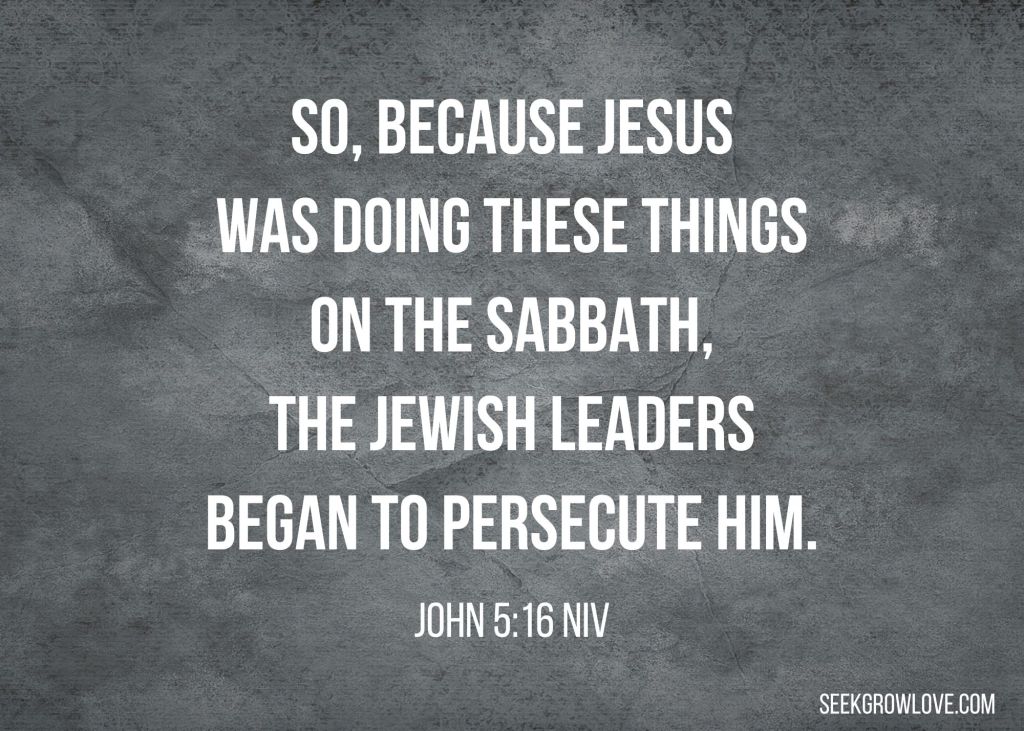
By healing the man on the Sabbath, Jesus attracts some unwanted criticism. First, the man is criticized for carrying his mat away, as Jesus told him to do. This was apparently against some of the rules about how much weight could be carried or how far something could be carried on the Sabbath. Then the religious leaders criticize Jesus for doing a healing on the Sabbath, since healing qualifies as some form of work in the rule book. They probably just wanted to find any way possible to be critical.
How does Jesus respond? From verse 17: “My Father is still working [on the Sabbath], and I also am working.” Doesn’t this challenge the traditional wisdom about the Sabbath? If God rested on the seventh day, we observe that pattern and do the same each week. But Jesus is claiming here that God works even on the Sabbath, and maybe even that he has never stopped working. Jesus is all about the business of his Father, so if the Father is working on the Sabbath, so will Jesus.
A large point of the law about the Sabbath is to carve out time to foster a connection with God. By focusing on the technicalities, the religious leaders were missing the point completely, for had their standards been followed, it would have resulted in less connection with God. The man wouldn’t have been healed, and wouldn’t have had the amazing experience that brought him to know Jesus and by proxy, the Father. By maximizing connection to God, Jesus had actually followed the spirit of the law, even though he may not have been within the letter of it.
I think what God wants us to know through this story is that he values compassion and mercy above legalism. I am reminded of what Jesus says in Matthew 9:13 (in reference to Hosea 6:6): “Go and learn what this means, ‘I desire mercy, not sacrifice.’ For I have come to call not the righteous but sinners.” Our God is a God of genuine love and kindness, and he wants us to mirror that, not just perform the outward ritual.
-Jay Laurent
Reflection Questions:
1. Can you think of a time when obsessing over the rules made you miss the big picture?
2. It’s a busy world. Do you carve out any time to connect with God?
3. If you do, what are some of your favorite ways of connecting?
Esther Introduction
The Book of Esther tells the story of how a Jewish orphan girl became the queen of Persia and saved the Jews from Haman’s plot to kill them all. The feast of Purim, still celebrated today, celebrates that deliverance. We don’t know who wrote the book of Esther, but it may have been her cousin, Mordecai (who also raised her after she became an orphan).
The book of Esther is the only book in the Bible that has no direct reference to God, and is only one of two (the other is Ruth) named after a woman.
One of the most well-known verses is Esther 4:13, “For if you remain silent at this time, relief and deliverance for the Jews will arise from another place, but you and your father’s family will perish. And who knows but that you have come to royal position for such a time as this.”
Bonus trivia: The longest verse in the Bible is Esther 8:9.
This book is a great example of the positive difference one person can make when acting courageously despite fear. What difference can you make – with God’s help?
-Steve Mattison
 Seek Grow Love