Making Choices

Daniel 1-3

Devotion by John Tullis (Ohio)

Part of walking with God involves making choices.  Sometimes, these choices are very hard when you must decide between what you know is right and what is comfortable or easy.  Often, through the power of His Holy Spirit, we often know what we need to do to please God (John 16:13).  However, we live in a world that is against everything that God desires for His people (1 John 2:15-16).  How do we continue to please God in compromising situations that challenge our devotion to our Father in heaven? 

Often the land of the Bible found itself in conflict.  When Daniel was a young man, Judah, the southern kingdom of the Hebrew people, was struggling under the leadership of King Jehoiakim.  Judah had denied God and allowed foreign nations to pollute their devotion to God.   Judah began to welcome idol worship (false gods) and began to lose faith and obedience to God.  As punishment, God allowed the kingdom of Babylon to destroy Judah and enslave the people.  The Babylonian King Nebuchadnezzar believed in integrating conquered nations into the Babylonian empire.  He ordered that some of the more cultured Judean youths be captured and moved to his own palace in the city of Babylon.  There they would be assimilated into Babylonian culture.  Among these were Daniel, Hananiah, Mishael, and Azariah, all of the tribe of Judah (Daniel 1:6). 

Daniel and his friends were boys who dared to worship and follow God despite the culture they lived in.  Even before they were captured by the Babylonians, Daniel and his friends resisted the cultural changes and influence of the Judean culture.  Instead of bowing to foreign gods and worshipping idols, they chose to submit and follow the one true God.  When their kingdom was punished and destroyed and they found themselves being hauled off to Babylon, they relied on the God who had always sustained them (Psalm 55:22). 

In order to begin assimilating the captured youths into Babylonian society, Daniel and his friends were ordered to eat the king’s food and drink his wine (Daniel 1:5).  Many times in the ancient world, the food that a king ate was food that had been offered to pagan gods.  These foods would violate God’s law (Lev 1:1).  Daniel resolved (“purposed in his heart” – Proverbs 4:23) that he would not compromise his devotion to God.  As a result, God ensured that Daniel would receive favorable treatment among the heathen leaders of Babylon.   

Daniel and his friends grew in influence, knowledge, and even physical fitness.  They had clearly become the favorites of Nebuchadnezzar (Dan. 1:20).  God had recognized their faithfulness and their obedience to His word.  He blessed them with learning and skill in literature and wisdom (1:17).  Instead of bending their beliefs to impress their new masters, Daniel and his friends continued to remain devoted and obedient to God. 

Daniel’s friends (now renamed Belteshazzar, Shadrach, Meshach, and Abednago) would once again be thrown into a situation in which they were forced to choose to obey God or Nebuchadnezzar.  Challenged to bow down and worship a golden image of Nebuchadnezzar, Daniel’s friends choose to obey God (Daniel 3:17-18).  They understand that this choice could result in their deaths, but they had resolved long before to honor God – no matter what the cost.    As they were thrown into the fiery furnace, God demonstrated his faithfulness as no one was consumed by the flame.  In fact, in the midst of the struggle, God sent His angel to walk with them – inside the flames (Daniel 3:25-27).  We are never truly alone.  Amid our own “fiery furnace”, God faithfully cares for us. 

As Daniel teaches us, obeying God and being devoted to Him is much easier when we decide in advance to obey Him.  As Daniel resolved to follow God, we too should resolve to follow God whenever compromising situations come along.  It is not easy to remain faithful to God in every situation.  Jesus promised to give us a “Helper” to help us live lives of devotion to God (John 15:26; 16:7).  Through the power of the Holy Spirit, which is given to each of us who believe, God will help us to overcome sticky situations.  It may not “feel” good at the time, but ultimately God will walk with us because of our obedience.  Just as he walked with and helped Daniel, God will walk with and strengthen you.  Resolve in your own heart to follow God today! 

Questions for Discussion: 

  1. Have you “resolved” in your own heart to follow God in every situation? 
  1. Who is the Helper promised by Jesus?  Do you rely on God’s power to sustain you during sticky situations? 
  1. Besides rewarding Daniel for his faithfulness, what other motives would God have to reward those who are faithful? 

Fulfilled

Matthew 2

January 2

While I am greatly looking forward to this year’s reading plan, I must say I am a little sad knowing we won’t be in the Old Testament everyday as we were last year. There is a LOT of good stuff in the Old Testament! Thankfully, even our New Testament readings will often take us back to the foundations laid in the Old Testament. My NIV Study Bible notes say that Matthew quotes from various Old Testament authors at least 47 times throughout his book of 28 chapters. He obviously knew his Scriptures well and saw great value in them. Matthew, inspired by God, would use these Old Testament passages wisely to show the connections from the plans God set into motion while working with the patriachs, kings and His chosen people, the Jews in the Old Testament to the birth, life, death, resurrection, ascension, and coming return of God’s Son the Messiah/Christ/Anointed One/Jesus! It is great fun reading through the Old Testament to find the clues leading to Jesus, and in the New Testament finding the prophecies fulfilled which had been spoken centuries before, pointing all generations and all peoples to this one-of-a-kind king that would show us God’s heart and purpose and plan like it had never been revealed before.

Two weeks ago the children and youth of our church performed a play called “Long Foretold”. It is a Christmas play from the Answers in Genesis organization which included not just the nativity but also many of the prophecies that would begin to see fulfillment with the birth of Jesus. The seed of woman that would crush the head of the serpent (Genesis 3:14-15). All nations shall be blessed through Abraham (Genesis 18:17-18). A child would come (Isaiah 9:6) – born of a virgin (Isaiah 7:13-14). A ruler would come from Bethlehem (Micah 5:2-5), from the tribe of Judah (Genesis 49:8-10), from the line of David (Isaiah 9:7). Kings from afar will bring gifts and worship (Psalm 72:10-11). Foretold in the Old Testament. Fulfilled in the New Testament. The Scriptures are all about Jesus who is God’s Son and God’s ultimate plan of redemption. God’s Scriptures are perfect in revealing this plan.

But what happens when traditions take over and God’s word is replaced bit by bit with human ideas and misconceptions. Errors occur. Then we get three kings bowing at the manger next to the shepherds. But what does Matthew 2 -the only Biblical account of the magi – say? It does not record how many magi had traveled from the east – only that they brought three gifts. We only know it was more than one but it could have been four, five or a much larger group of magi or wise men, never referred to as kings. We know that these learned men from the East (possibly Persia) saw a new star in the sky and recognized it as a sign that a new king of the Jews was born. They had heard amazing things about this king and wanted to worship and bring gifts and see him for themselves. So they traveled to Jerusalem, straight to the king’s palace, a likely place to find a child king. But King Herod the Great had heard no such news and was in no mood to welcome a child who would take his place. He wants more information so he calls in Jerusalem’s own “wise men” – the chief priests and teachers of the law. They are very familiar with the Scriptures and reveal that the long-awaited Messiah was to be born in Bethlehem, a small town near Jerusalem. The magi’s journey continues and now they follow the star directly to the HOUSE and find the CHILD (not the baby in the manger).

While we aren’t told, it is interesting to think about where the wise men from a far away country to the east of Israel would have received this information that a star would signal the birth of a Jewish king that would be like no other. In the play “Long Foretold”, as well as many other sources, a possible link is explored between these wise men from the east and Daniel, the devout Jewish exile who was elevated to the role of lead prefect of the wise men of Babylon (also in the East) about 550 years before the birth of Christ. We know Daniel was faithful in serving and speaking for his God even in a foreign pagan country so it makes sense that he would have passed along Jewish knowledge to the wise men under him. We know Daniel prophesied about the coming Messiah. And we know that SOME information God gave him was to be sealed up and saved for a future time. Perhaps this was information saved for the generation of wise men that would see the star and travel to Jerusalem to welcome the Jewish child king. Perhaps there is yet more information sealed up awaiting the generation of wise men (and women) who will be on earth to welcome the return of this same king with a trumpet blast. Get all of the accurate information you can and act on it! You don’t want to be unprepared when the King comes into town.

-Marcia Railton

Reflection and Discussion Questions -pick and choose
  • How many times in Matthew 2 does Matthew quote or refer to what the prophets had said? What do you think he is trying to tell his readers? As we go through the book of Matthew this month take note of all the times he writes about the prophets and the Old Testament. Can you find at least 47?
  • Do a little research on King Herod the Great. Who was he? What motivated him? What is he known for? His death is recorded in Matthew 2:19, thus making it safe for Mary, Joseph and Jesus to exit out of Egypt and return to the land of Israel (sound familiar from anything in the Old Testament)? What members of Herod’s family will we see later in Matthew?
  • We are not told a lot of information about the magi. But from their actions, what can we learn about them? What characteristics found in the wise men would we be wise for us to work on today?
  • Look up or create your own list of Old Testament prophecies of the Messiah and New Testament fulfillments of these prophecies. You can even create a matching game for family devotions or your small group. Why is it important to see the Old Testament connection? Are there some prophecies of Jesus not yet fulfilled? How does that make you feel?

Don’t Lose Heart

Revelation 13-16

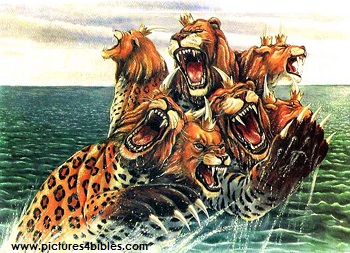
beast_sea

Thursday,  July 20

Revelation 13-16 gives a continuation of God’s judgments and wrath which are poured out upon the earth.  We are introduced here to two beasts.  For those who are familiar with the Old Testament book of Daniel with it’s four beasts, this material will be familiar.  These beasts are ferocious looking images that represent some of the great oppressive empires of the ancient world.  The land which we today know as the nation of Israel has always been a strategically important piece of geography.  It is a point of convergence for three continents: Europe, Asia and Africa.  It has been hotly contested for thousands of years.  All of the major world empires up to that time took turns occupying the land.  It was occupied by the Assyrians, the Babylonians, the Medes, the Persians, the Greeks and the Romans.  I’m sure that if you were a peasant trying to eek out your life living in a small village in Israel, you would look at these various invading armies as  monstrous beasts.  Suddenly, you were forced to follow a new set of laws and customs, and learn to speak new languages in order to understand your captors.  You would have to get used to new kinds of money in order to be able to negotiate your way in the new culture.  I imagine it would have been scary and overwhelming.
John foresees a time when these beastly powerful world empires who control all of life, will be brought to an end, to be replaced by God’s Kingdom.  Even though, for a while, it seems that they are all powerful and all controlling, this will not last forever.  Patience is required to live as a believer in this current world system, but one day, our patience will be rewarded.  Don’t lose heart.  While the mark of the beast would seem to protect you from temporary suffering by the powers of this word system, it is the mark of God, which we are given when we follow Jesus Christ, that will protect us from God’s wrath.  Which mark would you rather have?

-Jeff Fletcher


(Photo Credit: http://www.trackingbibleprophecy.org/revelation13A.php)

Peace in Our Time

 IMG_0034

Daniel 10-12

I am no expert on Biblical Prophecy, or on anything for that matter. So I’m not going to try to explain the prophecies in Daniel 10-12. Instead I want to share three things we can learn about God from Biblical Prophecy and three implications of those things for our own lives.

(1) Biblical Prophecy illustrates that God is not in time. This means that God is not bound by the same time constraints as we are. You and I can only deal with the present. We may have memories of the past and fantasies of the future, but we can see what is really happening only while it is actually taking place. God is not like this. He can see all of history at a glance; this is how He could reveal to people like Daniel the goings-on of the future.

(2) Because God is not in time He is the greatest of planners. The people we think of as planners (people like my wife) tend to have a focus on the future. This is why they plan—to be prepared for what is coming in the future. Since God can see the future He is able to plan things out in such a way as to generate best possible result. And because God loves us, those plans promote our welfare.

(3) Not only does God make plans, but those plans happen just as He promises. There are hundreds of prophecies throughout the Bible, some of which have already been fulfilled. Many of the prophecies in the Old Testament predicted that a Messiah would come. They foretold of the place of his birth, the characteristics that would define him, and the ultimate sacrifice he would have to make. When Jesus came, he was the embodiment of these promises—although many didn’t recognize this. When God makes a promise, you can bet your bottom dollar that He will come through.

(4) Because of God’s track record in promises department, we can trust that the prophecies in the Bible that haven’t yet happened will eventually happen. While it is very easy to lose trust in the empty promises of politicians, we can rest assured that God won’t let us down.

(5) Our trust in the promises of God should give us hope for the future. While the Bible does prophesy that in “the end” difficult and trying times will come, after that there will be no more pain, no more tears, and we will be with our God in His perfect Kingdom.

(6) What all this really means is that right now, in the time we are constrained to, we can live at peace. Despite the craziness of the world around us, however terrible and unbearable it may become, our hope can anchor us so that we can stand firm and live in serenity. So look at the promises God has made, see that He keeps them and that they are good, and live in peace, with hopeful expectation for the culmination of all the prophecies in the Bible.

– Joel Fletcher

How Daniel Sustained His Devotion (And How You Can Too)

Daniel 7-9

The same word has beep popping up each day in our last few devotions: devotion.  The reason for this is simple. Daniel was a man devoted to God. Each story we’ve read this week has clearly demonstrated this. 

In yesterday’s devotion I said that our devotion to God must remain constant despite the ever-changing world in which we live—just as Daniel’s did. Today I want to tell you how Daniel was able to sustain his devotion and how you can, too.

The word pray (and its derivatives) is found twelve times in the first nine chapters of Daniel. He prayed three times everyday. He was arrested and thrown into a lion’s den because he continued praying even though it was declared illegal. One of the most powerful prayers in all of scripture is recorded in Daniel Chapter 9—Daniel is its author. It is obvious that prayer was central in the life of this godly man. This is what enabled him to stay devoted to his God in midst of constant trials and changes. And a prayerful life is the key for us to maintain a devoted life today.

There are several reasons why prayer helps sustain devotion. The first reason is that it keeps us connected to God. The more you talk to someone (especially if you like them), the better the connection. On the other hand, if you don’t communicate, there will be little to no connection. This is case with God as well. Prayer—heartfelt prayer—creates connection, which leads to greater devotion.

A second reason is that prayer helps us understand the will of God. Prayer allows us (as much as possible) to get our minds aligned with God’s. The more we pray, the better we understand what God wants. His will is good, pleasing, and perfect. So when we understand God’s will (in all its goodness) it generates more devotion in us. In other words, we get a greater sense of how great God truly is and He becomes more alluring to us.

The last reason I’ll mention for why prayer helps us stay devoted is that it keeps us focused on what really matters. Our minds are truly amazing things, but they tend to get overcrowded—especially in the Information Age. We all carry smart phones, have personal computers, and own TVs. We are constantly taking in information—sometimes good and sometimes bad. I believe there has never been a harder time for individuals to stay focused than today. It is difficult to remain devoted when there are so many distractions. This is where prayer can help. When we put away our computers and smart phones and take time to talk to God, it clears the fog in our minds that prevents us from focusing on the one to whom we should be devoted.

Being devoted is not an easy thing. That is what makes Daniel so impressive. Only because of his prayer life was he able sustain such devotion to God. If we want to resemble Daniel in his devotion, we must strive to have a life filled with prayer. So go ahead, say a prayer.

– Joel Fletcher

IMG_0032

The Resolution that Stuck

IMG_0027

Daniel 1-2 

The book of Daniel is probably my favorite of the books we call the Prophets. It is filled with exciting stories (like the fiery furnace and lion’s den), captivating prophecies, and one of the best biblical examples of a godly man.

In the first two chapters of Daniel we begin to learn a lot about his character. The first story in Daniel begins in 1:8, which says “Daniel resolved not to defile himself with the royal food and wine.” Daniel was a part of a group chosen by king Nebuchadnezzar to be groomed to serve in his palace. Daniel, along with Hananiah, Mishael, and Azariah, were chosen from the tribe of Judah. The group was assigned to eat food that apparently was against the food laws outlined in law given to Moses. Instead of doing the easy and safe thing, Daniel made a resolution not to defile himself with the decadent, tasty food. After some reluctance, the official in charge of Daniel agreed to let him and his friends eat his own diet. 

At the beginning of every year, people make resolutions to start doing something good (like work out more or read Bible more) or give up something bad for them (like fried foods or too much TV). What seemly happens every year though, is that after a few weeks or, if you’ve done well, a few months, you give up on your resolution and start back on what you were doing before. Keeping resolutions is hard, but Daniel kept his. Not only that, but he and his friends looked better after ten days of vegetables and water than the other guys on the diet of choice foods and wine.

Daniel’s resolution stuck and for this he was rewarded. God gave he and his three friends knowledge and understanding and Daniel the ability to interpret visions and dreams. They found favor with the king and entered his service. This led to the second story in this great book, the interpretation of the king’s dream.

What will be a constant theme through the first half of this book is Daniel’s devotion to God. This is what led him to resolve himself not to eat the defiled food and, even when faced with opposition, to keep that resolution. This devotion will keep him praying even when it’s illegal.

Daniel was devoted to God above all us. We should be, too. It won’t be easy. We may face opposition. We may be thrown to the lions. But in end, it will be well worth the struggles. As the great songwriter Bob Dylan said, “you gotta serve somebody.” Why not let it be the God who will set up a kingdom that will never end? (Daniel 2:44) Resolve yourself to be devoted to the God who won’t let you down.

– Joel Fletcher