
OLD TESTAMENT:Daniel 1
POETRY: Psalm 136
NEW TESTAMENT: John 7:1-24
Over the next two weeks, we are going to spend some time in the book of Daniel. Daniel is a book that has generated a lot of discussion: it has been the subject of at least TWO retellings by our favorite cast of talking vegetables and at least one cookbook based on mostly eating those vegetables. However, we might miss the mighty story of this man of the Almighty when we get too hung up on cucumbers, mushrooms, and other morsels. Is the story of the fiery furnace really about chocolate bunnies? (See “note” below.) Are the health benefits of a “Daniel-Diet” the point of the refusal to eat the King’s food? But, if not, then what is the point of Daniel?
To be clear, this book is one of the most discussed in scholarship from the Old Testament canon. Any statement made about date, authorship and the rest of the book has been discussed ad nauseum by Jewish rabbis and Christian thinkers since the pen was put to paper. The author, Daniel for our devotions, wrote in Hebrew but also in Aramaic; not common for the Old Testament. Moreover, the genre of the book is more similar in style to Revelation than anything else in the Biblical canon. These two books are full of big, bombastic images, metaphors, poetry, talk of beasts, monsters, dreams, the clash of Empires and the Kingdom of God. But, if we are ready to work, to interpret Daniel on his own terms, and to clearly see what he was writing about and what he was prophesying, we will get much more out of Daniel than we have before.
For example, in chapter one, Daniel, and his buddies Hananiah, Mishael, and Azariah (rather than Shadrach, Meshach and Abednego), who we will call “the boys” today, decide to not eat the king’s food. The boys decide that they are going to eat vegetables and water. They look better after ten days and they prove that this is the diet everyone should eat and life is good… right? Not quite. First, what are the boys giving up? “Meat and wine and choice foods”. In the ancient world, those who worked with the King were expected to be plump (“fat”) because of the wealth and excess of the King. The steward over the boys was *concerned* that they would lose weight, not hoping for it! At the end of ten days, by a miracle of God, though the boys ate only vegetables and water, they look good and FAT. Not a divine diet, not wisdom-based weight loss; it was a miracle of God to keep them healthy and plump!
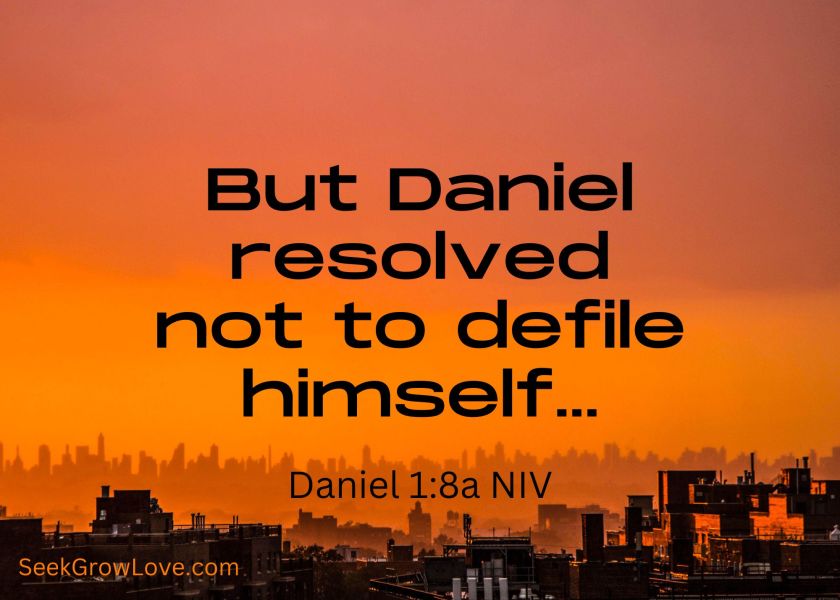
But again, the weight and food was never the real point in the first place. Look back at verse 8, “Daniel resolved that he would not defile himself with the king’s food or with the wine that he drank.” Daniel, as a good Jewish boy, knew that the King’s meat was probably slaughtered in the honor of a god of Babylon (much like the meat in the marketplaces in Greece, see 1 Cor. 10:27) and the wine was probably prepared in much the same way. Daniel’s choice to avoid this food was to honor God. YHWH, the God of Abraham, Isaac and Jacob, would be the only God that Daniel would follow; his law the only commands Daniel would obey, food laws as well as moral laws. Daniel’s obedience is blessed by God. The boys were able to understand the administration of state and Daniel was able to understand dreams and visions from God.
Chapter one is not a weird story about the diet of Jewish kids in a strange land. It is the story of God’s people, God’s Kingdom, clashing against the Kingdom of this world. Daniel and his buddies had a choice to make, to follow the ways of this world’s Empire, to eat the way everyone else ate, to drink what everyone else drank, to *worship* what everyone else worshipped. The choice they made was to follow God even at personal cost and they realized that resulted in blessing they could not have expected.
That is a story worth working to understand.
It’s the story Bob and Larry were trying to tell us all along.
Reflection Questions
- I’ve been a little harsh on “The Daniel Diet,” but it’s not just one diet or fast or book that makes this mistake. In fact, many have tried to take parts of Daniel to make a diet, or used Ezekiel 4:9 as a recipe for bread, without reading down to Ezekiel 4:12. Are you ready to use the Bible as it was intended? To work to interpret God’s word in a way that impacts you, not a small change but to lead a life of difference?
- In light of the first question, are you willing to make the choices that might cost you personally, if it means you remain faithful to God? Are you willing to look different, act different, eat different, vote different, shop different, wear different, **be different** if it means you can be more like Jesus? What strikes you as the first change you can make today that may cost you sounding or appearing cool, just like everyone else, but will make you more like Jesus?
- Are there other sections of scripture (beyond Daniel 1 and Ezekiel 4) where you think we may have missed the point? Talk to your mom, dad, grandparent, pastor, youth pastor, or Sunday School teacher about those ideas. What do they think about those harder sections that seem to be about more than surface level ideas?
Note: The author LOVES VeggieTales. In no way should his words be perceived as mocking or belittling the greatest show about talking vegetables ever made.
-Jake Ballard
 Seek Grow Love