
Old Testament: 1 Chronicles 5 & 6
Poetry: Ecclesiastes 3
New Testament: Philippians 4:5
Chapter 3 of Ecclesiastes begins with a long poetic structure on the nature of time. Verse 1 gives the overall premise and theme of the poem, “For everything there is a season, and a time for every matter under heaven.”
There are SEVEN double pairs in the poem (FOURTEEN pairs total), which likely is meant to represent completeness for all the possible human activities and experiences in life. All the pairings are all polar-merisms, where the two extremes of an activity are mentioned to represent all the various combinations and degrees that can exist between them.
The appropriateness of timing is a major theme in wisdom literature. Timing is everything in life. Wisdom promotes knowing how fitting the timing is for a particular activity. The idea that there is a proper time for everything stems from the premise in wisdom literature that God has created the cosmos in such a way that everything follows an orderly path and timing. So, if creation exhibits orderliness and appropriate timing of events, then wisdom would see that intention as being applied to human decisions and life experience as well.
While God has ordered the cosmos in such a way that it follows distinct patterns and activities, Solomon is not saying that such a mechanistic view of the world is meant to be replicated exactly in human life. The various circumstances described in the poem are not pre-determined to happen in the course of life like a formula or preset timeline.
Interestingly, outside of being born and dying, every other circumstance that is described in the poem is one which a person can respond to when they find themselves encountering that occasion. Throughout the poem, it is difficult to pin down exactly what some of the references actually mean. They are mostly generic and therefore can be applied to a wide range of human situations. Furthermore, it cannot be determined if they are meant to be understood concretely (i.e., literally) or figuratively.
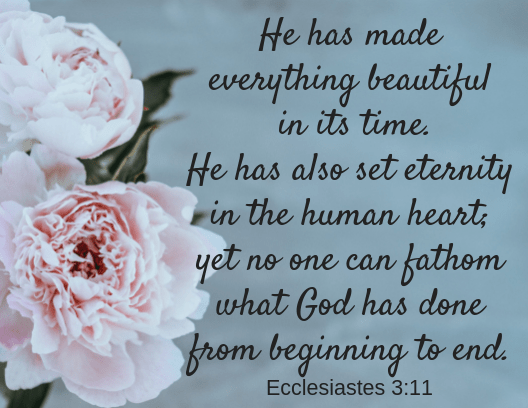
Verse 11 says that God makes “everything appropriate in its time”—what does it mean to be “made appropriate in its time”? This is perhaps one of the most difficult verses in the entire book of Ecclesiastes. It seems that the best way to understand this phrase is to begin with Solomon’s framework of the world in mind where he sees God as the one ultimately in charge in ordering the world. And so, in Solomon’s view, God has structured the world so that everything has its proper time in which everything happens, but the how and when of the appropriateness of the timing is elusive to the human mind. Only God can comprehend how he has made everything to have its own appropriate time.
Along with this complex statement, Solomon says next that God has also “set eternity” in people’s hearts, but not in such a way that they “can find out the work that God has done from the beginning to the end.” What does it mean to “set eternity” in the human heart? The phrase can be taken a couple of different ways, but it seems that the best way to take the phrase is referring to how God has placed a sense of time in the human heart where they are aware of past, present, and future and the duration of events. In a world that is ordered by time, humans can understand “that” there is a time and place in which all events happen, but to grasp the larger picture, to be able to see the whole, escapes the comprehension of humankind.
However, another way to understand this phrase could be that God has placed “a deep-seated desire, a compulsive drive…to know the character, composition, and meaning of the world…and to discern its purpose and destiny.”[1] In essence, God has placed an endless curiosity for understanding and acquiring answers in the human heart. Humans want to know, we crave to know, the answers to the questions we ask. Human beings desire to understand the “beginning” all the way to the “end” in order to control and manipulate it, thereby being able to obtain some profit or gain from their efforts.
But none can be collected. We are not able to discern the plan or pattern that God has set in motion in the world. The intricacies of God’s “work” (why he does what he does) are outside the realm of human investigation (i.e., we can’t find out no matter how hard we search), and therefore, it is beyond human comprehension, and by extension then, human control. And so, while we have “eternity” in our hearts, we are left in a state of bewilderment regarding the mystery of time by which all events happen in life.
What I think we can learn from this is that life is filled with a diversity of experiences and is not something that can be micromanaged. While we can choose how we respond to various circumstances in life, our lives are filled with events that are outside our control. God has ordered the world and life in general in such a way, and we experience life according to that ordering but not in a way that we can understand why everything happens the way it does, when it does. We must trust our lives to God who has infinite wisdom and sees all things. Only he has the “big picture” and knows the end from the beginning. To him be all the glory and praise. Amen.
[1] Walter Kaiser, Ecclesiastes, 66.
-Jerry Wierwille
Reflection Questions
- Where in your own life have you experienced “a time for everything”?
- How do you think God has put eternity in your heart?
- In what ways and understandings is God much much bigger than you?

 Seek Grow Love