
Where Did He Go? (2 Kings 1-3)

Saturday, November 5
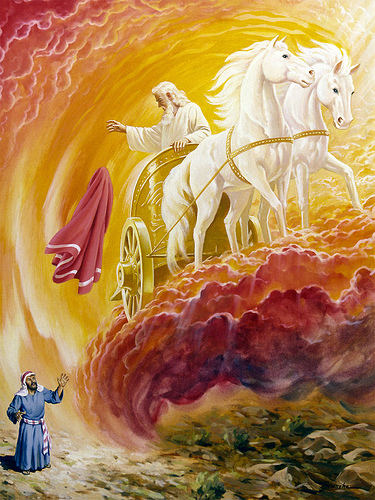
elijah-pic
Melissa New
Texts like II Kings 2 can be a problem for us when we are conversing with our friends or family who are convinced that we will go to heaven when we die. They know that we believe the Bible is the inspired word of God and, therefore, when the Bible states that “the LORD was about to take Elijah up to heaven in a whirlwind” they think this “truth” should be evident to us. It says plainly that Elijah went up to heaven, does it not? The trouble is that when we explain to them that our understanding of the word “heaven” now in modern times is different from the Hebrew word “heaven” as it is used in this Scripture, they sometimes think we are changing the Bible to go along with what we believe. How unfortunate. That verse could very easily have been written in our English language to say, “the LORD was about to take Elijah up into the sky in a whirlwind.”
There are many things that we just don’t know. Like, for instance, where did Elijah go? Where did Enoch go? But those questions don’t really need to be answered. We may be curious, but it really isn’t that important. What is important to know is what happens to us when we die. Our God would not leave this as a mystery. We can take our friends and/or family to Hebrews 11:37…”Some went about wearing skins of sheep and goats, destitute and oppressed and mistreated.” It seems like that verse could very well be speaking of many prophets, including Elijah. The author here says that “they placed their hope in a better life after the resurrection” (11:35) and “none of them received all that God had promised.” (11:39) We can also trust the words of Jesus who said, “No one has ever gone into heaven except the one who came from heaven–the Son of Man.” (John 3:13) It’s almost as if Jesus were trying to make sure this would be clearly understood.


Dealing with Depression (1 Kings 19-20)

Thursday, November 3

66897-still_small_voice7

Melissa New

An important lesson can be garnered from the life of Elijah in chapter 19 of I Kings. If you haven’t dealt with depression yet, there is a good chance you will at some point. Jesus said, “I have told you these things, so that in me you may have peace. In this world you will have trouble. But take heart! I have overcome the world.” (John 16:33) So how do we deal with depression? I believe all the steps are provided for us here…

1. Sleep – Elijah had just been through a pretty significant experience. He challenged the prophets of Baal and God used him in powerful way. On top of that, Elijah then ran mighty fast for about seventeen miles using the “special strength” God gave him! When we are physically drained everything seems worse. And at this point Elijah was ready to die. “Then he lay down and slept under the broom tree.” ( I Kings 19:5)

2. Eat – God knew what Elijah needed. He let Elijah sleep for a bit and then sent an angel with some fresh bread and water. (Food directly from God must taste extra yummy and it was undoubtedly super nutritious too!) Then Elijah slept some more and the angel returned to make sure he ate again so that he would have the strength to keep going.

3. Go to God – The spent and sorrowful prophet headed to Mount Sinai, the mountain of God. He needed some quality time talking to God and he poured out his heart to Him. Elijah was lonely. He felt like he was the only one left who wasn’t worshipping Baal. God, in a gentle whisper, told Elijah that it was time to anoint a new king in Israel and a new prophet to replace himself.

4. Remember you aren’t alone – Elijah wasn’t alone. There was a very good man in Abel-meholah that would become like a son to Elijah. There were “7,000 others in Israel who had never bowed down to Baal or kissed him!” And whatever trials we may face as Christians, we can be assured that we aren’t alone either.

From Bad to Worse (I Kings 16-18)

Wednesday, November 2

1-kings-18-2-best
Melissa New
Israel has already had several bad kings, but now we have Ahab, a man “who did more to provoke the anger of the LORD, the God of Israel, than any of the other kings of Israel before him.” (I Kings 16:33) It’s interesting that when there is great evil going on God provides an example of righteousness. Elijah’s first encounter with King Ahab is to tell him that the God who lives will be making sure there is a lack of dew and rainfall for years. Our God does nothing without reason.
King Ahab and Queen Jezebel were leading the Israelites into worshipping Baal. It’s important to note that Baal was supposed to be a fertility god. Baal was thought to keep the land producing crops and the people producing children. And so Elijah is sent to show Ahab and the people that the living God of Israel provides the water. The mention of the widow from Zarephath, another Baal-worshipping town, is insightful too. When the widow’s son dies, Elijah prays to the living God and “the life of the child returned!” Now who is the God of fertility? Who causes the crops to grow and the children to live?