Jobs for Everyone

1 Chronicles 26-27

Psalm 75

Ephesians 6

-Devotion by Kevin Shull (MN)

1 Chronicles 26-27 are chapters that can be easy to skim past as you are reading through the Bible.  However, hidden within these lists of names and positions, we can gain a glimpse of God’s order.  The Israelites were a nation that were set apart by God.  This can be seen in Leviticus 20:26 and 1 Chronicles 17:21.  What separated Israel from the rest of the nations was God’s Law, which provided the Israelites with the order that they needed to live a holy life.

1 Chronicles 26-27 puts a focus on the specific structure and design that God engineered for the Israelites’ success.  Within these chapters we see how King David is organizing the Levites to serve in the temple.  1 Chronicles 26:1-19 details the divisions of Levitical gatekeepers.  It is specific to their leading men, which gate they are assigned to, and how each watch should run.  26:20-28 focuses on the treasuries of God’s temple, and the individuals responsible for them.  26:29-32 highlights the work of the Levites outside of the temple, who are assigned to be judges and overseers for the tribes of Israel.  Each listing is detailed with their families and locations. 

This is continued in chapter 27, starting with the military.  From verse 1 we learn that the military is to be split into twelve divisions, with 24,000 in each division.  27:2-15 then lists the commanders of these divisions by name for their appropriate division.  In 27:16-22, the heads of tribes of Israel are also listed by name.  The chapter continues in 27:25-31 by listing those who were placed over the king’s various affairs and property.  Finally, 27:32-34 lists the king’s counselors and the commander of the king’s army.

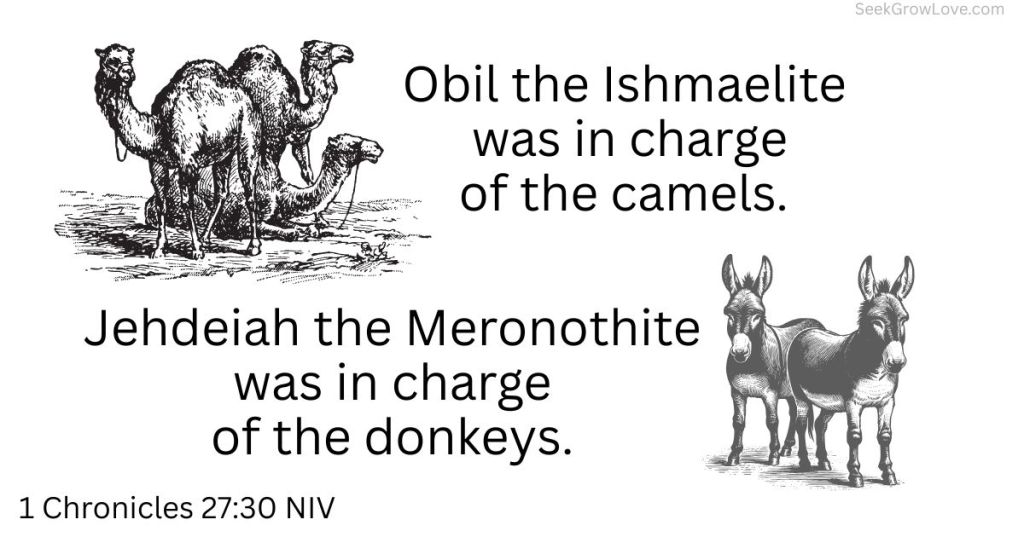
As I was reading through these lists, chapter 27 verse 30 stuck out to me.  “Obil the Ishmaelite was in charge of the camels.  Jehdeiah the Meronothite was in charge of the donkeys.”  In the greater scope of the Bible, I would not think of these as particularly noteworthy roles that would need to be listed.  But in the time of David, both camels and donkeys were vital to the success of the kingdom.  Camels were of key importance for desert transport and trade.  Donkeys were needed for their agricultural work and carrying heavy loads.  While not particularly flashy jobs, both Obil and Jehdeiah’s work was needed within the Israelite nation. 

We can apply these same concepts into our Church today.  The Church needs members in different roles to thrive.  We have all been given unique spiritual gifts for the purpose of serving our church.  1 Peter 4:10, “Each of you should use whatever gift you have received to serve others, as faithful stewards of God’s grace in its various forms.”  Not everyone is called to be a pastor or musician, but we can still find ways to serve.  God has given you gifts to better your church, even if it isn’t always in the flashiest positions.  1 Corinthians 12:21 reminds us that no part of the body of Christ should be looked down upon. “The eye cannot say to the hand, ‘I don’t need you!’ And the head cannot say to the feet, ‘I don’t need you!’”  It is pivotal that we don’t lose faith by neglecting the gifts God has given us.

While 1 Chronicles 26-27 are not the most riveting chapters of the Bible, I believe they are truly just as important.  God had a specific plan for the Israelites’ success, a clear order to ensure prosperity.  Lists like these remind me that God used each of these individuals for a specific purpose, as hard as their names might be to pronounce.  God used these people to orchestrate all the inner workings of complex bureaucracy that was David’s kingdom.  In comparison to a kingdom, imagine how simple our own lives must be to him.  Our God is a God of order, so why do we have such a hard time letting him lead?  I pray that we will be able to let go and follow where God’s plan is taking us.

Reflection Questions

  1. What did you find interesting in the description of the organization of the Levites and David’s kingdom?
  2. Of the jobs listed in 1 Chronicles 26-27, which one(s) would you have applied for if you lived during David’s reign and why?
  3. How has God gifted you for service? What role do you play in the church body? Why does it need to be done? What skills does it require?
  4. Where have you witnessed the God of order at work?

Prayer

Dear God, I thank You for creating the church as a body – not because You need us, but because we need You and we need one another. Help us to serve You well as an active, talented, giving part of the body of Christ.

The Judge

1 Chronicles 24-25

Psalm 75

Ephesians 5

-Devotion by Philip Kirkpatrick (MN & MI)

Judgment: the act or process of forming an opinion or evaluation by discerning and comparing.

Judging people is an inherent thing that everyone does.  In the English definition, at least of the word, it’s not inherently a bad thing to do.  For example, if I walk into my college class on a given day and notice there’s a different group of people, I might jump to a judgment, in this case, that this is not my class.  Or you see something in front of you, it has two arms, two legs, a head, upright, and a human face, you make the judgment automatically that this is, in fact, a human.  These are both judgments you’ve made, and they are
both useful. It’s your brain distilling information into a conclusion that’s easier to work with.

On a larger scale, there are scenarios though, that we are in no place to be the judge of.  In reality, even if we form judgments, we should think them through and not act upon those judgments.  We are told in Matthew as well to be careful of our judgments and not to think too highly of our own judgment. For we have one whose judgment will always be just and always be right. Psalm 75 speaks of this.  God is the ultimate judge, and he will judge without fault.

In many books I’ve read recently, this idea comes across of people making hard choices and having to live with the consequences. Whenever I read this, I am so grateful I am not the hero in those stories, having to make those calls and having to wonder if it was the right call. As the psalmist here does, I also thank God for being the judge. We do not have to worry about some of the hard judgments in life because we serve a God who will make the right judgments every time where we would not. We often thank God for the food he provides, or the home he gives, we should also thank him for this. Thank him for being the ultimate judge who judges with equity.

Reflection Questions

When have you made a false or poor judgment? What was the result? When do you feel you have been judged unfairly by others?

What qualities/characteristics of God make Him the perfect judge? What does God base all His judgments on?

What other things might you be able to thank God for beyond the normal
ones you pray for?

Prayer

Dear Father and Judge – Thank You for Your love and thank You for Your right and just judgments. Please give me a piece of Your wisdom and discernment, Lord. Help me know what is right and what is wrong, what is of You and what is not. Help me to make good choices and speak words that are pleasing to You. Thank You for seeing me through the gift of Your precious Son. In his name I pray. Amen

Anger, Sin, and the Sun

1 Chronicles 22-23

Psalm 74

Ephesians 4

-Devotion by Philip Kirkpatrick (MN & MI)

In Ephesians 4, the second half of the chapter is entitled “The Christian’s Walk,” and it lays down some guidelines for us.  There’s enough there to pull from that you could spend days just going through every sentence and applying it to your life. But there isn’t enough time for that now, so I’ll just focus on one section. Verses 26 and 27 read,

 “Be angry, and yet do not sin; do not let the sun go down on your anger,  and do not give the devil an opportunity.”

Anger can be a sore subject for many; it can lead to decisions and actions that cause divisions between people.  That can be even more of an issue in the church itself.  Yet the verse here highlights an aspect that can always be kept in mind: anger can lead to those actions, but it is not a direct indication that they will happen.  I’m not a psychologist and won’t pretend to be an expert, but anger is a mental reaction to something unpleasant happening, but it is not external.


Healthy expression of anger is something we all can struggle with and it is the unhealthy expression of anger that this verse warns us against.  Everyone has different methods that work well for them. In the end, though, we must all work to not let the anger drive us to sin.  To not let it lead us to those actions that would harm others.  A task easier said than done.

There is another part here to discuss as well, not letting the sun go down on your anger.  This is not saying that you must get all anger out of your system before the sun goes down every day, but rather advising us not to hold on to our anger.  Sometimes it might be easier to let anger sink somewhere where you can’t see it rather than address the cause of that anger.  But we mustn’t let this be the case; you’re not resolving the issue, just pushing it off and potentially making it worse.  Not that I’m saying you should hash it all the way out right away, that is situational, and if you’re not sure, asking someone wise who is disconnected from the situation can be useful.

Letting anger rule your actions is hazardous to you and everyone around you.  Don’t let it lead you into sin, into those terrible situations.  Today, I pray you can watch for the next time that anger might come about and not let it lead to sin, and resolve the conflict in a way that doesn’t leave the anger to fester.

Discussion Questions

At what times in your day do you often see your anger taking hold and leading to bad decisions?

Is there a recent time you might have gotten angry at someone? How could you go about letting that anger go?

What does the Bible teach us about God’s anger? In what ways could you work towards handling your anger in a godly manner?

Prayer

Dear God, I praise You for Your righteousness and love. Thank You for being a God who is slow to anger. Help me to learn from You, Your Son, and the words You have given in Your Word. Help me to be more patient with people and situations and when my anger does rise, help me to deal with it well, in healthy ways that do not lead to sin. In my anger and in my life help me stand strong against the devil and his schemes. In Your victorious Son’s name I pray. Amen

The Last of the Rephaim

1 Chronicles 20-21

Psalm 74

Ephesians 3

~ Devotion by Cayce Fletcher (SC)

Cayce Fletcher is a wife and homeschool mom of three. She writes and podcasts at amorebeautifullifecollective.com where she helps women grow in grace, build with purpose, and live beautifully. Read the latest post in the Systematic Theology series here

“Okay, everyone, here’s your order of service,” I said, as I started passing around the papers with handwritten songs and Bible lessons scribbled across the top. After running through announcements and singing a few worship songs led by my brothers, I gathered up my cousins and headed behind our podium (some bar stools with a blanket draped across the top). 

Up popped a little stuffed Beanie Baby chihuahua who exclaimed that he was David, ready to fight Goliath. On cue, someone lifted up our 10 lb (real-life) chihuahua, Max, who played his part well as he scoffed at the little David below. When the pretend slingshot hit its target, the beach condo living room cheered. The enemy was vanquished! The giant slain! God and his people were victorious! 

Many years have passed since that Sunday morning on vacation, but the story of David and Goliath captures my imagination just the same. Sometimes, we may be tempted to read the story (found in 1 Samuel 17) and assume that this guy, Goliath, just came out of nowhere. Or, we may think he is just the product of exaggeration. Giants didn’t really exist, did they? 

That’s a complicated question, but it is made even more mysterious when we place it against the backdrop of today’s reading. In 1 Chronicles 20:4-8, we read about the Philistines, along with descendants of the giants who had come to fight David. Three battles ensued – one of which was against the brother of Goliath, whose spear was like a weaver’s beam (thicker and about 5 ft long). In each of these battles, David and his men were victorious.

Importantly, these weren’t random large men who were intent on picking a fight with David. We are told they are the descendants of the Rephaim. Who are the Rephaim? One of the first mentions is back in Genesis 14 when a king that Abraham would eventually defeat first defeated a group of Rephaites. 

We read another mention of them in Deuteronomy 2-3. In this passage, the Israelites defeat Og, the king of Bashan, who is described as the last of the Raphaites. His bed is described as 14 feet long and 6 feet wide. 

We know that the spies described Canaan as a land of giants in Numbers 13. (These are the Anakim, or the descendants of the Anak.) Joshua fought these giants in Joshua 11 and destroyed almost all of them, but a few escaped and took refuge in Philistine cities. 

That brings us to today’s reading. For hundreds of years, the Israelites fought against these giants; finally, during David’s time, the giants were actually defeated. We aren’t quite sure where these giants came from (though there’s plenty of lore behind that you can research yourself). What we do know is that after David’s reign, we do not hear about giants again. 

We don’t see giants today, but the echoes of what David accomplished during his reign can be found in our lives today. Later Jewish writings started using the term Rephaim to refer to shades (or the people who were dead in Sheol, the grave). David defeated physical giants, but what he did foreshadows what Christ has done on the cross: The giants of sin and death are defeated. We are victorious! 

Hallelujah! Amen! 

Reflection Questions

  1. Where do you think these giants came from in the Old Testament? Do you believe that it is significant that they keep popping up throughout the first half of the Old Testament? 
  2. We’ve read about David has his mighty acts in battle. How did David have the courage to face down these giants? What do you learn from that? 
  3. What giants are you facing? How does this passage encourage you to stand your ground and fight? 

Prayer

Lord, 

Thank you for the battle that has already been won! Thank you for the victory against the giants of sin and death. Please strengthen me in my walk. Help me to be courageous as we stand and fight! 

In Jesus’ name,

Amen.

SGL.2026.CalendarDownload

Peace with God through Christ

1 Chronicles 18-19

Psalm 73

Ephesians 2

~ Devotion by Cayce Fletcher (SC)

Cayce Fletcher is a wife and homeschool mom of three. She writes and podcasts at amorebeautifullifecollective.com where she helps women grow in grace, build with purpose, and live beautifully. Read the latest post in the Systematic Theology series here

My brothers were older when I was born, so apart from occasionally being hit on the head with a basketball and called dumb when I teased them about girls, I didn’t live through the brunt of a boy’s household. With the birth of my oldest, however, I have been immersed in all things monster truck, dinos, and tractors—Minecraft, sports, and construction. The highlight of his day – no matter what I do – is to play ‘dinos’ with his dad, which really just means wrestling for 15 minutes. 

When his cousins are over, he loves to play ‘battle,’ and he’ll tell me sometimes of the preparations he’s making in his room for when the next war erupts between the girls and the boys. (It really is comical to watch the boys find wherever they can in the house to hit each other, while the girls play ‘kids’ and rock their little stuffed animals to sleep.) 

Today, we read of the battles that David waged against the neighboring nations. David is described in 1 Samuel 16:18 as someone “who knows how to play the lyre. He is a brave man and a warrior. He speaks well and is a fine-looking man. And the Lord is with him.” We just get a glimpse of these exploits today in our readings from 1 Chronicles. In 1 Chronicles 18:6b says, “The Lord made David victorious wherever he went.” 

David was continuing the work that the first Israelites who entered the promised land were called to do. He was conquering the land for the Lord and ridding it of the influence of the Canaanites. 

Interestingly, later on, one of the reasons that God gave David for not being able to build the temple is the fact that he is a warrior. 1 Chronicles 28:3 says, “but God said to me, ‘You are not to build a house for my name because you are a man of war and have shed blood.’” 

David followed God’s command to conquer the land, but in doing so, he was also limited in what he was able to do. In obedience, he had to let the dream of building the temple pass to his son. He used the time he reigned to help gather and prepare so that Solomon would have what he needed to build the temple. 

Solomon, whose name means peace (it is derived from the Hebrew word Shalom), would go on to build the temple. In his reign, the Israelites experienced unprecedented peace and prosperity. 

I find it interesting to think about the battles that David faced (and the foreshadowing of the peace of Solomon’s reign) as we consider Ephesians 2. This chapter lays out the gospel in its full glory. Ephesians 2:14 says, “For he is our peace, who made both groups one and tore down the dividing wall of hostility.”

In the gospel, we recognize our original place before God – as someone removed from him, hostile to him, and dead in sin. And, we also recognize our way to peace: Through Christ, the hostility between God and us is torn down. 

In David’s time, the enemy was the surrounding nations, but we know that our enemy is not against flesh and blood (Eph. 6:12). David had to wage war, and victory against the enemy was only accomplished through bloodshed. We have victory in Christ (1 Corinthians 15:57)! The battle is already won. David could not build a temple but had to wait for peace in this world. Our peace is not tied to any physical circumstance; it rests on the peace we already have in Christ. 

“Thanks be to God! He gives us the victory in Christ!” 

Reflection Questions

  1. Why do you think that God told David he was not able to build the temple? Why did the temple need to be constructed by a man of peace, not war? 
  2. If the Israelites were battling against surrounding nations, what are we battling against now? How does this change how we live? 

Prayer

Lord, 

Thank you for the gift of your son! We praise you and are so thankful that we have peace with you in Christ! Help us to fight the battles we are called to against sin and darkness in the world – knowing that you have the victory in Christ! 

In Jesus’ name,

Amen.

SGL.2026.CalendarDownload

The Legacy of Asaph

1 Chronicles 16-17

Psalm 73

Ephesians 1

~ Devotion by Cayce Fletcher (SC)

Cayce Fletcher is a wife and homeschool mom of three. She writes and podcasts at amorebeautifullifecollective.com where she helps women grow in grace, build with purpose, and live beautifully. Read the latest post in the Systematic Theology series here

We’ve talked about legacy this week as the sum total of our life and our work. Another way we describe legacy is the way that work, skills, and even ministry are passed down through generations. 

My family was not a sports family (I don’t think I can emphasize that enough). Even though my dad was about 6’3” and played basketball in high school, none of my siblings really inherited the sports gene. My husband, however, is a football (and golf) fan, and I have learned more than I ever really wanted to know watching Sunday Ticket on lazy fall afternoons. 

Football and sports are a skill legacy passed down, with the Mannings a notable example. In the world of Golf, I remember watching one pre-Masters tournament when Jack Nicklaus’ grandson shot a hole-in-one during the pre-tournament ‘family’ round. It’s a legacy.

I did not inherit the ‘sports’ gene from my father, but I did inherit – and was encouraged to pursue – the music gene. We took piano lessons from a young age from Miss Alma Carter, who served up Cokes in the bottle and let us watch SpongeBob in her sun porch as we waited for the lessons to start. We were in every church program and cantata. And, we learned the VBS songs before anyone else so that our mom could lead the music when it started each summer. 

The legacy that started with my grandmother singing folksy Appalachian hymns on the local radio has continued to me singing harmony on Sunday mornings during worship. 

We often think of spiritual disciplines in terms of words. We read the Bible, we pray, and we journal. But a crucial spiritual discipline is worship. Worship gets us out of our heads and gets us focused on God. It is something that we do on our own, but we love to do in a group. There is such a special moment when you pause and listen to everyone singing in a song. The sound is a picture of the church – individual notes combined together to meld into something beautiful and transcendent. 

Music has always been a central part of how we interact with God. When we learn more about God, we are moved to worship him. When the ark returned to Jerusalem, David was immediately moved to celebrate. He offered sacrifices and then called some Levites “to be ministers before the ark of the Lord, to celebrate the Lord God of Israel, and to give thanks and praise to him” (1 Chronicles 16:4). 

The chief minister of musicians was named Asaph. He was a Levite who was a skilled musician and also described as a seer (or prophet) (2 Chron. 29:30). 1 Chronicles 9:33-34 describes how these musicians “stayed in the temple chambers and were exempt from other tasks because they were on duty day and night.” 

What may seem like a trivial detail about the daily routines of temple life actually speaks to something incredibly important: Worship was so important to the Jewish people that they had a dedicated team of people whose only duty was to sing to God. It wasn’t just something tacked onto a worship service to ‘spice it up.’ It was crucial. Someone was on duty day and night, worshipping before God. 

GotQuestions makes an important point: “The church musicians of our day can be considered spiritual ‘children of Asaph.’” Anyone who sings psalms, hymns, and spiritual songs (which should be all of us) is part of the legacy of Asaph. We walk in his footsteps as we minister before the Lord. Worship is not just ‘filler’ to add to a service; it is how we glorify God and testify to who he is. 

As you read through Psalm 73, you are walking in the footsteps of your spiritual great(+)-grandfather worshipping our great God and singing of the good he has done for us. 

Reflection Questions

  1. Have you ever thought about how important worship is for our spiritual life? Why is it important? How does worship change our hearts? 
  2. Why do you think one of David’s first acts when the ark arrived was to worship with singing? 
  3. Some of us may not feel musically inclined. Why should we still make a point to participate in worship? 

Prayer

Lord, 

Thank you for the gift of worship. Thank you for the gift of music, songs, and harmony. Lord, we praise you!

In Jesus’ name,

Amen.

SGL.2026.CalendarDownload

The Burdens We Carry

1 Chronicles 14-15

Psalm 72

Galatians 6

~ Devotion by Cayce Fletcher (SC)

Cayce Fletcher is a wife and homeschool mom of three. She writes and podcasts at amorebeautifullifecollective.com where she helps women grow in grace, build with purpose, and live beautifully. Read the latest post in the Systematic Theology series here

I was recently tasked with an errand by my husband. I was to go to the store and return to silt screens (big tarps with pickets attached to help with run-off on construction sites). When I pulled up to the store, I noticed there were no carts nearby, so I tried – with my three-year-old daughter in tow – to somehow lift the two rolls while she hung onto my shirt. (Any moms reading this probably are nodding their heads. You’ve done something similar.) 

As we walked through the parking lot, I could feel the plastic start to slip down, and white-knuckling it, I tried to maneuver the tarps to the side to lift it back up without stopping in the middle of the road. About that time, a guy walked up with his wife and child, looked over, and immediately said, “Hey, do you need help with that?” Laughing, I responded that help would be great. 

No matter who you are, this truth applies to you: We are all limited by our bodies. As parents with more than two children like to say, you only have two hands. We can only lift so much, and even the strongest person in the world has a limit to their ability. (If you are wondering, that title goes to Hafþór Júlíus Björnsson, who deadlifted 1,124 lbs(!).) We can only carry so much. 

Today’s readings dealt with the idea of carrying burdens. In 1 Chronicles 14-15, we read the second part of the ark’s journey back to Jerusalem. After Uzzah died when the men tried to return the ark on a cart, David left the ark at a man’s house. In 1 Chronicles 15, David had done his research, and this time, he brought Levites who would carry the ark in the proper way back to Jerusalem. 

Exodus 25:10-22 describes the way that the ark was meant to be carried – the ark was to be lifted up on poles. According to BibleHub, “The method of carrying the Ark on poles symbolizes the separation between the divine and the human, emphasizing God’s holiness and the need for reverence in worship. It also signifies the role of the Levites as mediators between God and the people, entrusted with the sacred duty of handling holy objects.”

Carrying the ark was the burden of the Israelites – one they could not shirk without dire circumstances. 

In Galatians 6, we read more about burdens, but in this passage, we read about our own burdens as the new royal priesthood. After Paul lays out the freedom we find in Christ in the first half of Galatians, he then moves to encourage the people ‘to not bite and devour one another’ (Gal. 5:15) and instead produce fruit in keeping with the Spirit (Gal. 5:22-23). 

In Galatians 6, he turns his focus from our own individual spiritual growth to how we can support each other in overcoming sin. In Galatians 6:2, we read, “Carry one another’s burdens; in this way you will fulfill the law of Christ.” The Enduring Word Commentary explains it like this, “When Paul brought up the idea [in verse 1] of the one overtaken in any trespass, it painted the picture of a person sagging under a heavy load. Here he expanded the idea to encourage every Christian to bear one another’s burdens.”

We don’t bear the weight as the Levites did of the ark. We are not the mediator between God and the people. But, we can lift each other up – just as the Levites lifted up the ark – towards God. When we come alongside each other and support one another in our spiritual growth, we are doing the good work we are called to do (verse 9-10). 

Interestingly, right after this passage, we have a seeming contradiction in verse 5 when Paul seems to say that each person will have to carry their own load. 

Some commentators say that this is due to the differences in translation. Load, in verse 2, comes from a word that emphasizes the heaviness of the burden. It paints the burden as excessive, something you would stumble under. Whereas in verse 5, load or burden is a word that comes from the word for a backpack a soldier would have. Verse 5 is in reference to loads that other people cannot carry for us (think: calling, marriage, family, etc.). 

Other commentators say that this is actually a counter-example. Verse 2 is the optimal, Spirit-led response to burdens: We should bear each other’s burdens. However, if we want to respond ‘in the flesh’, we may try to think of ourselves as more highly than we ought. We take pride in ourselves alone and are responsible for our own work. Thus, we have to shoulder our own burdens. 

Verse 9-10 sum up our work and should be our motto as we do ministry: “Let us not get tired of doing good, for we will reap at the proper time if we don’t give up. Therefore, as we have opportunity, let us work for the good of all, especially for those who belong to the household of faith.” Amen!

Reflection Questions

  1. Why do you believe the ark had to be carried in this way? What does it symbolize?
  2. What do you think is the most likely interpretation of Galatians 6:2-5? 
  3. What is a burden you could share with others? And, what is a burden someone has that you can help bear?

Prayer

Lord, 

Please help us to be a people who support one another, not bite and devour one another. Help us to lift each other up to you. Let us not grow weary of doing good. 

In Jesus’ name,

Amen.

SGL.2026.CalendarDownload

The Shepherd King of Israel

1Chronicles 10-11 

Psalm 72

Galatians 5

~ Devotion by Cayce Fletcher (SC)

Cayce Fletcher is a wife and homeschool mom of three. She writes and podcasts at amorebeautifullifecollective.com where she helps women grow in grace, build with purpose, and live beautifully. Read the latest post in the Systematic Theology series here

I live on family land, and over the years, there have been several different kinds of livestock that we’ve had ‘out to pasture.’ Cows, goats, and chickens all have their challenges, but what they all will do, when given a chance, is escape. 

Several years ago, before we moved back to the Farm (as we call it), we got home after a long week at Southeast Camp only to find that the cows had escaped the fence and were busy eating up the vegetable garden and walking on the flowers in the yard. We had to shepherd them back into the fence. 

Israel often follows the same path. In the story of Israel, we see their propensity for ‘escape’ – or their ability to wander off the good path of God and pursue their own desires. They desperately needed a shepherd to care for them. God was their shepherd king, but in the time of Samuel, they rejected him. David stepped in to care for the people as the kingdom was handed to him. 

What did the shepherd king do for his people? 

The shepherd king guided them to green pastures. 

The shepherd king needed to bring the people to good pastures. That means he needed to guide the people to the place where they would get life – and that place is in God’s presence. David recognized the importance of bringing people to God. 1 Chronicles 13:3, “Then let’s bring back the ark of our God, for we did not inquire of him in Saul’s days.” 

During the time of the judges and Saul, the Israelites did not have a close relationship with God. As king, he could bring the people to God and show them how good God was. This is why bringing the ark back was one of his first actions as king. 

The shepherd king protected them from harm. 

David was a man of war. This was one way that David used his unique abilities in obedience to God. The people had not fully conquered the land in the time of Joshua. David continued this work during his time as king. 

In 1 Samuel 17:34-36, he describes what a shepherd does: “David answered Saul, “Your servant has been tending his father’s sheep. Whenever a lion or a bear came and carried off a lamb from the flock, I went after it, struck it down, and rescued the lamb from its mouth. If it reared up against me, I would grab it by its fur, strike it down, and kill it. 36 Your servant has killed lions and bears; this uncircumcised Philistine will be like one of them, for he has defied the armies of the living God.”

The shepherd had to protect his flock from dangerous animals. The shepherd king had to protect his people from the surrounding nations and influences that would harm the people and lead them away from God. 

The shepherd king watched out for the weakest in the flock. 

1 Chronicles 12 describes the people who came to support David when he was on the run from Saul. 1 Samuel 22:2 gives more insight into who they were when it says, “All those who were in distress or in debt or discontented gathered around him, and he became their commander. About four hundred men were with him.” 

David looked out for the outcast, the ‘weak links’, the poor. He took them in and led them in such a way that they turned into the mighty men we read about in 1 Chronicles 11-12. They were men of valor with such jaw-dropping military exploits that we can’t really comprehend them today. 

In Psalm 72, we read about a prayer for this shepherd king. Verses 12-14 say, “12 For he will rescue the poor who cry out and the afflicted who have no helper. He will have pity on the poor and helpless and save the lives of the poor. He will redeem them from oppression and violence,

for their lives are precious in his sight.”

The shepherd king sees with the people the eyes of God. Each one is precious in his sight. 

Every person who leads someone else has to step into the role of shepherd. That is why we call ‘pastors’ pastors – it is a word derived from the Latin pastor, which means shepherd. When we shepherd others, we don’t do it for our own glory, but to bring people to glorify God. The ultimate example of this type of shepherd is Jesus – the perfect fulfillment of the shepherd king. 

May we humbly follow his example! 

Reflection Questions

  1. Why do you think that the shepherd imagery is so strong throughout the scriptures? What can we learn from this today? 
  2. Who has been a ‘shepherd’ in your life, leading you to God? 
  3. How can you be a better shepherd to others? 

Prayer

Lord, 

Help me to guide other people to you through my words and deeds. Please bless the shepherds around me. Strengthen them for the task at hand. May we approach all things with humility and dependence on you. 

In Jesus’ name,

Amen.

SGL.2026.CalendarDownload

The Tragedy of Saul, the first King of Israel

1 Chronicles 10-11 

Psalm 71

Galatians 4

~ Devotion by Cayce Fletcher (SC)

Cayce Fletcher is a wife and homeschool mom of three. She writes and podcasts at amorebeautifullifecollective.com where she helps women grow in grace, build with purpose, and live beautifully. Read the latest post in the Systematic Theology series here

Last week, as I was working on writing our summer camp journals, I turned on David for my kids to watch. It was the first time that I had seen the movie myself, but with The Prince of Egypt being one of my favorite movies as a kid, I had high expectations. 

Of course, there were things that I wish they had done differently, but overall, I was pleasantly surprised. I so appreciated how they didn’t just stop at the Sunday School version of David’s life (just covering the story of David and Goliath), but instead told his story up until he received the kingship after Saul’s death. 

Saul is such a tragic figure. He was so earnest in the beginning. If you remember in 1 Samuel 9, when Saul was first anointed, he responded to the kingship with humility. In verse 21, Saul responds to Samuel, “But am I not a Benjamite, from the smallest tribe of Israel, and is not my clan the least of all the clans of the tribe of Benjamin? Why do you say such a thing to me?” 

As the years went on, this humility began to wane, and it was replaced by pride and self-focus. He is so scared to lose the kingdom, to do something wrong, that he ultimately loses it anyway. In Saul’s story, we see an example of someone who holds the ‘good’ so tightly that it becomes an enemy of the ‘great’ – a deep relationship with and dependence on God.

Over and over, Saul chooses to do ‘little sins’ in order to bring honor and fame to himself. He tries to manipulate the outcomes of battles. He’s willing to kill Jonathan (multiple times). He tries to keep the spoils of war and hides them from Samuel. By the end, he even turns to witchcraft to get answers because he feels like God has left him. 

Like Macbeth and other power-hungry characters, Saul’s downfall was his lack of awareness that God can just as easily take away the responsibilities that he gave if the holder is found lacking. If Saul had depended on God completely, we would have read a different ending to his story than what we read today in 1 Chronicles 10. 

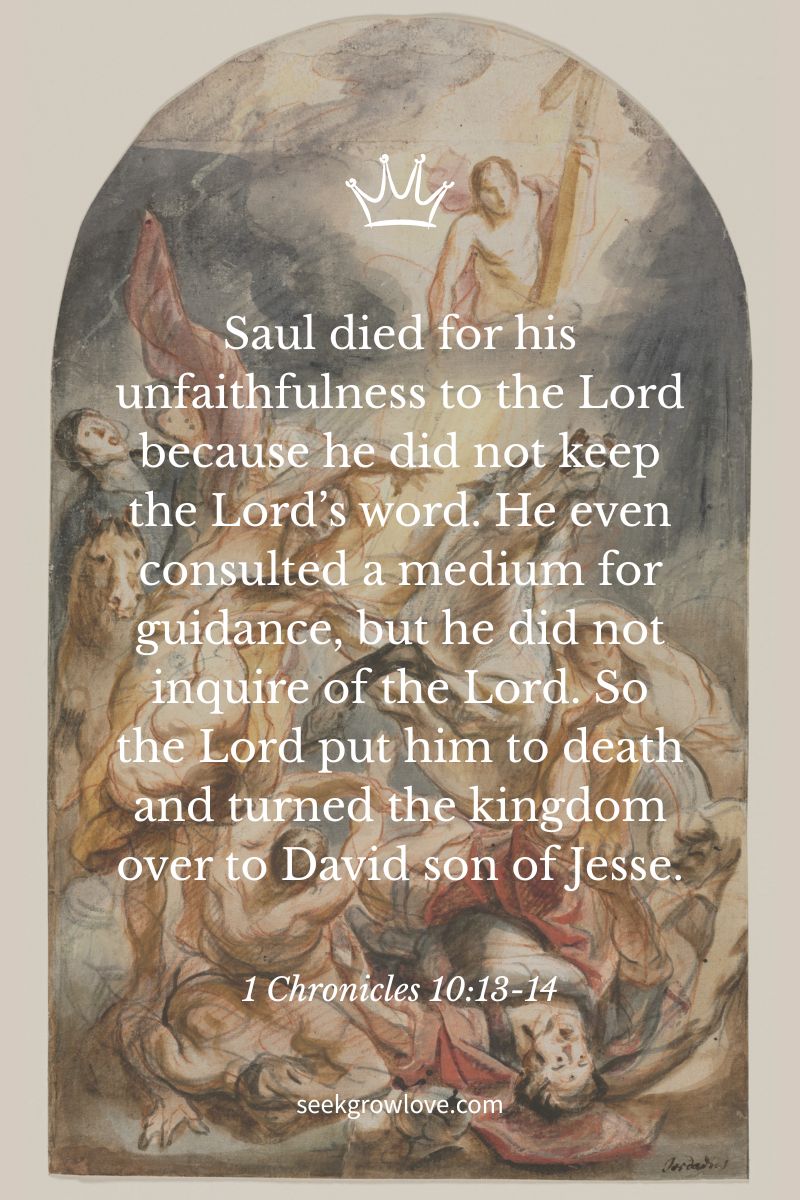
1 Chronicles 10:13-14 sums up Saul’s life: “Saul died for his unfaithfulness to the Lord because he did not keep the Lord’s word. He even consulted a medium for guidance, but he did not inquire of the Lord. So the Lord put him to death and turned the kingdom over to David, son of Jesse.”

The tragedy of Saul affected more than just him. All of his sons fell in the doomed battle against the Philistines – an entire house extinguished. 

Writing this just after Father’s Day, this makes me think about the responsibility we have as leaders. Saul was so concerned with his own pride and recognition that he ultimately sacrificed not only himself but also his family on that altar. As a leader of the people, we were supposed to steadfastly point them to God. Instead, he foolishly acted in ways that ‘seemed right in his own eyes’ but were contrary to God’s law. 

Wherever you are leading – whether in your own homes, your church, or your community – you have a great responsibility to be steadfast. You cannot fall prey to the temptation of allowing the lines between right and wrong to blur in the service of your own desires. You cannot hold the good you feel like you deserve too tightly, ultimately rejecting wholehearted obedience to God. 

Saul’s life is a reminder to look at our own lives and the gravity of our actions. How are they measuring up? May our lives always be characterized by faithfulness, not unfaithfulness like Saul. 

Reflection Questions

  1. Saul’s life is a tragedy, and tragedy is often characterized by a central character flaw that leads to their doom. What do you think is the core sin of Saul’s life? 
  2. As Saul began to grow in influence and power, that tainted his relationship with God. How do you handle influence rightly so that it brings glory to God – not yourself? 
  3. When we think of Saul, we often think of Saul the King, not Saul the Father. How did Saul’s actions affect his family? What lessons can we learn from this about parenting?

Prayer

Lord, 

Help me hold my responsibilities rightly so that they bring glory to you. May I not fall prey to the dangers of pride, but instead lead with humility. Help me to guide those who are following after me to a better relationship with you. 

In Jesus’ name,

Amen.

SGL.2026.CalendarDownload

Faithfulness in Every Season of Life

1 Chronicles 7-9 

Psalm 71

Galatians 3

~ Devotion by Cayce Fletcher (SC)

Cayce Fletcher is a wife and homeschool mom of three. She writes and podcasts at amorebeautifullifecollective.com where she helps women grow in grace, build with purpose, and live beautifully. Read the latest post in the Systematic Theology series here

My family always loved musicals, like Hello Dolly, The Wizard of Oz, and of course, the Disney classics. One special favorite was Fiddler on the Roof, and sometimes, we couldn’t help but jump up and dance around the room when a few of the songs came on. 

One of the most famous songs from that movie came to mind when I was reading through today’s passages. The parents are preparing for their children’s marriages, and while they were watching the processional, they sang the following words: 

“Sunrise, sunset

Sunrise, sunset

Swiftly flow the days

Seedlings turn overnight to sunflowers

Blossoming even as we gaze

Sunrise, sunset

Sunrise, sunset

Swiftly fly the years

One season following another

Laden with happiness and tears”

Psalm 71, an anonymous Psalm (but potentially written by King David during Absalom’s rebellion), speaks of a similar sentiment. Only this writer is not focusing on the fleetingness of life, but on how God is there for us in every stage of our lives. 

He speaks of his childhood in verse 6 when he says, “I have leaned on you from birth; you took me from my mother’s womb.” About the present, he says in verse 17, “God, you have taught me from my youth, and I still proclaim your wondrous works.”  As he looks forward to the future, he says in verse 18, “Even while I am old and gray, God, do not abandon me, while I proclaim your power to another generation, your strength to all who are to come.

We see the psalmist’s faithfulness to God in the past, present, and future. From ‘sunrise to sunset’, they are leaning on God. Their commitment to God compounds, multiplying as the generations continue to us, who are reading their words today. 

I’ve come to realize that a legacy is made like a chain. When we are strong in our faith and commitment to God, we create a strong link. We are tied to the people that come before us and the future generations that come after us. Time is fleeting, but we can create a lasting impact with our lives when we choose faithfulness in our daily lives. 

What does this look like? We actually see an example nestled in the genealogies we read today. In 1 Chronicles 9, the chronicler notes what happened during the Babylonian exile. When the Israelites returned, one of their primary objectives was to rebuild the temple and begin temple worship – something they had deeply missed during their years in exile. 

In verses 3-21, the priests, Levites, and temple workers were listed. Verse 13 describes them as “capable men employed in the ministry of God’s temple.” According the Enduring Word commentary, “this same phrase is translated mighty men of valor in many other Old Testament passages (Joshua 1:14, Judges 6:12, 1 Samuel 16:18, and many others). It shows that when it came to doing the work of the service of the house of God, it takes a man of strength and courage, the same qualities that are needed in a warrior.” 

Each group was on duty, day and night, guarding the temple, caring for the temple, baking bread, and making music. They all had their own jobs based on gifting and tradition, but they all fulfilled them to the best of their ability, to the glory of God. 

Interestingly, the ‘mighty men of valour’ is not the only callback to the past. Verse 22 references how David and Samuel had instituted the temple worship with these groups, and verse 20 takes it back even further to Phinehas, Aaron’s son. We see how the legacy of the temple workers was created in the past and carried forward for hundreds of years. 

The key to this faithful legacy is found in verse 20. It says that the Lord was with Phinehas. Psalm 71 reiterates this. In his prayers, the psalmist says that God has been with him every step of the way, through trials and through rejoicing. We place our trust in God, we live our lives faithfully, and like the psalmist, God’s great works in our lives brings us to “tell about your righteousness and your salvation all day long, though I cannot sum them up” (Ps. 71:15). 

Reflection Questions

  1. It is a beautiful truth to remember that God will be with us in the past, present, and future. What is one moment that you can point to recently that is evidence of God’s faithfulness? 
  2. Why was the reinstatement of temple worship so important for the returning Jews? 
  3. What can we learn from the description of the temple workers? 

Prayer

Lord, 

Thank you so much for how you have been with me since I was a young girl. Please continue to be with me as I live and work. May all I do bring glory to you. 

In Jesus’ name,

Amen.

SGL.2026.CalendarDownload