Don’t Let Anyone Deceive You

Old Testament: 2 Chronicles 6 & 7

Poetry: Psalm 2

New Testament: 2 Thessalonians 2

     2 Thessalonians 2 is one of those chapters of scripture that can make us wonder why it was written. Did the people receive a false “spirit or a message or a letter as if from [Paul], to the effect that the day of the Lord” had already come (2)? And if they received such a communication about the day of the Lord, what was its purpose? Was the idea just to plant doubts and create turmoil? Did it achieve anything more than getting the people to check in with Paul?

     Maybe someone tailored a piece of misdirection based off Paul’s words in 1 Thessalonians 5:2, that the day of the Lord would come like “a thief in the night,” to suggest that the day was able to arrive and pass without people becoming aware of it. Such an idea would not fit well with the overall uses of the “day of the Lord” in the Bible, as Paul pointed out in 2 Thessalonians 1:10 speaking of “that day”, but we don’t know how the Thessalonians thought of the phrase before Paul wrote this letter. In 2:1 Paul linked “the coming of our Lord Jesus Christ” with “our gathering together to Him” before he addressed the idea of false communication about the day of the Lord. Perhaps the point of whatever deceiving message the people received was an attempt to separate the day of the Lord from one or both of those ideas in their thoughts.

     Returning to the “thief” metaphor for a moment, any metaphor or parable generally has only one application to be made from it, and can easily be misunderstood by being overapplied. The “thief” metaphor came from Jesus’ words, and it emphasized diligence (Matthew 24:43, see through chapter 25). Jesus didn’t apply any risks of the metaphor to those who were faithful. We do not know when Jesus is coming, but as believers we will not be left floundering when the world changes because of his return – the believers will join with him in celebration.

     Paul has a much plainer case to make than the implications of a metaphor, however, he points out that he already told the church that those who are alive when Jesus is just about to return will have seen signs before his coming. As part of this Paul describes a man engaged in a campaign of evil on behalf of Satan. Paul may seem to write of this remarkably calmly, though admittedly it can be difficult to read tone into written words. And, of course, we don’t know what the Thessalonians had imagined their situation was based on the “spirit” or “message” or “letter” Paul wrote of – he needed to clear things up. We do know that the circumstances Paul is describing will be extreme, and he mentions that he spoke about these things with them in person (v. 5), so he may have previously offered comforting words about the potential of living during this situation. In any case Paul leaves no doubt of who is more powerful, the man of lawlessness, or Jesus. Jesus will slay him by his mere breath (maybe a spoken word?) – it is not a contest. The call to the believers is to stand firm, and having received eternal comfort, and good hope by grace, to desire also to be strengthened in their hearts in every good work and word.

     On the other hand, the situation will be extreme for those who have rejected the truth. They will receive a “deluding influence so that they will believe what is false, in order that they all may be judged who did not believe the truth, but took pleasure in wickedness” (11‑12). This is not the situation of those we are trying to reach with an understanding of God’s love, history will have moved beyond that. It will be like what we read about in Exodus, when God hardened Pharaoh’s heart so He could show His signs and wonders in Egypt at the time of the ten plagues (4:21; 7:3). Pharaoh abandoned good behavior well before Moses arrived, but if shown enough miracles he might have been swayed from his course, even if only temporarily. God wanted a clear-cut setting in which to show His power. God intended to punish Egypt. It seems that things will go similarly with the man of lawlessness and his followers at the end of this age. It would be hard for anyone to remain loyal to such an evil leader and not try to weasel their way into compromises, even if just into other forms of evil, after God’s judgment is made clear. But by that point in history God wants a clear-cut setting to show His judgment. (I admit to finding some of this a bit distressing, but Paul had seen more of the evils of the world than I have, so I can understand if he was able to have a more clear-eyed view about it than I as he wrote about it.)

Lord, thank you for your strength, and that I feel able to put my trust in you no matter what situation I arrive in, even if I were to be living during the reign of the man of lawlessness. You are far greater than he. Your son is far greater than he. I trust that your love and your mercy will be comfort to me whatever may come. To whoever of your servants do live in that time, please let them have great outpourings of your grace and confidence from your Spirit. Life is not painless, but life is worthwhile when lived for you. Thank you, Lord. Amen.

-Daniel Smead

Reflection Questions

  1. Do you think the origins of 2 Thessalonians 2 might be from a prank? Or perhaps did it result from a serious attempt to damage a church’s faith where it seemed to be vulnerable? It has been said that it is normally easier to tear down than to build up. What is the best way you have experienced that a church has been built up? How can you visualize being part of building a church up?
  2. How surprising is it to you that Paul needed to write two letters to the church in Thessalonica, perhaps in the same year, based on their confusion about issues of eschatology? What might have happened if these issues went uncorrected? How much have you studied and compared scriptures about the future to develop your grasp on these ideas if you wanted to discuss them? How deeply do you choose to investigate these matters for yourself, compared to where you stop, considering that if you wished to examine the issue further you would take a question to a “Paul”?
  3. Do you find it hard to imagine a time when there will be no room for shifting between those who are fully committed to evil and those who serve God with their whole hearts? If you thought such a time was coming soon, are there things you would be doing today to prepare?


What’s in Your Future?

Old Testament: 2 Chronicles 3-5

Poetry: Psalm 1

New Testament: 2 Thessalonians 1

     Yesterday we read some of Paul’s words about the future, along with his instructions about preparing for the future through good conduct. In 2 Thessalonians 1 Paul chose to say more about coming events to the same audience. (Your Bible may have notes suggesting that only four to six months passed between the two letters.) Paul remains proud of the people’s conduct, and again mentions their shared status with him as persecuted believers (1 Thessalonians 2:2, 14; 2 Thessalonians 1:3-7). But here Paul emphasizes the coming of a “just” repayment for the poor treatment they have received: “when the Lord Jesus will be revealed from heaven with His mighty angels in flaming fire, dealing out retribution to those who do not know God and to those who do not obey the gospel of our Lord Jesus.” (7-8).

     Paul tells the Thessalonians that God intends to “repay with affliction those who afflict you, and to give relief to you who are afflicted” at the appearance of Jesus (6-7). I think it is worth noting that God’s justice for those who mistreated the believers is not about providing ongoing torture, as some have imagined, but “the penalty of eternal destruction” (9). Paul used the same Greek word for “destruction” here and in 1 Thessalonians 5:3 (when he wrote of “sudden” destruction), but here he emphasized a link to the coming age. (To say “eternal” destruction, as the NASB chose to do, is not a great translation of the Greek. What Paul wrote conveys more “of the aion” or “of the age”.) But, to those who have believed, the Lord Jesus “comes to be glorified in His saints” and “to be marveled at among all who have believed” (10). That is a lovely image.

     In a way Paul repeats his theme of preparation for the future at the end of the chapter. Paul says he always prays for the people in Thessalonica that God will count them worthy of their calling, and “fulfill every desire for goodness and the work of faith with power” (11). So, he wants them to be able to be as good and as faithful as they are desiring to be, knowing that it is God’s power which permits that desire to be fulfilled.

     It feels like Paul is inviting the Thessalonians to think about their lives more in terms of the future. We don’t know what he has heard about them in the last few months, but he is concerned over them. They are afflicted, we don’t know how badly, perhaps they are very frustrated. But Paul wanted them to realize that what they were waiting for was more than worth all they were going through. Of faith, hope and love we know that love is the greatest (1 Corinthians 13:13), but it would never be enough on its own. As Paul also said, if Christ had not been resurrected we would be in an awful state (15:13-19). We would have no future to look forward to no matter how much God valued us, and no matter how much we valued God or each other. But we do have a future, a glorious future we can tell others about and seek for them to share with us, and a savior on whom to put our faith and our hope. Rejoice, brothers and sisters!

     Lord, please help me to desire greater goodness, and more works of faith in my life. Please also clear out of the way whatever would prevent me from serving you as I ought to do, so that I can be the servant you desire me to be. Knowing that the day will come when Jesus is glorified in his saints, and that I hope to be among those saints, help me not to hold back from any good thing that I know I ought to do. Relying on you, I pray these things, Amen.

-Daniel Smead

Reflection Questions

  1. How different do you think the New Testament would appear to us if we had not only the letters Paul sent, but also messages he received which prompted those letters, so we could better understand things like the situation in Thessalonica which prompted what he wrote? Do you think that not having the specific causes for the letters may help us to treat what Paul wrote as being more universal in its application? If so, is that sometimes a problem?
  2. How often do you find yourself dealing with frustrations or concerns about your daily life by looking to the hope you have in the return of Christ? What aspects of that return do you find the most compelling to your thoughts? Is there some particular passage of scripture that draws you, or an image, or a piece of a song? Have you ever shared your perspective with someone else?
  3. Paul reminds us that in large measure what our lives becomes is about what we decide to aim for. Words like “perseverance” and “desire for goodness” and “the work of faith”, these are about the choices we make, particularly the choices we make against external and internal opposition. When did you last examine your life to decide what you will seek?

The Times

Old Testament: 2 Chronicles 1 & 2

Poetry: Psalm 150

New Testament: 1 Thessalonians 5

     1 Thessalonians 5 carries on Paul’s discussion from the end of chapter 4 about death and resurrection (13-18). Paul had just said what it meant for a person to be dead (asleep, as a metaphor), awaiting resurrection. He said this instruction was intended to avoid the Thessalonians being “uninformed” and allow them to “comfort” each other (4:13, 18). But it is hard to imagine that Paul had not already told them about these things. We aren’t told that the people received conflicting teachings from another source. Perhaps after members of the congregation died confusion developed about how events were meant to work out. It may be that they asked, through Timothy, for more instruction on the topic of death, resurrection, and the future.

     In 5:1 the discussion shifts to when these things could be expected. Paul wrote “you have no need of anything to be written to you” on the subject of “the times and epochs” – a phrase used by Jesus in Acts 1:7 apparently to describe the basic idea of events for the future including his return. When Paul wrote “you have no need” it doesn’t seem like Paul meant that the believers in Thessalonica had a clear understanding of everything related to the future, but rather that they have heard about these things before and should not need to ask for more information on the topic. The essence of the situation, as Paul lays it out, is that believers know about what is coming and non-believers don’t – in the sense of being forewarned. It is not just this awareness that affects their conduct, of course, but they will behave quite differently. One group is in preparation for that time and the other is not (Luke 21:34-36). But the future issue of knowing when that time will come is beyond both groups. Jesus had earlier declared it was even unknown to himself and to the angels in heaven (Matthew 24:36, 43). It is for God to set the schedule, and to declare it.

     The events of “the times and epochs” relate to judgment, rewards, resurrection, death, joy, sorrow, renewal, and discovery. There is more tied up in that than I would try to express in one devotional, and I don’t understand it all anyway. But even with the Thessalonians clearly not having understood all that was involved in that, Paul felt that he could write: “Therefore encourage one another and build up one another, just as you also are doing.” (5:11). He felt good about them, and what they were getting done, although they didn’t have their eschatology (ideas about the future) all straightened out. That is comforting. Still, Paul figured they were about to have it cleared up, since he had written his letter. I’m not saying none of this mattered to him (he didn’t want to leave them uninformed and figured it would have made them uncomfortable). But it is nice to think there is some room for uncertainty, while we seek to build each other up.

     Lord, thank you for those who have built me up and encouraged me. Help me to accept the strengthening they have offered me, and to not allow myself to be torn back down by the world. Let me use that strength for useful purposes. Help me to encourage and build up others. Please let me take that goal seriously and give me opportunities to do so. Let your Spirit work in your people to draw us closer together and show your love more clearly. Thank you, Amen.

-Daniel Smead

Reflection Questions

  1. We hear a lot about the day of Christ’s return being “like a thief” meaning it will catch people unawares – but it seems like that is meant to emphasize the effect on unbelievers. Do you think the real effect of the metaphor might have been to make us concerned about other people not being ready for that day?
  2. We don’t know what confusion the believers in Thessalonica had about death, we could imagine all kinds of things. Maybe they just assumed that believers weren’t supposed to die before Jesus returned, having heard of believers who were returned to life. What difficulties do you think there were for Christians as they moved into a second generation of believers?
  3. How might things have been changed if God simply told the first generation of disciples exactly when Jesus was going to return? Do you think they might have left that information out of the Bible if they had received it? What if Jesus promised to give the believers a 30-year warning alert of when he would return? Is it better to be left with each generation not aware if it is the generation that will be alive when the trumpet sounds?

Rescue from the Coming Wrath

Isaiah 23-24 and 1 Thessalonians 1

As editor of SeekGrowLove, last December I created the Bible reading plan we are using this year. Each day we are generally reading two Old Testament chapters and one New Testament chapter. But, to fit it all into 365 days we’ve included Psalms and Proverbs in chunks throughout the year, taking the place of the New Testament reading. I didn’t pay much attention to what Old Testament and New Testament chapters were lining up together for each day. But, I have been amazed throughout the year at how often the two readings have complimented each other. It just goes to show how God’s scriptures are all connected, forever pointing us to the One Almighty God, His Son Jesus, and His plan of salvation and hope for the future. And, it’s been that way for all the generations who went before us, even for those who were reading His words as they were originally written by their writers.

Isaiah had been writing and preaching to the Jews around 740 BC. He was sharing many prophecies he’d received from God of what destruction was to come if the Jewish people and their neighbors did not repent and turn to God. Many of the things Isaiah wrote about did indeed come true within the next few generations. Some of the prophecies Isaiah wrote about (such as we find in Isaiah 24) were telling of a coming judgment further down the timeline – a time still in our future as well. We have not seen it all take place yet, but we can be sure that God’s words are true and just and will happen as He told Isaiah they would – perhaps in our generation or the next few.

In Isaiah 24 we read that God’s judgments will reach across the earth and affect everyone: priest and people, master and servant, borrower and lender, rich and poor. There are none who will be able to escape it because of their wealth or power or position. “The exalted of the earth languish. The earth is defiled by its people; they have disobeyed the laws, violated the statutes and broken the everlasting covenant. Therefore a curse consumes the earth; its people must bear their guilt.” (Isaiah 24:4b-6a NIV). This will be the fate of the majority, those stuck in their sins without a Savior.

Isaiah also gives hope. To the Jews of his time he spoke of a remnant who would survive the destruction from the conquering armies and return to Jerusalem. This too, has already happened. And, regarding the judgment that is yet to come, Isaiah also has a word of hope and restoration for those who do trust in God in a world that doesn’t – the “very few” that are left after the harvest has taken place. (verse 6 and 13). We have not seen it take place yet, but we can be sure God’s words are true and just and will happen as He told Isaiah they would – perhaps in our generation or the next few.

Those who are left are shouting for joy, giving God praise and singing, “Glory to the Righteous One” (vs. 14-16). Isaiah warns it won’t be easy. This group will be targeted by the evil who tries to trap them. But, God is coming with power and justice. “In that day, the LORD will punish the powers in the heavens above and the kings on the earth below. They will be herded together like prisoners bound in a dungeon…for the LORD Almighty will reign on Mount Zion and in Jerusalem, and before its elders, gloriously.” Satan, his demons, and all sin and evil and those who have turned their backs on God will face God’s judgment. And God will reign.

Truly, there are so many passages that line up so well with Isaiah 24 (Matthew 24, Mark 13, Luke 21, Daniel 12, and Revelation just to name a few). For this is indeed a huge part of God’s story for the ages. It is what God wanted Isaiah to tell the nations nearly 3,000 years ago. And, it is what God wanted Paul to remind the church in Thessalonica less than 2,000 years ago. 1st & 2nd Thessalonians are often called the eschatological letters of Paul because of the many references to the end times (or, the end of this age and the beginning of the next). It was not enough for Paul to tell them how they ought to love and serve at the present, without preparing them for what was to come in the future, even if it wasn’t during their lifetime.

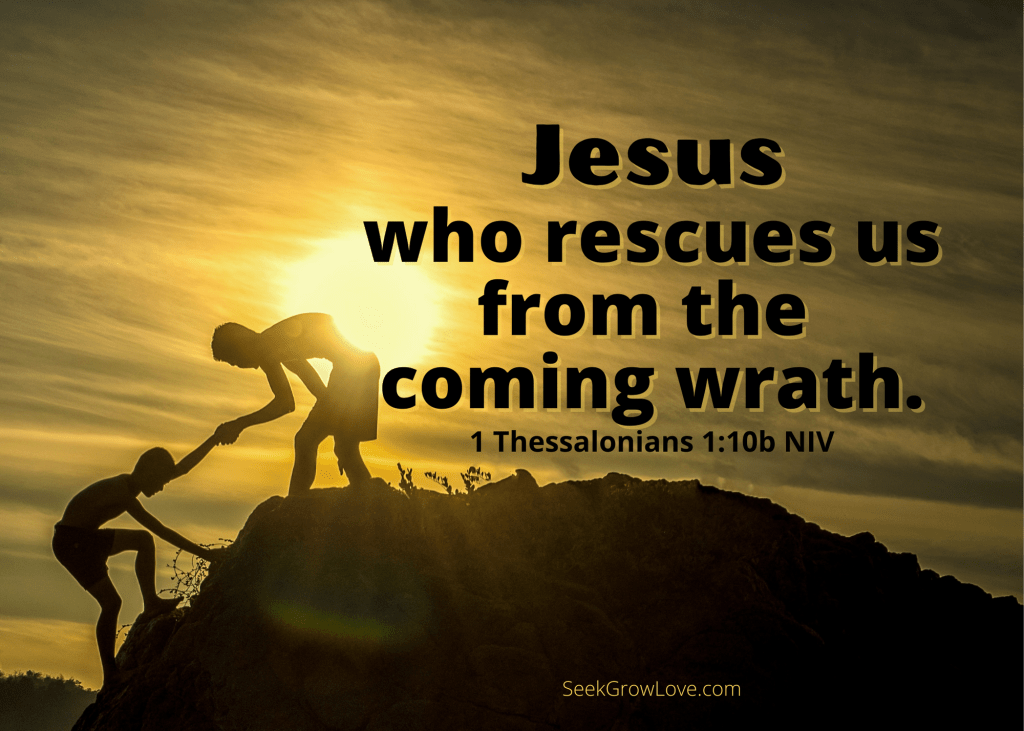
As we read 1st and 2nd Thessalonians this week and next, look for how many times Paul teaches, reminds, warns, and encourages the church with God’s perfect plans for our future. How does each chapter in 1st Thessalonians end? For a clue, let’s look at the end of chapter 1? “They tell how you turned to God from idols to serve the living and true God, and to wait for his Son from heaven, whom he raised from the dead – Jesus, who rescues us from the coming wrath.” (1 Thessalonians 1:9b-10 NIV). It is especially exciting reading of a part of the future that Isaiah was only able to allude to – the second coming of Christ Jesus, since Jesus had not come for the first time at the time of Isaiah’s writing.

May we read and heed the warnings of Isaiah and Paul as sent by God. May we be encouraged by God’s plan for the ages as displayed throughout His scriptures. And may we too turn, “to God from idols to serve the living and true God, and to wait for his Son from heaven, whom he raised from the dead – Jesus, who rescues us from the coming wrath.” (1 Thessalonians 1:9b-10 NIV).

-Marcia Railton

Today’s Bible reading plan passages can be read or listened to at BibleGateway.com here Isaiah 23-24 and 1 Thessalonians 1