
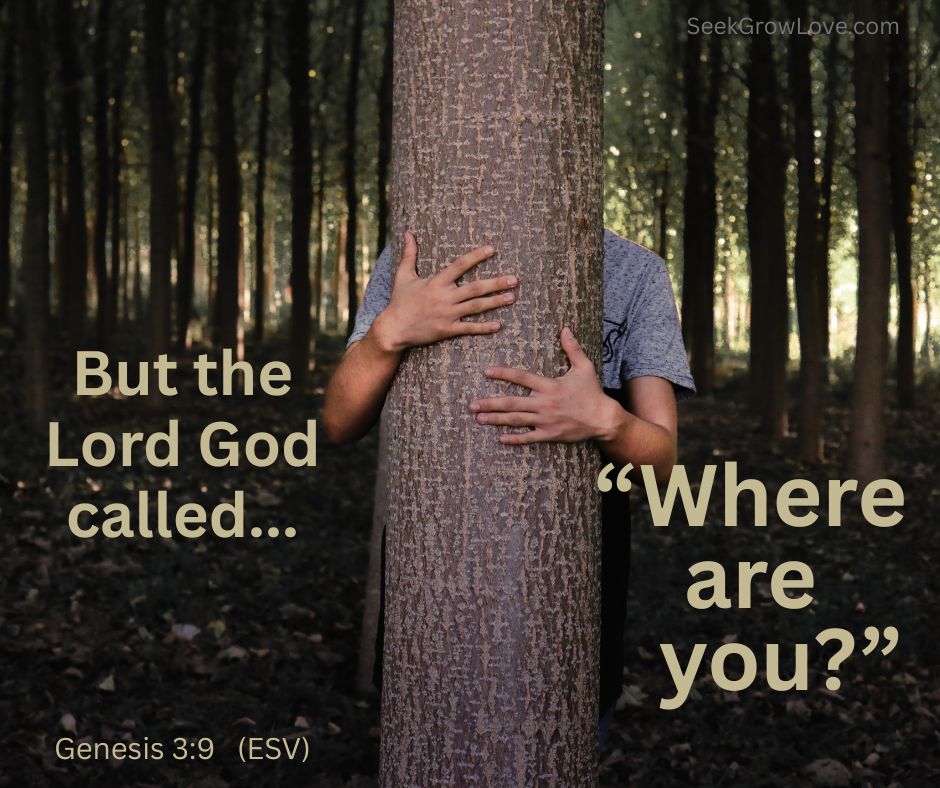
Hide and Seek

Genesis 3, Proverbs 3, Matthew 2

Devotion by Aaron Winner (SC)

Our two-year-old’s favorite game is probably hide and seek. She is actually pretty remarkable at staying still and quieting her breaths so she will not be found. The only problem with her strategy is that she always chooses the same hiding spot—the curtains in our master bedroom. For her, the game is not about actually remaining hidden. It would lose its appeal quickly if she stayed concealed too long. Her joy is ultimately to be found and to be reunited with family, “Daddy, you found me!”

In today’s reading, we see God playing the seeker as He looks for His favored creation in the garden. No matter how still Adam and Eve remain, God knows the hiding place. When He asks, “Where are you?”, it is a loaded question from the one who knows us most intimately, both our physical location and hearts. God is not met by the joyful giggles of a toddler, but by the shameful chagrin of sin (Prov. 3:7). Even though God knew where He would find them and did not withhold discipline (Prov. 3:12), by His infinite grace, He still searched for them.

That same grace carries forward into the arrival of the Son of Man. God hung a star in the east to announce the birth of Jesus Christ. He is the hope first spoken in Genesis, the One who would crush the head of the serpent (Gen 3:15). Though the distance was far, men who were seeking found a child, guided by both the heavens and the Word of God (Matt. 2:6). God makes His mercies known.

And so, when we are searching, we are always led to the same place. If we are looking for rest, we look to Jesus. If we are looking for meaning, we look to Jesus. If we are looking for hope, we look to Jesus. Throughout the Old Testament, again and again, God “hides” His promise of His Son in plain sight some 300 times, all pointing toward the life, death, resurrection, and return of Jesus Christ, who conquers sin once and for all.

So who are we fooling if we think we can remain hidden among the foliage and unseen by God? If we feel distant from him, the heavens and His word are still declaring we need only turn to the same place where our faith begins, Jesus Christ. Unchanged is the place where grace and hope begin.

Let us pray this together:

Abba Father, I have been desperately hoping you would find me. I will trust in You with all of my heart. I won’t lean on my understanding but Yours. Give me correction along with your grace that is greater still. In all Your ways, let me submit to You, for I know You will make my path straight. Lead me to the advent of Christ, to be found among the faithful who seek You. In your name of your Son, whose resurrection gives us hope. Amen

Reflection Questions

  1. It is good for us to remember we do not have the mind of God – but what tone of voice do you imagine God used when asking, “Where are you?” Why might He have started with a question, and this specific question? What tone of voice might He have used when giving correction and consequences?
  2. How are you like Adam? How are you like Eve? How did God show grace and correction with consequences to Adam and Eve? How have you experienced both grace and correction with consequences from God? What is the purpose of each?
  3. Adam and Eve obviously didn’t have Proverbs 3:5-7 on their refrigerator. How might it have helped them to know these verses of wisdom? How can you better live out Proverbs 3:5-7? When do you most need to hear these verses? How can you memorize them and/or plaster them in your life so they will be part of your first line of defense against temptation so you can spend less time hiding from God.
  4. From today’s readings, what are some beautiful things about God’s plan of salvation through His Son Jesus?

A Dare

Genesis 3

January 31

      I had an art teacher in elementary school who was used to students making mistakes, and at the start of a school year he would advise his students about the need to be careful in his classroom. He told us about the student who spilled a pot of melted wax on his pants. He told us about the student who was sliced with the paper cutter. He told us about the student who, having been warned that the pottery kiln remains hot long after it shuts off, chose to unlatch and open it to see how the artwork looked. Our teacher wanted to make sure we would not be harmed, and he used the damage that others had suffered to warn us. He knew about the risks, and his knowledge had been proven and tested.

      I think that is part of the problem we see played out in Genesis 3. Adam and Eve were like inexperienced children, so unused to the risks they faced they would not take them seriously. And what could God point back to? No one had ever died, it seems, so saying that they risked dying may not have meant much to them. It even seems like somewhere along the way someone started trying to expand on the rules, not just saying the fruit wasn’t supposed to be eaten but that it wasn’t supposed to be touched. We don’t know whether Adam invented that idea in passing on the rule to Eve, or if Eve created that rule as a reminder for herself to keep herself mindful not to do what God said not to do. But making extra rules can just be a distraction from what God wants, they are hard to justify. When she looked at the fruit it seemed like the kind people could eat, which was totally beside the point – nobody ever said the reason people shouldn’t eat it was because it was poisonous. God entered into this situation like my art teacher if he had simply said “don’t touch these pieces of equipment in these ways” – and students would have invented reasons for why that mattered, and worked out their own solutions for how to avoid the problems they thought were the issues.

      The whole scene with the serpent reminds me of someone getting dared. It isn’t how it is presented, but it is how it comes across. The nudging, suggesting ideas that wouldn’t have come into the mind otherwise, and like so many dares getting a person to cross lines into a bad idea.

      I hate dares.

      And the results of the situation are such incredible losses we can’t really understand them, because we are only used to the results. A world with death and suffering. A world with toil and sweat. One of the most disturbing is what happened to Eve, she had been created to be an appropriate helper for Adam. In chapter 1 they had been blessed and told to rule over the animals of the world. But by chapter three we are told that the man would seek to rule over the woman, and the desire of the woman would be for the man – perhaps meaning she would desire to return to the closeness and openness they previously had.

      Happily, I see no rule requiring us to treat these words as a command. Just as farmers can use pesticides and herbicides rather than letting the struggles of the soil continue as they were originally set up, we can try to improve our situation as humans with each other. Jesus offers us a new pattern for living, based not on rule but on self-giving. The core promise of this passage is that a child would come who would allow changes to be made, breaking the head of the serpent. This is part of the classic “now and not-yet” that affects so much of what the Bible teaches, we know that the ultimate fulfillment is for later, but the start of what we have been offered is already with us and we can rejoice to have it.

-Daniel Smead

Questions for Reflection and Discussion

  1. In what ways today does the Deceiver still use the line, “Did God really say…”? How are God’s words and commands being questioned, twisted and discarded?
  2. What are your greatest temptations? What excuses have you used when you gave into them? Any blaming? How can you better fight the urge to give in to these or other temptations? What do you think would have happened if Eve would have taken her new questions raised by the serpent back to God before eating the fruit? How can God be a part of your fight against temptation?
  3. In their guilt they tried to hide from God. Can you think of a time your guilt has led you to try to distance yourself from God, the church, your family or your Christian brothers and sisters? What was best for Adam and Eve when they were ashamed? What do you think is best for you?
  4. How has the serpent attacked Jesus, the child prophesied? In what ways has Jesus already beat the serpent? What battle is yet to come – with what results? Which side will you be on?